Tag Archives: Redistricting

Rep. Devin Nunes to Resign

By Jim Ellis

Ten-term US Rep. Devin Nunes (R-CA)

Dec. 8, 2021 — Ten-term US Rep. Devin Nunes (R-CA) will leave Congress at the end of this year according to an announcement made late Monday.

Rep. Nunes, the ranking Republican on the House Intelligence Committee and the man who appeared to have the inside track to become chairman of the House Ways & Means Committee if the Republicans re-gain the chamber majority next year, will become CEO of the Trump Media & Technology Group that former President Donald Trump is launching.

While the congressman, who was first elected in 2002 to his Central Valley California seat, will leave the legislative scene, he certainly will still be very active in politics as he attempts to position a new social media platform that will give right of center individuals a greater voice in the public issues discussion arena.

“The time has come to reopen the Internet and allow for the free flow of ideas and expression without censorship,” Nunes was quoted as reported in the New York Post. “The United States of America made the dream of the Internet a reality and it will be an American company that restores the dream. I’m humbled and honored President Trump has asked me to lead the mission and the world-class team that will deliver on this promise,” Nunes concluded.

Rep. Nunes’ departure creates major change in the Central Valley’s politics. His current 22nd District is one of the just seven California districts that Trump carried in the 2020 presidential election campaign.

One would think that a special election would be called with a year remaining on the term, but in a similarly timed situation in 2020, when then-Rep. Duncan Hunter (R) resigned in January, such was not the case. Gov. Gavin Newsom (D), taking advantage of a quirk in California election law, was able to leave Hunter’s 50th District – like the Nunes seat, a safe Republican domain – vacant for the balance of the entire year.

Considering that the likely special election winner in the Nunes Fresno County-anchored district would be a Republican, and cognizant of the ongoing redistricting process, it is entirely possible that Newsom will again let the seat remain vacant for all of 2022.

Continue reading

The Incumbent Pairings

By Jim Ellis

Nov. 30, 2021 — At this point in the national redistricting process, six sets of incumbents have been paired together, mostly in nomination battles, while an additional five incumbent combinations have been averted.

Over half the states have either completed the district re-drawing process or are well down the road to finishing. Illinois leads the nation with two sets of incumbent pairings, one set for each party. An additional four states have single pairings. A total of three Republican primary pairings are on the board, two feature Democratic incumbents, and one, in North Carolina, is a potential pairing with a member from each party.

Retirements have largely averted several more pairings. Reps. Karen Bass (D-CA), Tom Reed (R-NY), Tim Ryan (D-OH) and Anthony Gonzalez (R-OH), and Conor Lamb (D-PA) and Mike Doyle (D-PA), not seeking re-election have likely prevented obvious pairings in their states.

Iowa Rep. Mariannette Miller-Meeks (R-Ottumwa), deciding to seek re-election in the new 1st Congressional District, has avoided a Republican primary pairing with her freshman GOP colleague, Rep. Ashley Hinson (R-Marion/Cedar Rapids).

Below, we review the individual pairings.


GA-7:

• Rep. Carolyn Bourdeaux (D) vs. Rep. Lucy McBath (D)
Candidate Filing: March 11
Primary: May 24
Runoff: July 26

The surprise pairing of the early cycle occurs in the Atlanta suburbs. The Republican map drawers changed Rep. McBath’s 6th District back into a seat that favors the GOP, and instead of running an uphill campaign in a general election, McBath immediately announced that she would launch a primary challenge to freshman Rep. Carolyn Bourdeaux in a politically marginal district that was made safely Democratic.

This will be one of the more interesting pairings. Rep. Bourdeaux represents most of the new 7th’s constituency, but Rep. McBath will likely be viewed as the stronger Democratic base candidate. Bourdeaux starts with an early edge, and with each candidate already approaching $2 million in their respective campaign accounts, this primary campaign will be an old fashioned political shoot out. The winner earns a virtual free ride in the general election.


IL-6:

• Rep. Sean Casten (D) vs. Rep. Marie Newman (D)
Candidate Filing: March 14
Primary: June 28

The second Democratic pairing is the result of the party’s map drawers creating a second Chicago Hispanic district. This led to freshman Rep. Marie Newman standing without her own district. Instead of challenging Rep. Jesus “Chuy” Garcia (D-Chicago) in the original urban Hispanic seat, the district in which her La Grange residence was placed, she decided to instead oppose Rep. Sean Casten in the safely Democratic suburban 6th CD.

Though the seat carries Rep. Casten’s 6th, a bit more of the constituency belongs to Rep. Newman. The early resources favor Casten, as his $1 million in the bank is more than double Rep. Newman’s Sept. 30th filing deadline cash-on-hand total. This race will be one that turns sharply left, as both members identify with the party’s leftward faction. Rep. Casten is likely to attract more Chicago establishment support whereas Rep. Newman will get the bulk of leftward social issues coalition backing.

On paper, it appears that Rep. Casten would have at least a slight edge, but we can count on seeing a major campaign contest all the way to the June 28 primary.


IL-12:

• Rep. Mike Bost (R) vs. Rep. Mary Miller (R)
Candidate Filing: March 14
Primary: June 28

The second Land of Lincoln pairing features two Republican incumbents in the state’s southern sector. Typically, in a gerrymandered state the minority party inherits several very safe districts. Such is the case for the GOP in the new IL-12.

Most of Rep. Bost’s current 12th District constituency is in the new 12th, but the eastern part of a district that now encompasses all of the southern Illinois territory currently belongs to freshman Rep. Miller. The early financial edge also goes to Rep. Bost, but the two begin this race separated only by approximately $200,000.

Continue reading

Ohio Redistricting Set to Pass

WBNS TV – Channel 10 – Columbus

By Jim Ellis

Nov. 19, 2021 — The Ohio legislature has sent the new congressional and state legislative maps to Gov. Mike DeWine (R) for his approval. Ohio loses one seat in reapportionment.

As expected, the new map radically changes the seats that outgoing members Tim Ryan (D-Warren/Youngstown) and Anthony Gonzalez (R-Rocky River) currently hold. Rep. Ryan, running for the Senate, sees his eastern Ohio 13th District collapsed, with a sizable chunk of Akron remaining in the seat and the remainder going to Rep. Bob Gibbs’ (R-Lakeville) 7th District.

Instead of moving east, as under the current map, the new 13th moves to the west, annexing Medina County and the western part of the Cleveland metro area in Cuyahoga County. Much of this territory comes from the retiring Rep. Gonzalez’s current 16th District, a seat whose territory gets absorbed in several neighboring CDs.

At first glance, the map looks to break 12R-3D, meaning Democrats would take the seat loss in typical election years. Three of the districts, however, two of which Democrats now hold, would become highly competitive.

The members with the most competitive districts would again be Reps. Steve Chabot (R-Cincinnati) in the 1st District, in addition to Marcy Kaptur’s (D-Toledo) 9th CD, and the open 13th District.

The safest members are Reps. Brad Wenstrup (R-Cincinnati), though he loses a significant part of his anchor city, Joyce Beatty (D-Columbus), Jim Jordan (R-Urbana), Bob Latta (R-Bowling Green), Bill Johnson (R-Marietta), Bob Gibbs (R-Lakeville), Warren Davidson (R-Troy), Shontel Brown (D-Cleveland), and Troy Balderson (R-Zanesville).

Reps. Mike Turner (R-Dayton), David Joyce (R-Russell Township, and Mike Carey (R-Columbus) all would get reliable Republican districts, but not overwhelmingly so. Turner’s composite improves his marginal district a net three points in his party’s favor. Rep. Joyce sees his partisan complexion remaining at about a 10-point positive district for him when comparing the composite average to the 2020 presidential results.

Continue reading

North Carolina’s Rep. Cawthorn Switching Districts in 2022

By Jim Ellis

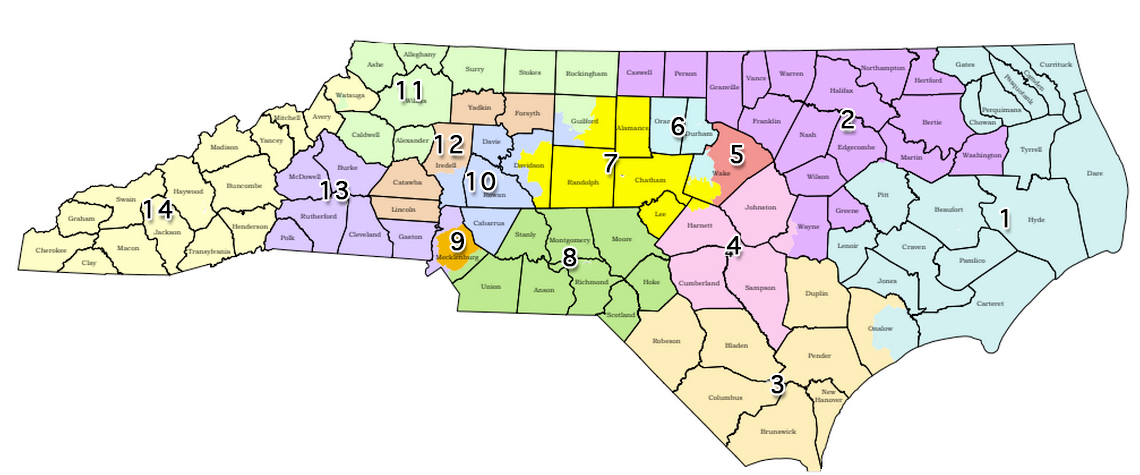
Nov. 15, 2021 — With the newly enacted North Carolina congressional map being vetted and analyzed, candidates for the various districts are beginning to come forth. One surprising move is the decision from freshman Rep. Madison Cawthorn (R-Hendersonville) to run in new District 13 instead of where his home and the majority of his current constituents reside, in new District 14.

Rep. Madison Cawthorn

Cawthorn, at at the age of 26, is the youngest member of Congress; he was elected to represent the 11th District in 2020, succeeding Mark Meadows, the former Trump chief of staff who left the US House to enter the White House. The 11th has traditionally been the number for the district that sits in the Tar Heel State’s far western corner, anchored in Asheville and nestled among the Virginia, Tennessee, Georgia, and South Carolina borders, but the newly enacted congressional map changes its number to 14.

Though the seat in its present configuration has become strongly Republican, that was not always the case. Throughout the 1980’s the district became one of the most politically marginal CDs in the country. During that entire decade, the 11th switched repeatedly back and forth between Democrat James Clarke and Republican Billy Hendon.

Once businessman and former state legislator Charles Taylor defeated Rep. Clarke in 1990, he was able to hold the district for eight consecutive terms until losing in 2006 to Democrat Heath Shuler, the former star University of Tennessee quarterback and NFL player. Shuler represented the district for three terms before retiring, leading to Meadows winning the first of his four elections. Rep. Cawthorn then recorded a 55-42 percent win in 2020 to keep the seat in the Republican column.

The new iteration of the westernmost North Carolina district returns to a more politically marginal status with a statistical history producing Republican victories in the low 50s rather than the high 50s. The adjacent new open 13th District, which annexes the western part of the Charlotte metropolitan area and moves to the Buncombe County line, becomes the region’s new safe Republican seat.

Continue reading

Rep. Beutler Trailing in New Poll

Six-term Washington Rep. Jaime Herrera Beutler (R-Battle Ground/Vancouver)

By Jim Ellis

Nov. 9, 2021 — Another of the House Republican Trump impeachment supporters appears to be having trouble back home. A new Trafalgar Group poll (Oct. 30-Nov. 2; 682 likely WA-3 primary voters; combination live interview, interactive voice response system, and text) finds six-term Washington Rep. Jaime Herrera Beutler (R-Battle Ground/Vancouver) placing third in a field of four as a prelude to next year’s jungle primary.

According to Trafalgar, former Green Beret Joe Kent (R), who has former President Trump’s endorsement, leads the candidate field with 35 percent preference. Next is Democrat Brian Hennrich, a movie theatre technician, who records 24 percent. For this poll, Hennrich realistically serves as a placebo candidate to test Democratic support. Rep. Beutler then places third with 23 percent and another Republican, pastor and author Heidi St. John, posts 10 percent support. An additional eight percent said they would vote for “another Democrat.”

Surveys such as this will likely spur the Democrats to recruit a much stronger candidate in what plays as a marginal southwestern Evergreen State congressional district.

Washington is one of three states that employs a top-two jungle primary system. All candidates are placed on the same ballot and the top two finishers, regardless of percentage or party, advance into the general election. Therefore, this poll would suggest that Rep. Beutler, at least today, could be eliminated before the general election cycle even officially begins. Washington has a late primary, Aug. 2, 2022, so plenty of time remains for the congresswoman to right her political ship.

The Washington districts won’t likely change a great deal in redistricting. Washington redistricts by commission, and has since 1991. Because none of the state’s 10 districts need a major population influx, it is probable that most of the seats, and especially District 3 (largely because it must only shed 2,222 individuals) will remain relatively constant.

The 3rd District is nestled into the southwestern corner of the state, bordering Oregon and the Pacific Ocean. The seat needing to gain the most people is Rep. Derek Kilmer’s (D-Gig Harbor) 6th District, but the 33,730 residents it requires is still a relatively small number in comparison to some other states.

Currently, the Beutler district votes as a marginal Republican seat. Former President Trump carried WA-3 in 2020 with a 51-47 percent margin after posting a 50-42 percent showing against Hillary Clinton in 2016. Rep. Beutler, in what was billed as a competitive race at the beginning of the 2020 election cycle, scored a 56-43 percent re-election victory. She has averaged 57.6 percent of the vote in her six successful congressional elections.

Fundraising so far has been significant. The September 30 FEC reports find Rep. Beutler already raising $1.73 million for the cycle with $1.38 million cash-on-hand. Kent has also done well, especially for a challenger, raising $1.09 million with $837,000 in the bank. St. John (R) has also raised a respectable $334,000, and held just over $213,000 in her campaign account at the reporting period’s end.

Continue reading

North Carolina Map Passes

By Jim Ellis

Nov. 8, 2021 –The North Carolina legislature passed a congressional redistricting map late last week featuring a new seat that pushes the state to a 14-member delegation, but court challenges are again inevitable.

Under North Carolina law, the governor, in this case Democrat Roy Cooper, has no veto power over redistricting. Therefore, when the map cleared both legislative chambers, the plan became law.

The Tar Heel State legislature and the courts have battled over redistricting for most of the previous decade, with the judiciary changing the legislature’s maps no fewer than three times during that 10-year period.

The last court iteration, in which the Democratic controlled state Supreme Court added two Democratic seats at the GOP’s expense, created safe districts for their party in Raleigh and Greensboro. The effect transformed the delegation’s partisan division to eight Republicans and five Democrats.

Under the legislature’s new 2021 version, the members returned to the previous GOP model for the Greensboro area, while largely keeping the Democratic draw for central Raleigh. Though political data is not yet available for the 14 new districts, estimates suggest that the new plan will yield 10 Republican seats and four Democratic districts, at least for the 2022 election cycle.

With a March 8, 2022 primary and candidate filing opening in about a month on Dec. 6, it will be difficult to move quickly through the court process to stop the map before officially beginning the election cycle.

The new map displaces several members and is another example of the map drawers changing the district numbers, thus making it more difficult to make comparisons. The members most negatively affected are Reps. Kathy Manning (D-Greensboro), Virginia Foxx (R-Banner Elk), and Richard Hudson (R-Concord).

The Manning district currently covers all of Guilford County, including the cities of Greensboro and High Point, and moves west into Forsyth County to annex the city of Winston-Salem. The court’s 2020 draw was split four ways, giving Rep. Manning the choice of approximately four immediate districts in which she could run, all of which are Republican. Therefore, it appears at first glance without the aid of political data that she would have to choose among four bad options in order to attempt to continue her congressional career.

Rep. Foxx, who currently represents a western North Carolina 5th District that stretches from Virginia to South Carolina would now see her new 11th CD begin in the western mountains and stretch easterly along the Virginia border and south into the city of Greensboro. This may be a relatively Republican district, but the addition of Democratic Greensboro clearly changes the district’s complexion and takes Foxx into a region that she has not represented over her nine terms in Congress.

Continue reading

Today’s Election Scorecard

By Jim Ellis

Nov. 2, 2021 — Today is a significant Election Day, and the menu of races stretches beyond a Virginia governor’s race that has attracted the lion’s share of political attention.

While the VA governor’s race will of course be top of mind as results come in tonight and analysts attempt to assign precursor status to the contest regardless of the final result, other campaigns will also be of significance.

In the Virginia race, if Republican Glenn Youngkin scores an upset win, and the late indications are clearly moving his way, it may be cast as an affront to the Biden Administration and the Democratic majorities in Congress relating to their legislative agenda. In actuality, it is a more locally based issue, education, that should correctly be cast as the linchpin to describe a Youngkin victory.

Former Gov. Terry McAuliffe’s (D) debate comment saying he did not believe “parents should be telling schools what they should teach,” will actually prove to be the key turning point to a Youngkin victory should it materialize. In McAuliffe wins, then the talk of a coming Republican wave election next year will certainly dissipate at least in the short term.

In addition to the Virginia governor’s race, the remainder of the statewide ticket, the lieutenant governor and attorney general races could be of significance. If Winsome Sears (R), running for lieutenant governor, and Jason Miyares (R), running for attorney general, both win their races to compliment a Youngkin victory, then talk of a clear precursor or budding Republican wave election will carry a more serious tone.

New Jersey voters will decide their governor’s contest as well. In Jersey, late polling, after seeing some closer numbers not even 10 days ago, seems to show Gov. Phil Murphy (D) pulling away from Republican Jack Ciattarelli in the closing week. The final result will likely be closer than most analysts would have projected at the beginning of the odd-numbered year election cycle, however.

In both Virginia and New Jersey, voters will also be electing members of the state legislature. In the Old Dominion, only the House of Delegates is on the ballot, as state senators, with their four year terms, won’t face the voters as a unit until the 2023 election cycle.

In the Garden State, both parties are projecting they will gain seats, but no one believes the strong Democratic majorities in the state Senate and Assembly are in any danger. In the Virginia House of Delegates, Republicans need to convert a net six seats to re-claim the majority they lost in the 2019 election.

Continue reading

Illinois Redistricting Advances;
Rep. Kinzinger Out

Latest Illinois Congressional redistricting map

By Jim Ellis

Nov. 2, 2021 — On Friday, the Illinois legislature voted to send a new congressional redistricting map to Gov. J.B. Pritzker (D), altering what they had drawn at the beginning of last week. This third map design came largely because of objections from both Reps. Sean Casten (D-Downers Grove) and Marie Newman (D-La Grange) who had been paired in one Chicago suburban district for the 2022 party primary.

A recent court decision rejecting the Illinois state legislative maps influenced the Democratic leadership to draw a second congressional map. A 10-year argument as to whether a second Hispanic seat should be drawn in Chicago this time became the principle discussion point.

In the 2011 redistricting plan, such a seat wasn’t drawn, and also wasn’t part of this year’s original Illinois congressional map. Seeing the Mexican American Legal Defense and Educational Fund (MALDEF) already threatening to sue over the first draw even before a final map had been adopted clearly was a factor in creating a second plan that did feature an additional Hispanic seat.

While this new third congressional version did assuage Rep. Casten and MALDEF, such was not the case for freshman Rep. Newman. She remains paired, but now with Rep. Jesus “Chuy” Garcia (D-Chicago) in an inner city Hispanic district. This is an even more difficult situation for Newman. She appears to be a leadership target likely because she defeated Chicago machine Democrat Dan Lipinski in the 2020 Democratic primary, and this latest map could well be a payback for her challenging the local party authorities.

Another political casualty is Rep. Adam Kinzinger (R-Channahon). Facing a paired situation with Rep. Darin LaHood (R-Peoria) in a Republican primary for the newly drawn 16th District — mostly foreign territory for Kinzinger in a seat that stretches from the Wisconsin border all the way to central Illinois — the congressman announced on Friday that he will not seek re-election to a seventh term.

Continue reading

First California Map Released

The California Citizens Redistricting Commission released its first congressional redistricting map in rudimentary form, not even including district numbers.

By Jim Ellis

Oct. 29, 2021 — The California Citizens Redistricting Commission released its first congressional map, and, while a long way from completion, the first edition gives us an idea as to where the members are headed. Though the map was released for public comment, it is rudimentary in form, not even including district numbers.

Since California loses a seat in reapportionment, the mystery of which area and political party will absorb the seat loss appears to be answered. Using raw numbers, because all 18 congressional districts that are self-contained within or partially occupy Los Angeles County need more residents, the seat loss should come there.

Such is the case with this first commission map, and it is the district that Rep. Karen Bass (D-Los Angeles) is vacating to run for mayor. Most of the current Bass district is collapsed into Rep. Maxine Waters’ (D-Los Angeles) seat under this first plan. If this were the final draw, Democrats would sustain the seat loss.

Dave Wasserman of the Cook Political Report released a partial analysis of the map, and finds that each party would benefit in an equivalent number of seats. Using the Biden-Trump ’20 numbers, the incumbents getting the worst draws appear to be Reps. Darrell Issa (R-San Diego), Devin Nunes (R-Tulare), and Josh Harder (D-Turlock/Modesto).

The Issa seat in San Diego appears to annex the Democratic city of Chula Vista before expanding all the way to Arizona through Imperial and Riverside Counties. It would move from a Trump plus-6 to a Biden plus-3 according to the Wasserman analysis. The Issa district was radically changed even though the current version required only 3,240 more people to meet the state population quota of 760,350 residents per congressional district.

Rep. Nunes’ Central Valley district would move from a Trump plus-5 seat to a Biden plus-3 but still maintain most of the congressman’s political base. Rep. Nunes’ current 22nd District is one of 18 CDs that are over-populated, the sixth highest in fact, having to shed 27,443 individuals. Clearly, most of the exiting individuals are from Republican areas.

Continue reading