Tag Archives: Public Policy Polling

Missouri Aside, Senate Polls Break Toward GOP

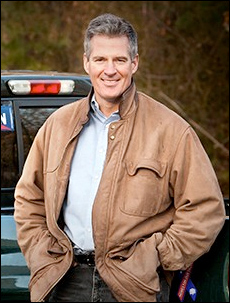
Sen. Scott Brown (R-MA)

A spate of new US Senate polls is giving Republican Party leaders some solace in the face of the Todd Akin debacle in Missouri.

Public Policy Polling (Aug. 16-19; 1,115 likely Massachusetts voters) projects Sen. Scott Brown (R) to a 49-44 percent lead over consumer advocate and Harvard law professor Elizabeth Warren (D). This is the senator’s largest lead in months. Most recent polls showed him either trailing by a point or two, or tied.

Rasmussen Reports (Aug. 20; 500 likely Montana voters) gives Republican Rep. Denny Rehberg (R-MT-AL) a 47-43 percent edge over Sen. Jon Tester (D).

Michigan-based Foster McCollum White & Associates (Aug. 16; 1,733 likely Michigan voters), for the first time, posts challenger Pete Hoekstra (R) to a 48-46 percent advantage against two-term Sen. Debbie Stabenow (D).

PPP also released data for the Wisconsin Senate race, as did Marquette University Law School. According to the former (Aug. 16-19; 1,308 likely Wisconsin voters), Republican ex-governor Tommy Thompson has the upper hand over Rep. Tammy Baldwin (D-WI-2) by a five-point, 49-44 percent, spread. The latter survey (Aug. 16-19; 706 registered Wisconsin voters) shows Thompson with an even larger lead, 50-41 percent.

And, as we reported yesterday, Foster McCollum White & Associates (Aug. 17; 1,503 likely Florida voters) gives Rep. Connie Mack IV (R-FL-14) his largest lead of the campaign, 51-43 percent, over two-term Sen. Bill Nelson (D).

If the patterns in each of these campaigns were to hold, the Republicans would surely capture the Senate majority and see their conference grow to 52 members and possibly beyond. Much will change, however, between now and Nov. 6.

Colorado Crazy


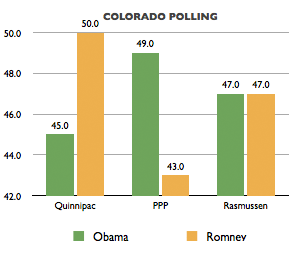
A trio of national pollsters just descended upon the swing state of Colorado and produced wildly divergent presidential campaign results. During the period of July 31 – Aug. 6, three national survey research firms each conducted a separate study of likely Colorado general election voters.

Quinnipiac University (July 31 – Aug. 6) surveyed a sample cell of 1,463 likely voters and actually found Republican Mitt Romney to be leading President Obama 50-45 percent. Public Policy Polling (Aug. 2-5; 779 likely Colorado voters), also in the field during the same period, found the exact opposite result: Obama ahead 49-43 percent. Finally, on Aug. 6, Rasmussen Reports conducted a one-day survey of 500 likely Colorado voters and projected the two candidates to be tied at 47 percent apiece.

The differing results tell us several things. First, the fact that we see the President leading by six in one poll, trailing by five in another, and tied in a third likely tells us that the Colorado electorate is split very finely between the two men. Second, all three polls reveal a very high degree of commitment. Those not expressing a defined choice were only in single-digit percentiles for all three polls. Third, the data also suggests that this state, which typically splits its votes rather evenly between candidates of the two parties, is clearly in play for both presidential contenders. In 2008, then-Sen. Barack Obama carried Colorado over his colleague John McCain by a 54-45 percent margin but, today, it appears the 2012 result will be much closer.

Primary Tipping Points: Mo., Mich., Wash.

Missouri: The polling was right. During the final week of the Missouri Senate Republican primary, late surveys from research organizations such as Public Policy Polling detected Rep. Todd Akin (R-MO-2) mounting a serious come-from-behind surge. Akin, who billed himself as the campaign’s “true conservative,” had not led for any substantial period of time, but his campaign peaked at exactly the right moment. Last night, Akin notched a 36-30-29 percent GOP nomination win over St. Louis businessman John Brunner and ex-state treasurer Sarah Steelman, respectively.

The victory sends Akin to the general election against first-term incumbent Claire McCaskill (D), who may be the weakest Democrat incumbent currently seeking re-election. While Sen. McCaskill’s party leaders and political activists believe Akin is the best Republican for her to run against, the Missouri voting trends may tell a different story come November. This will be a hard-fought campaign and one in which the presidential contest will play a major role. The real race begins today.

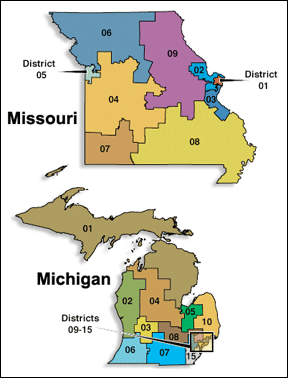
Turning to the paired House races, in Missouri’s St. Louis-anchored 1st Congressional District, veteran Rep. Lacy Clay (D) easily turned back a challenge from fellow Democrat, Rep. Russ Carnahan (D-MO-3) who chose to run in a contested primary after his seat was collapsed in reapportionment. Clay was renominated 63-34 percent, amongst a turnout of about 90,000 voters. Late polling was predicting a decisive Clay win and such occurred mostly due to overwhelming support within the African-American community.

Michigan: As expected, former Rep. Pete Hoekstra (R-MI-2) scored an easy 54-34 percent victory over charter school advocate Clark Durant in the contest for the Senate. The retired congressman will now face two-term incumbent Debbie Stabenow in what will be a major uphill battle. Sen. Stabenow is the clear favorite for re-election.

In Detroit, also as local polling predicted, two-term Rep. Gary Peters (D-MI-9), who was paired with veteran Rep. Sander Levin (D-MI-12) in the new 9th District but chose to run in the Detroit/Oakland County CD because he believed he could take advantage of a split within the African-American community, saw his strategy bear fruit last night. Mr. Peters defeated freshman Rep. Hansen Clarke (D-MI-13) 46-36 percent in a field of five candidates, three of whom are African-American.

In the adjacent 13th District, 24-term Rep. John Conyers, who will now likely complete at least 50 years of service in the House, defeated a field of four challengers, garnering a clear majority 57 percent of the vote. State Sen. Glenn Anderson, Mr. Conyers’ strongest opponent, only managed 15 percent, again just as the late polls were predicting.

North of Detroit in suburban Oakland County, former state Senate majority leader Nancy Cassis’ (R) late-developing write-in campaign fell way short as reindeer rancher and staunch Ron Paul supporter, Kerry Bentivolio, the only person who officially qualified for the Republican primary ballot, looks to be in the 65 percent range when all of the votes are finally counted. Physician Syed Taj won the Democratic primary and this has the potential of becoming a hotly contested general election campaign. Incumbent Rep. Thaddeus McCotter (R-MI-11), reeling from a disastrous six-week presidential campaign, failed to qualify for the congressional ballot and then subsequently resigned his seat. This will be an interesting general election race between two people, neither of whom was expected to be a serious candidate. Democrats have a chance to snatch this seat even though it historically votes Republican.

Washington: Sen. Maria Cantwell (D) will face state Sen. Michael Baumgartner (R) in her bid for a third term. Such is not expected to be a highly competitive race. In House races, all incumbents secured a general election ballot position in this top-two primary format. As in California and Louisiana, the candidates finishing first and second, regardless of political party preference, advance to the general election. All seven incumbents seeking re-election placed first with percentages exceeding 50 percent.

In the three open seats, Republican John Koster placed first in the new 1st District that gives the GOP a much better chance of securing a general election victory. He will face Democratic former congressional nominee Suzan DelBene who placed ahead of two-time congressional nominee Darcy Burner.

With Rep. Norm Dicks (D-WA-6) retiring after 36 years of congressional service, it appears that Democrat state Sen. Derek Kilmer, as predicted, will become his successor. Kilmer placed first in the jungle primary and becomes the prohibitive favorite in what is a heavily Democratic district.

In the new 10th District, awarded the fast-growing state in reapportionment, former state House majority leader and 2010 congressional nominee Denny Heck (D) placed first in the low 40-percentile range and will face Pierce County Councilor Dick Muri (R) in what shapes up as a reliable Democratic district. The Washington delegation is likely to split with five Democrats, four Republicans, and one marginal district (the 1st to be decided in the tough Koster-DelBene contest).

Late Primary Polling in Mo., Mich.

Several polls have just been released about today’s primary elections in Missouri and Michigan.

First, Public Policy Polling (Aug. 4-5; 590 likely Missouri GOP primary voters) gives businessman John Brunner a slight 35-30-25 percent lead over Rep. Todd Akin (R-MO-2) and former state treasurer Sarah Steelman in the Missouri Senate Republican primary. The race is anybody’s game, however. Rep. Akin actually leads Brunner by two points in the category of those most excited to vote. Brunner’s edge is much larger among lower propensity voters, thus accounting for his overall advantage. More upward momentum has been detected for Akin during the last two weeks than Brunner. Steelman, according to the PPP data, is actually losing support in comparison to previous polls of the race during the same period.

In the 1st Congressional District, Survey USA, polling for St. Louis television station KDSK (Aug. 2-4; 490 likely MO-1 Democratic primary voters), gives Rep. Lacy Clay (D) a huge 56-35 percent lead over his Democratic colleague, Rep. Russ Carnahan (D-MO-3). The two were paired because Missouri lost a seat in national reapportionment. Among African-Americans, who will be the largest demographic sector participating in the primary, Clay leads 81-12 percent.

Turning to Michigan, EPIC-MRA released two congressional polls, both for the Detroit based districts. In the 13th (Aug. 4-5; 800 likely MI-13 Democratic primary voters via automated interviews), 24-term incumbent John Conyers (D) commands a 57-17 percent lead over his nearest rival, state Sen. Glenn Anderson. The remaining three candidates are in single-digits.

In the new Wayne/Oakland County-based 14th CD, Rep. Gary Peters (D-MI-9) appears poised to win this incumbent pairing campaign as he leads fellow Rep. Hansen Clarke (D-MI-13) 52-33 percent according to EPIC-MRA (Aug. 4-5; 800 likely MI-14 Democratic primary voters via automated interviews). Even among African-Americans Clarke fares poorly, leading Peters only 38-34 percent. Peters, who is white, hoped to split the black vote among the three African-American candidates and it appears that his strategy is working.

A Change in Momentum in the Wisconsin Senate

A new Public Policy Polling survey (July 30-31; 400 likely Wisconsin GOP primary voters) shows a three-way race developing for the Republican Senate nomination as former Rep. Mark Neumann (R-WI-1) has now moved into serious contention in the Badger State. According to PPP, wealthy businessman Eric Hovde places first with 28 percent while Neumann moves into a second place tie with former governor Tommy Thompson at 25 percent. State Assembly Speaker Jeff Fitzgerald has dropped off the pace, posting only 13 percent.

Simultaneously, We Ask America also surveyed the Wisconsin race and arrived at a similar conclusion. They also see the contest closing around the three candidates. According to their poll (July 30; 1,237 Wisconsin GOP voters through automated calls) Hovde and Thompson are tied at 23 percent, and Neumann moves up to 17 percent.

The Wisconsin primary is Aug. 14, so the race’s determining factors will occur in final two weeks. Should the current trends continue and Neumann continue to gain strength – he moved up 10 points in the three weeks between PPP surveys, for example – then an interesting three-way finish with no clear leader could be on the horizon for the final few days. Obviously, this campaign is in a fluid state without a clear conclusion visible yet. The Republican winner will face Rep. Tammy Baldwin (D-WI-2), the consensus Democratic candidate, in a highly competitive general election campaign.

Texas-Sized Upset in the Making?

Yesterday, we covered the races being decided in today’s run-off (Texas) and primary elections (Georgia) and mentioned that former Texas solicitor general Ted Cruz has a legitimate chance of upsetting Lt. Gov. David Dewhurst in the Lone Star State’s US Senate Republican run-off. The release of the new Public Policy Polling data for Texas underscores that the trends are supporting an upset result. According to their survey (July 28-29; 665 Texas GOP likely run-off voters) Cruz has a 52-42 percent lead over the lieutenant governor. The Dewhurst campaign countered with their internal Baselice & Associates poll showing their candidate with a 48-44 percent lead, but these results appear out of line with the other publicly presented trends.

Perhaps most disconcerting for the Dewhurst camp, the PPP numbers report Cruz to be leading 63-33 percent among those who are most excited about voting in the run-off election. Additionally, the ex-solicitor general leads the veteran statewide office holder among those considering themselves as Tea Party voters by a huge 75-22 percent split. In a low turnout election where 70 percent identify themselves to be somewhat or very conservative, this type of spread could well be the defining factor.

Typically, Texas primary and run-off elections record very low turnouts. More than 1.4 million people voted in the May 29 primary election, but a considerable smaller number will vote in the secondary election. The likely turnout projection suggests a participation rate of less than one million voters.

Mass. Senate Race Still Up for Grabs

Brown | Warren

The widely watched Massachusetts U.S. Senate race continues to be one of the country’s top campaigns and, as polling released this past week reveals, the contest remains too close to call. It has grown ever tighter over the past four months.

Democratic hopeful Elizabeth Warren is challenging incumbent and first-term Sen. Scott Brown. The Commonwealth, normally considered bedrock blue in a political context, chose Brown in early 2010 during a hard-fought special election campaign after veteran Sen. Ted Kennedy (D) passed away. Brown became a national name after becoming the first elected Republican senator in Massachusetts since 1972.

According to a poll released this past Tuesday from the MassINC research group for WBUR, the Boston National Public Radio station, Warren was shown to be leading with 40 percent support, while Brown registered 38 percent. The study, taken during the July 19-22 period, had a sample size of 503 registered voters. While the survey projects Warren to a two-point advantage, the margin of error factor is 4.4 percent; therefore, it is reasonable to conclude that the race remains a dead heat. In June, Public Policy Polling also released a survey putting the two in a virtual tie, with Sen. Brown running well among Independents.

Voters in Massachusetts appear to be warming to both Warren and Brown. This week’s poll reveals that Warren’s favorability rating stands at 47 percent, which is a 13-point jump from the last MassINC poll conducted in April. Brown’s positive index increased, too, reaching 50 percent, which is up from 46 percent as measured three months ago.

One category to watch here is the undecided vote. Historically in Massachusetts, the undecideds tend to move back toward their party’s incumbent as the election draws near. Should the undecided Democrats return to support Barack Obama over Mitt Romney in November, Warren could also benefit. If this current undecided model projection is correct, it will be Warren who has the greater room to grow, mostly because there are so many more Massachusetts Democrats than Republicans.

Sen. Brown is formerly a member of the Massachusetts State House of Representatives (1998-2004), and then the state Senate (2004-2010). He is also a practicing attorney and considered to be a moderate Republican, voting with his party approximately 80 percent of the time. Warren, a Harvard Law School professor, is considered to be an American bankruptcy law expert who provided oversight to the 2008 bailout program and oversaw the establishment of the Consumer Protection Financial Bureau.

Both candidates bring unique qualities to the race and, as polling has consistently indicated over a period of months, this battle appears to be too close to call. It is certainly a race to watch over the next 102 days.

Presidential Popular Vote is Even

President Obama. / Photo: The White House

A series of new presidential election polls reveals a further tightening of the campaign on the national level, though President Obama maintains a lead over Mitt Romney in the most competitive states.

The two daily tracking pollsters, Gallup and Rasmussen Reports, both give the president only a one-point national lead, 46-45 percent and 45-44 percent, respectively. Looking at an actual benchmark survey, Public Policy Polling, conducting their study (July 19-22; 1,000 registered voters) for the Daily Kos national liberal blog and the Service Employees International Union, projects a flat 46-46 percent tie.

The only national poll not showing a dead heat, taken over virtually the same time frame as PPP’s survey with an identical sample size (July 18-22; 1,000 registered voters) from Republican pollster Bill McInturff and his Democratic counterpart Peter Hart, actually stakes the president to a 49-43 percent advantage. Based upon the available data, though the polling methodology appears sound, the McInturff/Hart result appears to be an outlier.

National Public Radio released their poll of the 12 commonly viewed battleground states (conducted by the Resurgent Republic and Democracy Corps organizations, July 7-12; 1,000 voters nationwide with an oversample of 462 from the battleground states) but its aggregate result is of little consequence. Though this poll, too, shows an Obama-Romney tie at 46 percent, such a figure is virtually useless because the combined popular vote in the most hotly contested states doesn’t translate into specific electoral votes.

What is valuable are battleground voters’ perceptions and attitudes about the candidates. As we have seen for months, there is severe polarization between the two major parties. By almost a 9:1 majority, Democrats believe the president has performed well in office. Conversely, the same virtual ratio of Republicans believes he has not. Independents tend to fall more on the Republican side, slightly rating Obama’s job performance more negative than positive. Also, Independents in these states generally oppose the Obama healthcare law and, by a slight margin, believe that the Supreme Court decision upholding the law is incorrect. This could prove significant as the campaign continues to evolve.

One thing that does deviate somewhat from at least the conventional wisdom, the NPR battleground state poll does show that both candidates have a strong base. Especially for Romney, this is a change. Before, most data indicated weakness among Republicans for their presumptive nominee, but the NPR data gives both contenders right around 90 percent support within their own party voter cell sample. This finding is good news for both men.

New individual key state surveys stack up relatively well for the president in the fact that he leads in most, but in no case is his advantage more than mid-level single-digit numbers.

Rasmussen Reports gives the President a six-point, 48-42 percent advantage in Michigan. Survey USA finds a similar five-point, 48-43 percent margin for Obama in all-important Florida; and We Ask America returns similar 49-42 percent and 49-43 percent spreads (in Obama’s favor) in Wisconsin and Nevada, respectively. Magellan Strategies produced a much closer 50-46 percent Nevada model. Quinnipiac University shows a tie in Virginia, and the Civitas Institute projects Romney to a one point, 49-48 percent razor-thin edge in North Carolina. Though it’s not a battleground state, Survey USA detects only a 46-40 percent advantage for the president in liberal Minnesota, which is a surprise.

The cumulative effect of the most recent survey data makes the president and his advisers uncomfortable. These are not the type of results strong incumbents would be seeing at this point in the election cycle. It’s going to be quite a remainder of the year.

Several Races Tighten: Fla., Ohio, Calif.

Rep. Connie Mack IV

Four new polls were released on Friday and each showed developing races that are becoming close. In yet another study that depicts Rep. Connie Mack IV
(R-FL-14) performing very well against two-term Sen. Bill Nelson (D), Survey USA produces numbers reflecting a hot Florida Senate race. According to S-USA (July 17-19; 647 likely Florida voters), Mack actually leads the incumbent Democrat 48-42 percent. The same sample gives President Obama a 48-43 percent lead over Mitt Romney, telling us there is no Republican skew in the respondent sample.

Since May 1, eight public polls of this Florida race have been released from six different pollsters (Quinnipiac University conducted three of the surveys as part of their monthly polling program). In five of the eight Nelson leads. In the other three, challenger Mack has the advantage. The swing goes all the way from 49-36 percent in the senator’s favor (Public Policy Polling; May 31-June 3) to Mack leading 46-37 percent (Rasmussen Reports, July 9). This provides us a net curve of 22 points. Such a large polling variance often reveals an extremely volatile campaign with an electorate willing to change course on a dime. There has been enough polling to tell us that the Florida Senate race features true competition and the thought that Sen. Nelson would have a relatively easy ride to re-election has now been firmly dispelled.

Staying in the Senate, Rasmussen Reports (July 18; 500 likely Ohio voters) projects that the Ohio race is continuing upon a competitive path. The latest RR data gives first-term Sen. Sherrod Brown (D) a 46-42 percent lead over GOP state Treasurer Josh Mandel. The senator has maintained at least a small lead for most of the previous 12-month period. In the presidential race, this Rasmussen sample returned a 47-46 percent spread in the president’s favor.

Other polls have shown much stronger leads for Sen. Brown. Seven surveys have been taken of the Ohio Senate race since the beginning of May, from four different pollsters. All show Brown ahead. His advantage ranges from the four-point lead in the current Rasmussen poll all the way to sixteen (50-34 percent; Quinnipiac University, June 19-25).

Polling also indicates that two southern California congressional campaigns are very close. In the new 24th Congressional District, in what appears to be a pure 50/50 toss-up seat for incumbent Rep. Lois Capps (D), Public Opinion Strategies, polling for Republican Abel Maldonado’s campaign (June 26-28; 400 registered CA-24 voters just now released), projects a two-point race with the incumbent leading 48-46 percent. In the jungle primary, Capps received 46.4 percent, Maldonado obtained 29.7 percent, and Republican Chris Mitchum, son of late actor Robert Mitchum, garnered 21.5 percent. With the combined Republican primary vote exceeding a majority of the ballots cast (51.2 percent), the general election battle is clearly becoming a toss-up.

To the southeast in Long Beach, another survey indicates a close race developing in a newly created open seat, numbered District 47. Here, Democratic state Sen. Alan Lowenthal and Republican Long Beach City Councilman Gary DeLong qualified for the general election with the former scoring 33.8 percent to the latter’s 29.4 percent in a field of eight candidates.

Though this district sets up well for the Democrats, a Probolsky Research survey for the DeLong campaign (June 28-July 3, 400 registered CA-47 voters – released just now) gives Lowenthal only a 44-41 percent advantage as the general election campaign begins in earnest.

This race merits attention and should be considered a lower-level upset opportunity for Republicans. Lowenthal has been underwhelming on the fundraising front, raising just over $511,000, which pales in comparison to DeLong’s $862,908. Gov. Jerry Brown carried this seat 50-41 percent; Sen. Barbara Boxer won it 49-41 percent; and Democratic Attorney General Kamala Harris lost the district 39-45 percent. The Democrats’ voter registration advantage is a little over 10 percent more than Republicans. This campaign carries a Lean Democratic rating with movement toward the toss-up column.

Countervailing Polls in Texas, Wisconsin

Earlier in the week we presented surveys from Texas and Wisconsin that showed underdog Republican Senatorial candidates Ted Cruz (Texas, vs. Lt. Gov. David Dewhurst) and Eric Hovde (Wisconsin, vs. Tommy Thompson, Mark Neumann and Jeff Fitzgerald) surging to the lead in their respective campaigns. Yesterday, their main opponents, both considered heavy favorites when their efforts began, cited polls that produced a different result.

In Texas, Dewhurst, stung by the Cruz campaign’s Wilson Perkins Allen poll showing him trailing 40-49 percent, countered with his own Baselice & Associates data (July 5-8; 601 likely Texas GOP run-off voters) that posts him to a 50-42 percent lead. In comparison, the Cruz poll is likely the better of the two. Wilson Perkins Allen drew their sample from only those people who actually voted in the May 29 primary. Dewhurst’s survey is pulled from a larger universe and then screened for likely run-off participants. Though non-primary voters have the right to vote in a run-off election, it seldom happens. The overwhelming majority of people casting ballots in the July 31 election will be those who previously voted.

In Wisconsin, Marquette University Law School released a new survey (July 5-8; 1,000 Wisconsin adults, 949 registered voters), that puts former governor Thompson back into the lead. Yesterday, we covered a new Public Policy Polling study that showed businessman Eric Hovde holding a two-point advantage. According to Marquette, Thompson has a 35-23 percent lead over Hovde among the 427 people who identified themselves as planning to vote in the Aug. 14 Republican primary.

Like the PPP survey of yesterday, Marquette, too, shows Democratic Rep. Tammy Baldwin (D-WI-2) in very tight races with all four Republican candidates. Against Thompson, among likely voters (799), she trails 41-45 percent. When paired with Hovde, she leads 44-38 percent.

The Republican primary will be decided as a matter of turnout, but it is more plausible to believe that Thompson has the advantage. Both PPP and Marquette are in the same range for the general election, thus confirming all previous polls projecting that the two parties are in a close contest.