Tag Archives: Pennsylvania

More on Pennsylvania

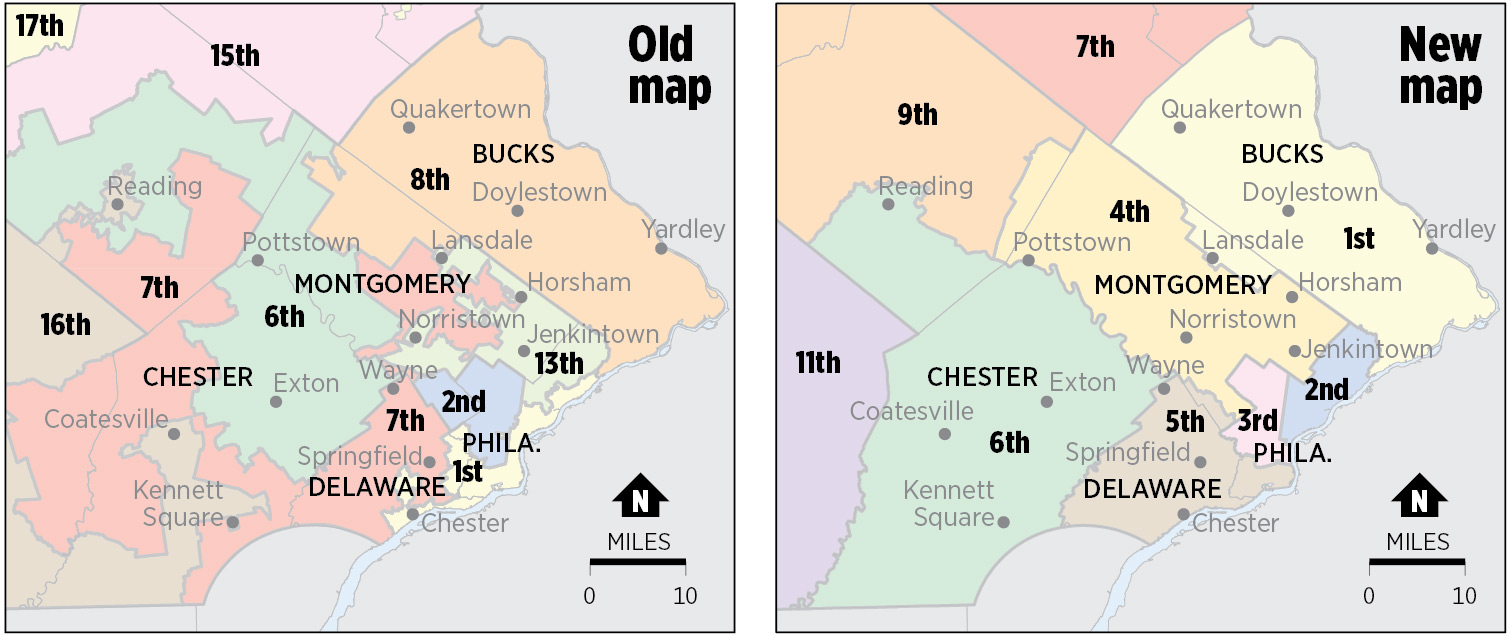
New Pennsylvania Congressional Map - Philadelphia Area

Old/New Pennsylvania Congressional Map Comparison – Philadelphia Area
(Click on map to see larger)

By Jim Ellis

Feb. 22, 2018 — A day after the court-imposed Pennsylvania congressional map was instituted, much action is occurring in and around the new districts. A more in-depth look at the now available political numbers, for example, tells a somewhat different story than the one gleaned from simply looking at the new map configuration.

Before discussing the historical numbers and trends, several non-mathematical happenings also transpired.

First, as promised, Republicans filed a federal lawsuit against the new plan, a complaint that largely attacks the state Supreme Court for usurping legislative duties, and less about the districts themselves. The Republicans also make the sub-point that no legal challenge from any party had been leveled against the previous map even though the map cleared the legislative process and stood through three complete election cycles.

The GOP is asking the federal court system to stay the new map until the appropriate judicial panel hears their case. Such a rendering would reinstate the 2011 plan for the current election cycle. Since the revised congressional candidate filing deadline is March 20, we can expect the ruling authorities, most likely the US Supreme Court, to quickly signal an intent.

Assuming the new map stands, Rep. Brendan Boyle (D-Philadelphia), whose Montgomery County-anchored 13th District was split into three southeastern Pennsylvania districts, announced that he will run in District 2. The new PA-2 is predominantly a downtown Philadelphia district that features a voting history where Republicans don’t even reach 30 percent of the vote. This leaves new District 4, where the other large section of his 13th District now resides, as an open seat. The new 4th, where Republicans fare better than in the 2nd but still don’t come close to winning, will elect a freshman Democrat if the court map survives its legal challenge.
Continue reading

An Open Review – Part II

By Jim Ellis

Feb. 7, 2018 — Continuing our look at the 53 open seats, today we look at those in the Lean R & D categories. It is here where Democrats will have to score big if they are to claim the House majority.

2018-elections-open-seatsThe US Supreme Court declined to hear the Pennsylvania Republicans’ arguments earlier this week to move the live redistricting case to the federal level. To review, the Pennsylvania Supreme Court ruled the current congressional map a political gerrymander, but without citing any election law statute violations. State Senate Republicans are refusing to provide the court with their requested data until the legislative bodies are informed about what is legally wrong with the current map.

In the meantime, the court has already appointed a special master from Stanford University to draw a new plan, and moved the congressional candidate filing deadline from March 6 to March 20. Additionally, Gov. Tom Wolf (D) is already saying he will veto the legislature’s map, so all of these developments suggest that a new, Democrat-friendly map will likely be in place before the 2018 elections.

In our overview of the current House open seat configuration, two of the Pennsylvania seats are either in the Lean D category (PA-7; Rep. Pat Meehan-R) or Lean R (PA-15; Rep. Charlie Dent). With a new map likely to collapse most, if not all, of the four open Republican seats, it is likely that both of the aforementioned districts will find themselves in the Democratic column after the next election.

Currently, the Lean Democrat column consists only of Republican seats. In addition to PA-7, and probably adding at least PA-15 post-redistricting, retiring GOP Reps. Ileana Ros-Lehtinen (R-FL) and Frank LoBiondo (R-NJ) are leaving seats that are also trending toward the Democratic side of the political ledger.

Continue reading

An Open Review – Part I

By Jim Ellis

Feb. 6, 2018 — With so many House retirements coming into focus within the past several weeks, it is a good time to review the list of 53 districts heading into their next election without an incumbent on the ballot.

Of the 53, Republicans currently hold 37 seats versus just 16 for the Democrats. Here’s the breakdown of how things look regarding all 53 seats right now:

2018-elections-open-seats

  • Safe Republican (19)
  • Likely Republican (6)
  • Likely Democrat (6)
  • Safe Democrat (6)
  • Lean Republican (5)
  • Lean Democrat (3)
  • Toss-up (8)

This configuration could change drastically if the Pennsylvania map is re-drawn in a court-ordered redistricting. The state Supreme Court has declared the Keystone State map a political gerrymander and has ordered a new plan drawn by Feb. 15.

The state Senate President Pro Tempore is responding, however, that the legislature will not comply with the court order to turn over statistical data need to draw a new map because the state court did not cite the legal provisions violated in making the current plan a gerrymander. Additionally, the US Supreme Court is sending signals that it may try to involve itself even though this case is filed against the Pennsylvania Constitution and not its federal counterpart. We can count on major action coming here within the next several days.

Furthermore, the US Supreme Court is in the process of deciding the Wisconsin political gerrymandering case, which will also affect active lawsuits in Michigan, North Carolina, Texas, and Virginia; in Pennsylvania, the political gerrymandering lawsuit realm is not directly part of this group because its case is filed within the state court system. But the Republicans have petitioned the federal high court to look at this case for other legal reasons.

Continue reading

No. 51

By Jim Ellis

Jan. 31, 2018 — The number of House open seats continues to grow. Veteran New Jersey Rep. Rodney Frelinghuysen (R-Morristown), chairman of the House Appropriations Committee, announced Monday that he will not seek a 13th term later this year.

2018-open-house-seats-toss-upDespite averaging 65.3 percent of the vote during his 12 successful elections and even winning with a healthy 58-39 percent victory margin in 2016, Rep. Frelinghuysen was considered vulnerable for 2018. Democrats have recruited at least two candidates who are pulling in strong financial resources in order to stock a large campaign war chest for a presumed political battle in what is always a very expensive state.

The Dems say this district is changing because Hillary Clinton came within one percentage point of carrying it (49-38 percent) in the 2016 presidential campaign. Still, her performance here pales in comparison to a 55-41 percent Garden State win, and even though the district became close in the presidential contest, it has yet to fall to a Democratic candidate.

Yesterday, we covered the Ohio political situation as being potentially favorable to Republicans. Conversely, the northeastern tri-state region comprised of Pennsylvania, New York, and New Jersey perhaps has even a better chance of adding a strong number of seats to the Democratic conference.

Continue reading

Ohio’s Red Leap

By Jim Ellis

Jan. 30, 2018 — Thought of as one of the key swing states in American politics since the turn of the century, President Trump’s stronger than expected eight-point Buckeye State victory in the 2016 presidential race proved eye-opening. But, was his performance trend setting or an anomaly?

A new Fallon Group survey for the state’s 1984 Society group finds the upcoming open governor’s race is exceeding the Trump marker, at least in the early going. Such totals indicate that the presidential outcome could be signaling a more Republican-oriented direction beginning to form in the state, but a closer look may point to the Trump numbers as affirming a political trend rather than creating one.

Left - Mike Dewine (R) | Right - Richard Cordray (D)

Left – Mike Dewine (R) | Right – Richard Cordray (D)

According to the Fallon Group data (Jan. 16-19: 801 likely Ohio general election voters; 286 Ohio Republican likely primary voters, 248 Ohio likely Democratic primary voters), attorney general and former US senator, Mike DeWine (R), would lead recently resigned Federal Consumer Protection Bureau director and ex-Ohio attorney general Richard Cordray (D) by a whopping 48-29 percent margin. The polling demographics appear to correctly model the state, thus providing reliability support. In the polling sample, Anglo voters account for 77.4 percent of the respondents, as compared to 79.5 percent of the state population. African Americans are 14.2 percent of the polling universe, and 12.8 percent of the actual Ohio population. Hispanics register 2.2 percent of the respondent group, against a 3.7 percent state population figure. Therefore, the respondent universe is consistent with at least the overall Ohio population complexion. Additionally, the polling universe is comprised of 51.9 percent females, versus a 51.0 percent actual make-up.

The Republican leadership approval ratings are mixed. The respondents believe, by a margin of 54:25 percent, that Ohio is generally on the right track. Outgoing Gov. John Kasich’s (R) job performance is rated highly: a 57:29 percent favorability ratio. President Trump, on the other hand, is upside-down at 43:52 percent positive to negative.

Continue reading

Meehan to Go

By Jim Ellis

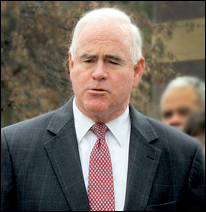
Jan. 29, 2018 — The alleged sexual harassment situation involving four-term Pennsylvania Rep. Pat Meehan (R-Chadds Ford) culminated with his retirement announcement, last week.

Pennsylvania Rep. Pat Meehan (R-Chadds Ford)

Pennsylvania Rep. Pat Meehan (R-Chadds Ford)

In a letter to Speaker Paul Ryan and his local Republican Party chairman, Meehan wrote that he will not be a candidate for a fifth term in November. But, his personal situation may not be the only reason that voluntarily leaving Congress makes sense for him.

As we’ve discussed on several occasions, the Pennsylvania state Supreme Court invalidated the state’s congressional map earlier this week on grounds that the empowered Republican political apparatus took partisanship too far in constructing the 2011 plan. The GOP will try to flip this case into federal jurisdiction — the US Supreme Court has never ruled a map invalid because of political gerrymandering, and are actively considering several such cases during the current term — but the party’s prospects of doing so are likely poor.

If the state high court’s ruling stands, the legislature and governor will be forced to present a new map to the Justices by Feb. 15 in order to keep pace with the current election calendar. The short deadline will likely avoid compelling the court to delay the state’s March 6 candidate filing deadline and May 15 primary election.

Now with a Democrat governor in office, and not the Republican that signed this map into law, it is highly probable that a veto will occur over the next GOP iteration. If so, then the court will appoint a special master to draw the new map.

Continue reading

Looking at the Governors’ Races

2018-gubernatorial-elections

By Jim Ellis

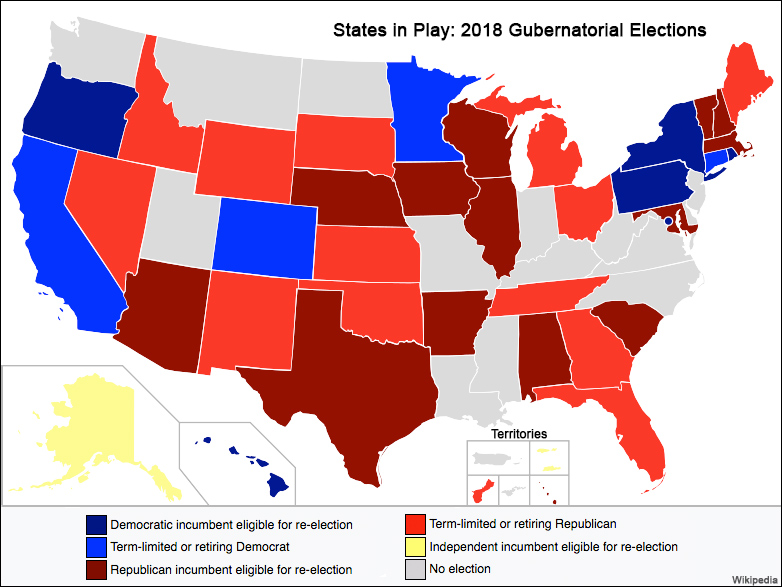
Jan. 25, 2018 — Earlier this month, we set the stage for the Senate and House campaigns. Today, we look at another important election platform, that of the nation’s governors. Though these races will elect people who will obviously determine future individual state policy, most of the 2018 gubernatorial winners will carry redistricting veto power in 2021. Therefore, these elections also carry national implications.

Of the 36 governors’ campaigns, 17 will be open races mostly due to state term limit laws. While the Democrats must protect the preponderance of US Senate seats this year, the opposite situation exists in the governors’ races. Here, Republicans must defend 26 state houses, 13 of which are open seats.

Of the 13 GOP incumbents seeking re-election, three are actually running for governor for the first time. Govs. Kay Ivey (R-Alabama), Kim Reynolds (R-Iowa), and Henry McMaster (R-South Carolina) were all lieutenant governors who ascended to their current position because the person elected in 2014 is no longer in office.

Alabama’s Gov. Robert Bentley (R) was forced to resign as part of a plea bargain arrangement over campaign finance violations. The other two state chief executives, Terry Branstad (IA) and Nikki Haley (SC), accepted positions in the Trump Administration. At this point in the election cycle, all three unelected governors are favored to win a full term.

Continue reading