Tag Archives: Illinois

Ohio Congressional Map Tossed

The Ohio State Supreme Court invalidated the state’s newly enacted congressional map and returned the plan to the Ohio state legislature to be redrawn. The state lost a seat in reapportionment. (Map: Dave’s Redistricting App)


By Jim Ellis

Jan. 19, 2022 — The Ohio State Supreme Court, on a 4-3 vote with the Republican Chief Justice Maureen O’Connor voting with the three Democratic members, last Friday invalidated the state’s newly enacted congressional map and returned the plan to be redrawn. The decision may result in a blow to Republican hopes of re-capturing the US House majority as the Ohio draw is one of the party’s most important maps.

The high court’s action followed a similar 4-3 decision the previous day to reject the state House and Senate maps. All of the plans were invalidated for the same reason: they did not meet the competitiveness provision in the Ohio redistricting proposition that the people’s vote enacted prior to the commencement of the re-mapping process. The justices claimed the plan must better reflect the partisan statewide voting pattern, a measure that favors Republicans but not to the extent of the district ratios projected for the jettisoned maps.

The current Ohio congressional map stands at 12 Republicans and four Democrats. The state lost a seat in reapportionment, so the advisory redistricting commission members and the legislature were tasked with creating a new 15-district congressional plan.

By most accounts, the new map would have likely elected 10 Republicans and two Democrats, while featuring three politically marginal districts, those of Reps. Steve Chabot (R-Cincinnati) and Marcy Kaptur (D-Toledo) and an open seat largely created because Reps. Anthony Gonzalez (R-Rocky River) and Tim Ryan (D-Warren) are leaving their seats to retire and run for the Senate, respectively. Therefore, the state’s electoral split could have swung anywhere from 10R-5D all the way to 13R-2D.

The ruling likely creates the greatest change for two of the aforementioned members. The court specifically cited the Hamilton County draw in Rep. Chabot’s seat that attached a swath into downtown Cincinnati. This created a city attachment to Butler County, thus placing it in Rep. Warren Davidson’s (R-Troy) strongly Republican 8th District. As a result, the 1st District became more Republican for Chabot, but still left him with a swing seat at best.

Continue reading

New York Rep. John Katko to Retire

New York Rep. John Katko (R-Syracuse)

By Jim Ellis

Jan. 18, 2021 — New York Rep. John Katko (R-Syracuse) announced Friday that he will not seek a fifth term later this year, creating a 47th open seat for the 2022 US House elections.

Katko, who indicated that he and his wife buried all four of their parents during the past three years, which he said was “gut-wrenching,” says he now desires more time with his family. He leaves a seat where he has averaged 56.5 percent of the vote as one of only eight Republicans from the 27-member Empire State delegation.

Other factors may also have played a role in his retirement decision. Redistricting appeared to be creating some re-election problems for Rep. Katko, as had former President Donald Trump.

New York lost a seat in reapportionment — a district collapse that will come from the Upstate region. Early maps suggested that Katko’s Syracuse-anchored seat would be combined with Rep. Claudia Tenney’s 22nd District, which would result in a paired incumbent situation before the primary winner likely would face another competitive general election campaign.

In the past two election cycles, Rep. Katko’s opponent was college professor Dana Balter (D), and her challenges resulted in expensive and hard fought 53-43 percent (2020) and 52-47 percent (2018) victories. Balter spent $2.7 million and $3.3 million in her two successive races against Rep. Katko, totaling $6 million, which he countered with a combined $6.3 million. Additionally, both candidates received hundreds of thousands of dollars in support from their respective political parties and outside groups.

The NY-24 seat is one of only nine districts where the electorate supported President Biden and elected a Republican to the House. In the current Congress, the 24th is one of just three districts that Hillary Clinton carried while electing a Republican Representative. Katko had repeatedly proven himself as an effective and successful political candidate.

In a paired 2022 situation against Rep. Tenney, however, the retiring congressman would have faced increasing pressure from his political right largely because of his vote to impeach former President Trump. Additionally, the New York Conservative Party leadership said they would not allow Katko to run with their ballot line in the 2022 general election. In New York, a candidate can run with more than one party designation.

Continue reading

Rep. Titus (D) Decries Nevada Dem Map

By Jim Ellis

Nevada Congresswoman Dina Titus (D-Las Vegas)

Dec. 21, 2021 — Nevada Congresswoman Dina Titus (D-Las Vegas) is drawing a great deal of recent media attention largely for the vulgar way in which she described the Democrats’ new Sliver State congressional redistricting map before a meeting of the Nevada AFL-CIO.

She is upset because her once politically rock-solid downtown Las Vegas-anchored district is now in the competitive realm, and she believes the legislators not only did her a disservice, but endangered, from a Democratic partisan context, all of the Clark County districts.

At the labor meeting, Titus described what the state Democrats did by saying, as quoted in the Nevada Current online publication:

“… you read that the Republicans are using gerrymandering to cut out Democratic seats, but they didn’t have to in this state. We did it to ourselves.”

Nevada is one of the 15 Democrat trifecta states — which is where one party controls the governor’s office, the state Senate, and state Assembly — and therefore holds the redistricting pen. The number of places where they can actually gain congressional seats through the re-draw process, however, is only four: Illinois, New Mexico, New York, and Oregon, which is why it is critical for the Nevada Democrats to hold their three Silver State seats. Rep. Mark Amodei’s (R-Carson City) northern 2nd District, for geographic and political reasons, must remain safely Republican.

Rep. Titus, however, believes the final map puts all three of the state’s Democratic districts in jeopardy. Predicting what could be a difficult year for the party in Nevada, Rep. Titus apparently thinks Republicans could sweep the state’s four congressional seats in the 2022 election.

She further stated, again as the Nevada Current reported, that,

“Republicans are going to turn out, and they are excited. Democrats are kind of ‘meh, I have to pay more gas prices. Hispanics aren’t going to want to turn out if we don’t get something for immigration. I mean, why would they?”

Titus remembers the 2014 election cycle when Democratic turnout was so poor in a down year for her party that Republicans swept the ticket from top to bottom.

Continue reading

The Incumbent Pairings

By Jim Ellis

Nov. 30, 2021 — At this point in the national redistricting process, six sets of incumbents have been paired together, mostly in nomination battles, while an additional five incumbent combinations have been averted.

Over half the states have either completed the district re-drawing process or are well down the road to finishing. Illinois leads the nation with two sets of incumbent pairings, one set for each party. An additional four states have single pairings. A total of three Republican primary pairings are on the board, two feature Democratic incumbents, and one, in North Carolina, is a potential pairing with a member from each party.

Retirements have largely averted several more pairings. Reps. Karen Bass (D-CA), Tom Reed (R-NY), Tim Ryan (D-OH) and Anthony Gonzalez (R-OH), and Conor Lamb (D-PA) and Mike Doyle (D-PA), not seeking re-election have likely prevented obvious pairings in their states.

Iowa Rep. Mariannette Miller-Meeks (R-Ottumwa), deciding to seek re-election in the new 1st Congressional District, has avoided a Republican primary pairing with her freshman GOP colleague, Rep. Ashley Hinson (R-Marion/Cedar Rapids).

Below, we review the individual pairings.


GA-7:

• Rep. Carolyn Bourdeaux (D) vs. Rep. Lucy McBath (D)
Candidate Filing: March 11
Primary: May 24
Runoff: July 26

The surprise pairing of the early cycle occurs in the Atlanta suburbs. The Republican map drawers changed Rep. McBath’s 6th District back into a seat that favors the GOP, and instead of running an uphill campaign in a general election, McBath immediately announced that she would launch a primary challenge to freshman Rep. Carolyn Bourdeaux in a politically marginal district that was made safely Democratic.

This will be one of the more interesting pairings. Rep. Bourdeaux represents most of the new 7th’s constituency, but Rep. McBath will likely be viewed as the stronger Democratic base candidate. Bourdeaux starts with an early edge, and with each candidate already approaching $2 million in their respective campaign accounts, this primary campaign will be an old fashioned political shoot out. The winner earns a virtual free ride in the general election.


IL-6:

• Rep. Sean Casten (D) vs. Rep. Marie Newman (D)
Candidate Filing: March 14
Primary: June 28

The second Democratic pairing is the result of the party’s map drawers creating a second Chicago Hispanic district. This led to freshman Rep. Marie Newman standing without her own district. Instead of challenging Rep. Jesus “Chuy” Garcia (D-Chicago) in the original urban Hispanic seat, the district in which her La Grange residence was placed, she decided to instead oppose Rep. Sean Casten in the safely Democratic suburban 6th CD.

Though the seat carries Rep. Casten’s 6th, a bit more of the constituency belongs to Rep. Newman. The early resources favor Casten, as his $1 million in the bank is more than double Rep. Newman’s Sept. 30th filing deadline cash-on-hand total. This race will be one that turns sharply left, as both members identify with the party’s leftward faction. Rep. Casten is likely to attract more Chicago establishment support whereas Rep. Newman will get the bulk of leftward social issues coalition backing.

On paper, it appears that Rep. Casten would have at least a slight edge, but we can count on seeing a major campaign contest all the way to the June 28 primary.


IL-12:

• Rep. Mike Bost (R) vs. Rep. Mary Miller (R)
Candidate Filing: March 14
Primary: June 28

The second Land of Lincoln pairing features two Republican incumbents in the state’s southern sector. Typically, in a gerrymandered state the minority party inherits several very safe districts. Such is the case for the GOP in the new IL-12.

Most of Rep. Bost’s current 12th District constituency is in the new 12th, but the eastern part of a district that now encompasses all of the southern Illinois territory currently belongs to freshman Rep. Miller. The early financial edge also goes to Rep. Bost, but the two begin this race separated only by approximately $200,000.

Continue reading

Illinois Redistricting Advances;
Rep. Kinzinger Out

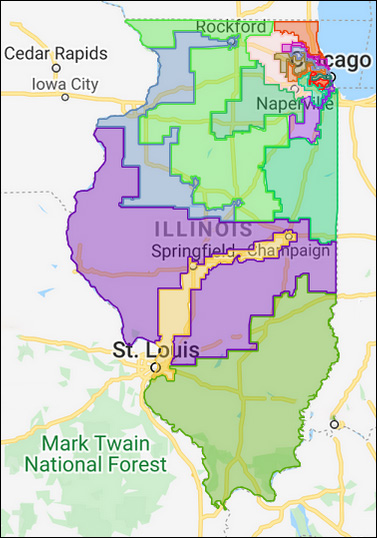
Latest Illinois Congressional redistricting map

By Jim Ellis

Nov. 2, 2021 — On Friday, the Illinois legislature voted to send a new congressional redistricting map to Gov. J.B. Pritzker (D), altering what they had drawn at the beginning of last week. This third map design came largely because of objections from both Reps. Sean Casten (D-Downers Grove) and Marie Newman (D-La Grange) who had been paired in one Chicago suburban district for the 2022 party primary.

A recent court decision rejecting the Illinois state legislative maps influenced the Democratic leadership to draw a second congressional map. A 10-year argument as to whether a second Hispanic seat should be drawn in Chicago this time became the principle discussion point.

In the 2011 redistricting plan, such a seat wasn’t drawn, and also wasn’t part of this year’s original Illinois congressional map. Seeing the Mexican American Legal Defense and Educational Fund (MALDEF) already threatening to sue over the first draw even before a final map had been adopted clearly was a factor in creating a second plan that did feature an additional Hispanic seat.

While this new third congressional version did assuage Rep. Casten and MALDEF, such was not the case for freshman Rep. Newman. She remains paired, but now with Rep. Jesus “Chuy” Garcia (D-Chicago) in an inner city Hispanic district. This is an even more difficult situation for Newman. She appears to be a leadership target likely because she defeated Chicago machine Democrat Dan Lipinski in the 2020 Democratic primary, and this latest map could well be a payback for her challenging the local party authorities.

Another political casualty is Rep. Adam Kinzinger (R-Channahon). Facing a paired situation with Rep. Darin LaHood (R-Peoria) in a Republican primary for the newly drawn 16th District — mostly foreign territory for Kinzinger in a seat that stretches from the Wisconsin border all the way to central Illinois — the congressman announced on Friday that he will not seek re-election to a seventh term.

Continue reading

Illinois Democrats
Alter Congressional Map

By Jim Ellis

Oct. 27, 2021 — A legal setback in court at the end of last week over the Illinois state legislative maps has apparently been part of the reason the Democratic leadership issued a new congressional map this Monday. The changes are very significant leading to three sets of incumbent pairings.

The overall partisan goal of creating a 14D-3R map from the current 13D-5R map looks on paper to be achieved, at least using the 2020 presidential race as a benchmark. The statisticians at Dave’s Redistricting App released their quick calculations to support the partisan division, but in previous data sets we saw the underlying races trending more Republican in some districts than the presidential race alone would have suggested.

Under this supposition, thinking the underlying races may show greater Republican strength when they are fully calculated, the new Illinois map may be a bit more competitive than meets the eye.

The big change is the creation of a second Hispanic plurality open seat in Chicago. The Mexican American Legal Defense Foundation was preparing to file suit on the first plan charging that, among other points and for the second time in two decades, the legislature bypassed the opportunity of drawing a second Hispanic seat in the city even though the numbers were clearly supporting such an addition. The various pressure points caused the leadership to draw a new map containing the second Hispanic district.

This draw causes a Democratic incumbent pairing in Chicago. Freshman Rep. Marie Newman (D-La Grange), who defeated former Rep. Dan Lipinski in the 2020 Democratic primary, would be placed in the same district as second-term Rep. Sean Casten (D-Downers Grove). Originally, Rep. Newman was paired with GOP Rep. Adam Kinzinger (R-Channahon) in a general election battle that would have favored her.

This new 6th District is one of the seats that could play a bit more competitive than the 55-43 percent Biden-Trump result last November yields. Certainly, the pairing winner, and Rep. Casten is at least considered the early favorite, would have a big advantage in the general election. A strong Republican candidate and a wave GOP election could make even the general election in this district interesting.

Continue reading

Illinois Redistricting Map Released

By Jim Ellis

The new Illinois redistricting plan, featuring 17 new districts that twist, turn, and meander throughout the state.

Oct. 19, 2021 — It had been speculated that the Illinois Democrats were attempting to draw a new congressional map to reduce the state’s Republican contingent from five members to three. The new plan, featuring 17 new districts that twist, turn, and meander throughout the state, appears to accomplish their goal.

Democratic leaders from the House and Senate Redistricting committees defend their actions, saying the plan is “designed to comply with federal law and ensure the broad diversity of the state is reflected in the elected officials sent to represent Illinois in Washington, D.C.” The map must still clear both houses of the Illinois legislature and obtain Gov. J.B. Pritzker’s (D) signature before becoming law but with Democrats holding big partisan majorities, enactment seems certain.

Republicans and even some analytical observers say the map is a blatant partisan gerrymander designed to net the Democrats three seats nationally. Under this plan, 14 at least “lean Democratic” districts are created opposite three Republicans. The current map stands at 13D-5R, but Illinois loses a congressional seat in reapportionment.

Therefore, if the map performs as designed, the Republicans will be down a net three seats nationally because the Democrats would convert two GOP districts while the latter party absorbs the loss of the 18th seat that went to another state.

A potential legal problem, in addition to a political gerrymandering lawsuit, is the lack of drawing a second Hispanic seat in Chicago, and the Mexican American Legal Defense Foundation (MALDEF) is reportedly poised to file suit. As was the case in the last decade, the demographic numbers appear high enough for Hispanics to have two seats within Chicago. Such a second seat was not drawn in 2011, and it is again not created on this map, but the black majority seats are reinforced.

One of the re-draw’s top targets is Rep. Adam Kinzinger (R-Channahon). His current 16th District is divided into several parts in an effort to sustain the marginal Democratic district that Rep. Cheri Bustos (D-Moline) is relinquishing in western Illinois, and help strengthen Rep. Lauren Underwood’s (D-Naperville) district in the Chicago metro area. Under the current map, Underwood won a second term with just a 51-49 percent margin.

Continue reading

Maps to the Max

By Jim Ellis

Oct. 13, 2021 — We’re beginning to see preliminary congressional redistricting plans appear around the country, and it seems both parties are attempting to draw maps to their maximum political advantage where possible.

We’ve seen the Democrats attempt to draw a 5D-1R map in Oregon. It appears on the surface that they may have succeeded, but at the very least, Rep. Kurt Schrader’s (D-Canby/Salem) 5th District looks to be highly competitive in the general election, so such a party division outcome is not yet a given.

Speculation coming from New York, Illinois, and New Mexico, suggest the Democrats will attempt to stretch their advantage in those states, the only ones they fully control for redistricting, to a risky maximum. Sources in New York indicate the Democratic leadership is attempting to craft a map that would convert five of the Republicans’ current eight seats in the state delegation to the Democrats.

In Illinois, the potential plan suggests the Democratic leadership will attempt to take the Republicans down to just three seats in the delegation from their current five. Illinois lost a seat in reapportionment, meaning the Land of Lincoln delegation will return to Washington with 17 instead of 18 members.

In New Mexico, plans have surfaced to attempt to draw the state’s lone Republican 2nd District into the Democratic column. This requires bringing the 2nd into the Albuquerque metro area for the first time since becoming a three-seat state.

While the aforementioned draws are possible, doing so could create enough politically marginal districts that the plans backfire at least to a degree.

Republicans look to be retaliating in the states that they control outright, meaning places that have not created a redistricting commission or where they don’t already control the maximum number of seats.

The first North Carolina plan was just released, and if passed, the Republicans could net three seats, gaining two when compared to the current plan, while the Democrats lose one. North Carolina is another of the states that is gaining a congressional district from national reapportionment.

The proposed map looks to make major changes and takes advantage of Rep. Ted Budd (R-Advance) leaving the delegation to run statewide for the Senate. This allows the GOP to effectively draw two new seats instead of one. Though the Democrats control the governorship in the person of Roy Cooper, under North Carolina law the state chief executive has no role in redistricting. Therefore, if maps pass both houses of the state legislature, they are enacted. Republicans have significant majorities in both the state House and Senate.

Continue reading

The Trifecta States

By Jim Ellis

In the trifecta of political parties controlling the House, Senate and Executive branches in a state, how many will actually benefit from that power in the redistricting process?

Oct. 11, 2021 — As the redistricting cycle moves forward, predictions are being made as to which party will benefit most through the decennial district boundary drawing process. Most analyses favor the Republicans as the party best positioned to gain under 2021 redistricting largely because of the number of states they control outright, but this could be an over-statement.

When a state features one party in control of the governor’s mansion, state House, and state Senate, the horse racing term of “trifecta” is used to describe such a political situation. Since Republicans hold 23 trifectas and Democrats just 15, it appears on the surface that the GOP will be the big gainer in redistricting.

Let’s look a bit closer because the aggregate trifecta number doesn’t tell the whole story.

On the Republican side, though they control 23 states, their redistricting position is lessened when examining their ability to extract a net gain of congressional seats.

Of their 23, in one, West Virginia, they are a sure bet to lose a seat. In this case, Republicans hold all three of the state’s CDs, but reapportionment reduces the Mountain State to two districts. Therefore, Republicans will unavoidably absorb the loss.

In two of their states, Arizona and Montana, a non-politician commission will draw the maps. In another dozen (Alabama, Arkansas, Idaho, Indiana, Mississippi, Missouri, Nebraska, North Dakota, South Carolina, South Dakota, Utah, and Wyoming) the GOP is already at the max level of partisan members and can’t stretch the new plan further.

In Iowa and Texas, though Republicans have trifecta control, legislative rules lessen their complete power; hence, the redistricting outcome is affected.

Finally, the GOP only has effective redistricting control in six states, and in two of those, Oklahoma and Tennessee, it could arguably backfire if the party tries to expand their ratio further. Therefore, it is in really just four states, Florida, Georgia, New Hampshire, and Ohio where we could see Republican redistricting gains.

The Democrats find themselves in similar position. From their 15 trifectas, they only have redistricting control in five, possibly, and realistically, three states. In five of their 15 (California, Colorado, New Jersey, Virginia, and Washington) redistricting goes to a citizens’ commission.

Continue reading

The New Mexico Ploy

By Jim Ellis

Sept. 15, 2021 — During the last week reports were surfacing that suggested the New Mexico State Democratic leadership was considering ways to turn the current 2D-1R congressional map into a 3D-0R plan. This might be easier said than done, however.

New Mexico is one of the Democrats’ 15 “trifecta states,” meaning the party controls all three legs of the redistricting stool: the state Senate, state House, and governor’s mansion. Republicans have 23 trifectas. Therefore, if the Democrats are to minimize the redistricting damage, or even possibly come out slightly ahead, they must fully use their political leverage in the states they control.

Of the Democrats’ 15 trifectas, however, five of the states handle redistricting through a commission, and in another five the party already controls all the congressional seats. Therefore, if they are to make a national redistricting play they must take maximum advantage in Illinois, Nevada, New Mexico, New York, and Oregon. The lay of the land, however, makes it very difficult to expand their fortunes in Nevada and possibly Oregon, which is why trying to take an extra seat from New Mexico makes some sense from a national Democratic perspective.

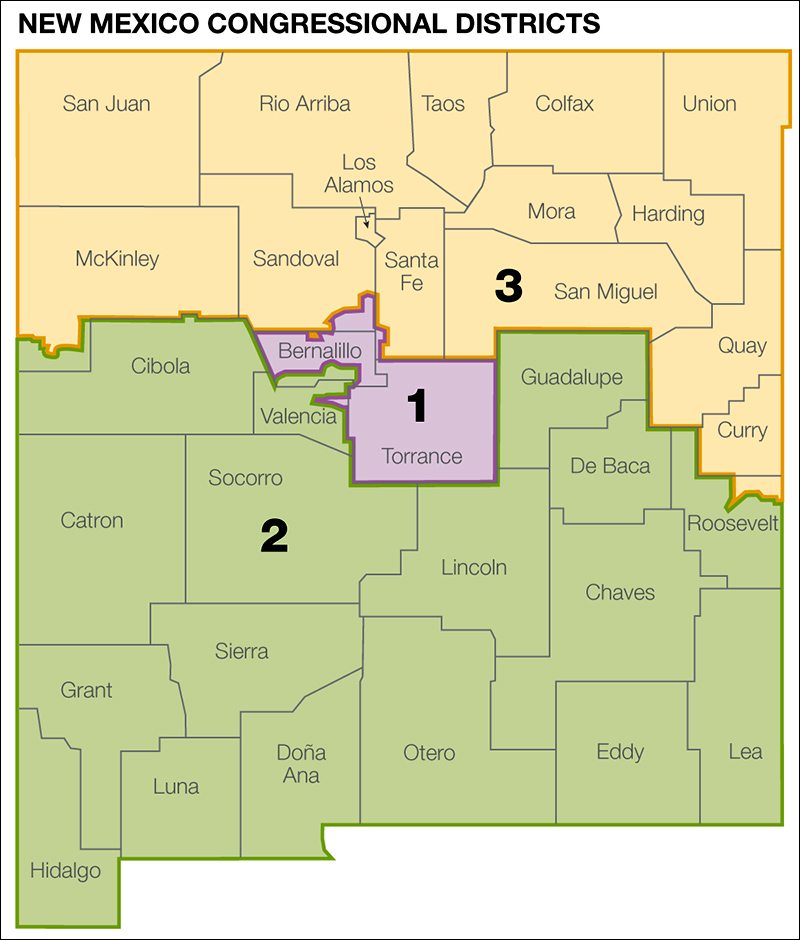
New Mexico has three congressional seats, all of which a freshman represents. The 1st (Rep. Melanie Stansbury; D-Albuquerque) and 3rd Districts (Rep. Teresa Leger Fernandez; D-Santa Fe) in the northern part of the state are safely Democratic.

The southern 2nd District (Rep. Yvette Herrell; R-Alamogordo), which encompasses almost all of the territory south of Albuquerque, has performed as a Republican seat at the congressional level in 19 of the last 21 elections. Democrats picked up the district in their recent wave election years (2006; 2018) with open seat victories, but the voters favored the Republican challenger in both successive elections. This, despite NM-2 being a majority Hispanic district: 53.7 percent of the overall population according to the previous census data.

Additionally, the current seats are not widely out of population balance. The 1st District needs to gain just 11,264 people, while the 2nd must shed 8,181 individuals, and the 3rd must relinquish 3,082 residents. Therefore, a radical re-draw that results in a sweep of the three districts for one party when the population swings are so small would certainly draw a political gerrymandering lawsuit upon adoption of the new map. Whether such a lawsuit would succeed of course is a question that can only be answered when the final map is drawn and enacted.

Likely, the only way to draw a 3D-0R map in New Mexico would be to keep the northern 3rd District Democratic seat virtually intact, and then draw the Republican 2nd into Albuquerque. This would cause the city and Bernalillo County to be split resulting in the 1st and 2nd then appearing as southwestern and southeastern seats that divide Albuquerque, and subsequently stretch all the way to the Mexican border.

Even this draw might make it difficult to create three Democratic seats because the southeastern district would still have the potential of being Republican enough to make the party’s candidate, in this case Rep. Herrell, strong enough to have a chance of winning a general election.

New Mexico is a good example as how a largely internal state exercise can transform itself to help achieve a national partisan goal. It remains to be seen just how bold the New Mexico Democrats will be, as this small and sometimes obscure state steps into the national redistricting limelight.