Tag Archives: Cygnal

Louisiana Elects a Governor;
Bevin Concedes in Kentucky

By Jim Ellis

Louisiana Gov. John Bel Edwards (D), left, and Republican challenger Eddie Rispone (R)

Nov. 18, 2019 — Louisiana Gov. John Bel Edwards (D) defied typical southern electoral history on Saturday as an incumbent winning a run-off election. Usually, when an office holder is forced into a run-off because he or she failed to secure majority support in the primary election, that individual loses the secondary vote. Not so, for Gov. Edwards as he scored a 51.3 – 48.7 percent victory over Baton Rouge developer Eddie Rispone (R).

Late polling suggested a different outcome, as the latest data proposed a trend line where Rispone might have well gone over the top. A new JMC Analytics poll (Nov. 12-13; 600 likely Louisiana voters) showed that Baton Rouge developer Rispone could slip past Gov. Edwards by a 46-45 percent count. The one-point margin was not particularly significant, since the result meant the two candidates were locked in a virtual tie, but the aggregate late-polling trend was more telling.

Since Nov. 1, five studies have been publicly released from five different pollsters and each find the spread ranging from a flat tie to four points. But even the four-point margin, 50-46 percent from Targoz Market Research (Nov. 7-13; 803 likely Louisiana voters) in Edwards’ favor, is inconsistent with the others. Removing this poll, with its strong sample size but long sampling period, means the average percentage difference between the two candidates from the four remaining surveys is only 1.25.

The actual turnout said something different, however, and the first clue came from early voting. According to the latest count on Thursday night, 46 percent of the early votes were coming from Democrats as compared to 38 percent from Republicans. In the jungle primary election, the Democratic early voting advantage was only 44-41 percent, and the GOP candidates secured 52 percent of the vote.

The Daily Kos Elections site authors calculated the percentages that Gov. Edwards would need to attain in key parishes in order to reach 50 percent. We see that the governor reached his projected benchmark in 13 of the 15 representative parishes selected, which accounts for his statewide total.

Over 1.5 million voters participated in the election, meaning a turnout percentage of 50.7 percent of registered voters. This was up 4.8 percent from the recorded primary turnout figure. Four years ago, when Gov. Edwards was first elected in defeating then-US Sen. David Vitter (R), just 40.2 percent of registered Louisiana voters cast their ballots.

Rispone centered his campaign around attacking Edwards over Louisiana ranking near the bottom of state statistics in job creation, and that he was fully in President Trump’s camp. The President came to the state to hold one of his rallies for Rispone, but even this did not help engender a victory.

Edwards’ campaign contended that Louisiana is in the top 10 of fastest growing state economies, that the $2 billion deficit the governor inherited is now a surplus and that was accomplished while increasing teacher pay and expanding Medicare.

Continue reading

What the First Poll Shows in Alabama With Jeff Sessions Entering Race

By Jim Ellis

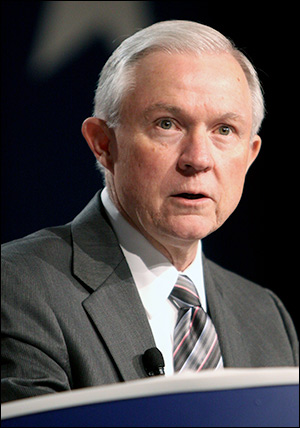
Former Senator and US Attorney General, Jeff Sessions (R)

Nov. 12, 2019 — The Club for Growth organization, the leadership of which had been encouraging former Alabama senator and US attorney general Jeff Sessions (R) to enter the state’s Senate race, conducted and released the first survey since Sessions announced his candidacy on Thursday.

WPA Intelligence administered the survey well before Sessions publicly declared, but just published the results over the weekend. The sampling period was Oct. 29-31, with a respondent universe of 511 likely Alabama Republican primary voters.

The results find Sessions leading the field with 36 percent voting preference. Auburn University former head football coach Tommy Tuberville is second with 23 percent support. The addition of Sessions to the field shows that Rep. Bradley Byrne (R-Mobile) dropping into a tie for third position with former state Supreme Court Chief Judge Roy Moore as the two record 11 percent apiece. Alabama Secretary of State John Merrill, the only current statewide elected official in the race, notches only six percent, and state Rep. Arnold Mooney (R-Shelby County) trails the entire field at just two percent.

If this poll is wholly accurate, it means that both Sessions and Tuberville would advance from the March 3 Super Tuesday primary into an April 14 run-off election to determine who will qualify for the general election opposite Democratic Sen. Doug Jones.

Just over two weeks before WPAi went into the field, the Cygnal polling organization tested the race. According to Cygnal (Oct. 10-12; 536 likely Alabama Republican primary voters), Tuberville led Rep. Byrne, 32-18 percent, and the two of them would have advanced into the second round. Secretary Merrill was next with 13 percent and Judge Moore followed with 11 percent, the same level of support that WPAi detected for the latter man when Sessions’ name was included. State Rep. Mooney records a similar one percent in this survey.

Continue reading

Sessions Looms Over Alabama Race

Former Senator and US Attorney General, Jeff Sessions (R)

By Jim Ellis

Nov. 4, 2019 — We’re getting close to the Nov. 8 candidate filing deadline in Alabama for the March 3 Super Tuesday state primary, and more speculation is brewing that former senator and US attorney general, Jeff Sessions (R), will decide to enter the crowded GOP primary field in order to re-claim his former position.

Reporting has indicated that Sessions, who originally won the Senate seat in the 1996 election, saw his re-election percentage substantially grow in all of his subsequent campaigns from 58.6 percent in 2002 to 63.4 percent in 2008 to 97.3 percent in 2014 when he didn’t even draw a Democratic opponent, is making calls to members of the Alabama House delegation and political leaders around the state to assess his chances. Sessions, of course, relinquished the Senate seat to accept President Trump’s appointment as US attorney general, and then his political trouble began.

To set the current stage, already in the race and running are US Rep. Bradley Byrne (R-Mobile), Secretary of State John Merrill, former Auburn University head football coach Tommy Tuberville, state Rep. Arnold Mooney (R-Shelby County), and former state Supreme Court Chief Justice Roy Moore who blew the 2017 special election when it became public that he dated under-age girls while in his 30s. Judge Moore won the special election nomination when he defeated appointed incumbent Luther Strange in the GOP run-off, which led to Doug Jones becoming the first Democrat to win an Alabama Senate seat since Howell Heflin was re-elected to his third and final term in 1990.

The 2020 Yellowhammer State race, however, may well be the most important contest in the nation to decide the next Senate majority. If the Republicans regain what is normally a safe seat for them, their chamber total increases to 54, which means the Democrats would have to sweep the top vulnerable GOP incumbent defense races in Arizona (Sen. Martha McSally vs. Mark Kelly), Colorado (Sen. Cory Gardner vs. presumably former governor and ex-presidential candidate John Hickenlooper), and North Carolina (Sen. Thom Tillis, assuming he wins the GOP nomination, against former state Sen. Cal Cunningham), and win the presidency.

This scenario would bring the 2021 US Senate into a tie but give the Democrats the majority because the new vice president, who also becomes the Senate president, would be a Democrat with the power to break a tie vote.

Most believe the Republicans would be in the political driver’s seat to defeat Sen. Jones should anyone but Moore win the GOP nomination. Alabama will be one of President Trump’s strongest states (62.1 percent in 2016), and the GOP tide should be strong enough to carry the party’s Senate nominee to victory over a Democratic incumbent who has held the party line on most controversial issues and will more than likely support President Trump’s removal from office.

Continue reading

Fox Poll: Moore Tied – Dubious

By Jim Ellis

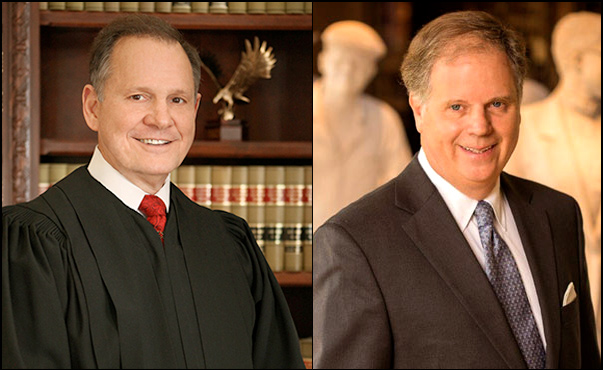
Left: Former state Supreme Court Chief Justice Roy Moore (R) Right: Ex-US Attorney Doug Jones (D)

Left: Former state Supreme Court Chief Justice Roy Moore (R) Right: Ex-US Attorney Doug Jones (D)

Oct. 20, 2017 — A new Fox Poll (Oct. 14-16; 801 registered Alabama voters) just released earlier this week finds former state Supreme Court Chief Justice Roy Moore (R) and ex-US Attorney Doug Jones (D) tied at 42 percent in the special Alabama Senate race to be decided Dec. 12, but such a result begs further analysis.

Though the sample size appears sound from a numerical perspective, its composition causes one to doubt the final result. The actual segment cell sizes are not revealed in the analysis section, but it appears they are not wholly reflective of the Alabama electorate. Those with the greatest error factors: non-whites (+/-7 percent), liberals (+/-7 percent), moderates (+/-7 percent), and independents (+/-8.5 percent) all are strong cells for Jones. The error factors for other segments: whites (+/-4 percent), conservatives (+/-4.5 percent), and gun owners (+/-4.5 percent) are all much lower than the other tested subgroups and each of those favor Judge Moore.

While the overall error rating within the entire sample of registered voters is only listed at +/-3.5 percent, all 18 of the subgroups have corresponding rates that are much higher. This is not particularly unusual since the subgroups, by definition, are smaller than the overall sample, but the considerably larger error factor among Jones’ best groups provides us clues that the poll is skewed in the Democratic nominee’s favor.

Earlier, the Cygnal polling firm released its statewide poll (Oct. 2-5; 497 likely Alabama special election voters) finding Moore leading 49-41 percent, a survey we analyzed last week, and the ex-Judge does particularly well among those identified as most likely to vote. By contrast, the Fox sample is only of registered voters and did not screen for voting propensity. Not isolating voting likelihood is another polling factor that favors Jones’ standing.

Continue reading

The Latest Alabama Data

By Jim Ellis

Left: Former state Supreme Court Chief Justice Roy Moore (R) Right: Ex-US Attorney Doug Jones (D)

Left: Former state Supreme Court Chief Justice Roy Moore (R) Right: Ex-US Attorney Doug Jones (D)

Oct. 16, 2017 — The Cygnal polling firm just released the latest survey for the special Alabama Senate race (Oct. 2-5; 497 likely Alabama special election voters), and it yields a spread between the two major political party nominees that is beyond the margin of polling error. But, these results come with a qualification: the last Cygnal poll for this race, before the Aug. 15 primary election and prior to the September run-off, badly missed the final outcome.

According to this small sample poll, former state Supreme Court Chief Justice Roy Moore (R) leads ex-US Attorney Doug Jones (D), 49-41 percent. Some of the more interesting segmentation includes a significant gender gap. Men prefer Moore 53-38 percent, while women give Jones a one-point edge, 46-45 percent. Jones also leads with voters 49 years of age and younger (a five percentage point advantage), but Judge Moore has a 12-point margin among those 50 and older. This latter spread is a more important advantage for Moore because the oldest age group has the highest propensity to vote in low participation elections.

This latest Cygnal poll is the first the organization has conducted in Alabama since before the special primary. They did not go into the field during the Sept. 26 run-off cycle.

In late July (20-21st), just under four weeks from the Aug. 15 primary, the firm released data that appears to badly miss the mark, but a closer analysis shows they correctly projected the strength of two of the top three candidates.

Continue reading

Alabama: Strange vs. Moore

By Jim Ellis

Sept. 27, 2017 — Voters returned to Alabama polling places yesterday, as Republican run-off participants voted to choose a nominee to advance to the Dec. 12 special general election. To re-cap, former state Supreme Court Chief Justice Roy Moore placed first in the Aug. 15 special Republican primary election, taking 40 percent of the vote from the over 423,000 individuals who cast their ballots. Appointed Sen. Luther Strange took second with 32 percent, which allowed both to move into yesterday’s run-off election. That’s almost exactly the way election turned out yesterday. Judge Moore scored a robust victory last night over Sen. Strange in the special Republican Alabama Senate run-off election. Sen. Strange went down to a 55-45% crushing defeat, just as the pre-election polls predicted. Judge Moore now advances to the Dec. 12 special general election against the Democratic nominee, former US Attorney Doug Jones.

Sen. Strange was the choice of the GOP establishment, which, in this case, somewhat surprisingly included President Trump, who usually lines up on the other side. But all the firepower this group brought to bear and Strange’s minimum 3:1 spending advantage was insufficient to overtake and defeat the former state Supreme Court chief, who was twice removed from the bench for disobeying federal court orders that violated his principles.

Since the primary, polls had shown Judge Moore holding the advantage heading into yesterday’s vote. So did the very last published polls released within the past 48 hours preceding election day.

The Trafalgar Group, proving to be the most accurate pollster from the 2016 election through the special elections held earlier this year, went into the field during the Sept. 23-24 period and interviewed 1,073 likely run-off voters. According to their results, Judge Moore’s lead was major: 57-41 percent, far beyond any reasonable margin of error.

Continue reading

Special Elections Today

By Jim Ellis

Aug. 15, 2017 — Voters go to the polls today in the long-awaited Alabama special US Senate primary, the first tangible step in permanently replacing Attorney General Jeff Sessions. As we know, Sessions resigned his Senate seat early in the year to accept the top law enforcement position in the Trump administration.

Most of the special election campaign action is on the Republican side, as appointed Sen. Luther Strange (R) fights to secure a run-off position.

With the nine GOP candidates clearly attracting enough support to prevent any one of them from capturing a majority and winning the party nomination outright today, moving to a Sept. 26 run-off vote appears certain. Polling suggests that former state Supreme Court Justice Roy Moore will seize the first run-off position, but with 40 percent or less support. Sen. Strange and Rep. Mo Brooks (R-Huntsville) are fighting for the second qualifying position with the other six candidates lagging behind.

The latest poll from the Trafalgar Group (Aug. 8-10; 1,439 likely Alabama GOP primary voters from more than 50,000 contacts), perhaps the most accurate survey research firm because of their most recent track record, finds Judge Moore capturing 35 percent support, with Sen. Strange far back at 23 percent and Rep. Brooks closing to 20 percent.

Continue reading

Will History Repeat in Alabama?

Bradley Byrne

Bradley Byrne

According to a brand new flash poll, history may repeat itself in Alabama’s 1st Congressional District special run-off election scheduled for next Tuesday.

In 2010, Alabama state Sen. Bradley Byrne scored 27.9 percent of the statewide Republican gubernatorial vote to finish in first place and advance to the two-person run-off election. He was paired with Tuscaloosa dermatologist and state Rep. Robert Bentley, who qualified for the secondary vote with the barest of margins over the man placing third, Tim James, the son of former Gov. Fob James. Backed by the various Tea Party organizations and his strongly conservative base voter, Bentley soared past Sen. Byrne to capture a 56-44 percent Republican nomination run-off victory, and then was elected governor in the general election.

Now, as a candidate in the special congressional election for resigned Rep. Jo Bonner’s (R-AL-1) former position, Byrne again placed first in the original primary, garnering 35 percent of the total Republican vote. He faces businessman and conservative activist Dean Young, who scored 23 percent on Sept. 24, but is now running much closer according to late race polling.

Byrne is leaving no stone unturned in this run-off campaign, employing aggressive fundraising and advertising techniques, capturing more endorsements, benefiting from outside independent expenditure advocacy, and attracting establishment Republican support. But, according to a new Cygnal consulting firm flash poll conducted on Oct. 30, Byrne has dropped behind his opponent, Young, by a 43-40 percent  Continue reading >