Post Redistricting:
Competitive Seats, Part I

Click on interactive map above to see Illinois Congressional Districts

By Jim Ellis

Dec. 9, 2021 — Redistricting has now been completed in 20 multi-congressional district states, so this is a good time to examine the races viewed as competitive in the places with new district boundaries. Today, we look at domains from Alabama through Massachusetts. Part II will include the second half of the alphabet.


Alabama:

The Alabama legislature and Gov. Kay Ivey (R) completed their work and delivered a plan similar to the 6R-1D map that is currently in place. At one point, it appeared Alabama would lose a congressional seat, but such proved not the case. Therefore, redistricting became relatively simple in a state where Republicans dominate politically.

Rep. Terri Sewell’s (D-Birmingham) Voting Rights seat was the most under-populated CD needing 53,143 individuals to meet Alabama’s 717,754 per district resident quota. Such a people swing was easily completed because Reps. Mo Brooks’ (R-Huntsville) 5th District and Gary Palmer’s (R-Hoover) 6th CD were over-populated.


Arkansas:

The state’s new four-district congressional plan easily passed the Republican legislature, but was enacted without Gov. Asa Hutchinson’s (R) signature. The main change was making Rep. French Hill’s (R-Little Rock) 2nd District more Republican. The map is likely to continue performing favorably for all four Republican incumbents.


Colorado:

The Colorado Independent Redistricting Commission was the first entity to complete the new maps, and with the state Supreme Court giving final approval in late October, it is unlikely that we will see lawsuits being filed. The map gives all seven current incumbents a place to run with only Rep. Ed Perlmutter’s (D-Arvada) 7th District becoming substantially more competitive. Perlmutter will still be the clear favorite to win again next November, but his current 60-37 percent Biden district is gone.

The major difference for the coming decade is the addition of a new 8th District, and the commission members decided to make this seat competitive. Sitting north and northeast of Denver and encompassing the cities of Thornton, Westminster, and Greeley, this new district gives the Democrats only a slight one-point advantage. In 2022, this seat will certainly be in play for both parties.


Georgia:

The legislature and Gov. Brian Kemp (R) recently approved a new congressional map that may net the Republicans a gain of one seat. The big difference comes in the northern Atlanta suburbs.

Returning Rep. Lucy McBath’s (D-Marietta) 6th District to a Republican domain sees her declaring for re-election in the adjacent 7th District where she will face freshman Democratic Rep. Carolyn Bourdeaux (D-Suwanee) in a primary battle. Also in the race is state Rep. Donna McLeod (D-Lawrenceville) who says she is the only candidate who actually lives in the district.

The new 7th contains more of Rep. Bourdeaux’s territory, but McBath likely has the stronger ideological base. This will be a tight and hard-fought nomination contest, but the winner earns a safe Democratic district for the general election.


Idaho:

The Gem State was the nation’s second fastest-growing entity in the previous decade, but they did not gain a third congressional seat. The map drawers only needed to swap 35,338 individuals from Rep. Russ Fulcher’s (R-Meridian) 1st District to Rep. Mike Simpson’s (R-Idaho Falls) 2nd CD in order to meet the state’s huge 919,513 per district population quota, the largest in the nation.

Should the Idaho growth trend continue in its current pattern, expect the state to earn a third district in the 2030 reapportionment. This map will remain safely 2R-0D.

Continue reading →

Rep. Devin Nunes to Resign

By Jim Ellis

Ten-term US Rep. Devin Nunes (R-CA)

Dec. 8, 2021 — Ten-term US Rep. Devin Nunes (R-CA) will leave Congress at the end of this year according to an announcement made late Monday.

Rep. Nunes, the ranking Republican on the House Intelligence Committee and the man who appeared to have the inside track to become chairman of the House Ways & Means Committee if the Republicans re-gain the chamber majority next year, will become CEO of the Trump Media & Technology Group that former President Donald Trump is launching.

While the congressman, who was first elected in 2002 to his Central Valley California seat, will leave the legislative scene, he certainly will still be very active in politics as he attempts to position a new social media platform that will give right of center individuals a greater voice in the public issues discussion arena.

“The time has come to reopen the Internet and allow for the free flow of ideas and expression without censorship,” Nunes was quoted as reported in the New York Post. “The United States of America made the dream of the Internet a reality and it will be an American company that restores the dream. I’m humbled and honored President Trump has asked me to lead the mission and the world-class team that will deliver on this promise,” Nunes concluded.

Rep. Nunes’ departure creates major change in the Central Valley’s politics. His current 22nd District is one of the just seven California districts that Trump carried in the 2020 presidential election campaign.

One would think that a special election would be called with a year remaining on the term, but in a similarly timed situation in 2020, when then-Rep. Duncan Hunter (R) resigned in January, such was not the case. Gov. Gavin Newsom (D), taking advantage of a quirk in California election law, was able to leave Hunter’s 50th District – like the Nunes seat, a safe Republican domain – vacant for the balance of the entire year.

Considering that the likely special election winner in the Nunes Fresno County-anchored district would be a Republican, and cognizant of the ongoing redistricting process, it is entirely possible that Newsom will again let the seat remain vacant for all of 2022.

Continue reading →

Perdue to Challenge Kemp in Georgia

By Jim Ellis

Former US Sen. David Perdue (R-GA)

Dec. 7, 2021 — Something that has been rumored about and speculated upon for weeks has finally come to fruition. Defeated Sen. David Perdue has formally announced that he will challenge Gov. Brian Kemp in next year’s Republican primary.

The serious primary challenge is part of the aftermath from the 2020 election controversy where Gov. Kemp’s perceived handling of the voter fraud complaints and challenges left a significant portion of the Republican base expressing discontent. Former President Donald Trump has many times attacked Kemp on the subject and is one of the key people behind Perdue’s fledgling gubernatorial candidacy. Trump is expected to play a large role in the primary.

Georgia Gov Brian Kemp

Sen. Perdue lost his seat in the 2020 post-general runoff to Jon Ossoff (D) by a 50.6 – 49.4 percent count (54,944 votes of a total turnout of 4.48 million) after placing first in the general election by almost two full percentage points. Georgia has a majority victory rule, however, that requires all candidates to win their elections with more than 50 percent. In the November vote, Sen. Perdue fell just one-quarter percent short of securing outright victory.

One of the reasons he lost is the state’s strongest Republican counties didn’t perform in the runoff as strongly as did the best Democratic counties. Many Republicans, it is believed, did not return for the runoff because they listened to some of the key Trump leaders, including the former president himself, argue that the Georgia election system is “rigged.”

Gov. Kemp was elected in 2018, winning the primary largely because he positioned himself far to the right, thus successfully appealing to the ardent Trump Republican voter. After moderating for the general election campaign, Kemp defeated former state House Minority Leader Stacey Abrams (D) by just 54,723 votes, an almost identical number to the difference between the Ossoff-Perdue election two years later. She, like Trump, challenged the election results.

The relationship between Gov. Kemp and Trump first became strained when the former disregarded the latter’s endorsed candidate for the US Senate appointment: then-Rep. Doug Collins who was in the running to replace resigned Sen. Johnny Isakson. The three-term senator, former House member and state legislative leader, was forced to leave office for health reasons, thus allowing the governor to appoint an interim successor.

Instead of Collins, Gov. Kemp chose billionaire businesswoman Kelly Loeffler, who would go onto lose her special election runoff campaign to current Sen. Raphael Warnock (D).

Continue reading →

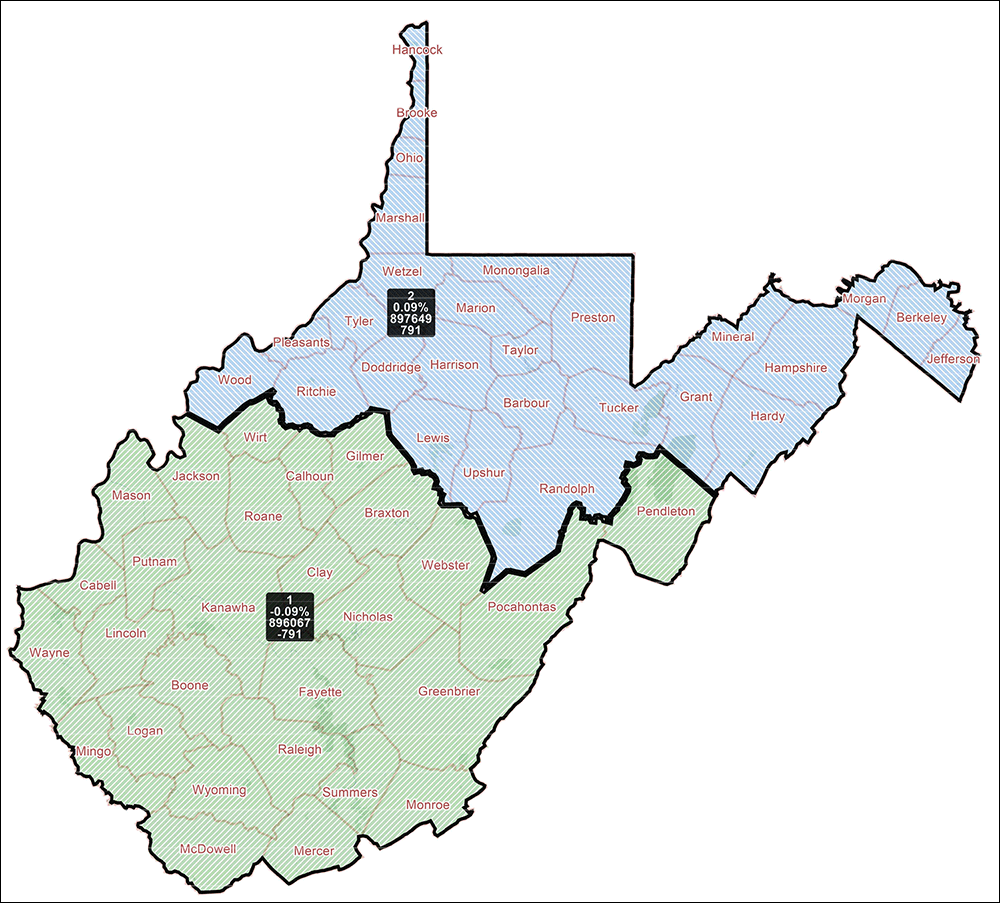
WEST VIRGINIA REDISTRICTING UPDATE

West Virginia Legislature’s 2021 redistricting process has concluded.

The Mountain State is down a congressional district in reapportionment because West Virginia lost approximately three percent of its population since 2010. Therefore, despite Republicans controlling the redistricting process, their 3R-0D delegation will recede to 2R-0D. The district collapse forces Rep. Alex Mooney (R-Charles Town) into a paired situation with Rep. David McKinley (R-Wheeling). This race will be decided in the May 10 Republican primary, with the winner becoming the prohibitive favorite in the general election.

Sans Sununu, New Hampshire Republican Candidates Still in Favorable Position

By Jim Ellis

US Senate candidate Corky Messner (R) | Photo by Amanda Blundo, Corky for Senate Campaign

Dec. 6, 2021 — A new Tarrance Group poll of the New Hampshire general electorate conducted for potential US Senate candidate Corky Messner (R) shows the Republicans in a favorable position to challenge Sen. Maggie Hassan (D) even without Gov. Chris Sununu (R) as her opponent.

The survey (Nov. 14-17; 500 likely 2022 New Hampshire general election voters, live interview) finds Messner lagging only two points behind the first-term senator, 47-45 percent. This type of ballot test result shows a weaker standing for the Republican nominee than when Gov. Sununu was paired with Hassan — in virtually every poll during the past year, the governor was leading — but a lesser known candidate’s support figure lying within the polling margin of error is certainly a positive sign for Republican chances.

Digging deeper into the poll, we find positives for both candidates. Sen. Hassan’s job approval rating is in positive territory at 50:45 percent, with a personal favorability index of 48:44 percent. Though her numbers are not stellar, considering the generic question (would you vote for a Republican or Democrat for US Senate) actually favored the GOP by a 45-42 percent count, her standing is at least stable within the context of what, for her, is an adverse political climate. Typically, the Democrats almost always lead on the generic question.

Perhaps the biggest positive for Messner from this data revolves around a ballot test within the cell group of respondents who are familiar with both candidates. This is a particularly large cell, since 74 percent of the sample participants expressed knowledge of both contenders. In looking at the ballot test figures within just this group, Messner forges into the lead, 50-43 percent.

Assuming the electorate at large would also behave in such a manner upon gaining adequate familiarity with both candidates, such a finding would be highly significant and reinforces the analysis that New Hampshire remains the Republicans’ strongest conversion opportunity.

Messner has not yet announced for the Senate, only saying he is considering becoming a candidate. He was the party’s 2020 Senate nominee, losing to Sen. Jeanne Shaheen (D), 57-41 percent, with the senator outspending Messner, $17 million to $7 million.

Continue reading →

MASSACHUSETTS REDISTRICTING UPDATE

Gov. Charlie Baker (R) is considering a map the legislature passed that would continue sending the state’s 9D-0R delegation to Washington for most, if not all, of the current decade.

The biggest change is Ways & Means Committee chairman Richard Neal’s (D-Springfield) western district having to gain 50,635 individuals. Otherwise, the core of the Massachusetts’ CDs remain intact.

MAINE REDISTRICTING UPDATE

Maine Congressional Districts

The new Maine map made changes in the Augusta area, transferring the region from Rep. Chellie Pingree’s (D-North Haven/Portland) 1st District to Rep. Jared Golden’s (D-Lewiston) expansive 2nd District. The move meant 23,031 people were moved from the 1st to the 2nd.

Maine’s districts are important in that this is one of two states where congressional seats carry their own electoral votes in the presidential race. Though Maine went for Joe Biden in 2020 and Hillary Clinton in 2016, Donald Trump gained an electoral vote in each election because he carried the 2nd District. Under the new map, the Augusta area addition makes the 2nd slightly more Democratic, but it will remain competitive

Rep. Peter DeFazio to Retire

By Jim Ellis

Rep. Peter DeFazio (D-Springfield)

Dec. 3, 2021 — Saying that he “…need[s] a little more time for myself, for my health and well-being, for my wife, my family, and the things I love in Oregon,” veteran Beaver State Rep. Peter DeFazio (D-Springfield), chairman of the House Transportation & Infrastructure Committee, announced Tuesday that he will retire after completing his 18th term next year. He ranks sixth in House seniority.

Rep. DeFazio becomes the 19th Democrat, and third full committee chair, to not seek re-election in this cycle. The other retiring chairs are Reps. John Yarmuth (Budget) and Eddie Bernice Johnson (Science, Space, and Technology).

Through his 18 congressional elections, DeFazio averaged 64.4 percent of the vote, but his victory margins dropped precipitously since 2010. His 2020 performance, scoring just 51.5 percent of the vote, was the lowest of his long career. Since the 2010 election, inclusive, he failed to reach the 60 percent threshold and averaged 55.9 percent in a district that was becoming more Republican as the population grew substantially.

In all but the 2020 election during this 12-year period, Rep. DeFazio faced the same Republican opponent, college professor Art Robinson. Though Robinson ran five consecutive times from 2010 through 2018, he would make a maximum effort in only three of the campaigns.

In the most recent contest, a battle that DeFazio won 51-46 percent against Afghan War veteran and anti-terrorist hero Alex Skarlatos, the Republicans did target the contest. Skarlatos’ campaign committee spent almost $5.2 million, not counting the substantial independent expenditures that came into the district.

The 4th District of Oregon hugs most of the state’s beautiful Pacific Ocean coastline, and encompasses the Eugene-Springfield metro area as its population anchor. At the time of the 2020 election, 595,443 people were registered to vote in this congressional district, the second-highest total in the state. Of that number, 32.6 percent were registered Democrats, and 31.2 percent registered as non-affiliated, while 28.8 percent chose the Republican Party.

Despite the high number of registered voters, the 4th District’s population shed figure was 117,399 individuals, very large for most states, but actually the lowest total among Oregon’s five CDs. Such is the principal reason the state gained a sixth district in reapportionment.

When the new map was drawn, the state legislative leadership had a goal of creating a 5D-1R map. In order to achieve this ratio, at least one of the Democratic seats would be weak from a partisan perspective.

Continue reading →