Conflicting Trends in Ohio; Johnson Opening Advantage in Wisconsin; Dead Heat in Pennsylvania

By Jim Ellis — Tuesday, Sept. 20, 2022

Senate

Ohio 2022 Senate candidates Rep. Tim Ryan (D) and author J.D. Vance (R)

Ohio: Conflicting Trends — In the mid-August through early September period, three pollsters found US Rep. Tim Ryan (D-Warren/Youngstown) snatching the polling lead away from GOP author J.D. Vance. The research entities Impact Research, Suffolk University, and Fallon Research, in studies conducted during the Aug. 17 through Sept. 11 time realm, found Rep. Ryan trending ahead with margins between one and six points.

Two news polls, however, see the race flipping back to Vance. Emerson College (Sept. 10-13; 1,000 likely Ohio voters; multiple sampling techniques) and the Civiqs survey research entity, polling for the Daily Kos Election site (Sept. 10-13; 780 likely Ohio general election voters), and in the field during the same period, see Vance now holding close leads of 44-40 and 48-45 percent, respectively.

Wisconsin: Trend Favors Sen. Johnson — Since the Aug. 9 Wisconsin primary, we’ve seen several polls conducted of the Wisconsin Senate campaign. Immediately after the nomination vote, Lt. Gov. Mandela Barnes (D) opened the general election cycle with a polling lead. Marquette University Law School, a regular Wisconsin pollster, found Barnes holding a 52-45 percent advantage over Sen. Ron Johnson (R) in their Aug. 10-15 poll of 713 likely Wisconsin general election voters.

Late last week, Marquette released a new survey (Sept. 6-11; 801 registered Wisconsin voters; live interview) and the law school research organization now posts Sen. Johnson to a slight 48-47 percent advantage. Civiqs, polling for the Daily Kos Election site (Sept. 10-13; 780 likely Wisconsin general election voters), confirms the Marquette result. They find Sen. Johnson up 49-48 percent. Though the lead is small, the Johnson trend line is positive.

House

OR-5: Getting Closer — The Democratic survey research firm Global Strategy Group, polling for the 314 Action super PAC (Sept. 1-8; 400 likely OR-5 general election voters) finds Democrat Jamie McLeod-Skinner, who defeated Rep. Kurt Schrader (D-Canby) in the May primary election, leading businesswoman and former local mayor Lori Chavez-DeRemer (R), by a tight 41-38 percent margin.

GSG finds the district statistics even closer, however. They see a Democratic partisan edge of just one percentage point, even though the party has a five-point voter registration advantage. In terms of the generic congressional vote, the Republicans have a one-point lead. Under various turnout models according to the GSG research, the race changes. If the turnout model is closer to what was found in the New Jersey and Virginia governors’ races (2021), a Biden+5 model, the congressional race becomes a dead heat at 40-40 percent. Under both a 2014 and 2020 turnout model (Biden+10), McLeod-Skinner would establish a 42-38 percent spread. The trouble for McLeod-Skinner, in a district that slightly leans Democratic, is that she doesn’t reach beyond the low 40s under any turnout model. This suggests that Chavez-DeRemer has serious upset potential.

PA-8: Dead Heat Developing — In what is appearing to be a classic example of a Democratic incumbent claiming independence but seeing Republican forces producing stats showing total compliance with the Biden agenda, the people of Pennsylvania’s northeast 8th Congressional District are dividing evenly.

The Republican polling entity, Cygnal, surveying for the Jim Bognet campaign (Sept. 6-8; 440 likely PA-8 general election voters), finds the two candidates, Rep. Matt Cartwright (D-Moosic/Scranton) and Bognet, tied at 48-48 percent. At an R+8 partisan rating according to the FiveThirtyEight polling organization, PA-8 is the second-most Republican district in the country that elects a Democrat to the House.

Sen. Warnock Back Ahead in Georgia; Utah: Response Results; Sen. Johnson Rebounds in Wisconsin

By Jim Ellis — Monday, Sept. 19, 2022

Senate

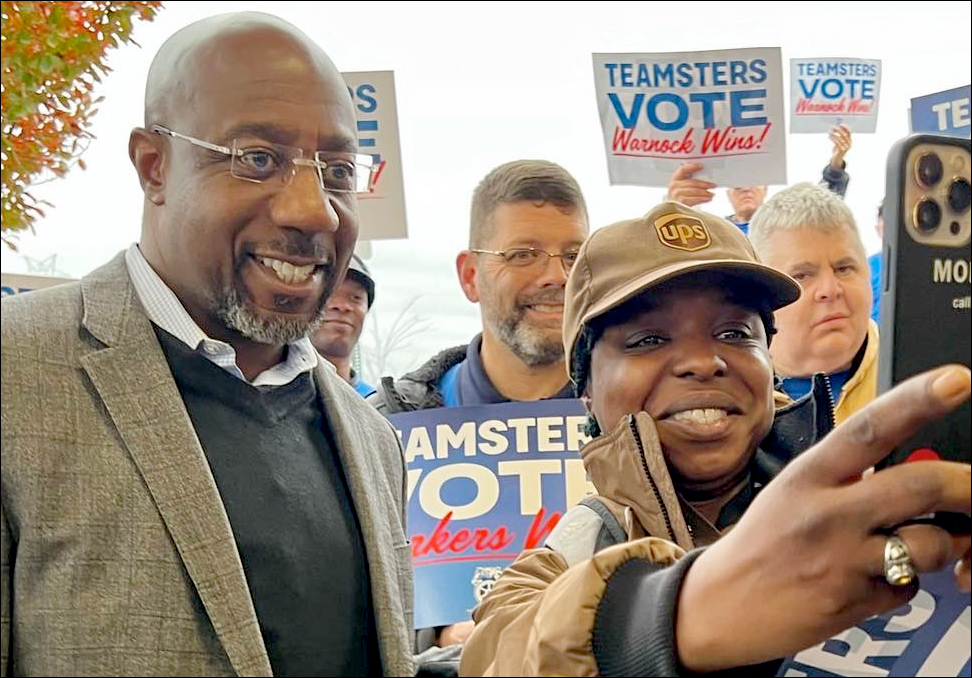
Georgia Sen. Raphael Warnock (D) and Republican challenger Herschel Walker

Georgia: Sen. Warnock Back Ahead — After several polls were released showing Republican Herschel Walker topping Sen. Raphael Warnock (D), Quinnipiac University publicized their most recent Georgia poll (Sept. 8-12; 1,278 likely Georgia voters) that projects a different conclusion. Not only does the Q-Poll place Sen. Warnock back into the lead, but the margin, 52-46 percent, is larger than any regular poll released since July. More will have to be seen in order to determine if a new trend is forming or if the Q-Poll is an anomaly.

Utah: Response Poll — Last week’s surprise Impact Research poll that showed Independent challenger Evan McMullin leading Sen. Mike Lee (R) by a slight 47-46 percent margin has now been countered, at least to a degree. The Center Street PAC released the results of their new Utah survey (Sept. 6-9; 563 likely Utah general election voters) that posts Sen. Lee to only a 43-39 percent edge. The Utah Democratic Party did not field a candidate in order to coalesce behind McMullin. The move allowed McMullin a head-to-head match-up with the two-term incumbent, and it appears, at least in the short term, that the strategy to make this a competitive race has worked.

Wisconsin: Sen. Johnson Rebounds — After seeing a series of three post-primary surveys where Lt. Gov. Mandela Barnes (D) held a lead over Sen. Ron Johnson (R), the regular Marquette Law School Wisconsin poll (Sept. 6-11; 801 registered Wisconsin voters; live interview) finds the incumbent forging a one-point edge, 49-48 percent. Lagging in the polls is nothing new for Sen. Johnson. In 2016, 30 polls were conducted of the Wisconsin Senate race according to the Real Clear Politics polling archive, and Sen. Johnson trailed in 29; yet, on election night, he claimed a three-point victory.

Though he was behind in most of the polling this year, the margins are much closer than in 2016, and Sen. Johnson has now already captured a lead. Compared to his last race against former Sen. Russ Feingold (D), the two-term incumbent appears to be in much better political shape in this election campaign.

Governor

Wisconsin: Gov. Evers in Toss-Up Campaign — The Marquette Law School Wisconsin poll (see Wisconsin Senate race above) also finds a tight governor’s race. The MU survey posts Gov. Tony Evers (D) to a 47-44 percent lead over GOP nominee and businessman Tim Michels. If the undercount of Republican voters that has been present in recent Wisconsin races is again in evidence, Michels could already effectively be in a dead even race.

Ohio Senate Race Flip-Flopping; NY-19 Close; Zeldin-Hochul Race Tightens

By Jim Ellis — Friday, Sept. 16, 2022

Senate

Author J.D. Vance, Ohio Senate Candidate

Ohio: Senate Race Flip-Flopping — After most polling had given author J.D. Vance (R) a small lead in the Senate race, Suffolk University’s new survey (Sept. 5-7; 500 likely Ohio general election voters; live interview) finds US Rep. Tim Ryan (D-Warren/Youngstown) claiming a slim one-point, 47-46 percent advantage. Additionally, the Democratic firm, Impact Research, also went into the field (Aug. 17-23; 800 likely Ohio general election voters) finds Rep. Ryan holding a slightly larger 50-47 percent margin. This race continues to seesaw between the two candidates.

Alaska: Sen. Murkowski Falls Behind — A new poll from the Fabrizio Ward/Impact Research organizations for AARP (Sept. 6-11; 1,050 likely Alaska voters; 500 statewide sample; 550 voters 50 years of age and older; live interview & text) sees the Alaska Senate race heading in a much different direction than even the jungle primary results revealed. The AARP poll finds former Alaska Administration Director Kelly Tshibaka (R) leading Sen. Lisa Murkowski (R), 43-35 percent, which is a significant change from the Aug. 16 primary vote when the senator topped her main opponent, 45-39 percent.

The AARP pollsters delved into the Ranked Choice rounds and found that in the final vote, Murkowski and Tshibaka fall into a virtual dead heat tie. The pollsters indicated the internal raw number final round count among the survey participants was 227 for Sen. Murkowski and 224 for Tshibaka. The pollsters then stated that it is “an understatement to call that within the margin of error.” Because the race is coming down to a pair of Republicans battling, the partisan context is not an issue. Still, the implications associated with this major contest are of national political interest.

House

NY-19: Another Race Brandishing a Close Poll — Though Rep. Pat Ryan (D-Poughkeepsie) won the NY-19 special election in late August, he is seeking re-election in the 18th District. Attorney Josh Riley is the succeeding Democratic nominee who is opposing Dutchess County Executive Marc Molinaro (R). A new Garin Hart Yang Research Group poll (Aug. 29-Sept. 1; 403 NY-19 likely general election voters; live interview) again finds the race within the polling margin of error, like most competitive races around the country. The GHY data finds Riley leading Molinaro, 47-44 percent.

The new 19th CD has only 43 percent carryover from the current 19th where the August special election was held. Therefore, this race with a new candidate lineup is a much different campaign. The special election ended in a 51-49 percent Democratic victory. The new 19th is slightly more Democratic but still very much in play during the general election. This is yet another key House race carrying national implications toward determining the next majority.

Governor

New York: Becoming Closer — A new survey, this one from the Republican survey research firm co/efficient, confirms an earlier poll that Gov. Kathy Hochul’s (D) lead over US Rep. Lee Zeldin (R-Shirley/East Long Island) is down to single digits. The co/efficient survey (Sept. 5-7; 1,194 likely New York general election voters; live interview & text) posts the governor to only a 49-43 percent lead. Last week, the Trafalgar Group released their poll (Aug. 31-Sept. 1; 1,091 likely New York general election voters; multiple sampling techniques) that gave the governor a similar 48-43 percent edge. In between, however, Emerson College (Sept. 4-6; 1,000 likely New York general election voters; online, text & interactive voice response system) produced a 50-35 percent ballot test in Gov. Hochul’s favor.

The Turnout Precursor

By Jim Ellis — Thursday, Sept. 15, 2022

Retired Army Gen. Don Bolduc (R)

While the New Hampshire results are not completely final, retired Army Gen. Don Bolduc has been projected as the Republican primary winner and he now advances to face Sen. Maggie Hassan (D).

The senator’s campaign wasted no time in attacking Bolduc, hitting him with an abortion ad the day after the primary ended.

Gen. Bolduc’s margin of victory over state Senate President Chuck Morse (R-Salem) will be in the neighborhood of 1,800 votes when all the counting is finally complete.

Turnout was robust. It appears the New Hampshire Republican primary will feature, when the counts become official, approximately 145,000 voters. This is an extraordinarily high figure, since it is only about 8,000 short of the number who participated in the 2020 first-in-the-nation New Hampshire presidential primary.

The Democratic side will have drawn only approximately 95,000 when all of the towns and counties finally report, though Sen. Hassan and state Sen. Tom Sherman (D-Rye) were largely unopposed in the Senate and governor’s race.

The presidential nomination election, which in many ways becomes an economic industry in New Hampshire because of the major campaign spending from so many national campaigns that is associated with winning the first vote in the nominating process, last drew 153,674 GOP voters. Typically, turnout for the presidential primaries are close to general election participation levels.

The 2nd Congressional District Republican race was just as close as the Senate campaign, but it now appears certain that former Hillsborough County Treasurer Robert Burns defeated Keene Mayor George Hansel by just under three percentage points or a little over 1,600 votes. He now advances to face five-term Rep. Annie Kuster (D-Hopkinton/Concord).

The 1st District was decided on Tuesday night, and former Trump White House aide Karoline Leavitt will officially challenge two-term Rep. Chris Pappas (D-Manchester) in one of the most politically volatile congressional districts in the country.

Though former President Trump did not endorse a candidate in the Senate race, his supporters had a big night on Tuesday and are largely credited with delivering the victories for Bolduc, Leavitt, and Burns. It remains to be seen how the national Republican committees respond, since there was clear consternation among the party leadership about the candidates and Bolduc, in particular.

Yesterday, however, Sen. Rick Scott (R-FL), the National Republican Senatorial Committee chairman, said his committee remains fully committed to New Hampshire as a key target race. The organization has over $9 million in media time already reserved for the Granite State’s general election.

Continue reading

Tight Polls in Arizona; Independent Fairs Well in Utah; More Alaska Ranked Choice Voting Analysis

By Jim Ellis — Thursday, Sept. 15, 2022

Senate

Arizona Sen. Mark Kelly (D)

Arizona: Two Tight Polls — In the 2020 special US Senate election, then-candidate Mark Kelly (D) consistently ran ahead of then-Sen. Martha McSally (R) and by an average of 7.1 percentage points in 21 polls conducted from Oct. 1 to Election Day, but only won the race, 51-49 percent. In the 2020 cycle, we see much closer polling as two new surveys exemplify.

The pair of studies, both taken during the Sept. 6-7 period, are from Emerson College (627 likely Arizona voters; multiple sampling techniques) and the Republican research firm Insider Advantage (550 likely Arizona voters). Emerson finds the race well within the polling margin of error at 47-45 percent, while the IA result projects a 45-39 percent division. Both post Sen. Kelly leading Republican nominee and venture capitalist Blake Masters.

Utah: Another Independent Faring Well — Utah Independent US Senate candidate Evan McMullin released a Democratic firm’s poll that yields him a one-point edge. Impact Research (Aug. 29-Sept. 1; 800 likely Utah general election voters) found McMullin leading Sen. Mike Lee (R) by a 47-46 percent margin. Sen. Lee quickly countered with re-releasing his early August WPA Intelligence poll that saw him holding a major 50-32 percent advantage. Expect the Lee campaign to soon release more recent data.

House

AK-AL: More Ranked Choice Analysis — The Fair Vote organization, which is the principal promoter of the Ranked Choice Voting system, released a further analysis of the RCV vote in the Alaska special election that elected Democrat Mary Peltola, even though she attracted only 40 percent of the actual vote. The Ranked Choice advocates claim the system rewards the candidate who has the broadest support, but it tends to do the opposite since candidates with minority support have won most of the major races where the system has been used.

The analysis suggests that had candidate Nick Begich III been opposite Peltola in the final round instead of former governor and vice presidential nominee Sarah Palin, he would have won the race. The Fair Vote analysis reveals that 59 percent of the Palin vote would have gone Begich’s way — as opposed to Palin gaining only 50.3 percent of the Begich second choice votes. The bigger difference, however, was Peltola attracting only six percent of the Palin second-choice votes as compared to the 28 percent she received from Begich voters.

What the analysis fails to include, however, are the more than 11,000 Begich voters whose ballots were not counted in the second round. The analysis claims those people simply didn’t make an additional ranked choice, but in reality, it may be due to a lack of understanding the confusing system. In other places, attorneys who have challenged the system report that most ballots are disqualified because the voter inaccurately completed the ballot. Since Palin lost by 5,219 votes, more than 11,000 non-counted Begich ballots could have made the difference, and it is likely that a large number of these had their ballots disqualified as opposed to not making a choice. Therefore, the Fair Vote conclusion that Palin lost because the Begich voters eschewed her may not be entirely accurate.

Governor

Arizona: Evolving Dead Heat Race — The aforementioned pair of Arizona polls from Emerson College and Insider Advantage (see Arizona Senate race above) forecasts an even closer race for governor than they do for US Senate. Emerson College projects a straight tie between Secretary of State Katie Hobbs (D) and former Phoenix news anchor Kari Lake (R), with both candidates posting 46 percent support scores. Insider Advantage finds a similar result with Hobbs leading by the slightest of margins, 44-43 percent.

Gen. Bolduc Leads;
Gov. McKee Survives

By Jim Ellis — Sept. 14, 2022

The Final Primaries

Retired Army Gen. Don Bolduc (R)

New Hampshire — The last major US Senate primary is close to concluding as retired Army Gen. Don Bolduc, despite being wildly outspent, appears to have turned back state Senate President Chuck Morse’s late race momentum and is staked to a one-point, 37-36 percent lead (1,270 votes) in the New Hampshire Republican Senate primary with 85 percent of the expected vote counted.

Though the margin is tight, it is most likely that Gen. Bolduc will advance into a shortened general election cycle against incumbent Sen. Maggie Hassan (D).

A great deal of controversy surrounded this primary, particularly a verbal sparring battle between Gen. Bolduc and Gov. Chris Sununu (R). Both had unflattering things to say about the other, and now it will be interesting if we see a quick healing between the two. No doubt Democrats will use the governor’s words against Bolduc. Even before the votes were tabulated, however, Gov. Sununu was sending more conciliatory signals and stressing the importance of Republicans uniting to defeat Sen. Hassan, whom he says, “nobody likes.”

Though Bolduc was viewed as the weakest general election candidate in the field of six, head-to-head test polling didn’t show him any further behind Sen. Hassan than those, such as Sen. Morse, who were viewed as the better options to become the Republican standard bearer.

The Republican leadership will now have a difficult decision about how to proceed. Do they invest heavily in this race to back a candidate who they believe is weak even though Sen. Hassan appears vulnerable in a state that could easily swing Republican, or to do they cut their losses early and transfer the funds to another place where their chances for victory might be brighter? It will be interesting to see what they decide.
Continue reading

Final Primary Preview

By Jim Ellis — Tuesday, Sept. 13, 2022

We have finally reached the end of primary season, as voters in three northeastern states will cast their nomination ballots today. Once these votes are counted, all of the stand-alone primary states will have nominated their general election candidates. At that point only Louisiana, which holds its qualification election concurrently with the general, will remain in primary mode.

Each of the states holding their primaries are in the east, with New England’s New Hampshire and Rhode Island on the schedule along with Delaware in the Mid-Atlantic region.

New Hampshire — The most noteworthy primary is the New Hampshire Republican Senate race, complete with its share of controversy. Polling leader Don Bolduc, a retired Army General who ran unsuccessfully in 2020 (failing to prevail in the Republican primary in order to challenge Democratic Sen. Jeanne Shaheen), and Gov. Chris Sununu (R) have been in a public war of words. Gen. Bolduc accused the governor of being a “communist sympathizer” and that his family’s business supports terrorism. The governor retorted that Bolduc is a “conspiracy theory type” who is not “a serious candidate.”

Many in the Republican Party, including Gov. Sununu, believe that Gen. Bolduc will not be a strong enough nominee against Sen. Maggie Hassan (D) even though polling shows that she is vulnerable. The governor has endorsed state Senate President Chuck Morse (R-Salem), who seems to be the only viable competitor who could deny Bolduc the nomination among the 10 others on the ballot.

The latest available Senate poll, this from the University of New Hampshire (Aug. 25-29; 892 likely New Hampshire Republican primary voters; online), found Gen. Bolduc leading Sen. Morse, 43-22 percent. Since this poll was conducted, however, some $4 million has been spent attempting to deny Bolduc the nomination, and Democratic organizations have come from the outside to help him win the primary since they, too, believe that he would be easiest for Sen. Hassan to beat.

The retired General is at an extreme financial disadvantage, so he has little ability to promote himself. This race will draw the most attention tonight.

New Hampshire’s two congressional districts also feature competitive Republican primaries. Both seats will be hotly contested in the general election because Reps. Chris Pappas (D-Manchester) and Annie Kuster (D-Hopkinton/Concord) are clear Republican targets.

Another crowded ten-person Republican 1st District primary appears to be coming down to a battle among 2020 nominee Matt Mowers, who held Rep. Pappas to a 51-46 percent re-election victory before an electorate that has defeated more incumbents than any other in the nation, former Trump White House aide Karoline Leavitt, and ex-television news reporter Gail Huff Brown, wife of former Massachusetts Sen. Scott Brown (R). Polling suggests that Mowers has the slight edge heading into election day.

In the western 2nd District, the Republican race is a two-way battle between former Hillsborough County Treasurer Robert Burns and Keene Mayor George Hansel. Should Burns win the GOP nomination, and polling suggests he will, his challenge opposite Rep. Kuster will be formidable.

Rhode Island — The most notable race on the Rhode Island card is the Democratic primary for governor. Dan McKee assumed the governorship when incumbent Gina Raimondo (D) resigned to accept her appointment as US Commerce Secretary.

The new governor, running for a first full term in his own right, has four Democratic challengers, and a close outcome in tomorrow’s primary is expected. McKee’s four opponents are Secretary of State Nellie Gorbea, businesswoman Helena Foulkes, former Secretary of State Matt Brown, and physician Luis Daniel Munoz. It appears the race is winnowing to a battle between Gov. McKee and Gorbea. Today’s winner becomes the prohibitive favorite in the general election.

Delaware — With no governor or senator on the ballot this year, the Delaware primary is basically a non-event. At-large Rep. Lisa Blunt Rochester (D-Wilmington) is unopposed in the Democratic primary, and educator/actor Lee Murphy is the only candidate on the Republican side. The general election will not be competitive, since Rep. Blunt Rochester is a lock for re-election.