Category Archives: Polling

PA-Senate: Republicans in Trouble

Former US Ambassador to Denmark, Carla Sands — a Pennsylvania senate candidate to watch.

By Jim Ellis

Nov. 29, 2021 — The Keystone State of Pennsylvania, with an open Senate and governor’s race, will be a focal point of the 2022 election cycle, and last week the Republicans’ early problems grew worse.

The Pennsylvania GOP began this election cycle in a seemingly underdog position as they fought to hold the Senate seat from which two-term incumbent Pat Toomey (R) is retiring; now they are clearly playing from behind.

Iraq War veteran Sean Parnell (R) had former President Donald Trump’s endorsement and was leading the Republican primary in early polling. However, due to losing a child custody judgment rendered at the beginning of this week after a contentious trial in which his ex-wife had accused him of domestic abuse, Parnell withdrew from the Senate contest.

It’s a loss for his party, but Parnell wasn’t even the best of candidates. In his first bid for public office, running for the 17th Congressional District seat against Allegheny County area incumbent Conor Lamb (D-Pittsburgh), now himself a Senate candidate, Parnell came close but lost 51-49 percent. Based upon a close defeat in a winnable district, he decided to make a statewide Senate run.

Two other primary opponents, former lieutenant governor nominee Jeff Bartos and Army veteran, Trump campaign activist, and former congressional candidate Kathy Barnette, also lost their most recent political races. Therefore, the original three leading Republican candidates in either polling or fundraising hadn’t ever won a race and were falling well behind their Democratic counterparts.

The Democrats feature the overall early race leader, Lt. Gov. John Fetterman. He commands first position in primary and general election polling and has raised way more campaign capital than all of his opponents, over $9.2 million through the Sept. 30 financial disclosure period.

John Fetterman, however, isn’t without his own flaws. In 2013, when he was mayor of Braddock, a borough southeast of Pittsburgh in Allegheny County and located on the Monongahela River, Fetterman pulled a loaded weapon on an unarmed African-American jogger after hearing gunshots fired in his neighborhood. The Fetterman campaign has already produced a short video explaining the incident in anticipation of this becoming an issue in his 2022 statewide effort.

Rep. Lamb is running second to Lt. Gov. Fetterman in polling and dollars raised, almost $7 million behind his chief Democratic rival. The latest poll, from the Civiqs organization (Oct. 31-Nov. 1; 929 likely Pennsylvania Democratic primary voters, online) found Fetterman way ahead of Rep. Lamb, 52-12 percent, with other announced and possible candidates, state Rep. Malcolm Kenyatta (D-Philadelphia), Montgomery County Commissioner Val Arkoosh, and potential contender Sharif Street, a state senator and son of former Philadelphia Mayor John Street, all polling at five percent or less.

Continue reading

Rep. Beutler Trailing in New Poll

Six-term Washington Rep. Jaime Herrera Beutler (R-Battle Ground/Vancouver)

By Jim Ellis

Nov. 9, 2021 — Another of the House Republican Trump impeachment supporters appears to be having trouble back home. A new Trafalgar Group poll (Oct. 30-Nov. 2; 682 likely WA-3 primary voters; combination live interview, interactive voice response system, and text) finds six-term Washington Rep. Jaime Herrera Beutler (R-Battle Ground/Vancouver) placing third in a field of four as a prelude to next year’s jungle primary.

According to Trafalgar, former Green Beret Joe Kent (R), who has former President Trump’s endorsement, leads the candidate field with 35 percent preference. Next is Democrat Brian Hennrich, a movie theatre technician, who records 24 percent. For this poll, Hennrich realistically serves as a placebo candidate to test Democratic support. Rep. Beutler then places third with 23 percent and another Republican, pastor and author Heidi St. John, posts 10 percent support. An additional eight percent said they would vote for “another Democrat.”

Surveys such as this will likely spur the Democrats to recruit a much stronger candidate in what plays as a marginal southwestern Evergreen State congressional district.

Washington is one of three states that employs a top-two jungle primary system. All candidates are placed on the same ballot and the top two finishers, regardless of percentage or party, advance into the general election. Therefore, this poll would suggest that Rep. Beutler, at least today, could be eliminated before the general election cycle even officially begins. Washington has a late primary, Aug. 2, 2022, so plenty of time remains for the congresswoman to right her political ship.

The Washington districts won’t likely change a great deal in redistricting. Washington redistricts by commission, and has since 1991. Because none of the state’s 10 districts need a major population influx, it is probable that most of the seats, and especially District 3 (largely because it must only shed 2,222 individuals) will remain relatively constant.

The 3rd District is nestled into the southwestern corner of the state, bordering Oregon and the Pacific Ocean. The seat needing to gain the most people is Rep. Derek Kilmer’s (D-Gig Harbor) 6th District, but the 33,730 residents it requires is still a relatively small number in comparison to some other states.

Currently, the Beutler district votes as a marginal Republican seat. Former President Trump carried WA-3 in 2020 with a 51-47 percent margin after posting a 50-42 percent showing against Hillary Clinton in 2016. Rep. Beutler, in what was billed as a competitive race at the beginning of the 2020 election cycle, scored a 56-43 percent re-election victory. She has averaged 57.6 percent of the vote in her six successful congressional elections.

Fundraising so far has been significant. The September 30 FEC reports find Rep. Beutler already raising $1.73 million for the cycle with $1.38 million cash-on-hand. Kent has also done well, especially for a challenger, raising $1.09 million with $837,000 in the bank. St. John (R) has also raised a respectable $334,000, and held just over $213,000 in her campaign account at the reporting period’s end.

Continue reading

Today’s Election Scorecard

By Jim Ellis

Nov. 2, 2021 — Today is a significant Election Day, and the menu of races stretches beyond a Virginia governor’s race that has attracted the lion’s share of political attention.

While the VA governor’s race will of course be top of mind as results come in tonight and analysts attempt to assign precursor status to the contest regardless of the final result, other campaigns will also be of significance.

In the Virginia race, if Republican Glenn Youngkin scores an upset win, and the late indications are clearly moving his way, it may be cast as an affront to the Biden Administration and the Democratic majorities in Congress relating to their legislative agenda. In actuality, it is a more locally based issue, education, that should correctly be cast as the linchpin to describe a Youngkin victory.

Former Gov. Terry McAuliffe’s (D) debate comment saying he did not believe “parents should be telling schools what they should teach,” will actually prove to be the key turning point to a Youngkin victory should it materialize. In McAuliffe wins, then the talk of a coming Republican wave election next year will certainly dissipate at least in the short term.

In addition to the Virginia governor’s race, the remainder of the statewide ticket, the lieutenant governor and attorney general races could be of significance. If Winsome Sears (R), running for lieutenant governor, and Jason Miyares (R), running for attorney general, both win their races to compliment a Youngkin victory, then talk of a clear precursor or budding Republican wave election will carry a more serious tone.

New Jersey voters will decide their governor’s contest as well. In Jersey, late polling, after seeing some closer numbers not even 10 days ago, seems to show Gov. Phil Murphy (D) pulling away from Republican Jack Ciattarelli in the closing week. The final result will likely be closer than most analysts would have projected at the beginning of the odd-numbered year election cycle, however.

In both Virginia and New Jersey, voters will also be electing members of the state legislature. In the Old Dominion, only the House of Delegates is on the ballot, as state senators, with their four year terms, won’t face the voters as a unit until the 2023 election cycle.

In the Garden State, both parties are projecting they will gain seats, but no one believes the strong Democratic majorities in the state Senate and Assembly are in any danger. In the Virginia House of Delegates, Republicans need to convert a net six seats to re-claim the majority they lost in the 2019 election.

Continue reading

Youngkin Catapults to Lead In Virginia Gubernatorial Race

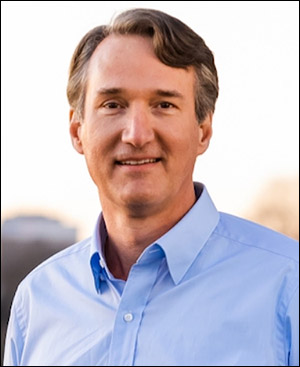
Glenn Youngkin, Virginia Republican governor candidate

By Jim Ellis

Nov. 1, 2021 — A surprising polling turn of events came to light late last week as Fox News released a new Virginia survey that shows Republican Glenn Youngkin (R) holding an eight-point lead in the race for governor, his largest of any poll throughout the campaign. The surprise comes in a result that reverses last week’s Fox poll that found former Gov. Terry McAuliffe holding a five-point advantage.

The Fox News poll (Oct. 24-27; 1,212 registered Virginia voters; 1,015 individuals identified as likely VA gubernatorial election voters, live interview) finds Youngkin claiming a 53-45 percent advantage within the likely voter segment. When looking at the entire registered voter sample, however, the Youngkin edge shrinks to 48-47 percent.

The previous Fox poll (Oct. 10-13; 1,004 registered Virginia voters; 726 individuals identified as likely VA gubernatorial election voters, live interview) gave McAuliffe a 51-46 percent margin. Within the entire sample, the McAuliffe advantage leapt to a double-digit eleven point lead at 52-41 percent.

Though Fox News has a well-known right-of-center orientation, their polling operation does not. The Fox Polls are conducted jointly through a Democratic survey research firm and a Republican polling organization. Beacon Research is the Democratic firm, formerly known as Anderson Robbins Research, while the Republican entity is Shaw & Company Research. The two have been collaborating on the Fox polls for 10 years, since 2011.

According to the FiveThirtyEight research organization that ranks polling firms, Fox News is scored with an A rating, but has a Democratic bias factor of 1.8 percentage points. Therefore, despite Fox News’ reputation, their polling arm has trended more Democratic over the joint partnership’s long history.

That being said, this particular poll appears to have a Republican skew. Looking at the likely voters, 46 percent identified themselves as solid or leaning Republican, while 42 percent responded Democratic. This ratio is contrary to recent Virginia voter history.

The Commonwealth does not register voters by political party, so people can float between the two major political organizations. The move toward the Republicans in this poll could be the centrist, or independent voter, moving to the right for this particular election. Regardless, it is probable that Youngkin’s eight-point margin among likely voters is at least somewhat inflated.

A further problem for McAuliffe is his standing among committed voters. In both the current survey and the previous Fox study that found him leading by five points, his committed support remained constant at 44 percent. Seeing no movement on this question suggests that McAuliffe is lacking momentum in the closing days.

Continue reading

Is the McCrory Lead a Mirage
In North Carolina Senate Race?

By Jim Ellis

Former North Carolina Gov. Pat McCrory

Oct. 28, 2021 — Former North Carolina Gov. Pat McCrory’s campaign did something rather strange this week.

They released their internal Pubic Opinion Strategies poll, which in and of itself is not unusual, and extolled how well McCrory was running, but they did not publish the ballot test numbers in the polling synopsis. Why? Because the figures aren’t as good as meets the eye.

Once found, the ballot test shows McCrory leading Rep. Ted Budd (R-Advance), 40-25 percent, a 15-point edge, which was truthfully cast as a double-digit lead. The underlying story, however, is that the ballot test actually represents a net gain of 20 percentage points for Budd.

In April, POS released their first public poll of the GOP primary and it showed McCrory leading Rep. Budd, 48-13 percent. Comparing the latest 40-25 percent result shows some sustained momentum for Rep. Budd in that McCrory’s support has dropped eight points while his own climbed a dozen.

A third candidate, former Rep. Mark Walker, only registered eight percent in this poll, but it is possible that he will not even file for the Senate at the Dec. 17 deadline. If the legislature moves forward with a version of the redistricting plan that puts the Greensboro area seat back in play for Republicans – a court decision robbed Walker of the House seat he held for three terms with their ruling changing the state’s congressional map before the 2020 election – it is quite possible that Walker would have the option of returning to a winnable House contest.

If Walker were to abandon the Senate race, it would be another plus for Rep. Budd. It is likely that more Walker voters will gravitate toward Budd than McCrory since they clearly are familiar with the former governor but chose not to back him in the three-way contest.

Pat McCrory was elected governor in 2012, but lost to then-Attorney General Roy Cooper (D) on the same night that Donald Trump claimed North Carolina against Hillary Clinton. In fact, Republicans won eight of 12 statewide elections that evening, with McCrory being the only GOP incumbent to fall.

Continue reading

NJ Governor’s Race In Upset Range

Click on above image from TV ad to go to New Jersey gubernatorial Republican candidate Jack Ciattarelli’s ad about state taxes and opponent incumbent Gov. Phil Murphy (D).

By Jim Ellis

Oct. 26, 2021 — The most recent Emerson College poll for the New Jersey governor’s race (Oct. 15-18; 600 likely New Jersey voters; combination live interview, text, and interactive voice response system) suggests that Republican challenger Jack Ciattarelli, a former state assemblyman and ex-county official, has an outside chance of scoring an upset victory over Gov. Phil Murphy (D) in next week’s statewide election.

While the odds still favor a Murphy win, the new survey certainly shows areas of weakness for the Democratic incumbent and a path to victory for the Republican challenger. According to Emerson, Gov. Murphy leads 50-44 percent, and when leaners are added to the mix, the margin tightens to an even closer 52-48 percent.

Among those who classify themselves as “very likely” voters, the Murphy lead shrinks well within the polling margin of error at 48-45 percent. The biggest Ciattarelli positive sectors are among undecided voters, who are breaking his way on a 59-41 percent clip, the Independent segment, 56-32 percent, men, 50-41 percent, and those in the 50-64 age range, 49-46 percent.

Gov. Murphy obviously can highlight positive sectors of his own. The most favorable sign pointing to a Murphy victory next Tuesday is among the people who say they have already voted. Of those, 76 percent indicated they supported Gov. Murphy as opposed to just 24 percent who cast their ballot for Ciattarelli.

The Emerson poll finds the governor leading among women, 57-40 percent, those aged 18-29, at 58-42 percent, the 30-49 aged sector, 47-41 percent, and the oldest and most reliable voting segment, the people aged 65 and older, 53-42 percent.

Neither candidate has a particular advantage on the favorability index. Gov. Murphy records a 49:47 percent favorable to unfavorable rating, while Ciattarelli posts an even 40:40 percent ratio.

Continue reading

New Hampshire Senate:
Toss-up Results

By Jim Ellis

New Hampshire first-term incumbent Sen. Maggie Hassan (D)

Oct. 25, 2021 — Only needing to gain a net one seat to claim the Senate majority, Republicans face a frustrating in-cycle map that yields few 2022 Democratic targets. One of those scarce opportunities, however, lies in the Granite State of New Hampshire.

Arguably, the New Hampshire race is the party’s best conversion opportunity and becomes a Republican prerequisite toward building a winning coalition of states. The latest University of New Hampshire poll, released late last week, suggests the GOP is well positioned to compete in the “Live Free or Die” region of New England.

The regular UNH Granite State poll (Oct. 14-18; 1,061 New Hampshire panel members, 979 likely New Hampshire voters, online) tested first-term incumbent Sen. Maggie Hassan (D) against several potential Republican opponents … and she falls into an early toss-up result against all.

First, a word about the UNH polling operation. Several years ago it was among the most inaccurate of pollsters, largely because they utilized long sampling periods sometimes lasting three weeks, and small respondent universes. They have improved since that time, though their online format chosen for this poll is typically not optimal.

The FiveThirtyEight statistical organization, in their latest pollster rankings, rates the UNH operation as their 112th best pollster, with a B- rating. They assign a 2.4 percent Democratic bias factor to the organization’s polling results over 122 tested surveys.

That being said, yesterday’s survey release finds Gov. Chris Sununu (R) again leading Sen. Hassan in a hypothetical ballot test pairing. There is no doubt Republican leaders are trying to persuade Gov. Sununu to run, but so far he has not committed to the race. He has the opportunity of running for a fourth gubernatorial term – New Hampshire has two-year terms for their governors – or pursing opportunities in the private sector.

This poll finds the Sununu advantage at three percentage points, 45-42 percent, which is of course in toss-up range, but seeing an incumbent well below 50 percent does not bode well for Sen. Hassan.

UNH also tested the senator against the woman she defeated by a tenth of a percentage point in 2016, or just over 1,000 votes statewide, former Sen. Kelly Ayotte (R). The new poll virtually replays that result, posting Sen. Hassan to a bare 44-43 percent edge.

Continue reading