Category Archives: Polling

Kentucky Senate: A GOP Toss-Up

By Jim Ellis — Friday, March 20, 2026

Senate

A newly released Public Opinion Strategies survey confirms that Kentucky Rep. Andy Barr (R-Lexington) and former Attorney General and 2023 gubernatorial nominee Daniel Cameron are evolving into a toss-up Republican primary battle, which is the first step toward succeeding retiring Sen. Mitch McConnell (R).

Businessman Nate Morris is the third significant GOP Senatorial candidate, though nine additional Republicans will be on the ballot. Morris has injected more than $5 million of his own money into his Senate campaign and is positioned to benefit from a $10 million Super PAC that Elon Musk supported. Still, he significantly trails Cameron and Barr.

The POS survey finds the former Attorney General retaking the lead at 31-29 percent over Rep. Barr, meaning a virtual tie, while Morris, who has advertised heavily, trails with a 13 percent support figure.

Two polls from last month found Rep. Barr, who has a huge resource advantage over Cameron, claiming the first position.

A Feb. 4 online Quantus Insights study of 870 likely Republican primary voters saw a virtual tie at the top – Barr leading 28-27 percent – with Morris pulling 17 percent. The Emerson College Kentucky Senate poll (Jan. 31-Feb. 2; 523 likely Kentucky Republican primary voters; multiple sampling techniques) likewise found a similar result, 24-21-14 percent, with Barr leading Cameron and Morris in said order.

Therefore, at this point, two months before the May 19 primary election, we see an evolving close finish with Barr having a slight edge.

One place where the Congressman has a clear advantage relates to fundraising and campaign resources. New reports will be made public in a month, but the year-end 2025 totals found Mr. Barr holding at that time $6.5 million in his campaign account versus just $630,000+ for Mr. Cameron.

Mr. Morris has also raised or self-funded more than $6 million, but he had spent three-quarters of his resources before the end of 2025. He reported $1.4 million in the bank at that time, so he too is considerably behind Rep. Barr in terms of reserved campaign dollars. Morris could loan further money to the race, but the question remains as to how far he will tap his personal assets to compete in this Senate campaign.

Since only 25 percent of the Morris campaign assets come from others, it is likely that he will have to further rely upon himself to promote his campaign effort. He will be receiving major support from the substantial unconnected Super PAC that Musk supports, but obviously the Morris campaign cannot control or influence the entity’s messaging strategy.

The Democrats are clearly in the underdog position in this race, and have been since Gov. Andy Beshear, who could have put the open Senate race in play, opted to prepare a run for President.

Four of the seven filed Democratic candidates are competitive for the nomination. Former US Senate and congressional nominee Amy McGrath, a retired Marine Corps officer, is a strong fundraiser, but she fared poorly in a 2018 congressional campaign against Rep. Barr and in a challenge opposite Sen. McConnell two years later.

State House Minority Leader Pamela Stevenson (D-Louisville), former state Representative and 2020 and 2022 US Senate candidate Charles Booker, and thoroughbred horse trainer Dale Romans also have a chance to claim the party nomination.

Post-primary, the eventual Republican nominee will be rated as the favorite to win the general election and succeed Sen. McConnell, the former Majority Leader, who will leave the body next year after serving what will have been 42 years in office.

Three Now Battling for
Louisiana Senate Seat

By Jim Ellis — Thursday, March 19

Senate

Sen. Bill Cassidy (R-LA) faces challengers to hold his US Senate seat.

It has been known for some time that Sen. Bill Cassidy (R) was going to face real competition in his fight for renomination this year, but a legitimate three-way race scenario was not often speculated upon.

A series of late February surveys and the most recent Cassidy campaign poll confirm that State Treasurer and former Congressman and ex-White House Deputy Chief of Staff John Fleming is a viable Republican Senate candidate. This, even though President Trump has endorsed Rep. Julia Letlow (R-Start) against Sen. Cassidy.

The two-term incumbent is not a Trump favorite because he is one of two GOP Senators on the ballot in 2026 – Maine’s Susan Collins is the other – who voted to impeach President Trump in early 2021 over the January 6 Capitol conflict.

Public Opinion Strategies, surveying for the Cassidy campaign (March 7-10; 500 likely Louisiana Republican primary voters; live interview), sees the Senator holding a 35-24-21 percent advantage over Rep. Letlow and Fleming. Testing a Cassidy-Letlow runoff, the incumbent would hold only a 45-43 percent edge. The Cassidy-Fleming runoff possibility was not tested, but it would not be surprising to see a similar preference division.

The February polls, however, show a stronger Fleming standing. The BDPC survey research organization, a bipartisan Louisiana firm, tested the Republican Senate race during the Feb. 21-23 period (600 likely Louisiana Republican primary voters) and found a closer ballot test result, 28-21-21 percent with Sen. Cassidy leading and Letlow and Fleming tied. According to this survey, Fleming would lead both Cassidy (43-32 percent) and Letlow (36-27 percent) in runoff scenarios.

Quantas Insights and JMC Analytics & Polling also project a three-way race in their February polling.

Quantas (Feb 23-24; 1,428 likely Louisiana Republican primary voters; online) saw a 34-25-20 percent split with Fleming leading, Rep. Letlow second, and the Senator dropping to third. A Fleming-Letlow runoff was tested and broke 42-32 percent in Fleming’s favor.

JMC Analytics, another regular Louisiana pollster (2/14-16; 645 Louisiana likely Republican primary voters; live interview), found a virtual three-way tie with Mr. Fleming holding a slight 26-25-22 percent lead over Rep. Letlow and Sen. Cassidy.

The renomination road for Sen. Cassidy is more difficult than in his first two elections. The state has moved away from its jungle primary system that featured all candidates on the same ballot in a vote scheduled concurrently with the general election. If a contender received majority support, the individual was elected outright in the one election. If no one attained the 50 percent plateau, the top two finishers, regardless of political party affiliation, would advance to an early December runoff election.

In 2024, the legislature and Governor changed the law for federal and some state offices, concluding that their freshmen federal officials were at an organizational disadvantage in Congress because some of their members were joining the body a month after all others. Therefore, the legislative leaders and Gov. Jeff Landry (R) believed that the state was penalizing itself in terms of key committee assignments and in some leadership elections. This, even though the Speaker and Majority Leader both hail from Louisiana.

A reason less talked about for the change is the Senate race. Clearly, the legislators were aware that returning to a partisan primary/runoff system would make re-election much more difficult for Sen. Cassidy, who is viewed as less conservative than the typical Louisiana Republican legislator and primary voter.

Therefore, under the new nomination system, we see a closed primary (voters must be registered party members) scheduled for Saturday, May 16 with a runoff if no one receives majority support calendared for June 27.

Sen. Cassidy is certainly prepared for a tough challenge. He reported over $10.1 million cash-on-hand (COH) at the end of 2025, which is a 4:1 COH advantage over Rep. Letlow, and 5:1 opposite Fleming.

Considering the Trump endorsement for Rep. Letlow and the GOP/MAGA base expressing anti-Cassidy sentiments, the Senator will need every bit of his financial advantage to fight his way through to renomination.

How Polls Can Mislead

By Jim Ellis — Monday, March 16, 2026

Polling

Polling is an important element in campaigning for office and also an invaluable tool in helping to forecast elections, but one that can also mislead. That’s why it’s so important to understand the polling methodology in order to best comprehend what the data tells us.

A good example of not taking a ballot test at first glance comes in Maine’s 2nd Congressional District Democratic primary where two polls taken within the same relative time frame are producing very different results. Delving into the methodology gives us a better idea of which pollster has the better information.

The 2nd District is Maine’s northern congressional seat that encompasses most of the Pine Tree State’s vast land area and stretches to the Canadian border. The major population centers are the cities of Bangor, Augusta, and the Lewiston-Auburn metro area. Four-term Rep. Jared Golden (D-Lewiston) is not seeking re-election.

The ME-2 seat is also the most Republican congressional district in the country that sends a Democrat to the House of Representatives. President Trump has carried the 2nd District in all three of his national general election campaigns. The Dave’s Redistricting App partisan lean calculation shows a 52.9R – 41.1D split. The 2026 open race here may become the Republicans’ best conversion opportunity in the nation.

The 2026 campaign features former two-term Gov. Paul LePage, who faces only minor opposition for the Republican nomination, and two major Democrats vying to become their party’s standard bearer: state Sen. Joe Baldacci (D-Bangor), brother of former Governor, ex-Congressman, and previous state Sen. John Baldacci, and State Auditor and former Secretary of State Matt Dunlap.

The conflicting polls in question come from the Maine-anchored Pan Atlantic Research firm conducting its regular “Omnibus Poll,” and Tulchin Research for the Dunlap campaign.

The methodology disclosure for the Pan Atlantic survey reveals that 810 likely voters were questioned online during the period of Feb. 13 through March 2nd. Tulchin conducted their survey soon after Pan Atlantic finished, from March 5-8 of 400 likely ME-2 voters, via multiple sampling techniques.

When looking at the 2nd District Democratic primary, Pan Atlantic projects Sen. Baldacci as holding a significant 36-14-12 percent advantage over Dunlap and former congressional aide Jordan Wood, respectively. Tulchin, however, found a very different result. According to the TR ballot test, it is Dunlap who holds a 36-29-11 percent lead over Sen. Baldacci and Wood.

Obviously, the two pollsters come to contrary conclusions as to what may happen in this particular political campaign. Digging deeper, we can find which of these two surveys is likely the more accurate predictor.

Looking at the Pan Atlantic methodology, we see, as previously stated, that 810 likely voters have been surveyed. This, however, is the number for the entire state and contains many more than just 2nd Congressional District likely Democratic primary voters. The Tulchin Research data focuses only on the 2nd District, and though their sample size of 400 respondents is approximately only half the size of the Pan Atlantic aggregate, in actuality it is the better sample.

Looking closely at the Pan Atlantic report, we find that only 144 individuals comprise the 2nd District Democratic primary subset. This is barely large enough to form a segment cell let alone a sample for an entire congressional district. Therefore, while this Pan Atlantic survey is viable to forecast the statewide general election races, its candidate preference data for the 2nd District Democrats that shows Sen. Baldacci holding a large lead should be discarded.

The better picture comes from the Tulchin Research data. Their polling sample of 400 likely partisan primary voters is sound, thus the projection of Dunlap leading the Democratic primary beyond the polling margin of error is the more believable study.

Expect this Democratic primary to be hard fought through the June 9 primary election. The winner will then face former Gov. LePage in what promises to be a highly competitive general election congressional contest in a race that carries national implications relating to which party will control the House of Representatives in the next Congress.

Illinois Senate Senate Democratic
Primary Race Tightens in Week

(VIEWER WARNING: this is the original, unedited, candidate-approved video version straight from Lt. Gov. Juliana Stratton’s official YouTube campaign website. Before you click on this to watch, we must warn you that it contains much unedited profanity.)

By Jim Ellis — Friday, March 13 2026

Senate

The Illinois Senate Democratic primary, which will be determinative in terms of who will succeed retiring Sen. Dick Durbin (D), is scheduled for next Tuesday, and the race is closing tight.

Rep. Raja Krishnamoorthi has led the open statewide primary from Day 1 and most polling, but not all, still shows him maintaining at least a small advantage. Lt. Gov. Juliana Stratton has enjoyed strong outside support, which to a degree has checked Rep. Krishnamoorthi’s major campaign fundraising advantage (better than 7:1 over Stratton).

Furthermore, two March Public Policy Polling (PPP) surveys find her taking the slightest of leads. Yet, two other surveys still see Rep. Krishnamoorthi holding first place.

The Lieutenant Governor is creating controversy and absorbing push back, however, because of her new ad (shown above) showing various individuals using censored profanity to express their displeasure with President Trump. Therefore, the final week of this campaign is proving interesting.

The most recent PPP poll for Democratic Lieutenant Governors Assn (March 9-10; 700 likely Illinois Democratic primary voters; live interview & text) projects Stratton to a 32-30-13 percent advantage over Rep. Krishnamoorthi and Rep. Robin Kelly (D-Matteson/Chicago). For a time early in the race, it appeared that Kelly could make this a three-way contest but she has failed to catch fire.

A week earlier, the PPP tracking survey (March 2-3; 577 likely Illinois Democratic primary voters; live interview & text) found a similar 33-30 percent Stratton lead. The previous track (Feb. 23-24; 546 likely Illinois Democratic primary voters; live interview & text), however, saw Krishnamoorthi ahead by an equivalent 29-27 percent spread.

During the same early March time period, two different pollsters, Tulchin Research and Change Research, continued to detect Krishnamoorthi as the front runner by margins beyond the polling margin of error.

The most recent of these latter polls, from Tulchin (March 4-8, 600 likely Illinois Democratic primary voters), sees the Krishnamoorthi margin at a still substantial 39-28 percent. Change Research reported almost identical numbers. According to the CR results (March 3-5; 717 likely Illinois Democratic primary voters; online) the spread is 36-26 percent.

The combined surveys tell a conflicting story, but it is important to remember that all of the research studies showing Stratton leading come from one pollster, Public Policy Polling, using a consistent methodology. The studies repeatedly posting Krishnamoorthi to the first position are from seven different pollsters, even including Public Policy Polling, during the early June to late February period.

Considering Krishnamoorthi’s large cash reserves – he disclosed over $6.5 million in the bank through the Feb. 25 Federal Election Commission pre-primary reporting period – one must surmise that most of the money, after a late media blitz is financed, will go toward voter turnout programs.

The Lieutenant Governor’s outside support comes largely from two sources. The first is a Super PAC spending approximately $7 million, which Gov. J.B. Pritzker (D) and his family largely fund, with the second being the Democratic Lieutenant Governor’s Association. It is also presumed that the Pritzker organization and labor unions supporting her effort will be running the major voter turnout programs on the Stratton campaign’s behalf.

Illinois is a plurality primary state, so the candidate attracting the most votes next Tuesday will be victorious irrespective of percentage attained. Therefore, either Rep. Krishnamoorthi or Lt. Gov. Stratton will claim the Democratic nomination on March 17 and then proceed into a long pro forma general election campaign.

With Illinois being one of the strongest Democratic states in the country, the Senate campaign will not be a Republican general election conversion target. Therefore, Tuesday’s winner will coast through to November and take the Senate seat when the new Congress is sworn into office next January and Sen. Durbin exits the political stage after what will be 44 years in Congress.

Rep. Issa to Retire From CA-48;
Non-Partisan Rep. Kiley to Run in CA-6

By Jim Ellis — Thursday, March 10, 2026

CA-48

California Rep. Darrell Issa (R-San Diego)

In another House retirement decision, veteran California US Rep. Darrell Issa (R-San Diego) reversed course and announced on Friday that he will not seek re-election this fall.

The new California redistricting plan was not kind to Rep. Issa, but he initially made statements predicting victory in the new version of District 48. Under the current map, the Dave’s Redistricting App partisan lean calculation revealed a 58.3R – 39.8D split for CD-48. The new Dave’s Redistricting App version, in use for the 2026 election, yields a 50.6D – 48.7R partisan lean.

Though the Democratic map drawers attempted to make this a seat for their new party standard bearer, the numbers suggest a competitive contest will develop potentially resulting in a toss-up rating.

With the news of Issa’s intended retirement, San Diego County Supervisor Jim Desmond (R), who was running in Congressional District 49 against Rep. Mike Levin (D-San Juan Capistrano), will change his focus and move into what will now be an open 48th CD.

Desmond, who represents much of CA-48 on the county Board, will be a strong candidate for the GOP and can now compete in a district more favorable for a Republican. New District 49 carries a 53.8D – 45.3R partisan lean according to the DRA calculations.

There are 12 announced CA-48 Democratic candidates. California candidate filing closed on Friday but because the incumbent did not file in this district, the deadline extends until March 11. Therefore, it becomes unclear exactly how many individuals will ultimately qualify.

Among the notable Democratic individuals who had previously announced are frequent candidate Ammar Campa-Najjar, San Diego City Councilwoman Marni von Wilpert, and Vista City Councilwoman Corinna Contreras.

A recent Public Policy Polling company survey (Feb. 16-17; 727 registered CA-48 voters; live interview and text) produced a 40-18 percent Issa lead over Campa-Najjar with no other potential candidate even reaching the 10 percent level.

Under California’s top-two jungle primary system, all contenders will compete in a June 2 qualifying election. The top two finishers, regardless of partisan affiliation and percentage attained, will advance to the general election. Under the new lineup, Supervisor Desmond appears as a lock to advance, because he will likely coalesce the Republican vote, while the large Democratic grouping will split their party’s votes and battle for the second qualifying position.

While the partisan lean slightly favors the Democrats, the CA-48 election could conceivably develop into a toss-up general election campaign as previously mentioned. Without Rep. Issa in the race, however, the eventual Democratic finalist will begin the general election with a slight advantage.

CA-6

As candidate filing was coming to a close in northern California’s 6th District, we see 3rd District Congressman Kevin Kiley (R-Rocklin) filing in this domain while 6th District incumbent Rep. Ami Bera (D-Sacramento) is seeking re-election in the adjacent District 3.

Rep. Kiley appeared indecisive about where he would run. Most observers believed he would file against Republican Rep. Tom McClintock (R-Elk Grove) in District 5, which stretches all the way to the Fresno area. The 5th is one of four Republican favorable districts in the state after the new redistricting plan was enacted.

Kiley clearly did not want to challenge Rep. Bera in CD-3, so as the filing deadline drew near the Congressman announced that he would enter the District 6 race indicating that he did not want to run in a place, meaning CD-5, that didn’t include his hometown.

District 6, located to the north and east of downtown Sacramento and stretching to the city of Roseville, is now as Democratic as District 3 (each new draw for Districts 3 and 6 show a partisan lean of approximately 53D – 46R). While running in CD-6 does not provide Kiley with a partisan edge, he isn’t facing a fellow incumbent.

His surprise move, likely in an attempt to negate some of his partisan disadvantage, is to file as a No Party Preference candidate, meaning an Independent.

While he isn’t opposing Rep. Bera, Kiley does have a group of formidable Democrats to overcome. In the field are Sacramento County District Attorney Thien Ho, West Sacramento Mayor Martha Guerrero, and ex-state Sen. Richard Pan. In all, six Democrats, four Republicans, and Rep. Kiley on the NPP ballot line appears to be the 6th District field.

How Rep. Kiley not filing as a Republican helps him remains a subject of debate. While he is trying to ditch the GOP party label in an area where it is unpopular, he loses the institutional party support and likely many donors. He begins the campaign with just over $2 million in his campaign account, which should be enough to run a credible campaign if the money is spent late in the campaign cycle.

Both CA-48 and CA-6 will be districts to watch in the June 2nd qualifying election and the November campaign.

Texas Incumbents Who Could Lose

By Jim Ellis — Tuesday, February 24, 2026

Texas Races

Multiple Republican seats are in jeopardy in the upcoming Texas primary on March 3.

Knocking on the door of the March 3 Texas primary, we see analyses surfacing predicting that more than one Texas congressional incumbent could lose their renomination battles.

The Senate race has attracted a great deal of attention throughout the early part of the 2026 election cycle. Regarding incumbent John Cornyn’s Republican primary status, his fate will not likely be decided on March 3.

The Senator, on the ballot for a fifth term, is virtually assured of being forced into a runoff election likely with Attorney General Ken Paxton. Rep. Wesley Hunt (R-Houston) is also in the race and making positive strides. It is probable, however, that he will fall short of securing one of the two available runoff ballot positions.

For months, large numbers of polls have shown neither Sen. Cornyn nor AG Paxton coming anywhere near the 50 percent plateau in primary ballot test results. In fact, neither has even seriously approached the 40 percent mark at any time after July. Since then, 30 Texas Senate primary campaign polls have been publicly released.

Typically, when an incumbent is forced into a runoff in those states where securing majority support is necessary to win a party nomination, the challenger prevails in the secondary election because a majority of voters had already forced the incumbent below the required victory vote percentage figure.

A Cornyn-Paxton runoff may be different, however. First, Texas now has a long runoff cycle – from March 4 through May 26 – so much can change in a long campaign duration.

Secondly, Sen. Cornyn enjoys a significant campaign resource advantage as evidenced in that AG Paxton is only moderately advertising at the end of the primary period. He is obviously pooling his lesser resources for the runoff. By holding his money, Paxton indicates that he perceives fundraising will be difficult against Cornyn in a one-on-one situation.

And, finally, Paxton has been scandal-ridden in the past, and those negatives will be wholly revisited in the runoff cycle.

Reports suggest that three US House incumbents could lose their renomination battles with an outside possibility of a fourth.

The new redistricting map has forced incumbents Al Green (D-Houston) and newly elected (Jan. 31 special election) Christian Menefee (D-Houston) into a new 18th District. Though 65 percent of the constituency in the new 18th comes from Green’s 9th CD, the polling overwhelmingly suggests that Rep. Menefee is in prime position to win the Democratic primary and do so without a runoff.

Also on the Democratic side, in Dallas County, freshman Rep. Julie Johnson (D-Farmers Branch) saw her 32nd District turned into a Republican seat that now stretches into East Texas. Because the new seat heavily favors Republicans, Rep. Johnson decided to seek re-election in the new 33rd District, after Rep. Marc Veasey (D-Ft. Worth) chose to retire.

The move looked promising for Rep. Johnson until former Representative and 2024 Democratic US Senate nominee Colin Allred suddenly decided to end his announced 2026 Senate campaign and instead filed for District 33. Polling suggests that Allred’s strong name identification and resource advantage will send him back to the US House of Representatives and relegate Rep. Johnson’s congressional service to one term.

Clearly the most bizarre race involves three-term Rep. Tony Gonzales (R-San Antonio); he too is in danger of failing to win renomination. In 2024, Gonzales, not a favorite among the hard right faction within his sprawling 23rd District that stretches from San Antonio to El Paso, was forced into a runoff election with firearms manufacturer Brandon Herrera and he survived by only 354 votes. In the current campaign, not only did Herrera return, but former Congressman Quico Canseco is also in the race.

Rep. Gonzales has been at the forefront of a political storm resulting from a tragic situation where a former aide, Regina Santos-Aviles, was alleged to be in an extramarital affair with Gonzales and then committed suicide by lighting herself on fire. As the campaign draws to conclusion, Santos-Aviles’ husband is coming forward to confirm his wife’s affair with Gonzales and accuses the Congressman of abusing his power.

Though the challengers have little in the way of campaign funding, the negative publicity and the closeness of his 2024 renomination campaign makes Rep. Gonzales highly endangered.

Some point to Rep. Dan Crenshaw (R-Humble) as being another incumbent on the precipice of defeat. His main opponent is state Rep. Steve Toth (R-The Woodlands) who has a strong conservative following. Rep. Crenshaw dominates the resource phase of the campaign, and though Toth has a support base it is unlikely that he will dethrone the Congressman in this primary battle. With four candidates on the ballot, however, moving to a runoff is possible. This is a race to watch on March 3.

New Minnesota Data Not So Lopsided

By Jim Ellis — Tuesday, February 17, 2026

ICE & Minnesota

A new Emerson College political survey suggests that the adverse publicity from the ICE controversy in Minneapolis may not be favoring Democrats to the degree one might have anticipated considering the intense media coverage surrounding the issue.

The Emerson College poll (Feb. 6-8; 1,000 likely Minnesota general election voters; multiple sampling techniques) actually finds that a plurality of the Minnesota poll respondents do not support abolishing ICE (42 percent in favor; 46 percent opposing), and recently recruited US Senate candidate Michele Tafoya (R), a former national sportscaster, trails in a general election ballot test by only six percentage points.

Tafoya fares basically the same when individually paired with both Lt. Gov. Peggy Flanagan (D) and Rep. Angie Craig (D-Prior Lake): 47-41 percent against Flanagan, and 47-40 percent opposite Craig.

Not surprisingly, as he is nationally, President Trump’s approval rating is upside-down, largely due to the ICE situation and negative perceptions about the economy. His Minnesota favorability index is 39.1 – 56.3 favorable to unfavorable.

Gov. Tim Walz’s (D) approval is also in negative territory (41.4 – 47.0 percent), and that is largely because of the public assistance program fraud scandal, a story that has temporarily disappeared because of the ICE coverage, but one that will certainly return during the campaign.

Sen. Amy Klobuchar (D), who is running for Governor, is positively regarded but not overwhelmingly so with a 48.1 – 40.7 percent favorability index. While Tafoya is already running relatively close to her potential Democratic opponents in the Senate race, Sen. Klobuchar posts positive ballot test results of more than 50 percent against two potential Republican opponents, state House Speaker Lisa Demuth (51.1 – 37.7 percent), and My Pillow company owner and spokesman Mike Lindell (52.8 – 30.9 percent).

Though Minnesota is the most loyal Democratic state in presidential campaigns – the last Republican national nominee to carry the domain was Richard Nixon in 1972 – the partisan divide is not in landslide proportions. In fact, through President Trump’s three campaigns, the combined Democratic nominees, Hillary Clinton, Joe Biden, and Kamala Harris, averaged 49.9 percent of the vote. For his part, Trump recorded an average support figure of 45.6 percent over the same three elections.

While the Democrats control all of the statewide positions in the Land of 10,000 Lakes, the congressional delegation is split evenly at 4D – 4R. In the legislature, Democrats have only a one seat majority in the state Senate, and the state House of Representatives is tied between the parties.

The Dave’s Redistricting App statisticians calculate a statewide partisan lean for Minnesota of 51.3D – 43.2R, but the Republican lean number still surpasses the Democratic figure in four of the eight congressional districts.

Another indication that the state could become more competitive than recent statewide election results suggest is the responses to the ICE and immigration questions on the Emerson College poll.

While the respondents certainly believe that the ICE presence in communities has been more harmful (60.2 percent) than beneficial (36.2 percent), a plurality of the survey participants (42.3 percent) would not only oppose disbanding ICE, but they also favor the Trump Administration’s immigration policies to that of the Biden Administration (35.0 percent).

The Republican leadership recruiting Tafoya, a well-known sports broadcasting figure in Minnesota throughout her entire career, appears as a strong move.

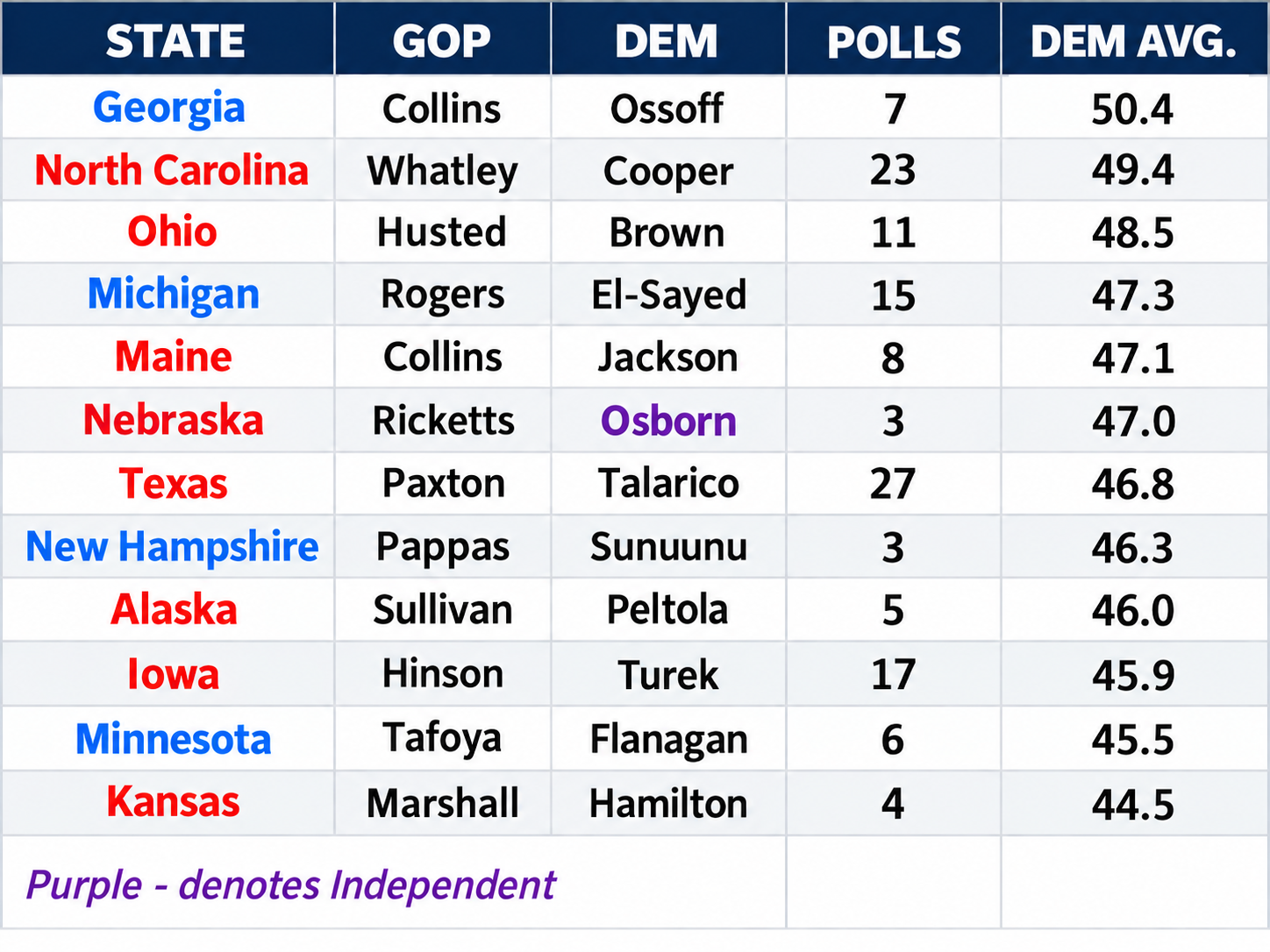
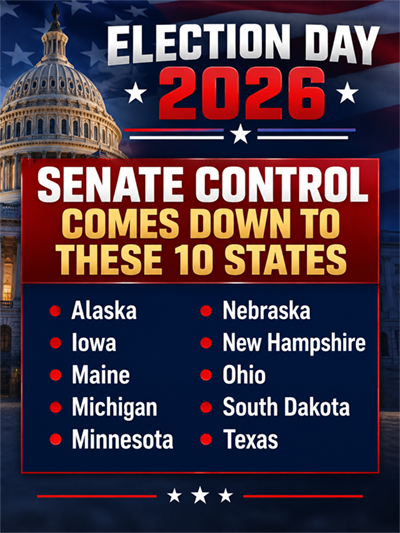
With the Democrats making offensive moves in the North Carolina, Maine, Texas, Ohio, and Alaska Senate races, Republicans need to expand their conversion opportunities beyond Michigan, New Hampshire, and Georgia. A competitive run from Tafoya in Minnesota could significantly boost their already strong chances of holding the Senate majority.

The Democrats would have to win four of their five top conversion opportunities to secure a bare Senate majority. They are attempting to expand their target list by adding Iowa, Nebraska, and Kansas to improve their chances. Conversely, Republicans even taking one Democratic seat away would more than likely seal their majority for another two years.

The initial Emerson College Minnesota poll suggests the state could soon ascend the national Republican Senate target list and become a race to watch.