Category Archives: Polling

Democratic Presidential Candidate Field Could Number 23 Very Shortly

By Jim Ellis

April 1, 2019
— Several presumed presidential candidates whose aspirations appeared dormant have suddenly sprung to life. In reading the current political tea leaves, and should the latest trends prove true, we could return to projections of a Democratic presidential field as large as 23 candidates.

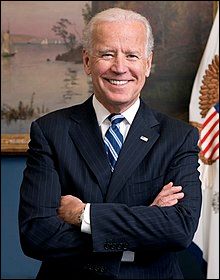
While it has been generally regarded as a given that former Vice President Joe Biden would enter the race next month, and all indications are that he will, as many as six others may also soon join according to individual published reports late last week.

Sen. Michael Bennet (D-CO), whose name surfaced months ago as an individual contemplating becoming a national candidate, all of a sudden says that he will likely do so. This, after seemingly weeks of not even being mentioned in the long list of aspiring candidates.

Ex-Virginia Gov. Terry McAuliffe, who looked to be gearing up early but hadn’t been heard from lately, also confirms that he is headed toward announcing his candidacy this month.

Montana Gov. Steve Bullock has brandished more overt signs of planning to run. Always admitting that he was considering becoming a candidate, Gov. Bullock has spent some time in Iowa conducting meetings and getting to know the political terrain. He has also firmly ruled out challenging Sen. Steve Daines (R-MT) and appears headed toward the national stage. Bullock is ineligible to seek a third term as governor, so these underlying signals seem more indicative that he will, in fact, run for president.
Continue reading

New CNN National Numbers Are Out

By Jim Ellis

March 22, 2019 — The CNN television network released their new national survey of the Democratic presidential contest (conducted by SSRS research company; March 14-17; 1,003 US adults, 456 self-identified Democrats and those Independents who lean to the Democratic Party, 448 self-identified Republicans and those Independents who lean to the Republican Party), and while the ballot test results were consistent with most other polling, some different and interesting questions were asked.

CNN compared this poll to their previous study conducted during the Dec. 6-9 period. The first four finishers remain in relatively the same order, but the percentages have shifted and some significantly.

In the current poll, former Vice President Joe Biden continues to lead the pack of 17 tested candidates. He tops the field with 28 percent, down from the 30 percent support he held in December. Sen. Bernie Sanders (I-VT) is second with 20 percent, making a big jump from the 14 percent base CNN found three months earlier.

Sen. Kamala Harris (D-CA) surpasses former US Rep. Beto O’Rourke (D-TX), and tripled her preference from December. Sen. Harris leaps from 4 to 12 percent support. For his part, O’Rourke drops to fourth but still gains two percentage points in comparison to December (rising from 9 to 11 percent). All of the others remain in single-digits, though Sen. Elizabeth Warren (D-MA) doubled her support from 3 to 6 percent.

Continue reading

Understanding Independent Voters

By Jim Ellis

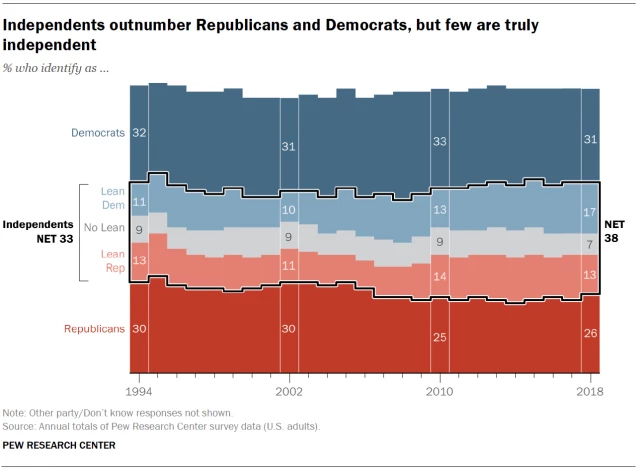
March 20, 2019 — In most elections, particularly in today’s polarized political climate, the independent vote is often the determining factor. As the non-affiliated share grows within the American electorate, these individuals become even more important.

But, who are the independents and how different are they from the average partisan Republican or Democrat? The Pew Research Center released a new study at the end of last week about the independent voter. Their data sources were a compilation of polls taken during the past few years, up to and including 2019.

The Pew conclusions are interesting in that the study basically reveals the lion’s share of independents align very closely with partisan Republicans and Democrats. Or, in other words, they generally vote with one party or the other, hold similar views and values as one of the major parties, but don’t want to associate themselves with the particular entity.

Based upon the sourced data, Pew denotes that approximately 38 percent of the electorate considers themselves to be independent. This compares with 31 percent who self-identify as Democrats and 26 percent who say they are Republican. Within the aggregate independent segment, 46 percent align with the Democrats while 35 percent identify with Republicans. Therefore, 19 percent of this group can be considered the true swing voter.

While those identifying more closely with the Republican Party are fewer, they have a higher voter turnout proclivity. According to the 2018 midterm election statistics, 54 percent of the Independent/Lean Republicans cast a ballot versus 48 percent of those generally identifying with the Democrats. The greater turnout figure for Republicans, even in a more Democratic year like 2018, suggest that the two parties are basically at parity within the independent voting sector.

Continue reading

With Brown Bowing Out,
Does That Mean Biden Will Begin?

By Jim Ellis

Ohio Sen. Sherrod Brown (D) – not running for president

March 11, 2019 — Ohio Sen. Sherrod Brown, another of the potential Democratic presidential candidates who most observers thought would enter the race, is not.

His announcement late last week was a bit surprising considering his home state with 136 first-ballot delegates and 153 overall (the seventh largest state delegation at the Democratic National Convention) moved the primary to March 10, partially with the idea of giving him a boost.

Sen. Brown’s decision provides us a clue as to what else may happen, however. He, like former New York City Mayor Michael Bloomberg, basically said the reason for not becoming a candidate is that the victory path is not evident. The underlying conclusion is they obviously believe former Vice President Joe Biden will enter the race.

Though all three men (Biden, Bloomberg, and Brown) certainly must be considered liberals on the ideological scale, they are not part of the far-left faction that Sens. Bernie Sanders, Kamala Harris, Elizabeth Warren, Cory Booker, and others are attempting to attract. Therefore, if the Bloomberg and Brown paths are blocked, then it is Biden who is their most formidable impediment.

If the former vice president and Delaware senator enters the race, and some say he will do so early next month, is he a lock for the nomination? Polling indicates he would jump to the top of the current heap but would be nowhere close to the majority of delegate votes required to win the nomination on the first convention ballot. In four late February national polls of likely Democratic primary voters, Biden tops them all but with preference percentages of 27, 30, 29, and 31 – hardly dominating numbers.

Continue reading

As Joe Goes, So Go the Democratic Presidential Contenders

By Jim Ellis

Former vice president and ex-Delaware senator Joe Biden: is he in or out of the 2020 presidential campaign?

Feb. 28, 2019 — A new national Morning Consult poll (Feb. 18-24; 15,642 registered US voters likely to vote in a Democratic primary via online questionnaire) finds former Vice President Joe Biden and Vermont Sen. Bernie Sanders pulling away from the rest of the Democratic presidential field.

Sen. Sanders is clearly getting a boost from his formal announcement. According to the Morning Consult regular tracking, he is up six points from just before he became an official candidate. It remains to be seen if his rise begins a trend or is just a polling blip because of increased media attention.

Overall, the MC data finds Biden’s national lead among the segmented Democratic voters dropping to just two points over Sen. Sanders, 29-27 percent. But, the pair are now well ahead of the remaining contenders. Sen. Kamala Harris (D-CA) drops a point in her own support, meaning she lost a net seven percent to Sanders from the last poll. Her new national total is 10 percent, three points ahead of both Sen. Elizabeth Warren (D-MA) and former US Rep. Beto O’Rourke (D-TX).

Continue reading

Tracking Trump’s Approval Ratings
Against Electoral College Results

2016 Electoral College Results map (270toWin)


By Jim Ellis

Feb. 26, 2019 — Already beginning to project where the states might fall in the 2020 presidential election, the Gallup organization released a 50-state survey tracking study Friday that summarizes their cumulative research collected throughout the past year.

Gallup finds President Trump slightly improving his standing over a similar project conducted from their aggregate 2017 data. Meanwhile, the Civiqs polling organization projects, as do all other pollsters, that Trump’s job approval remains upside-down. In the good news category for the president, however, the latter organization finds that he is viewed more positively than either of the national political parties.

Nationally, Trump carries a 44:52 percent job approval ratio according to the Civiqs poll of registered voters (polled continually from Oct. 12, 2015-Feb. 23, 2019; 181,729 responses during that multi-year tracking period). The Democratic Party, however, posts a lesser 39:52 percent rating, while the Republican Party lags behind both the president and their political party counterpart. The GOP registers a poor 26:60 percent index.

But these numbers are not particularly unusual because the same trend among the three polling subjects has been consistent for many months. The more telling conclusion is that the deviation factor among the approval ratings has remained constant for well over a year, suggesting that the electorate continues locked in a highly polarized and negative status.

Continue reading

Alabama Senate Race Begins

By Jim Ellis

Rep. Bradley Byrne, a Republican, formally announced his candidacy for the Senate.

Feb. 25, 2019 — One of the critical 2020 US Senate contests is beginning to take shape. Over the past few days, Alabama Rep. Bradley Byrne (R-Mobile) formally announced his statewide candidacy with the goal of opposing Democratic Sen. Doug Jones, who won the controversial 2017 special election that attracted national attention.

The Jones victory, defeating beleaguered Republican Roy Moore, a former state Supreme Court Chief Justice, represented the first time a Democrat won an Alabama statewide federal election since incumbent Sen. Howell Heflin secured his final term in 1990.

Prior to that, Richard Shelby, then a Democratic congressman, unseated Republican Sen. Jeremiah Denton in 1986. Shelby then switched to the Republican Party immediately after the 1994 election. Prior to the Denton victory on the same night that Ronald Reagan was first elected president, no Republican had won an Alabama seat for more than 100 years.

The Yellowhammer State Senate race could well be the lynchpin to determining which party will control the chamber after the 2020 election. With the electoral map favoring the Democrats because Republicans must defend 22 of the 34 in-cycle seats, including the Arizona special Senate election, Alabama becomes a virtual “must-win” for the GOP.

Continue reading