Category Archives: 2022

PA-Senate: Republicans in Trouble

Former US Ambassador to Denmark, Carla Sands — a Pennsylvania senate candidate to watch.

By Jim Ellis

Nov. 29, 2021 — The Keystone State of Pennsylvania, with an open Senate and governor’s race, will be a focal point of the 2022 election cycle, and last week the Republicans’ early problems grew worse.

The Pennsylvania GOP began this election cycle in a seemingly underdog position as they fought to hold the Senate seat from which two-term incumbent Pat Toomey (R) is retiring; now they are clearly playing from behind.

Iraq War veteran Sean Parnell (R) had former President Donald Trump’s endorsement and was leading the Republican primary in early polling. However, due to losing a child custody judgment rendered at the beginning of this week after a contentious trial in which his ex-wife had accused him of domestic abuse, Parnell withdrew from the Senate contest.

It’s a loss for his party, but Parnell wasn’t even the best of candidates. In his first bid for public office, running for the 17th Congressional District seat against Allegheny County area incumbent Conor Lamb (D-Pittsburgh), now himself a Senate candidate, Parnell came close but lost 51-49 percent. Based upon a close defeat in a winnable district, he decided to make a statewide Senate run.

Two other primary opponents, former lieutenant governor nominee Jeff Bartos and Army veteran, Trump campaign activist, and former congressional candidate Kathy Barnette, also lost their most recent political races. Therefore, the original three leading Republican candidates in either polling or fundraising hadn’t ever won a race and were falling well behind their Democratic counterparts.

The Democrats feature the overall early race leader, Lt. Gov. John Fetterman. He commands first position in primary and general election polling and has raised way more campaign capital than all of his opponents, over $9.2 million through the Sept. 30 financial disclosure period.

John Fetterman, however, isn’t without his own flaws. In 2013, when he was mayor of Braddock, a borough southeast of Pittsburgh in Allegheny County and located on the Monongahela River, Fetterman pulled a loaded weapon on an unarmed African-American jogger after hearing gunshots fired in his neighborhood. The Fetterman campaign has already produced a short video explaining the incident in anticipation of this becoming an issue in his 2022 statewide effort.

Rep. Lamb is running second to Lt. Gov. Fetterman in polling and dollars raised, almost $7 million behind his chief Democratic rival. The latest poll, from the Civiqs organization (Oct. 31-Nov. 1; 929 likely Pennsylvania Democratic primary voters, online) found Fetterman way ahead of Rep. Lamb, 52-12 percent, with other announced and possible candidates, state Rep. Malcolm Kenyatta (D-Philadelphia), Montgomery County Commissioner Val Arkoosh, and potential contender Sharif Street, a state senator and son of former Philadelphia Mayor John Street, all polling at five percent or less.

Continue reading

Welch In; Johnson Out; McBath Switches Districts in Georgia


NOTE: Ellis Insight will be taking a break starting tomorrow through the weekend. We’ll return on Monday, Nov. 29. Happy Thanksgiving to all!


By Jim Ellis

Nov. 24, 2021 — Vermont Congressman Peter Welch announces his Senate candidacy, two-term Georgia Rep. Lucy McBath announces a switch from her GA-6 district to GA-7 as a result of redistricting, and 85-year-old veteran Rep. Eddie Bernice Johnson announces her retirement. Details below:

Vermont Senate

As expected, Vermont at-large Congressman Peter Welch (D-Norwich) announced his US Senate candidacy this week and becomes the prohibitive favorite to succeed retiring Sen. Patrick Leahy (D). With Welch representing the same statewide constituency as a senator, the move to the chamber of the states should be seamless.

It does not appear that Welch will have major opposition. At this point, Sanders for President campaign activist Niki Thran, a physician, is the only announced Democratic candidate. The more serious potential contenders are likely to opt for the now open at-large House seat.

Rep. Welch was first elected to the US House in 2006, and has cruised to re-election ever since. He was originally elected to the state Senate in 1980, and served 10 years. He became the Senate Democratic Leader for one two-year term.

In 1988, Welch ran for the US House, but lost the Democratic primary. He returned in the governor’s race two years later, this time winning the Democratic nomination but losing the general election. He would return to the state Senate in 2001 when then-Gov. Howard Dean (D) appointed him to fill a vacancy. He was then elected as a member of the Vermont legislative body in 2002, and became the Senate’s President Pro Tempore, a position he held until winning his first US House race.

GA-6

In a surprising response to the Georgia state House voting in favor of the new congressional redistricting map, two-term Rep. Lucy McBath (D-Marietta) announced, even before Gov. Brian Kemp (R) approves the final legislation, that she will depart her current 6th District since its new constituency trends strongly Republican.

Instead, she will challenge freshman Rep. Carolyn Bourdeaux (D-Suwanee) in adjacent District 7 in next year’s Democratic primary. McBath will run to the left of her new opponent, who she will attempt to paint as being too conservative before the primary electorate.

Continue reading

North Carolina Rep. G.K. Butterfield’s Retirement Leaves a Competitive 2nd

North Carolina Rep. G.K. Butterfield (D-Wilson)

By Jim Ellis

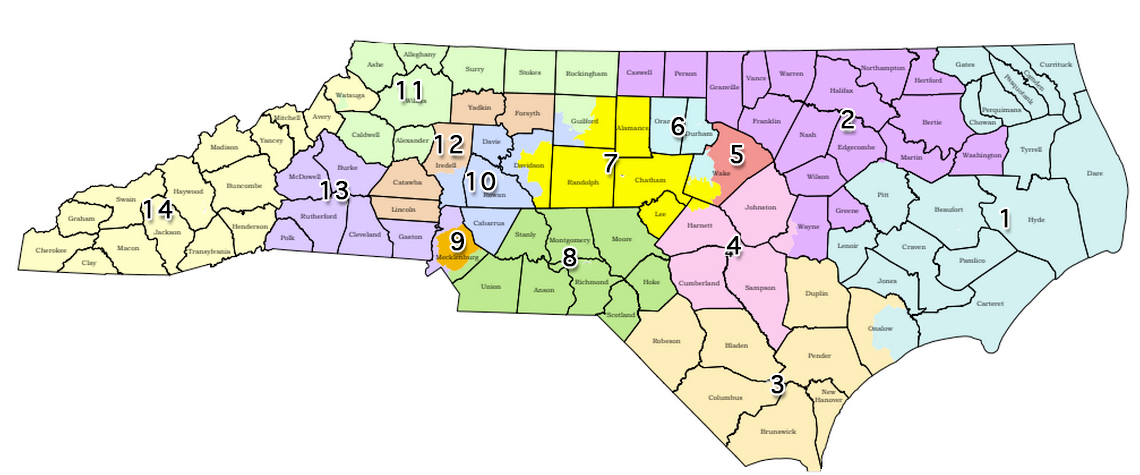
Nov. 22, 2021 — As was suggested earlier in the week, 10-term North Carolina Rep. G.K. Butterfield (D-Wilson) announced late last week that he will not seek re-election next year. He leaves a new 2nd District – his seat had been numbered NC-1 throughout his career – that will be more competitive in 2022.

Rep. Butterfield attacked the Republican-passed redistricting plan as a gerrymander on his way out and says the draw hurts African Americans in his district. He says that largely because an African American section of Pitt County was removed from the district, along with a small conservative county, and replaced with three larger and decidedly more Republican localities along the Virginia border.

North Carolina gained a seat in reapportionment, but the Butterfield seat was the only current Tar Heel State CD that needed to gain residents. The current 1st District was 58,205 individuals short of the state’s new population quota of 745,671 individuals per CD, so the map drawers had no choice but to add people. Virtually all of the surrounding counties are Republican.

The new 2nd District is certainly more competitive. While President Biden carried the current 1st District with a 54-45 percent margin, on par with Hillary Clinton’s 55-44 percent spread in 2016, the new 2nd District would have given Biden only a 51-48 percent vote split.

Though the new 2nd will be more competitive, the current 1st District was beginning to show signs of political change. This somewhat dispels Rep. Butterfield’s gerrymandering argument. While the previous eight elections delivered an average vote of 72.6 percent for Butterfield, his 2020 victory margin dropped to 54-46 percent opposite accountant and political activist Sandy Smith (R).

Though the state Supreme Court changed the North Carolina map for the 2020 election and basically awarded the Democrats two of the Republicans’ seats, the 1st was left largely unchanged. This suggests that the electorate could be transforming naturally, thus alternative reasons exist for the district becoming more conservative than simply altering the district lines.

We can expect to see competitive primaries in both parties, and things will quickly unfold now that the seat is open. Prior to the retirement announcement, Henderson City Councilman Jason Spriggs had announced a Democratic primary challenge to Rep. Butterfield but he was not rated as a serious challenge to the congressman.

Continue reading

California Rep. Jackie Speier to Retire

California Rep. Jackie Speier (D-Hillsborough/San Mateo)

By Jim Ellis

Nov. 18, 2021 — The second congressional retirement of the week was announced Tuesday as veteran California Rep. Jackie Speier (D-Hillsborough/San Mateo), following Vermont Sen. Patrick Leahy’s similar statement Monday, said in a video to her constituents that she will not seek an eighth full term in the House next year.

Speier has a long career in politics that began well before her first election to the San Mateo County Board of Supervisors in 1980. Two years prior, Speier, as a staff member for then-US Rep. Leo Ryan (D-CA), was shot five times on a remote airport runway in Guyana exactly 43 years ago today during the infamous Jim Jones mass murder-suicides of his so-called religious followers. (See this brief article as Speier recounted that day at a National Archives lecture.)

A total of 918 people died during the mass killing, including Rep. Ryan who was on a mission to investigate reports of criminal activity in the commune. Jones had run what was described as a church in the congressman’s district and most of his followers were from the northern California region. Speier, left for dead after being attacked and shot, lay for a reported 22 hours before being rescued and treated.

She obviously recovered from her wounds and was successful in her first run for public office. Six years later, she won a state Assembly seat, and then captured the area state Senate seat before winning a special election to the US House in 2008 after then-Rep. Tom Lantos (D-CA) passed away.

The 14th District contains over 85 percent of San Mateo County, and a portion of south San Francisco, adjacent to Speaker Nancy Pelosi’s 12th District. The seat is safely Democratic, voting in a 78-21 percent clip for President Biden in 2020, and a similar 77-18 percent spread for Hillary Clinton in 2016.

Continue reading

The “Fail Up” Senate Candidates

By Jim Ellis

Nov. 16, 2021 — There is an interesting phenomenon developing in the 2022 US Senate races, and that is the number of currently leading primary nomination candidates who have lost their last race. No less than five current US Senate contenders, all topping the latest polling, were defeated the last time they were on the ballot, some even in political campaigns for offices with less prominence.

In recent election years, we’ve seen a number of candidates lose a race and then attempt to “fail up” in the next campaign year. Most of the time, the same result occurs. The seemingly lone exception to the rule is Georgia Sen. Jon Ossoff (D), who lost a special election for the US House in 2017 only to run for the Senate in 2020 and be elected.

Turning to 2022 and the unusually high number of such “fail up” candidates allows us to see if this pattern can reverse itself, or if the vast majority of these contenders will again find themselves on the short end of the vote totals when their election cycle ends either in the nomination contest or general election.

The 2022 “fail up” Senate candidates are Abby Finkenauer (D) in Iowa, Adam Laxalt (R) from Nevada, Pat McCrory (R) and Cheri Beasley (D) in North Carolina, and Pennsylvania’s Sean Parnell (R). Dr. Al Gross, who lost the 2020 Senate race in Alaska is a possibility to enter the 2022 race in the Last Frontier, but so far has not announced his candidacy.

Finkenauer, a Democrat, is a former state representative and congresswoman from Dubuque, Iowa. She was elected to the House in 2018, only to lose her seat after one term, 50-47 percent, to current US Rep. Ashley Hinson (R-Marion/Cedar Rapids).

Finkenauer is leading in early polling for the Senate Democratic nomination as she and retired Navy admiral and defeated 2020 US Senate candidate Mike Franken battle to challenge venerable Sen. Chuck Grassley (R) who has won seven US Senate elections. Early polling finds Finkenauer trailing by close to 20 points.

Laxalt was elected Nevada’s attorney general in 2014, but with only 46 percent of the vote in a place where his party swept all of the statewide offices in that election year with his being the lowest victory percentage. Laxalt then entered the open 2018 governor’s race but lost to current incumbent Steve Sisolak (D), 49-45 percent. The latest polling (September) finds him trailing Sen. Catherine Cortez Masto (D) by five points in a Mellman Group survey but holding a two-point lead in a study from WPA Intelligence.

North Carolina actually features candidates in both parties leading in nomination polling after losing their last race. McCrory is the former governor who lost his 2016 re-election campaign, even while Donald Trump and seven other Republicans were winning their statewide elections.

Continue reading

North Carolina’s Rep. Cawthorn Switching Districts in 2022

By Jim Ellis

Nov. 15, 2021 — With the newly enacted North Carolina congressional map being vetted and analyzed, candidates for the various districts are beginning to come forth. One surprising move is the decision from freshman Rep. Madison Cawthorn (R-Hendersonville) to run in new District 13 instead of where his home and the majority of his current constituents reside, in new District 14.

Rep. Madison Cawthorn

Cawthorn, at at the age of 26, is the youngest member of Congress; he was elected to represent the 11th District in 2020, succeeding Mark Meadows, the former Trump chief of staff who left the US House to enter the White House. The 11th has traditionally been the number for the district that sits in the Tar Heel State’s far western corner, anchored in Asheville and nestled among the Virginia, Tennessee, Georgia, and South Carolina borders, but the newly enacted congressional map changes its number to 14.

Though the seat in its present configuration has become strongly Republican, that was not always the case. Throughout the 1980’s the district became one of the most politically marginal CDs in the country. During that entire decade, the 11th switched repeatedly back and forth between Democrat James Clarke and Republican Billy Hendon.

Once businessman and former state legislator Charles Taylor defeated Rep. Clarke in 1990, he was able to hold the district for eight consecutive terms until losing in 2006 to Democrat Heath Shuler, the former star University of Tennessee quarterback and NFL player. Shuler represented the district for three terms before retiring, leading to Meadows winning the first of his four elections. Rep. Cawthorn then recorded a 55-42 percent win in 2020 to keep the seat in the Republican column.

The new iteration of the westernmost North Carolina district returns to a more politically marginal status with a statistical history producing Republican victories in the low 50s rather than the high 50s. The adjacent new open 13th District, which annexes the western part of the Charlotte metropolitan area and moves to the Buncombe County line, becomes the region’s new safe Republican seat.

Continue reading

Sununu Won’t Take Senate Plunge

New Hampshire Gov. Chris Sununu (R) will not run for the Senate.

By Jim Ellis

Nov. 11, 2021 — New Hampshire Gov. Chris Sununu (R) held a long awaited news conference this week to announce his political plans for 2022. The governor had been the Republicans’ top recruitment prospect to challenge vulnerable Democratic Sen. Maggie Hassan, but the three-term state chief executive has chosen to eschew a tough Senate challenge and will instead run for a fourth gubernatorial term.

Though Sununu, like his father before him, has been elected three times as governor, he is still only in his fifth year of service. New Hampshire and Vermont are the only states that have two-year gubernatorial terms. In fact, for a 146-year period, no one had served more than one term as the state’s top office holder. The only governor in New Hampshire history to serve four terms is Democrat John Lynch, who was in office from 2005-2013.

Gov. Sununu’s decision certainly changes the New Hampshire political landscape and will cause potential candidates to begin assessing their chances both in a Senate race against Hassan and as a gubernatorial contender opposite Sununu. Attention now may turn to two-term US Rep. Chris Pappas (D-Manchester).

The Republicans, with trifecta control of the New Hampshire political system in that they hold the governor’s office and have majorities in both houses of the legislature, are looking to change the marginal 1st Congressional District, the seat that has defeated more incumbents than any CD in the country since 2004, into a Republican domain. Doing so would concede the politically marginal 2nd District to incumbent Democratic Rep. Annie Kuster (D-Hopkinton/Concord).

Pappas, aware that a significant change in his district could make him an underdog for re-election, was likely headed into an open governor’s race if Sununu decided to run for Senate. Now that he would have to take on a popular incumbent, his next political move may be less clear.

Turning back to the Senate picture, incumbent Hassan still remains as the most vulnerable Democrat seeking re-election in 2022; so where do Republicans go now? Looking at the crowded 1st District race, two contenders stand out as potential statewide candidates.

Gail Huff Brown, a long time New England television news reporter, is the wife of former Massachusetts Sen. Scott Brown, and she has already announced her congressional candidacy. Former Sen. Brown, himself, would also be a possibility since he has already run for the Senate once in New Hampshire. Matt Mowers is the 2020 1st District nominee who held Rep. Pappas to a 51-46 percent re-election victory. He, too, is an announced congressional candidate but it appears possible that at least one of the aforementioned could instead enter the Senate race.

Continue reading

Rep. Beutler Trailing in New Poll

Six-term Washington Rep. Jaime Herrera Beutler (R-Battle Ground/Vancouver)

By Jim Ellis

Nov. 9, 2021 — Another of the House Republican Trump impeachment supporters appears to be having trouble back home. A new Trafalgar Group poll (Oct. 30-Nov. 2; 682 likely WA-3 primary voters; combination live interview, interactive voice response system, and text) finds six-term Washington Rep. Jaime Herrera Beutler (R-Battle Ground/Vancouver) placing third in a field of four as a prelude to next year’s jungle primary.

According to Trafalgar, former Green Beret Joe Kent (R), who has former President Trump’s endorsement, leads the candidate field with 35 percent preference. Next is Democrat Brian Hennrich, a movie theatre technician, who records 24 percent. For this poll, Hennrich realistically serves as a placebo candidate to test Democratic support. Rep. Beutler then places third with 23 percent and another Republican, pastor and author Heidi St. John, posts 10 percent support. An additional eight percent said they would vote for “another Democrat.”

Surveys such as this will likely spur the Democrats to recruit a much stronger candidate in what plays as a marginal southwestern Evergreen State congressional district.

Washington is one of three states that employs a top-two jungle primary system. All candidates are placed on the same ballot and the top two finishers, regardless of percentage or party, advance into the general election. Therefore, this poll would suggest that Rep. Beutler, at least today, could be eliminated before the general election cycle even officially begins. Washington has a late primary, Aug. 2, 2022, so plenty of time remains for the congresswoman to right her political ship.

The Washington districts won’t likely change a great deal in redistricting. Washington redistricts by commission, and has since 1991. Because none of the state’s 10 districts need a major population influx, it is probable that most of the seats, and especially District 3 (largely because it must only shed 2,222 individuals) will remain relatively constant.

The 3rd District is nestled into the southwestern corner of the state, bordering Oregon and the Pacific Ocean. The seat needing to gain the most people is Rep. Derek Kilmer’s (D-Gig Harbor) 6th District, but the 33,730 residents it requires is still a relatively small number in comparison to some other states.

Currently, the Beutler district votes as a marginal Republican seat. Former President Trump carried WA-3 in 2020 with a 51-47 percent margin after posting a 50-42 percent showing against Hillary Clinton in 2016. Rep. Beutler, in what was billed as a competitive race at the beginning of the 2020 election cycle, scored a 56-43 percent re-election victory. She has averaged 57.6 percent of the vote in her six successful congressional elections.

Fundraising so far has been significant. The September 30 FEC reports find Rep. Beutler already raising $1.73 million for the cycle with $1.38 million cash-on-hand. Kent has also done well, especially for a challenger, raising $1.09 million with $837,000 in the bank. St. John (R) has also raised a respectable $334,000, and held just over $213,000 in her campaign account at the reporting period’s end.

Continue reading

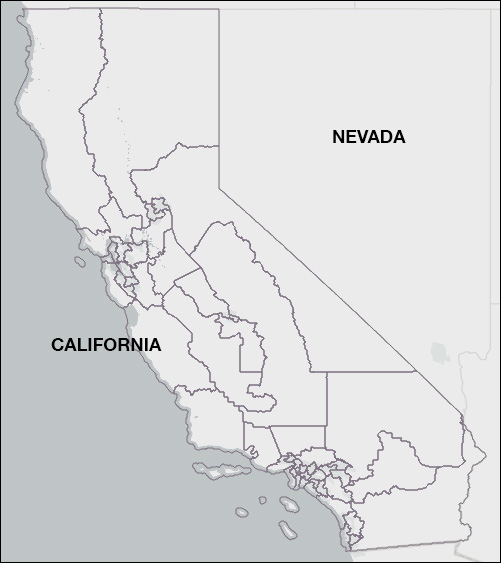
First California Map Released

The California Citizens Redistricting Commission released its first congressional redistricting map in rudimentary form, not even including district numbers.

By Jim Ellis

Oct. 29, 2021 — The California Citizens Redistricting Commission released its first congressional map, and, while a long way from completion, the first edition gives us an idea as to where the members are headed. Though the map was released for public comment, it is rudimentary in form, not even including district numbers.

Since California loses a seat in reapportionment, the mystery of which area and political party will absorb the seat loss appears to be answered. Using raw numbers, because all 18 congressional districts that are self-contained within or partially occupy Los Angeles County need more residents, the seat loss should come there.

Such is the case with this first commission map, and it is the district that Rep. Karen Bass (D-Los Angeles) is vacating to run for mayor. Most of the current Bass district is collapsed into Rep. Maxine Waters’ (D-Los Angeles) seat under this first plan. If this were the final draw, Democrats would sustain the seat loss.

Dave Wasserman of the Cook Political Report released a partial analysis of the map, and finds that each party would benefit in an equivalent number of seats. Using the Biden-Trump ’20 numbers, the incumbents getting the worst draws appear to be Reps. Darrell Issa (R-San Diego), Devin Nunes (R-Tulare), and Josh Harder (D-Turlock/Modesto).

The Issa seat in San Diego appears to annex the Democratic city of Chula Vista before expanding all the way to Arizona through Imperial and Riverside Counties. It would move from a Trump plus-6 to a Biden plus-3 according to the Wasserman analysis. The Issa district was radically changed even though the current version required only 3,240 more people to meet the state population quota of 760,350 residents per congressional district.

Rep. Nunes’ Central Valley district would move from a Trump plus-5 seat to a Biden plus-3 but still maintain most of the congressman’s political base. Rep. Nunes’ current 22nd District is one of 18 CDs that are over-populated, the sixth highest in fact, having to shed 27,443 individuals. Clearly, most of the exiting individuals are from Republican areas.

Continue reading

Is the McCrory Lead a Mirage
In North Carolina Senate Race?

By Jim Ellis

Former North Carolina Gov. Pat McCrory

Oct. 28, 2021 — Former North Carolina Gov. Pat McCrory’s campaign did something rather strange this week.

They released their internal Pubic Opinion Strategies poll, which in and of itself is not unusual, and extolled how well McCrory was running, but they did not publish the ballot test numbers in the polling synopsis. Why? Because the figures aren’t as good as meets the eye.

Once found, the ballot test shows McCrory leading Rep. Ted Budd (R-Advance), 40-25 percent, a 15-point edge, which was truthfully cast as a double-digit lead. The underlying story, however, is that the ballot test actually represents a net gain of 20 percentage points for Budd.

In April, POS released their first public poll of the GOP primary and it showed McCrory leading Rep. Budd, 48-13 percent. Comparing the latest 40-25 percent result shows some sustained momentum for Rep. Budd in that McCrory’s support has dropped eight points while his own climbed a dozen.

A third candidate, former Rep. Mark Walker, only registered eight percent in this poll, but it is possible that he will not even file for the Senate at the Dec. 17 deadline. If the legislature moves forward with a version of the redistricting plan that puts the Greensboro area seat back in play for Republicans – a court decision robbed Walker of the House seat he held for three terms with their ruling changing the state’s congressional map before the 2020 election – it is quite possible that Walker would have the option of returning to a winnable House contest.

If Walker were to abandon the Senate race, it would be another plus for Rep. Budd. It is likely that more Walker voters will gravitate toward Budd than McCrory since they clearly are familiar with the former governor but chose not to back him in the three-way contest.

Pat McCrory was elected governor in 2012, but lost to then-Attorney General Roy Cooper (D) on the same night that Donald Trump claimed North Carolina against Hillary Clinton. In fact, Republicans won eight of 12 statewide elections that evening, with McCrory being the only GOP incumbent to fall.

Continue reading