Tag Archives: Texas

How Texas Changes

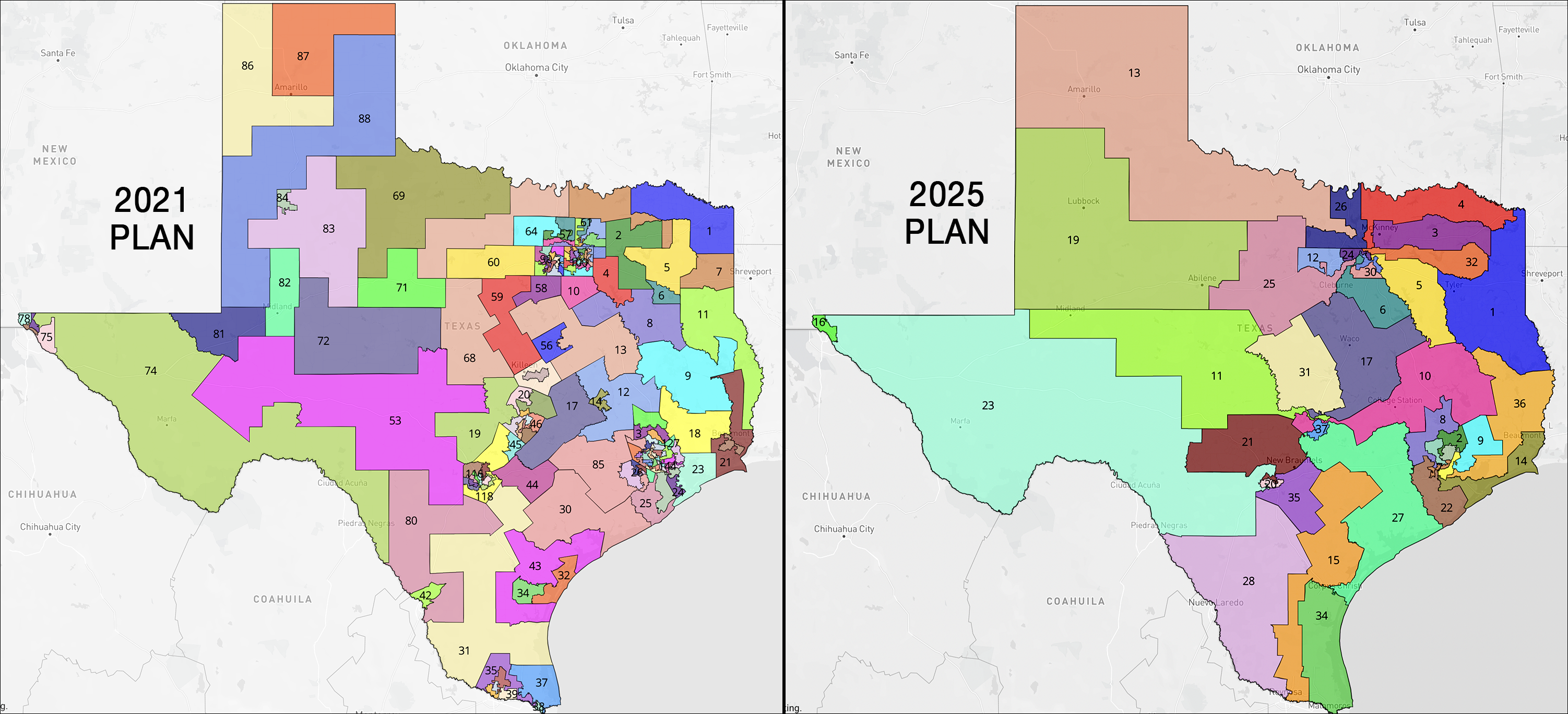
To see larger image, click on above map. To see interactive maps, go to Dave’s Redistricting App: Texas 2021 Plan | Texas 2025 Plan

By Jim Ellis — Thursday, Nov. 20, 2025

Redistricting

The El Paso three-judge panel ruling that invalidates the new Texas map, if allowed to stand, will greatly disrupt the Lone Star State political cycle as candidates currently prepare for an early March 3, 2026, primary election.

In reverting to the 2021 map, 37 of the state’s 38 congressional districts will change, thus altering virtually all the candidates campaign strategies and geographic targets.

Only District 19, now the open seat of retiring Rep. Jodey Arrington (R-Lubbock), remained constant between the two maps. A total of 26 districts experience only minor changes, while 11 see major alterations.

Under the 2025 Texas plan, nine seats are open, but returning to the 2021 map will likely mean that number drops to seven. It is also probable that one member who announced his retirement under the 2025 map, Rep. Lloyd Doggett (D-Austin), will return to run again if the 2021 map is formally reinstated.

In the invalidated plan, Reps. Doggett and Greg Casar (D-Austin) were paired in a new 37th District, while Rep. Casar’s 35th CD was created as an open seat that stretched into rural counties east of San Antonio. If the 2021 plan is in place for next year’s election, both will have back their previous districts. Doggett said earlier that he would return to seek re-election if the 2025 map was tossed and the previous plan restored.

In the ’25 draw, a new 9th District was created in eastern Harris County. Should the three-judge panel’s ruling be upheld, this district will go away and the candidates seeking this seat will have no place to run.

Should the previous 9th District return, Rep. Al Green (D-Houston) would again seek re-election in this district and would not be paired in a new 18th CD with the winner of the Jan. 31 special runoff election to fill the vacancy created when Rep. Sylvester Turner (D) passed away.

Rep. Michael McCaul’s (R-Austin) 10th District would still be an open seat, and though the territory is different from the invalidated map, the candidate pool would likely remain the same. This is similar to the situation in the 8th and 21st Districts where Rep. Morgan Luttrell (R-Magnolia) is retiring, and four-term incumbent Chip Roy (R-Austin) passed on re-election to run for state Attorney General.

Turning to South Texas, Rep. Monica de la Cruz (R-McAllen) will naturally see a return to her original 15th District configuration. The new 15th would have given her more Republican voters. Still, she should again be able to win re-election in the 2021 version.

Rep. Henry Cuellar (D-Laredo) saw some of the territory that gave him the most trouble go away under the new version of District 28. Rep. Cuellar had two close calls in the Democratic primary largely because of the San Antonio region. The 2025 map moved this district further into South Texas. If the previous districts are reinstated, he may again draw a more combative Democratic primary opponent, while still facing a competitive general election.

One of the districts most affected in South Texas was Rep. Vicente Gonzalez’s (D-McAllen) 34th CD anchored in Brownsville. The Congressman would have been in serious trouble under the new plan, but the 2021 version returns his much stronger Democratic base. Still, his victory margin in 2024 was only 51-49 percent over former Congresswoman Mayra Flores (R), and he can expect to face her again. She would have been favored in the new district, but Rep. Gonzalez returns to having the stronger political position under the 2021 map.

The Dallas area was changed greatly under the 2025 plan. The two members most affected were Reps. Marc Veasey (D-Ft. Worth) and Julie Johnson (D-Farmers Branch). Under the new plan, all of Rep. Veasey’s home Tarrant County turf was moved into different districts, leaving his 33rd CD as a self-contained seat within Dallas County.

Under the new plan, Veasey was looking to leave the House to run for Tarrant County Judge (Executive). If the previous map returns, it is possible that he will seek re-election.

Rep. Johnson, who saw her 32nd District moved largely into Republican East Texas, would return to the previous district under the 2021 plan. She was looking to move into Rep. Veasey’s vacated 33rd District if the new map were in place.

Republicans had calculated a gain of five seats under the new map, though some of the predictions might have been overly optimistic, such as, beating Rep. Cuellar in his new 28th CD and securing the open 35th CD.

If the three-judge panel’s decision holds, it is probable that we will see no Republican gain under the 2021 map thus making the chances of retaining their slim majority even more precarious.

Texas Redistricting Map Tossed

(Click on map to see full-size detail.)

By Jim Ellis — Wednesday, Nov. 19, 2025

Redistricting

The already complicated 2025 national redistricting scene is now even more complex.

Yesterday, in a 2-1 ruling, a three-judge federal panel in El Paso ruled that the new Texas map is a racial gerrymander and therefore voided. The panel majority ordered the previous 2021 map reinstated.

Critics say the ruling is questionable since no racial data was used in drawing the map and the decision knowingly defines the US Department of Justice officials’ intent. The 160-page ruling document also quotes liberal news sources to provide support for its supposition that Republican legislators en masse were opposed to a redraw until DOJ added a racial component regarding coalition districts, meaning those where a compilation of all minority groups create a non-white majority.

The state of Texas is expected to appeal the ruling. All appeals of three-judge panel decisions go directly to the US Supreme Court, and the justices must respond.
The ruling also creates a further potential conflicting situation when considering that the Justice Department filed a racial gerrymandering complaint against the new California map on Nov. 13. A California three-judge federal panel will be formed to hear that case.

Things will change to an even greater extent if, which is likely, a 9th Circuit three-judge panel rules that the California map is not a racial gerrymander. If so, then expect the Justice Department to appeal such a ruling, meaning the Supreme Court will be dealing with conflicting decisions within a similar issue set.

Because the Texas political calendar features an early March 3 primary, and candidate filing concludes on Dec. 8, a great deal of confusion now reigns for the candidates running in the various 38 districts. Only District 19, now the open seat of retiring Rep. Jodey Arrington (R-Lubbock), remained constant in the two maps. Under the 2025 Texas plan, nine seats are open and some of the districts are radically different from the 2021 map.

If the Supreme Court issues the requested stay, possibly because the Texas case arguments could be affected with the high court’s eventual ruling on the Louisiana racial gerrymandering case, the 2025 map would likely return for the 2026 election cycle.

Considering the chaos surrounding the Lone Star State case, what the California decision could be, and the subsequent US Supreme Court action on the coming stay motion, along with the ultimate Louisiana ruling, it is possible that Texas could postpone the state primary.

There has been precedent for postponing a primary for a set of affected political contests, in this case the congressional campaigns because of redistricting. Doing so would give the high court more time to render a final decision that hopefully would be definitive as it relates to racial gerrymandering.

Louisiana, awaiting their SCOTUS redistricting decision after going through a second round of oral arguments, has already postponed their primary one month — from April 18 to May 16.

To further complicate matters, Gov. Greg Abbott has now ordered the special runoff election to fill Houston’s 18th District congressional vacancy to be held on Jan. 31, 2026.

The runoff features a contest between Harris County Attorney Christian Menefee (D) and former City Councilwoman Amanda Edwards (D), both of whom qualified for the secondary election in the Nov. 4 initial vote.

Immediately upon winning the special election, the victor will face Rep. Al Green (D-Houston) in the regular 2026 primary election on March 3. Now with the confusion about where the candidates must file, the District 18 special election could be one more reason the Texas regular primary might be postponed. TX-18 is vacant because incumbent Rep. Sylvester Turner (D) passed away earlier in the year.

With such a short time frame affecting so many Texas congressional candidates and electorates, firm decisions must soon be made.

NJ Rep. Coleman to Retire; Rogers Up in Michigan; Allred Down in Texas

By Jim Ellis — Tuesday, Nov. 11, 2025

A congressional retirement announcement from New Jersey, ex-US Rep. Mike Rogers (R) taking the lead in a new Michigan Senate general election poll, and a Texas Senate survey that finds 2024 US Senate nominee and ex-Congressman Colin Allred again trailing in the Democratic primary, are outlined in this round up. These are the top political stories coming from the early part of the Veterans Day weekend. Also, overnight, Republican House Budget Committee Chairman Jodey Arrington (TX-19) announced that he will not seek re-election in 2026. Arrington has served for nearly a decade in the US House. More on his retirement in an upcoming post.

NJ-12

New Jersey Rep. Rep. Bonnie Watson Coleman (NJ-12)

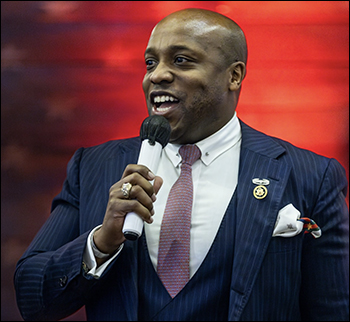
Yesterday, saying “it’s time to pass the torch,” six-term Rep. Bonnie Watson Coleman (D-Ewing Township/Trenton), 80, announced that she will not seek re-election next year.

Prior to her election to the US House in 2014, she served 17 years in the New Jersey General Assembly, four years as Majority Leader. From 2002-06, Watson Coleman chaired the New Jersey Democratic Party.

The Garden State’s 12th District, which includes the capital city of Trenton, Princeton University; and North, East, and South Brunswick; is reliably Democratic. The Dave’s Redistricting App statisticians calculate a 56.5D – 43.5R partisan lean.

The central New Jersey district was at one time a Republican domain but redistricting and a change in voting patterns have yielded Democratic representation since the beginning of 1999. Therefore, Rep. Watson Coleman’s successor will almost assuredly come from winning what promises to be a hotly contested Democratic primary.

The Watson Coleman retirement means 39 seats will be open in 2026, not counting the CDs headed to special elections in Tennessee and Texas, along with New Jersey’s 11th District seat when Gov-Elect Mikie Sherrill (D) resigns from the House.

From the group of 2026 open seat members, Rep. Watson Coleman becomes the 15th Democrat not to seek re-election and the 11th to retire from politics. The other 28 are seeking a different office or moving to a congressional district other than the one they currently represent.

Michigan Senate

The Rosetta Stone polling organization released the results of an independent poll that finds Republican former Rep. Mike Rogers polling ahead of all three Democratic US Senate contenders.

Rogers, who served seven terms in the House before retiring, returned to enter elective politics with his run for the Senate in 2024. In an open-seat battle with then-Rep. Elissa Slotkin (D), Rogers came within 19,006 votes from just under 5.6 million votes cast of winning the race, a percentage margin of 48.6 – 48.3.

The Rosetta Stone poll, released over the weekend, (Oct. 23-25; 637 likely Michigan general election voters) finds Rogers, who is virtually unopposed for the Republican nomination, ahead beyond the polling margin of error individually against each of the Democrats: Rep. Haley Stevens (D-Birmingham), state Sen. Mallory McMorrow (D-Royal Oak), and former Wayne County Health Director Abdul El-Sayed.

Opposite Rep. Stevens, Rogers leads 47-40 percent. If Sen. McMorrow was his opponent, the Rogers edge would be a similar 46-39 percent. The Rogers’ advantage grows if El-Sayed becomes his general election opponent. Under this scenario, the former Congressman posts a 45-31 percent margin.

Other polls have shown this race much closer, but this is the first publicly released statewide poll since June.

Rosetta Stone tested the Democratic Senate primary, but the sample size of only 287 likely Democratic primary voters indicates the results should be considered statistically insignificant in a state the size of Michigan.

Texas Senate

New polling in the Texas Senate Democratic primary again shows trouble for 2024 Senate nominee Colin Allred.

The Impact Research survey conducted for the James Talarico Senate campaign (Oct. 23-29; 836 likely Texas Democratic primary voters; live interview & text) finds state Rep. Talarico taking a 48-42 percent lead over Allred.

In a late September survey from the University of Houston and Texas Southern University, the academic pollsters found Allred lagging in last place if the Democratic field consisted of he, Rep. Jasmine Crockett (D-Dallas), former El Paso Rep. and statewide candidate Beto O’Rourke, and state Rep. Talarico. For her part, Rep. Crockett says she is considering the Senate race. Crockett has led several Democratic statewide polls.

It has been known for some time that the Republican Senate primary would be a hard-fought contest between four-term incumbent Sen. John Cornyn, Attorney General Ken Paxton, and recently entered Rep. Wesley Hunt (R-Houston). Now, however, analyzing the available polling data leads to the conclusion that the Democratic primary appears just as competitive as the Republican contest.

Competitive Senate Finance – Part II

By Jim Ellis — Wednesday, Oct. 22, 2025

Senate

Continuing from yesterday’s update, the Federal Election Commission has released new Senate campaign finance numbers, which help us preview the resource standing of the key 2026 US Senate contests. Today’s installment covers the most competitive contests from Massachusetts through Texas.

Massachusetts

Just in the past week we see a Democratic primary emerging between Bay State Sen. Ed Markey and Rep. Seth Moulton (D-Salem). Both men have equivalent cash reserves ($2.7M for Markey; Moulton: $2.1M) but it is clear that Sen. Markey begins as the favorite.

Rep. Moulton will try to make the incumbent’s age (Markey will be 80 years old at the time of the next election) an issue, but it is unlikely that such an attack will dissuade a majority of Democrats from voting for the veteran politician who first came to Congress in 1976.

This primary challenge is a very long shot but the Massachusetts primary cycle is lengthy, and much can change. The nomination election is not scheduled until Sept. 1, 2026.

Michigan

The open Michigan Senate race will be one of the top national contests next year. Republicans have successfully given former US Representative and 2024 US Senate nominee Mike Rogers a clear path to the nomination which helps solve one of their key past problem areas: fundraising. The fact that Rogers does not have to spend much to secure the nomination means virtually all fundraising assets will be directly applied to the general election. At this point, Rogers holds $2.7 million in his campaign account.

The Democrats, on the other hand, are embroiled in a tough primary that won’t be decided until Aug. 4. The three major candidates have equivalent resources. Rep. Haley Stevens (D-Birmingham) holds $2.6 million, state Sen. Mallory McMorrow (D-Royal Oak) reports $1.4 million cash-on-hand, and former Wayne County Health Director Abdul El-Sayed has also proven himself a strong fundraiser. His campaign account reports $1.8 in available resources.

The Democratic primary is a toss-up at this point. Expect a tough campaign before a nominee is crowned and financial resources will be exhausted. Democrats are adept fundraisers, however, so the winner’s campaign treasury will be quickly replenished after the party unites post-primary.

Minnesota

The Land of 10,000 Lakes also features a competitive Democratic Senate primary. In this case, the candidates are vying to replace the retiring Sen. Tina Smith (D). Today, it appears the nomination contest is evolving into a two-way affair between Lt. Gov. Peggy Flanagan and Rep. Angie Craig (D-Prior Lake).

In Minnesota, the state political party endorsements are very influential. Usually, a candidate not obtaining the party endorsement withdraws from the race but is not required to do so. For this Senate primary, it is likely that both of these candidates will advance into the Aug. 11 primary irrespective of the party endorsement process.

According to third quarter (Q3) financial reports, Craig has a significant fundraising advantage. She posts $2.9 million cash-on-hand as compared to just under $836,000 for Lt. Gov. Flanagan.

Nebraska

In 2024, Independent Dan Osborn became the election cycle’s surprise Senate candidate when he took several polling leads over Nebraska Sen. Deb Fischer (R). In the end, Sen. Fischer claimed a six-point win, but Osborn’s strong fundraising effort and populist appeal turned what should have been an easy Fischer win into a competitive contest.

Now, Osborn returns for another Senate campaign, this time against Sen. Pete Ricketts (R). Once again, Osborn is likely to enjoy Democratic Party official support; therefore, the party won’t field its own candidate. Sen. Ricketts is still a strong favorite, but this contest is likely to again draw national attention.

The Q3 financial disclosure reports show Sen. Ricketts holding $1.2 million in his campaign account while Osborn posts just under $517,000.

New Hampshire

Democratic Rep. Chris Pappas (D-Manchester) has successfully defined himself as the consensus party candidate to replace retiring Sen. Jeanne Shaheen (D).

Republicans are likely to soon see a new entry, possibly later this week. Former Sen. John E. Sununu, the son of former Governor and White House chief of staff John Sununu and brother of former four-term Gov. Chris Sununu, is likely to enter the campaign very soon. At this point, the leading Republican is former Massachusetts Senator and 2014 New Hampshire Senate candidate Scott Brown.

Early polling puts Sununu in position to tighten the race against Rep. Pappas, while the Congressman appears poised to easily defeat Brown. Rep. Pappas reports $2.6 million in his campaign account as compared to just under $803,000 for Brown. Since Sununu is not an official candidate, he is not yet required to file a disclosure report.

North Carolina

In what promises to be one of the defining national Senatorial contests, the general election candidates in the Tar Heel State are unofficially set: Democratic Gov. Roy Cooper and former Republican National Committee chairman Michael Whatley are virtually unopposed for their respective nominations.

Cooper has a major fundraising advantage. He already holds $8.6 million in his campaign account. Whatley, who started later, has just $1.1 million. Expect this race to go down to the wire. All North Carolina statewide races are tight, and this one will be no exception.

Ohio

The Ohio special election is another race where the general election is virtually set. Appointed Sen. Jon Husted (R) will run to serve the final two years of the current term. Opposing him will be former Sen. Sherrod Brown (D), who lost his seat in 2024.

This will be an expensive race, since then-Sen. Brown raised over $100 million for his last campaign. At this point, Brown has $5.9 million in cash-on-hand. Sen. Husted posts a similar $5 million. While Sen. Husted has the advantage because Ohio has been moving decidedly rightward in recent elections, we can count on seeing a very competitive contest here next year.

Texas

The Texas Senate situation has recently changed. With Rep. Wesley Hunt (R-Houston) joining the Senate Republican primary, the race is no longer solely a battle between Sen. John Cornyn and Attorney General Ken Paxton. The chances of the Republicans heading to a post-primary runoff are now high.

For the Democrats, former Congressman and 2024 Senate nominee Colin Allred is no longer a lock for the 2026 party nomination. Polling shows him dropping. Announced candidate James Talarico, an Austin state Representative, is making significant gains. Rep. Jasmine Crockett (D-Dallas), while not an announced candidate, is the clear polling leader. Not only is the Republican primary in a state of flux, but now the Democratic nomination battle is as well.

On the financial front, Sen. Cornyn is the strongest among all candidates. He holds $6.0 million in his campaign account, which compares favorably against AG Paxton ($3.2M) and Rep. Hunt ($1.5M).

For the Democrats, it is Talarico who possesses the most money at $4.9 million. Rep. Crockett, again not officially in the race, has $4.8 million, and Allred finds himself trailing in this category too, with $1.8 million. In 2024, Allred was one of the top Democratic fundraisers in the country.

The Texas Senate race will be a race to watch from the March 3 primary until the campaign concludes on Election Day, Nov. 4, 2026.

Allred’s Texas Primary Trouble

By Jim Ellis — Friday, Oct. 17, 2025

Senate

Former Texas Rep. Colin Allred (D-Dallas) / Photo: ReformAustin.org

Former Congressman Colin Allred ran a strong 2024 Texas US Senate campaign and was one of the nation’s top campaign fundraisers, but a new university survey finds him trailing an entire field of 2026 announced and potential Democratic candidates in the statewide party primary.

The surprising poll result comes from a rather exhaustive study from a pair of Lone Star State universities who partnered in conducting the survey. The academic institutions are the Hobby School of Public Affairs at the University of Houston, and the Barbara Jordan-Mickey Leland School of Public Affairs at Texas Southern University.

According to the queries asked of a sampling universe of likely Democratic primary voters, Allred’s preference figure ranks behind Rep. Jasmine Crockett (D-Dallas); former Congressman, ex-presidential and previous Texas statewide candidate Beto O’Rourke; and state Rep. James Talarico (D-Austin).

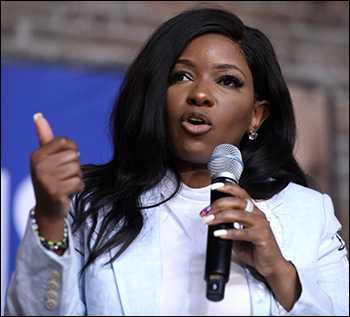
Allred and state Rep. Talarico are announced Senate candidates. Both Rep. Crockett and O’Rourke confirm they are considering joining the race. Crockett has intensified her interest in the Senate race after the new Texas redistricting map placed her home outside of the new TX-30 district, while O’Rourke has seemingly appeared less interested about joining the race in recent weeks.

With a March 3 primary schedule, final decisions will soon be made. Considering the kind of polling data we are seeing in this survey, it is plausible that Crockett and maybe even O’Rourke will look more favorably toward entering the Senate race.

The two university survey research teams polled 1,650 YouGov respondents between Sept. 19 and Oct. 1. The sampling universe was then winnowed to include 478 likely Democratic primary voters and 576 likely Republican primary voters. The pollsters do not indicate the method in which the interviews were conducted.

The large sample size, and the fact that they used the online pollster YouGov’s pre-identified respondents, suggest the poll was administered online. The notation, however, that the interviews were conducted in English and Spanish leads one to believe that the data responses were from live interviews. A combination of the two methodologies is also possible.

The Republican ballot test — understanding that this poll was conducted prior to Rep. Wesley Hunt (R-Houston) officially becoming a GOP Senate candidate — adds little new information. The addition of Hunt leads to the conclusion that the Republican primary will produce two runoff participants, likely Sen. John Cornyn and Attorney General Ken Paxton. This university data fails to suggest otherwise.

The interesting information comes from the Democratic responses. While Allred was commonly viewed as the leading 2026 Democratic Senate candidate based upon his 2024 performance where he raised almost $95 million and ran close to Sen. Ted Cruz (R) in polling until the closing days, the university survey’s likely Democratic voter base unexpectedly places him at the bottom of the list.

According to the ballot test results, Rep. Crockett leads state Rep. Talarico, former Congressman O’Rourke, and Mr. Allred, 31-25-25-13 percent.

To make matters worse for Allred, he also does very poorly when the likely Democratic respondent pool was segmented. Among, men, women, whites, Latinos, Baby Boomers, Gen-X, Gen-Z, those with some college, those with an advanced graduate degree, those who self-identify as Democrats, and those who consider themselves Independent but will vote in the coming Democratic primary, Allred places last among the candidates and potential candidates.

Only among blacks and those with a high school degree does Allred finish either tied or ahead of one of the others. Among blacks, Allred and O’Rourke are tied at 16 percent preference. State Rep. Talarico draws 17 percent, and Rep. Crockett leads the group with 45 percent support. In the high school graduate segment, Allred nips Talarico, 15-14 percent. Crockett leads within this segment with 33 percent followed by O’Rourke’s 31 percent preference figure.

While the recent entrance of Rep. Hunt has attracted greater attention to the Republican side of the ’26 Senate race, this new university poll finding Colin Allred dropping to last place within a Democratic likely voter pool could be the precursor to seeing a trajectory change within the party primary.

Rep. Morgan Luttrell to Retire

By Jim Ellis — Monday, Sept. 15, 2025

House

Two-term US Rep. Morgan Luttrell (R-Magnolia, Texas)

Just after a vacant seat is filled with newly elected Virginia Rep. James Walkinshaw (D-Fairfax) was sworn into office, another US House member has announced his retirement.

Two-term Texas Rep. Morgan Luttrell (R-Magnolia) announced his desire to return to the Lone Star State full-time and therefore will not seek a third term next year. In his retirement statement, Rep. Luttrell said, “I’m not walking away from service, and I’m certainly not walking away from the fight. I’m choosing a different path – one that allows me to stay rooted in Texas and focus on the people and places that matter most.”

The Luttrell surprise adds yet another open seat to the Texas 2026 election ballot, in a state that already has a great deal of political uncertainty. Both parties now are looking at a competitive US Senate primary, the new delegation redistricting map faces legal challenges, and several congressional incumbents, particularly on the Democratic side, are unsure of where, or even if, they will seek re-election.

In the Senate race, four-term incumbent John Cornyn faces a serious primary challenge from three-term Attorney General Ken Paxton in a race that is closing. Before, Sen. Cornyn was trailing badly. While it appeared that former Congressman and 2024 US Senate nominee Colin Allred would have an unencumbered path for the ’26 Democratic nomination, he must now face a serious primary challenge from Austin state Rep. James Talarico who is considered a major rising political star within the party.

On the congressional map, the delegation now sees six open seats from a total of 38 districts. Joining Rep. Luttrell in not seeking re-election is Rep. Chip Roy (R-Austin) who is running for state Attorney General. Their moves create open 8th and 21st District races next year.

Democratic Rep. Sylvester Turner passed away earlier in the year, and a special election will be held to replace him in November. Even this situation is not without confusion since the eventual special election winner will have to turn around and face veteran Rep. Al Green (D-Houston) in a Democratic primary election just weeks after winning his or her own seat in a new 18th CD where Mr. Green already represents two-thirds of the constituency.

Additionally, the new congressional map creates three new districts, in the Dallas area, Houston, and the San Antonio region. This leads to the potential pairing of several incumbents in each place.

In all, we are likely to see competition in either the primary or general election in at least 11 of the state’s congressional districts, the US Senate primary and general election, in addition to several open statewide races and Gov. Greg Abbott (R) seeking re-election to a fourth term.

In Rep. Luttrell’s 8th CD, we can expect to see a very crowded and competitive Republican primary. The 8th had typically been anchored in Montgomery County, a populous municipal entity located just north of Houston’s Harris County. Under the current map, less than half of Montgomery County is in the 8th with over half of the constituency in western Harris County.

Under the new map, the new 8th maintains about two-thirds of the current constituency but moves deeper into Harris County and adds some further rural regions. In both cases, the 8th will be a safely Republican seat and Rep. Luttrell’s successor will be determined in the succeeding Republican primary election.

Morgan Luttrell was first elected to Congress in 2022, which was his first run for public office. The Luttrell name became famous due to Rep. Luttrell’s brother, Marcus Luttrell and his military heroics. The book and movie, Lone Survivor, is Marcus Luttrell’s personal story as the sole survivor of Operation Redwing and the desperate battle in the mountains that led, at the time, to the largest loss of life in Navy SEAL history. Rep. Morgan Luttrell, Marcus’s twin brother, also served as a Navy SEAL for seven years until being medically retired in 2014 for a severe traumatic brain injury and spinal cord injury he sustained in a helicopter crash in 2009.

Special Election Season Begins

By Jim Ellis — Monday, Sept. 8, 2025

Special Elections

As we know, the House has four vacant seats and the first in a series of rapid special elections will occur tomorrow.

In Virginia’s 11th District, the battle to replace late Rep. Gerry Connolly (D-Fairfax) will largely be anticlimactic. The VA-11 seat is heavily Democratic (Dave’s Redistricting App partisan lean: 67.2D – 30.7R; Harris ’24: 65.7 – 31.4 percent), so an easy win for Fairfax County Supervisor and former Connolly chief of staff James Walkinshaw (D) is a prediction that all political prognosticators share.

The district is fully contained within Fairfax County and includes Fairfax City. A 2:1 Walkinshaw victory is expected over former FBI agent Stewart Whitson (R).

Two weeks after tomorrow’s Virginia special election, on Sept. 23, voters in the Tucson, Arizona area will participate in an election to replace the late Rep. Raul Grijalva (D), who died in March. The clear favorite to succeed Grijalva is the special election’s Democratic nominee, Adelita Grijalva, the Congressman’s daughter who is a former Pima County Supervisor. Ms. Grijalva won the special Democratic primary in July with 61.5% of the vote over four intra-party opponents.

As in VA-11, Arizona’s 7th Congressional District is strongly Democratic. The DRA partisan lean is 65.5D – 32.3R. Kamala Harris carried this district, 60.5 – 38.4 percent, in a place where she lost the statewide vote. Just like VA-11, this district’s Democratic nominee is expected to win in a proportion consistent with the partisan lean calculation.

Once Walkinshaw and Ms. Grijalva are sworn into office, the partisan division will feature 219 Republicans, 214 Democrats with two remaining vacancies (1D; 1R).

On Oct. 7 in western Tennessee, we will see perhaps the most interesting special primary election to date, as multiple candidates from both parties are seriously vying for their party’s nomination. On the favored Republican side, 11 contenders are competing including three state Representatives and a Montgomery County Commissioner. For the Democrats, three Nashville area state Representatives and a businessman have qualified for the ballot.

Though the voter history suggests a comfortable Republican win will result in TN-7 (Dave’s Redistricting App partisan lean: 55.1R – 42.1D; President Trump: 60.4 – 38.1 percent), Democrats believe they have a chance to pull an upset. They cite increased Democratic performances around the country in special elections as the basis for their political optimism.

Tennessee features partisan special primaries, so no inter-party upset will occur on Oct. 7. The state does not include a runoff for party nominations, so it is likely we will see a pair of nominees coming forward who do not earn majority support within their own partisan electorate. The special general election is scheduled for Dec. 2.

The Volunteer State’s 7th District contains nine counties and parts of three others west of Nashville and stretches from Kentucky to Alabama on a north to south plane. The CD includes part of Nashville city in Davidson County along with the Clarksville, Parsons, and Waynesboro municipalities.

Incumbent Rep. Mark Green (R-Clarksville) resigned the office earlier in the year to accept a position in the private sector. Before Green, Sen. Marsha Blackburn (R), now a gubernatorial candidate, represented the 7th CD for 16 years.

The final special election, scheduled for Nov. 4 in Houston, features 35 candidates (22 Democrats, 7 Republicans, and 6 minor party or Independent contenders). The candidate filing deadline was Sept. 3, so it remains to be seen how many of the 35 officially qualify for the ballot.

The TX-18 contest to replace the late Representative and former Houston Mayor Sylvester Turner (D) is certainly the most unique among the special elections.

Assuming a runoff will be required from the large field since no one is likely to secure majority support in the initial vote, Gov. Greg Abbott will then schedule the secondary election between the top two finishers when it becomes a mathematical certainty that no one received a majority. This means the runoff may not be held until early January.

While the new Texas map has been adopted into law, it must still pass the legal tests. If so, the eventual special election winner, and it will almost certainly be a Democratic candidate from the party’s safest Texas seat (DRA partisan lean: 73.6D – 24.4R), will immediately most likely be forced to face veteran Rep. Al Green (D-Houston) to compete in the regular election Democratic primary for a full term.

The regular election Democratic primary will occur in a newly configured 18th District on March 3rd that only contains 26 percent of the current 18th and 65 percent of Rep. Green’s 9th CD.

The new redistricting plan has certainly made life difficult for whoever wins the 18th District special election. The eventual winner having a short tenure in Congress appears likely and will prove a side effect of the 2025 Texas redistricting effort.

Decision Time in Texas

(Click on map above to see full-size detail.)

By Jim Ellis — Wednesday, Aug. 27, 2025

Redistricting

Now that the new Texas redistricting map has been signed into law displaced Democratic incumbents and potential candidates are deciding where they will run.

In the Dallas area, a game of political musical chairs must be played. All three Texas Democrats who currently represent part of Dallas County no longer live in the district for which they will likely run.

It is probable that Rep. Jasmine Crockett (D-Dallas), whose home is now in Rep. Marc Veasey’s (D-Ft. Worth) 33rd District, will still run in District 30, where almost 69 percent of her current constituency resides. By the same token, Rep. Veasey’s best opportunity is in District 33, but he loses all of his Ft. Worth and Tarrant County base. Only 33 percent of his current constituency lies in the new District 33.

The Dallas Democrat with the least favorable choices is freshman Rep. Julie Johnson (D-Farmers Branch/Dallas). While 41 percent of her current constituency will reside in new District 32, that district now stretches into East Texas and becomes a Republican seat.

Almost one-third of her constituents move to District 33, but Rep. Johnson says she is looking at potentially challenging Republican Rep. Beth Van Duyne (R-Irving) in new District 24. Rep. Johnson sees only three percent of her current constituents landing in TX-24 but says a large portion of her former state House district is included. President Trump carried new CD-24 with a 57-41 percent margin, so Rep. Van Duyne, who finds 87 percent of her current district comprising the new 24th, remains in the driver’s seat for re-election.

Moving to Houston, veteran Rep. Al Green (D-Houston) says he is surveying the new 18th District as a place to run. He would be paired with the winner of the current special election to replace the late Rep. Sylvester Turner (D), but the latter individual will only have two months to organize a primary campaign against Green after winning the special election.

Rep. Green’s 9th CD transforms into an eastern Harris County Republican seat, while none of his district will move to CD-18. Much of the current Green constituency, almost 44 percent, goes to Rep. Sylvia Garcia’s (D-Houston) 29th District, of which Garcia would represent only 37 percent of the new CD. Still, Green would be well known in the 18th, and not having to face another entrenched incumbent should be a favorable setup for the 77-year-old House member who was first elected in 2004.

Looking at Austin, Rep. Lloyd Doggett (D-Austin) says he will not seek re-election rather than squaring off with fellow Democratic Rep. Greg Casar (D-Austin) in the new 37th CD. Mr. Doggett says he would seek re-election if the court restores the previous map.

In South Texas, Rep. Henry Cuellar (D-Laredo) sees a much different district, but one that he should like. Gone is the San Antonio portion of the current TX-28 seat where Cuellar experienced trouble in two close Democratic primary challenges. He is still under federal indictment with several charges for bribery, obviously a significant hurdle to overcome, while rumors still abound that he may switch parties. If he doesn’t, his likely opponent will be Webb County Judge (Executive) Tino Tijerina, who also hails from Cuellar’s home domain.

A major development affecting the South Texas seats occurred the other day when former Rep. Mayra Flores (R) indicated that she will move back to TX-34 to again challenge Rep. Vicente Gonzalez (D-McAllen) in a re-match of the 2024 campaign that saw Gonzalez prevailing 51-49 percent. Earlier in the year, Flores said she would challenge Rep. Cuellar in District 28.

In a new 34th that now contains almost 40 percent new territory for Gonzalez and all coming from Rep. Michael Cloud’s (R-Victoria) Republican 27th District, the partisan lean of the newly configured TX-34 will favor a strong GOP candidate.

A lawsuit challenging the new map as a racial gerrymander will quickly be filed in an attempt to void the new districts. This will likely put further pressure upon the Supreme Court to finally rule on the Louisiana racial gerrymandering case, which has now been scheduled for a second oral argument session on Oct. 15.

If the high court upholds the previous federal three judge panel ruling, then the Texas map will also likely stand and we would see re-draws forced in Louisiana and likely Alabama, which is in an identical situation to that of the Bayou State. In a related ruling, the 5th Circuit Court of Appeals upheld the Galveston County case that affected the Texas minority districts and was the reason Gov. Greg Abbott (R-TX) added redistricting to the legislative special session.

With the Lone Star State candidate filing deadline set for Dec. 9 in conjunction with the March 3, 2026, primary election, much will happen in the political and legal arenas during the next few weeks.

New Texas Map Passes;
Rep. Chip Roy Running for AG

(Click on map above to see full-size detail.)

By Jim Ellis — Friday, Aug. 22, 2025

Texas

REDISTRICTING — The Texas state House of Representatives, with the Democrats returning to create a quorum, passed the new redistricting map on a party line vote. The bill then moved to the state Senate where passage became pro forma since the body passed the plan in the previous legislative special session. Gov. Greg Abbott (R) is expected to sign the new map into law as early as today.

While Republicans believe they can gain five seats in the Texas delegation, the number is largely predicated on winning Hispanic voters in numbers that President Trump similarly attained. Whether the new Trump Hispanic voter returns in a midterm election to vote the Republican line becomes a point of conjecture.

The new Texas map creates three open seats, two of which, one in Houston and the other in the San Antonio area, have large Hispanic populations. To reach their goal of converting five districts, the Republican candidates will have to carry the three open seats:

  • District 9 (Houston)
  • District 32 (Dallas area)
  • District 35 (San Antonio area)

Also, Republicans must defeat Reps. Henry Cuellar (D-Laredo) and Vicente Gonzalez (D-McAllen) in South Texas Districts 28 and 34, respectively.

Former Congresswoman Mayra Flores (R), who lost to Rep. Gonzalez 51-49 percent in November while President Trump was carrying the 34th District in the present configuration (51.8 – 47.4 percent), announced earlier in the year that she would move to District 28 to oppose Rep. Cuellar. Since District 34, now moving northward toward Corpus Christi and losing the McAllen portion of the current CD, becomes more Republican it is unclear if she will go through with the plan to run in CD-28 or return for a second re-match with Rep. Gonzalez in new CD-34.

The new map pairs several Democratic members: Reps. Lloyd Doggett (D-Austin) and Greg Casar (D-Austin), although Rep. Doggett is saying he will retire if this map stands; likely, Reps. Julie Johnson (D-Farmers Branch/Dallas) and Marc Veasey (D-Ft. Worth) in a Dallas County 33rd District that would contain neither of their home bases; and Rep. Al Green (D-Houston) with the winner of the TX-18 special election to be held later this year.

Rep. Chip Roy (R-Austin) — Rep. Roy, who had been publicly contemplating entering the open Texas Attorney General’s race, yesterday announced his candidacy for that position, thus opening his Central Texas 21st Congressional District for the 2026 election cycle.

Counting the Roy open seat along with the Texas trio of new open CDs, the national US House open seat count would rise to 29 (15R-11D-3 New).

Once the four special elections are filled beginning on Sept. 9 in Virginia with the VA-11 district and concluding with TX-18, which could stretch into January (under Texas election law, the Governor calls a special runoff once it becomes certain that the top finisher will not reach the majority support level in the initial election), the national open-seat count will revert to 25.

In the GOP Attorney General’s primary, Congressman Roy will face state Sen. Mayes Middleton (R-Galveston), state Sen. Joan Huffman (R-Houston), former Assistant US Attorney General Aaron Reitz, and possibly others. For the Democrats, state Sen. Nathan Johnson (D-Dallas) and former Galveston Mayor and ex-AG candidate Joe Jaworski are the announced contenders.

The new 21st District will be similar but not identical to the seat that Rep. Roy is vacating. The new TX-21 will contain northern Bexar County (San Antonio), move north to capture Comal and part of Hays County which borders Austin, and then travels west into the Texas Hill Country to include the flood-ravaged area around Kerrville when the Guadalupe River overflowed on the 4th of July.

The current CD-21 partisan lean is 61.0R – 36.7D. The new 21st would lose about 30 percent of the territory to other districts but gain a commensurate amount. The new partisan lean, again through the work of the Dave’s Redistricting App statisticians, would calculate as a similar 60.3R – 38.4D. Therefore, it is highly likely that Rep. Roy’s successor will be the winner of the next Republican nomination campaign.

Cornyn Rebounds

By Jim Ellis — Wednesday, Aug. 20, 2025

Senate

Texas Sen. John Cornyn (R)

For the first time this year, Sen. John Cornyn has posted a polling lead over Attorney General Ken Paxton in their 2026 Texas Republican primary battle.

Emerson College tested the Lone Star State electorate (Aug. 11-12; 1,000 registered Texas voters; 491 self-identified Texas Republican voters; multiple sampling techniques) and the results project Sen. Cornyn only edging AG Paxton by a scant 30-29 percent, but the survey clearly shows positive movement for the veteran incumbent.

A dozen Republican primary polls, including the current Emerson College study, have been released since the beginning of the year from 12 different pollsters (eight Republican firms, one Democratic pollster, and three university research departments).

Though the Emerson data still shows weakness for Sen. Cornyn, it detects a vastly improved incumbent standing. In the 11 polls conducted prior to Emerson’s, Paxton averaged a lead of just under 16 percentage points. In seven of the 11, the three-term AG reached or topped the 50 percent mark.

More data needs to be studied in order to confirm this new trend, especially since the Emerson poll consisted of registered voters as opposed to those likely to cast their ballot in a Republican primary. Additionally, the sample size of 491 self-identified Republicans is low for a state the size of Texas and one where GOP primary turnout reached almost 2 million voters the last time Sen. Cornyn appeared on the ballot (2020). Furthermore, the fact that Sen. Cornyn only reached a 30 percent preference figure is also a negative sign for a four-term incumbent within his own party.

Conversely, the results clearly show movement in Cornyn’s favor and coincide with a recent Cornyn campaign blitz designed to intensify a Paxton negative personal image. The new poll results suggest the Cornyn campaign strategy is working as Paxton is losing support even though the Senator’s preference number doesn’t yet appear to be rising. In the previously mentioned dozen polls, Emerson inclusive, Sen. Cornyn’s average is 33.2 percent.

The 2026 Texas Senate race will be exorbitantly expensive. In 2024, Sen. Ted Cruz (R) and then-Rep. Colin Allred (D), including approximately $64 million in outside expenditures that helped both candidates, spent an aggregate of $266 million. It is probable that such an amount will be equaled or topped in 2026.

According to the 2nd Quarter Federal Election Commission financial disclosure reports for the current election cycle, Sen. Cornyn has raised over $9.8 million for the 2026 campaign and holds almost $9 million in his campaign account. Paxton reported campaign receipts of $2.9 million with slightly over $2.5 million cash-on-hand.

Because he is a recently announced 2026 candidate, Allred has not yet had to file a disclosure report for the current campaign. For his 2024 effort, Allred raised over $94 million, a total that ranked as fourth-best among all Senate candidates. Therefore, we can again expect to see him well-funded for the coming campaign.

There is still some discussion that former Congressman, ex-US Senate, and former presidential candidate Beto O’Rourke could enter the ’26 Senate campaign. If he were to become a candidate, the Democratic primary would also become competitive. Since the Allred announcement, however, talk of an O’Rourke Senate campaign has faded, though the former El Paso Congressman is certainly politically active.

O’Rourke began raising money to fund the state House Representatives who fled Texas in order to prevent obtaining a quorum in the special legislative session. The politicians made their move to at least postpone the legislature from passing a new congressional redistricting map.

Because a law was passed to fine any member who purposely missed session for legislative purposes, O’Rourke went to work funding a non-profit political organization to pay the amassed fines. A Texas judge has struck down his effort, however, since the law purposely prevented political money from being used to pay the personal fines.

Along with Arkansas and North Carolina, the March 3 Texas primary is the earliest in the nation. Therefore, we can expect to see heavy political action coming from the Lone Star State during the latter half of this year.