Tag Archives: Sen. Amy Klobuchar

The Great Lakes’ Poll

By Jim Ellis

Nov. 12, 2019 — The Cook Political Report in conjunction with the Henry J. Kaiser Foundation of San Francisco sponsored a four-state survey, called the “Blue Wall Voices Project,” covering key Great Lakes states to determine Democratic presidential primary standing within the region among other issues.

The poll has an unusual methodology in that the survey period was long (Sep. 23-Oct. 15) and the 3,222 registered voter respondents, who were invited to participate, could do so through an online link or by calling to speak with an interviewer. The four selected states were Michigan (767 registered voter respondents; 208 likely Democratic primary voters), Minnesota (958; 249), Pennsylvania (752; 246), and Wisconsin (745; 274). The survey questionnaire contained 36 questions about issues, candidates, approval perception, and demographics, many with several subsets.

In terms of general election positioning, the results in all four states lead to the conclusion that President Trump is in need of refining his message since the respondents’ answers cut severely against his perceived positions on trade, immigration, and foreign affairs in particular.

Short-term, the Democratic presidential responses were of greatest interest and, in all four of these important states, we see a legitimate multi-candidate contest developing with less than three months until the first votes are cast in the Iowa Caucus.

While signs are beginning to surface that Minnesota Sen. Amy Klobuchar is gaining some traction in Iowa, a must for a Midwestern candidate, her home state poll shows her moving into the delegate apportionment mix.

Under Democratic National Committee rules, a candidate must obtain 15 percent of the at-large and congressional district popular vote in order to win committed delegate votes. According to the Cook/Kaiser survey, and including those who say they are leaning toward a particular candidate, Sen. Klobuchar attracts 15 percent among her home state Democratic respondents, in second place behind Sen. Elizabeth Warren’s 25 percent.

The top tier is tightly bunched after Warren. After Klobuchar’s 15 percent, former Vice President Joe Biden notches 14 percent, with Sen. Bernie Sanders right behind at 13 percent. Extrapolating this poll over the period before Minnesota holds its primary on Super Tuesday, March 3, suggests that all four of the contenders will qualify for a portion of the state’s 75 first-ballot delegate votes.

We see a similar split in Michigan, though Klobuchar is not a factor here or in any other tested state. Again, Sen. Warren leads the pack, also with support from a full quarter of the respondents. Following are Biden and Sanders with 19 and 15 percent, respectively. The Wolverine State has 125 first-ballot delegates.

Continue reading

Is Buttigieg a One-State Wonder?

By Jim Ellis

South Bend Mayor Pete Buttigieg

Oct. 23, 2019 — The new Suffolk University/USA Today poll of Iowa voters (Oct. 16-18; 500 likely Iowa Democratic caucus attenders) was conducted immediately after the most recent Democratic presidential debate and confirms that South Bend Mayor Pete Buttigieg registered a strong performance.

According to the Suffolk results, former Vice President Joe Biden posts only 18 percent support, a drop of six points from their July Iowa poll, while Sen. Elizabeth Warren (D-MA) is in a virtual tie with him at 17 percent. She gained four percentage points since mid-summer. Mayor Buttigieg now moves into a close third place with 13 percent, more than doubling his support from the July poll when he registered only six percent preference. Sen. Bernie Sanders (I-VT) remains constant with nine percent and holds fourth position.

The remainder of the field includes four candidates tied with three percent support: billionaire Tom Steyer who made his first debate appearance in the October forum, Sen. Kamala Harris (D-CA) who dropped a whopping 13 percentage points from the July Suffolk U. survey, Rep. Tulsi Gabbard (D-HI), and Minnesota Sen. Amy Klobuchar who, like Mayor Buttigieg, needs to take advantage of her Midwestern roots and reap a solid support percentage from the Iowa Democratic electorate. So far, however, she has failed to generate significant support.

While Mayor Buttigieg has appreciably increased his Iowa standing, it remains to be seen if this poll is reflective of a short-term bounce from a strong debate performance or whether seeds are being sown for a legitimate push into the top tier. And, even if he proves himself in Iowa, will that momentum carry over into other states? At this point, the available data suggests that Buttigieg could be a one-state wonder.

Iowa: Midwesterners Gain

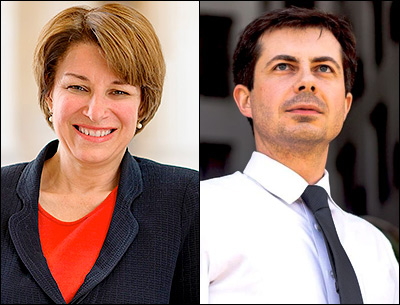
Minnesota Sen. Amy Klobuchar (left) and South Bend Mayor Pete Buttigieg

By Jim Ellis

Sept. 20, 2019 — While South Bend Mayor Pete Buttigieg and Minnesota Sen. Amy Klobuchar are lagging in the polls nationally, new data from Iowa may be providing them each with a ray of hope.

Hawkeye State caucus attenders from both parties tend to like candidates from the Midwest. This was true for Republicans when former Kansas Sen. Bob Dole twice won the Iowa Caucuses in his presidential campaigns. President Gerald Ford (MI) also beat Ronald Reagan here in 1976.

Since the beginning of the Iowa Caucus system, a Midwestern Democratic candidate has won this nominating event exactly half of the time. Those winners were former Vice President Walter Mondale (MN), ex-House Leader Richard Gephardt (MO), home state Iowa Sen. Tom Harkin, and President Barack Obama (IL) twice.

The current Democratic field features two Midwestern candidates, Mayor Buttigieg from South Bend, Indiana, and Minnesota’s Sen. Klobuchar. Neither has been doing particularly well in polling lately, and both need a strong showing in Iowa, the first voting state, next February to remain viable.

Two polls were just released for the impeding 2020 Iowa Caucus and both show Mayor Buttigieg rebounding. The Civiqs polling organization, surveying for Iowa State University (Sept. 13-17; 572 likely Iowa Democratic caucus participants) finds Sen. Elizabeth Warren (D-MA) placing first with 24 percent, and former Vice President Joe Biden and Sen. Bernie Sanders (I-VT) tied for second, each posting 16 percent.

Mayor Buttigieg then scores 13 percent, returning to double digit support and claiming a solid fourth position. Sen. Klobuchar does not do particularly well on this poll, recording only three percent preference and tying her with New York City businessman Andrew Yang.

Continue reading

Multiple Choice, Multiple Candidates

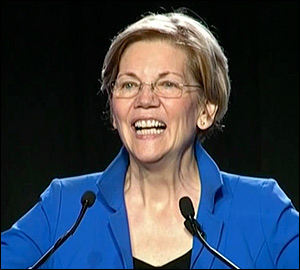
Sen. Elizabeth Warren (D-MA)

By Jim Ellis

Sept. 16, 2019 — The international polling firm YouGov for The Economist magazine just completed a major 86-question survey of 1,500 US adults (Sept. 8-10; online through an opt-in panel), 1,182 of whom are registered voters and found many interesting results. The most unique, however, might be their question asking the self-identified primary or caucus attending Democrats and Democratic-leaning Independents (632) just how many of their party’s presidential candidates they would consider supporting.

The purpose of the question was to test for multiple responses; therefore, most respondents named several candidates. Possibly the most interesting phase of the response process was that only one candidate exceeded 50 percent under this format, and the person receiving the 55 percent consideration factor might not be who you would name with your first guess.

Of the 20 candidates identified in the questionnaire, 10 broke into double digits. This is not particularly surprising when remembering that respondents were encouraged to give more than one candidate they are considering and, in fact, could name as many individuals as they liked.

But the candidate receiving the 55 percent mention factor was not former Vice President Joe Biden. Rather, it was Massachusetts Sen. Elizabeth Warren, and this type of outcome could be quite significant in determining who people might ultimately support. Biden was second but failed to reach a majority even from a respondent pool who could render multiple choices. He posted a 48 percent score.

In third position was Vermont Sen. Bernie Sanders (40 percent), so here again we see these three candidates, Warren, Biden, and Sanders, capturing the top positions by a wide margin.

Sen. Kamala Harris (D-CA) was fourth with 32 percent followed by South Bend Mayor Pete Buttigieg who was named by 27 percent of the sample. Others in double digits were New Jersey Sen. Cory Booker at 18 percent, ex-Rep. Beto O’Rourke recording 14 percent, and former HUD Secretary Julian Castro posting 13 percent, with Minnesota Sen. Amy Klobuchar and New York City businessman Andrew Yang both registering 11 percent under this format.

Continue reading

Inslee Bows Out of Presidential Race

By Jim Ellis

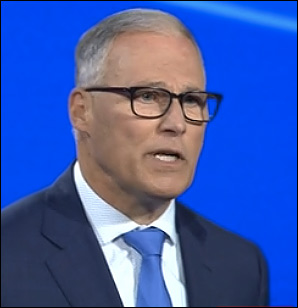
Washington Gov. Jay Inslee (D)

Aug. 23, 2019 — The Democratic National Committee leaders’ strategy to substantially increase the presidential debate qualification requirements in order to decrease the unwieldy and bloated candidate field is working.

The prerequisites to prove that a campaign has more than 130,000 donors and that each candidate reaches a minimum of two percent support from four of eight designated pollsters paid another dividend Wednesday as Washington Gov. Jay Inslee became the third Democratic candidate to officially exit the race.

Not making the debate stage signifies that a candidate has no chance to become a top-tier candidate. Without national exposure, also-ran candidates have little opportunity to increase name identification and familiarity in order to raise enough money to deliver a message, motivate people to work on their campaign, and attract serious media attention both nationally and in the important local markets within key states.

Inslee follows Rep. Eric Swalwell (D-CA) and former Colorado Gov. John Hickenlooper in making the decision to bow out of the race, and there are likely to be several more following suit once it becomes even more evident that the lower-tier candidates will no longer have the opportunity to climb onto the national debate stage.

Gov. Inslee, in an interview on MSNBC’s “The Rachel Maddow Show” Wednesday, stated ” … it’s become clear that I’m not going to be carrying the ball. I’m not going to be the president, so I’m withdrawing tonight from the race.” He is expected to announce that he will seek a third term as Washington’s governor.

The Inslee withdrawal is not a surprise to anyone, apparently even to the candidate himself. He remained non-committal about ruling out running for a third gubernatorial term, which froze most of the Washington Democratic potential aspirants in place. The rhetoric blocked them from overtly assembling a statewide campaign since most correctly interpreted the political tea leaves as meaning that Inslee would, in fact, be back to seek re-election.

With 10 candidates now qualified for the next debate since former HUD Secretary Julian Castro just joined the top-tier candidates of Joe Biden, Bernie Sanders, Elizabeth Warren, Kamala Harris, and Pete Buttigieg who are also joined by Sens. Cory Booker (D-NJ), Amy Klobuchar (D-MN), ex-Rep. Beto O’Rourke (D-TX), and businessman Andrew Yang, it remains to be seen just how many of those who won’t meet the qualifications will continue.

Continue reading

Nevada Looms Large for Biden, Harris

By Jim Ellis

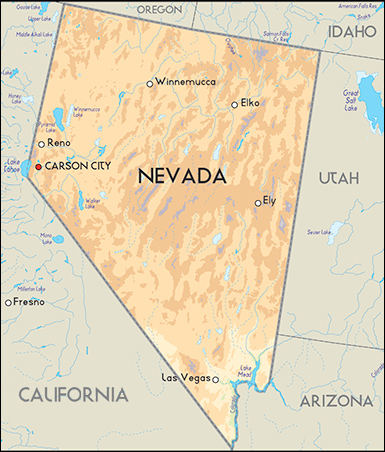
Aug. 22, 2019 — The Nevada Caucus is third on the presidential nomination schedule and it appears the Silver State nomination event will carry more weight than it has in past elections.

After the Iowa Caucus (Feb. 3) and New Hampshire primary (Feb. 11), the candidates will stream into Nevada for the Feb. 22 caucus event that is traditionally held on a Saturday.

Nevada could be critically important for two of the candidates, former Vice President Joe Biden and California Sen. Kamala Harris, should the first two states evolve as currently predicted.

Kicking the cycle off in Iowa, Biden may find himself in a similar position to that of Hillary Clinton in 2016. Coming into the state as the clear front runner, Clinton stumbled in Iowa as she technically won the caucus vote, but only after a series of coin flips were conducted to break ties … and she won them all.

The rules are different in 2020, and it will be easier for more people to participate, but Iowa voters tend to like the Midwestern candidates, something Biden is not. Additionally, with Sen. Sanders proving he has a base in the state and two Midwestern candidates in the field, Minnesota Sen. Amy Klobuchar and South Bend Mayor Pete Buttigieg, the chances of Biden faltering here are actually quite high.

Then the candidates will move to Sens. Bernie Sanders’ (I-VT) and Elizabeth Warren’s (D-MA) New England backyard in New Hampshire. In 2016, Sen. Sanders upended Clinton with a 60 percent victory, so Biden’s ability to derail both Sanders and Warren in this state will prove to be a difficult task. Therefore, it is entirely possible that Biden could move into Nevada in search of a badly needed win.

Sen. Harris has a major advantage in that her home state of California will award 416 first-ballot delegates, a figure 45 percent larger than even the second-largest state, which is Texas. But, in order to maximize this advantage, Sen. Harris will have to be competitive in the First Four states.

Continue reading

Warren Ahead in Iowa & Wisconsin

By Jim Ellis

Sen. Elizabeth Warren (D-MA)

Aug. 19, 2019 — The Change Research organization, which has previously conducted simultaneous multi-state polling within the same sampling period, just repeated their process. This time, the firm surveyed likely Democratic voters in both Iowa and Wisconsin over the Aug. 9-11 period and found Massachusetts Sen. Elizabeth Warren topping the field in both states.

As we know, the Iowa Caucus, with only 41 first-ballot delegate votes, is an important trend-setting state because of being placed first on the national voting calendar. In 2016, after her campaign was selling Hillary Clinton as the “inevitable nominee,” she barely won the first vote in Iowa, which arguably began a downward spiral for her campaign. Though Clinton obviously won the party nomination, the long fight with Sen. Bernie Sanders (I-VT) politically weakened her for the general election campaign.

According to the Change Iowa data (621 likely Iowa Democratic Caucus participants through online communication), Sen. Warren would lead Sen. Sanders, former Vice President Joe Biden, South Bend Mayor Pete Buttigieg, and Sen. Kamala Harris (D-CA), 28-17-17-13-8 percent, respectively. Minnesota Sen. Amy Klobuchar, who needs to make a major play in her neighboring state, still only shows two percent support, tying her with Rep. Tulsi Gabbard (D-HI), billionaire Tom Steyer, and Montana Gov. Steve Bullock, but behind the three percent score of both Sen. Cory Booker (D-NJ) and ex-Rep. Beto O’Rourke (D-TX).

Biden may have a similar problem to that of Clinton, and it could prove to be a major stumbling block. As the presumptive national front-runner, under-performing in Iowa would show clear vulnerability. Traveling the following week to Sens. Warren and Sanders’ New England backyard for New Hampshire’s first-in-the-nation primary after sustaining an Iowa loss would strengthen the two local candidates and possibly cause Biden to again fall.

This scenario would be quite damaging to the former vice president. Because his momentum would significantly slow, re-starting for the succeeding Nevada Caucus becomes very difficult and he would need a boost here before heading to the South Carolina primary and the southern states-dominated Super Tuesday. Currently, Biden is polling very strongly throughout the south, but faltering early could quickly change that dynamic.

Continue reading