Tag Archives: Rasmussen Reports

GOP Panic Premature in Missouri?

Rep. Todd Akin

Missouri Rep. Todd Akin (R-MO-2), who won the Republican Senatorial nomination and the right to oppose Sen. Claire McCaskill (D) on Aug. 7 and then turned around and made what most said were ludicrous abortion-related rape comments during a St. Louis TV station interview 12 days later, is surprisingly clawing his way back into contention.

You will remember that the Akin interview gained prolonged national media coverage and was swiftly denounced with outrage from Democrats, as well as many Republicans. The race, which GOP strategists initially believed to be a contest against the weakest of Democratic incumbents seeking re-election, seemed to snap strongly in favor of McCaskill as Akin immediately took a nosedive in the polls following the interview.

The GOP establishment was quick to respond by publicly pushing Akin to exit the campaign, however he refused to do so. Now running without the institutional support he once had from the party and business allies in Washington, as well as having seen many state and local candidates separate themselves from his comments, new polls are revealing increased viability despite his troubles.

According to polls released this week, the Missouri Senate race could be returning to “toss-up” status. Public Policy Polling released a research study yesterday showing McCaskill to be holding only the slightest 45 percent to 44 percent edge over Akin. PPP surveyed 621 likely Missouri voters Aug. 28-29 with a margin of error of plus or minus 3.9 percentage points. The study revealed that approximately 77 percent of Missouri Republicans say they accept Akin’s apology. While only 33 percent of voters view Akin favorably, even that number is up 11 points from the PPP survey released the week before.

Another poll by the Family Research Council, a socially conservative group supporting Akin, actually projects the embattled congressman to be leading McCaskill 45 percent to 42 percent (surveyed Aug. 27-28; 828 likely Missouri voters; +/- 3.38 percent error margin). Conversely, however, Rasmussen Reports released their poll on Aug. 26 posting the senator to a 10-point, 48-38 percent, advantage (surveyed Aug. 22; 500 likely Missouri voters; 4.5 percent error margin).

Now national Republican leaders are in a quandary. Immediately upon Akin making his comments, Republican National Committee chairman Reince Priebus and National Republican Senatorial Committee chairman John Cornyn (R-TX) publicly called for him to withdraw from the race. Karl Rove, who had previously promised a substantial advertising campaign to support Akin and disparage McCaskill, quickly said his American Crossroads organization was canceling their Missouri media reservations. Democrats are, of course, left with video tape of the Republican leaders’ comments, which will assuredly air in commercials as we head down the stretch. As a result, Akin’s own campaign fundraising apparatus came to a screeching halt.

Though the first deadline to withdraw from the Missouri ballot without cause has come and gone, Akin still has until Sept. 25 to formally decide if he will step down and allow his party to nominate a new candidate. At this point, now armed with more encouraging polling data, it appears that he is even less likely to exit. With his seeming rebound, will those aforementioned Republican leaders so willing to pile on him before the dust settled now be in a position to absorb as much criticism as Akin himself? While the seat still appears winnable, even for Akin, the Republican brain trust has made that task all the more difficult.

There is no question that Rep. Akin has taken a substantial hit from the comments he made over a week ago, but the damage may be subsiding. His own massive stumbles, and those of the Republican Party leaders’, have made Akin’s return to credibility much more difficult; however, it appears this race is not yet over. Continued polling results as we have seen in the past few days will shortly force this campaign back into the “toss-up” domain.

Missouri Aside, Senate Polls Break Toward GOP

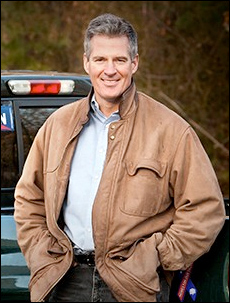
Sen. Scott Brown (R-MA)

A spate of new US Senate polls is giving Republican Party leaders some solace in the face of the Todd Akin debacle in Missouri.

Public Policy Polling (Aug. 16-19; 1,115 likely Massachusetts voters) projects Sen. Scott Brown (R) to a 49-44 percent lead over consumer advocate and Harvard law professor Elizabeth Warren (D). This is the senator’s largest lead in months. Most recent polls showed him either trailing by a point or two, or tied.

Rasmussen Reports (Aug. 20; 500 likely Montana voters) gives Republican Rep. Denny Rehberg (R-MT-AL) a 47-43 percent edge over Sen. Jon Tester (D).

Michigan-based Foster McCollum White & Associates (Aug. 16; 1,733 likely Michigan voters), for the first time, posts challenger Pete Hoekstra (R) to a 48-46 percent advantage against two-term Sen. Debbie Stabenow (D).

PPP also released data for the Wisconsin Senate race, as did Marquette University Law School. According to the former (Aug. 16-19; 1,308 likely Wisconsin voters), Republican ex-governor Tommy Thompson has the upper hand over Rep. Tammy Baldwin (D-WI-2) by a five-point, 49-44 percent, spread. The latter survey (Aug. 16-19; 706 registered Wisconsin voters) shows Thompson with an even larger lead, 50-41 percent.

And, as we reported yesterday, Foster McCollum White & Associates (Aug. 17; 1,503 likely Florida voters) gives Rep. Connie Mack IV (R-FL-14) his largest lead of the campaign, 51-43 percent, over two-term Sen. Bill Nelson (D).

If the patterns in each of these campaigns were to hold, the Republicans would surely capture the Senate majority and see their conference grow to 52 members and possibly beyond. Much will change, however, between now and Nov. 6.

Colorado Crazy


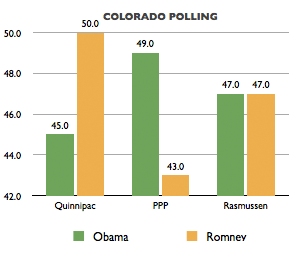
A trio of national pollsters just descended upon the swing state of Colorado and produced wildly divergent presidential campaign results. During the period of July 31 – Aug. 6, three national survey research firms each conducted a separate study of likely Colorado general election voters.

Quinnipiac University (July 31 – Aug. 6) surveyed a sample cell of 1,463 likely voters and actually found Republican Mitt Romney to be leading President Obama 50-45 percent. Public Policy Polling (Aug. 2-5; 779 likely Colorado voters), also in the field during the same period, found the exact opposite result: Obama ahead 49-43 percent. Finally, on Aug. 6, Rasmussen Reports conducted a one-day survey of 500 likely Colorado voters and projected the two candidates to be tied at 47 percent apiece.

The differing results tell us several things. First, the fact that we see the President leading by six in one poll, trailing by five in another, and tied in a third likely tells us that the Colorado electorate is split very finely between the two men. Second, all three polls reveal a very high degree of commitment. Those not expressing a defined choice were only in single-digit percentiles for all three polls. Third, the data also suggests that this state, which typically splits its votes rather evenly between candidates of the two parties, is clearly in play for both presidential contenders. In 2008, then-Sen. Barack Obama carried Colorado over his colleague John McCain by a 54-45 percent margin but, today, it appears the 2012 result will be much closer.

Interesting Michigan Polls

With the Michigan primary fast approaching on Aug. 7, some new numbers suggest a tightening of the US Senate race while a separate poll provides a clue as to how a reapportionment-created incumbent pairing might end.

Rasmussen Reports (July 23; 500 likely Michigan voters) delivers findings that are much different from other previously published polls. Incumbent Sen. Debbie Stabenow (D) has been consistently running substantially ahead of former Rep. Pete Hoekstra (R-MI-2). Looking at four polls conducted since May 1, including an earlier one from Rasmussen, Stabenow has led Hoekstra by an average of 12 points. In the latest RR July survey, her lead has shrunk to just six, 46-40 percent. When paired with Hoekstra’s Republican primary opponent, attorney and charter schools advocate Clark Durant, the senator’s advantage is 47-39 percent.

Durant has been trailing badly in polling but is now making a serious stretch drive effort, spending the more than $2 million he has raised for the race and benefiting from at least one $400,000 Super PAC expenditure. Hoekstra, however, is still the heavy favorite for the party nomination.

Turning to Detroit, two-term Rep. Gary Peters’ (D-MI-9) move to the 14th District in order to challenge his Democratic colleague, freshman Rep. Hansen Clarke (D-MI-13), may yet pay dividends. Despite the large African-American population in the 14th, Peters’ strategy of splitting the black vote among several candidates appears to be working. According to an automated 685 likely Democratic voter survey for local Fox 2 News, Peters has a 45-27 percent lead over Clarke, with the three second-tier candidates dividing the remaining votes.

Presidential Popular Vote is Even

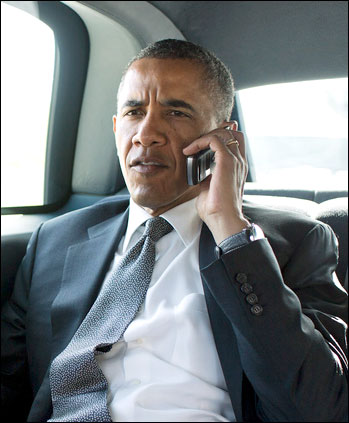
President Obama. / Photo: The White House

A series of new presidential election polls reveals a further tightening of the campaign on the national level, though President Obama maintains a lead over Mitt Romney in the most competitive states.

The two daily tracking pollsters, Gallup and Rasmussen Reports, both give the president only a one-point national lead, 46-45 percent and 45-44 percent, respectively. Looking at an actual benchmark survey, Public Policy Polling, conducting their study (July 19-22; 1,000 registered voters) for the Daily Kos national liberal blog and the Service Employees International Union, projects a flat 46-46 percent tie.

The only national poll not showing a dead heat, taken over virtually the same time frame as PPP’s survey with an identical sample size (July 18-22; 1,000 registered voters) from Republican pollster Bill McInturff and his Democratic counterpart Peter Hart, actually stakes the president to a 49-43 percent advantage. Based upon the available data, though the polling methodology appears sound, the McInturff/Hart result appears to be an outlier.

National Public Radio released their poll of the 12 commonly viewed battleground states (conducted by the Resurgent Republic and Democracy Corps organizations, July 7-12; 1,000 voters nationwide with an oversample of 462 from the battleground states) but its aggregate result is of little consequence. Though this poll, too, shows an Obama-Romney tie at 46 percent, such a figure is virtually useless because the combined popular vote in the most hotly contested states doesn’t translate into specific electoral votes.

What is valuable are battleground voters’ perceptions and attitudes about the candidates. As we have seen for months, there is severe polarization between the two major parties. By almost a 9:1 majority, Democrats believe the president has performed well in office. Conversely, the same virtual ratio of Republicans believes he has not. Independents tend to fall more on the Republican side, slightly rating Obama’s job performance more negative than positive. Also, Independents in these states generally oppose the Obama healthcare law and, by a slight margin, believe that the Supreme Court decision upholding the law is incorrect. This could prove significant as the campaign continues to evolve.

One thing that does deviate somewhat from at least the conventional wisdom, the NPR battleground state poll does show that both candidates have a strong base. Especially for Romney, this is a change. Before, most data indicated weakness among Republicans for their presumptive nominee, but the NPR data gives both contenders right around 90 percent support within their own party voter cell sample. This finding is good news for both men.

New individual key state surveys stack up relatively well for the president in the fact that he leads in most, but in no case is his advantage more than mid-level single-digit numbers.

Rasmussen Reports gives the President a six-point, 48-42 percent advantage in Michigan. Survey USA finds a similar five-point, 48-43 percent margin for Obama in all-important Florida; and We Ask America returns similar 49-42 percent and 49-43 percent spreads (in Obama’s favor) in Wisconsin and Nevada, respectively. Magellan Strategies produced a much closer 50-46 percent Nevada model. Quinnipiac University shows a tie in Virginia, and the Civitas Institute projects Romney to a one point, 49-48 percent razor-thin edge in North Carolina. Though it’s not a battleground state, Survey USA detects only a 46-40 percent advantage for the president in liberal Minnesota, which is a surprise.

The cumulative effect of the most recent survey data makes the president and his advisers uncomfortable. These are not the type of results strong incumbents would be seeing at this point in the election cycle. It’s going to be quite a remainder of the year.

Is a Serious Race Developing in PA?

Yesterday, we mentioned two Senate races bridging the gap toward competitiveness, Florida and Ohio, but is a third campaign on the cusp of becoming a serious? A new Rasmussen Reports survey suggests that the Pennsylvania Senate contest, despite incumbent Bob Casey Jr. (D) holding a comfortable lead, is not yet clinched. Though Sen. Casey has had a controversy-free first term, he still does not exceed 50 percent support in various statewide polls. Rasmussen Reports (July 18; 500 likely Pennsylvania voters) gives Casey a 49-38 percent lead over the Republican nominee, businessman Tom Smith.

Casey destroyed former senator Rick Santorum 59-41 percent in 2006, but the 2012 political climate may be different. If this year is anything like 2010, when Republicans captured the other Senate seat, the governorship, gained five congressional seats, and won both houses of the state legislature, the Senate campaign could be headed toward battle status.

With President Obama running ahead in the Keystone State, but lagging behind where most Democrats begin in the state, Smith could become the beneficiary of a hard-fought, polarizing national campaign. Having enough personal money to become relevant, Smith may just seize the opportunity of putting this state in play. The period between now and Sept. 1 is a critical positioning time for the challenger. If he proves his viability during the current segment, then count on a wild finish.

Several Races Tighten: Fla., Ohio, Calif.

Rep. Connie Mack IV

Four new polls were released on Friday and each showed developing races that are becoming close. In yet another study that depicts Rep. Connie Mack IV
(R-FL-14) performing very well against two-term Sen. Bill Nelson (D), Survey USA produces numbers reflecting a hot Florida Senate race. According to S-USA (July 17-19; 647 likely Florida voters), Mack actually leads the incumbent Democrat 48-42 percent. The same sample gives President Obama a 48-43 percent lead over Mitt Romney, telling us there is no Republican skew in the respondent sample.

Since May 1, eight public polls of this Florida race have been released from six different pollsters (Quinnipiac University conducted three of the surveys as part of their monthly polling program). In five of the eight Nelson leads. In the other three, challenger Mack has the advantage. The swing goes all the way from 49-36 percent in the senator’s favor (Public Policy Polling; May 31-June 3) to Mack leading 46-37 percent (Rasmussen Reports, July 9). This provides us a net curve of 22 points. Such a large polling variance often reveals an extremely volatile campaign with an electorate willing to change course on a dime. There has been enough polling to tell us that the Florida Senate race features true competition and the thought that Sen. Nelson would have a relatively easy ride to re-election has now been firmly dispelled.

Staying in the Senate, Rasmussen Reports (July 18; 500 likely Ohio voters) projects that the Ohio race is continuing upon a competitive path. The latest RR data gives first-term Sen. Sherrod Brown (D) a 46-42 percent lead over GOP state Treasurer Josh Mandel. The senator has maintained at least a small lead for most of the previous 12-month period. In the presidential race, this Rasmussen sample returned a 47-46 percent spread in the president’s favor.

Other polls have shown much stronger leads for Sen. Brown. Seven surveys have been taken of the Ohio Senate race since the beginning of May, from four different pollsters. All show Brown ahead. His advantage ranges from the four-point lead in the current Rasmussen poll all the way to sixteen (50-34 percent; Quinnipiac University, June 19-25).

Polling also indicates that two southern California congressional campaigns are very close. In the new 24th Congressional District, in what appears to be a pure 50/50 toss-up seat for incumbent Rep. Lois Capps (D), Public Opinion Strategies, polling for Republican Abel Maldonado’s campaign (June 26-28; 400 registered CA-24 voters just now released), projects a two-point race with the incumbent leading 48-46 percent. In the jungle primary, Capps received 46.4 percent, Maldonado obtained 29.7 percent, and Republican Chris Mitchum, son of late actor Robert Mitchum, garnered 21.5 percent. With the combined Republican primary vote exceeding a majority of the ballots cast (51.2 percent), the general election battle is clearly becoming a toss-up.

To the southeast in Long Beach, another survey indicates a close race developing in a newly created open seat, numbered District 47. Here, Democratic state Sen. Alan Lowenthal and Republican Long Beach City Councilman Gary DeLong qualified for the general election with the former scoring 33.8 percent to the latter’s 29.4 percent in a field of eight candidates.

Though this district sets up well for the Democrats, a Probolsky Research survey for the DeLong campaign (June 28-July 3, 400 registered CA-47 voters – released just now) gives Lowenthal only a 44-41 percent advantage as the general election campaign begins in earnest.

This race merits attention and should be considered a lower-level upset opportunity for Republicans. Lowenthal has been underwhelming on the fundraising front, raising just over $511,000, which pales in comparison to DeLong’s $862,908. Gov. Jerry Brown carried this seat 50-41 percent; Sen. Barbara Boxer won it 49-41 percent; and Democratic Attorney General Kamala Harris lost the district 39-45 percent. The Democrats’ voter registration advantage is a little over 10 percent more than Republicans. This campaign carries a Lean Democratic rating with movement toward the toss-up column.

Polls In Sync

We often bring polling inconsistencies to light and analyze why a particular survey may be more accurate than another. Right now, however, four diverse pollsters all are showing virtually the same result in the presidential race. The conclusion: The presidential campaign, in mid-May, between President Obama and Mitt Romney, is a virtual tie.

Our first comparison is between the two polling firms that track the national race on a daily basis: Gallup and Rasmussen Reports. The latest published Gallup numbers (April 15-May 6; 3,050 registered voters grouped in five-day tracking segments) show Obama and Romney with the exact same level of support, 45-45 percent. Rasmussen, which calls 500 people every night and then groups them in three-day tracking segments, arrives at virtually the same conclusion as Gallup, but their data has Romney grabbing the smallest of leads, 46-45 percent.

Next comes TIPP, the regular polling partner of Investor’s Business Daily and the Christian Science Monitor. TIPP is the acronym used for the polling section of the TechnoMetrica Market Intelligence corporation, which claims the mantra of “America’s most accurate pollster” based upon their presidential track record in 2004 and 2008 as compiled by Real Clear Politics. According to their traditional polling interview method conducted during the May 9-16 period of 778 registered voters, the President has a slight 43-40 percent lead, certainly consistent in margin of error terms with the other pollsters just cited.

Finally, Zogby Analytics, which has in the past been criticized for being among the least accurate of pollsters, and in this case polling for the Washington Times, also returns current data that agree with the rest. According to their traditional live interview survey May 11-12 of 800 likely voters, Romney has the one-point lead, 44-43 percent. Zogby also went one step further. They asked this particular sampling segment a second ballot test question that included Libertarian candidate Gary Johnson, the former New Mexico Republican governor, who will likely be on the general election ballot in many states. When adding Johnson to the mix, the result slightly changed the Romney-Obama split; the returned result showed a consistent 44-43-2 percent division, but this time in the President’s favor.

What this tells us – because the results from four such different pollsters each with their own methodological approach pertaining to sample selection and interview philosophy – is that at the present time, the national race deserves an unequivocal toss-up rating.

Poll Shows Thompson with Advantage in Wisconsin

The open Wisconsin Senate race has been close ever since incumbent Herb Kohl (D) announced that he would not seek re-election. Now, Rasmussen Reports just released a new survey (May 9; 500 likely Wisconsin voters) showing former four-term governor Tommy Thompson to be holding a substantial advantage for the first time over Madison Rep. Tammy Baldwin (D-WI-2). According to the RR data, Thompson would lead the general election 50-38 percent if he and the congresswoman win their respective party nominations. Baldwin is the consensus Democratic candidate while Thompson faces three potentially strong Republican opponents. Virtually every other poll has shown the race to be within very small margins.

Pitting Baldwin against the other Republicans, Rasmussen also finds very close spreads. Against former Rep. Mark Neumann (R-WI-1), Baldwin trails 42-45 percent. Opposing state Assembly Speaker Jeff Fitzgerald (R), the congresswoman leads 45-41 percent.

The Wisconsin race, along with four others, could very well decide which party will control the Senate majority in the next Congress.

Tester, Heller Rebound in Montana and Nevada

Just-released polling data is bringing good news for two western senators. After trailing at-large Rep. Denny Rehberg (R-MT) by 2-3 points consistently since last June, Democratic Sen. Jon Tester has clawed back into the Montana campaign lead according to Public Policy Polling. The survey of 934 Montana voters over the April 26-29 period gives the senator a 48-43 percent advantage over the GOP congressman.

This is obviously a positive result for Tester, a first-term senator who defeated incumbent Conrad Burns (R) by the closest statewide margin in the country six years ago – a difference of 2,847 votes. The timing of the poll compliments a new media push from Tester that features light, humorous commercials designed to promote a positive image. One of the ads plays upon Tester’s habit of bringing his own Montana steaks back with him to Washington. The ad shows Tester sending the steaks through the airport metal detectors and ends with the senator’s wife cooking him a meal in their Montana home. The theme of the ad reinforces Tester’s strategic point that the senator has not “gone Washington.”

It is not uncommon for a series of ads, particularly well-done, positive spots that are unchallenged, to drive polling data. The five-point Tester lead represents a seven-point swing from PPP’s Nov. 28-30 study. Rehberg was ahead 47-45 percent in the previous poll, meaning he has dropped four points while the senator gained three.

Turning to the southwest, in the similarly close Nevada senatorial contest between appointed Sen. Dean Heller (R) and Rep. Shelley Berkley (D-NV-1), Rasmussen Reports gives Heller his strongest showing of the cycle, a 51-40 percent spread against Ms. Berkley, as shown in their new April 30 poll (500 likely Nevada voters).

This is the third consecutive poll to show Sen. Heller with the advantage. He was up 46-43 percent in Public Policy Polling’s March 29-April 1 survey and 47-40 percent in Rasmussen’s March 19 study. Prior to March, Heller last led in data recorded in July 2011.

Nevada, unlike Montana, will be a presidential battleground state with an unstable electorate. Despite being the fastest growing state during the last decade (35 percent real growth rate), poor economic conditions have led to somewhat of an exodus from Nevada. How this will affect 2012 politics is open to question. Therefore, the presidential race’s progression and its effect on the turnout drive will have a lot to say about the final Senate results.

In the end, these two small states, Montana and Nevada, could be determining factors in deciding which party controls the Senate come 2013. The two highly competitive races will draw much national attention. The current volleys being traded among the candidates right now are only the beginning.