Tag Archives: Ohio

Presidential Paths to Victory

Today we turn our attention to the national election between President Barack Obama and former governor Mitt Romney in order to determine each candidate’s path to victory as the political map begins to evolve and change.

It is evident that are there are approximately a dozen battleground states upon which the candidates are focusing. The competitive states considered to be in this swing category include, alphabetically: Colorado (9 Electoral Votes), Florida (29), Iowa (6), Michigan (16), Nevada (6), New Hampshire (4), New Mexico (5), North Carolina (15), Ohio (18), Pennsylvania (20), Virginia (13) and Wisconsin (10).

Last year Obama advisers mapped out five different routes that would secure the minimum 270 Electoral College votes the president needs for re-election. Each path included Obama retaining some, but not all, of the swing states that he won in 2008. As we have seen through nationwide polling data, Team Obama’s strategic tenet in spreading the map as wide as possible is having some effect. Conversely, the Romney brain trust indicates that any realistic course to capturing their identified 270 votes requires them to win back historically Republican states that Obama carried four years ago, such as North Carolina, Indiana, and Virginia.

Each candidate understands the importance of winning the quintessential large swing states of Florida (29 Electoral Votes) and Ohio (18). In 2008, Obama claimed these places and is now spending heavily in hopes of retaining both. Romney advisers see Florida as their candidate’s most important swing state because there is no realistic way to score a national victory without its inclusion. Simply put, Florida’s 29 Electoral Votes are too many to replace.

Currently, several polls reveal Obama as having the edge in Ohio but a recent Gravis Marketing poll of 728 likely voters shows Romney opening up a three-point lead in Florida.

In the past few days two Great Lakes states, Michigan and Wisconsin, are showing signs of teetering toward Romney. Recent polls in both places have returned conflicting results and each candidate can point to data showing him to be in the lead. But even a split decision in August is a positive trend for the challenger.

Michigan, a traditionally Democratic state but one that turned hard for Republicans two years ago, is a place where Romney will heavily contest. A fundamental reason for the strategic decision to do so is his Wolverine State family ties. It is here where the Republican nominee grew up and the electorate twice voted for his father as governor. The Obama senior strategists scoff at the idea that Romney can win Michigan, citing his opposition to the auto bailout and recalling that Sen. John McCain, the 2008 Republican nominee, publicly abandoned the state some six weeks before the election.

Wisconsin, home of vice presidential running mate Paul Ryan, has been trending toward the Republicans in similar patterns to Michigan, cemented by Gov. Scott Walker’s recall election victory earlier this year. With former governor Tommy Thompson running strong in the open Senate race, the Badger State is certainly in play for a close Romney victory.

Early in the cycle we, as most other analysts, suggested that after counting Indiana returning to the Republican camp, Romney would have to carry Florida, Ohio, North Carolina and Virginia, and then one more 2008 Obama state to win the presidency. While such a formula remains valid, the president’s continued performance in Ohio and Virginia suggests that Romney will not likely sweep the four core states. But, numbers coming from the aforementioned Michigan and Wisconsin, and Midwestern and western states such as Iowa, Colorado and possibly Nevada, demonstrates other Republican victory paths are now possible.

Here are the scenarios:

• If the president carries Virginia, a Wisconsin-Iowa combination is the easiest way for Romney to neutralize this Obama core state victory. The Republican would still need one more state, such as New Hampshire, where Obama consistently leads, or Nevada or Colorado to claim national victory. New Mexico, normally a swing state, appears to be currently off the table as the President continues to score double-digit polling leads.

• If Obama wins Ohio, then Romney would be forced to win Wisconsin and Colorado. Under this scenario, Michigan comes into play. Unless Romney carries New Hampshire, Nevada, or Iowa, then the Wolverine State becomes his last neutralization option.

• Should the President carry both Ohio and Virginia, then Romney could still win by taking Iowa, Wisconsin, Michigan, and Colorado or Nevada. All scenarios assume that Romney re-unites Nebraska by winning that state’s 2nd Congressional District and thus providing one more vote to his electoral column.

The overall state chart still favors the president, but the campaign’s recent fluidity suggests several new victory options are now attainable for the challenger.

The Importance of Ohio

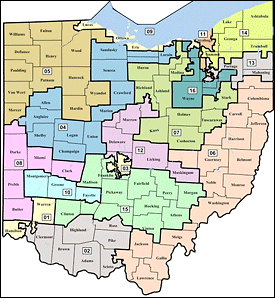
Ohio Congressional Districts

Since the 2000 presidential election, the state of Ohio has been front and center in determining the national political outcome. Despite having a Republican electoral history, the state voted twice for Bill Clinton before returning to support George W. Bush in both of his campaigns. In 2008, Ohio went 51-47 percent for candidate Barack Obama. Now four years later, it again becomes the quintessential political battleground. If Republican presidential nominee Mitt Romney is to unseat President Obama, his path must travel through the Buckeye State.

Along with the presidential contest, Republicans are hoping to make the Ohio Senate race highly competitive and appear to be doing so. State Treasurer Josh Mandel (R), who has already raised over $10 million for the statewide campaign, is challenging first term incumbent Sen. Sherrod Brown (D). This race will be determined along the same lines as the presidential contest and it is plausible that the party winning at the top of the ticket will also sweep in its Senatorial candidate. House races are critically important here, too, with as many as four contests in play for the general election.

The economy will be the determining factor here, as poor financial conditions during the last decade is one reason Ohio’s population growth rate was so anemic during the last census period. The state increased its number of residents only 1.6 percent during that time, which caused it to lose two congressional districts. Along with New York, this is the most in the nation. The US population grew at a 9.7 percent clip during the commensurate period.

The Obama campaign hopes to capture the senior vote with its depiction of the Republican budget proposals as being bad for the elderly. Conversely, the GOP will attempt to coalesce small business owners around the President’s statement saying that individual entrepreneurs didn’t build their own enterprises. Obama will, as he did in 2008, build a coalition of minority voters and single women. Romney will attempt to convince regular church goers to support him en masse.

Assuming that each is successful with their strategic objectives and the aforementioned voter segments break down about evenly in Ohio, another issue could become a wild card – at least that’s what the Romney campaign hopes, as evidenced during the visit to the state last week.

It is the coal issue that could possibly become determinative in Ohio. Perhaps Mr. Obama’s biggest mistake of his presidency was pushing the Cap & Trade measure as his first major legislative initiative. His party suffered greatly at the 2010 ballot box in coal country, and Cap & Trade was a big reason for the Democrats’ poor performance.

When veteran Democratic congressmen Alan Mollohan (WV-1) and Rick Boucher (VA-9) supported the legislation, they were summarily removed from office and clearly because of their energy positions. Things got so bad for Mid-Atlantic Democrats that now-Sen. Joe Manchin actually resulted to taking a gun and shooting a copy of the Cap & Trade bill in one of his campaign ads. The question is, will this voter vitriol continue at the same fever pitch in 2012?

It may in Ohio. With eight public polls being conducted in the state since July 1, most falling within a 3.2 point range between the two candidates (the two extremes gave Obama an eight-point advantage; the other had Romney up two), it is probable that the end result will come down to just a handful of votes.

This is why the Romney campaign is turning their attention to coal, as illustrated by the candidate’s visit to an Ohio coal mine last week. Coal is responsible for generating 82 percent of Ohio’s electrical power and, despite being the seventh-largest state in America, the Buckeye’s rank fourth in coal usage and 10th in production.

It is clear Ohio voters will be hearing a great deal about energy issues throughout the remaining campaign weeks and a lot about each presidential candidate’s position on the various means of energy production. Because coal is such an integral part of the lives and economic well-being of Ohioans, Romney may have found an issue that creates a definitive contrast with Obama where the president has little maneuvering ability. Will this make the difference in Ohio? Time will soon tell.

Incumbent Pairing Too Close to Call in OH-16

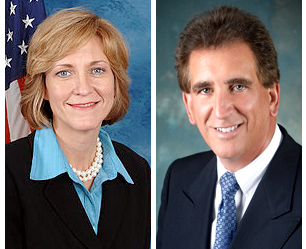
Sutton | Renacci


In Ohio’s only general election congressional race pitting two incumbent members against each other, a new poll reveals a very tight contest with tremendously high stakes.

A GBA Strategies internal poll (July 15-19; 500 likely OH-16 voters; margin of error plus-or-minus 4.4 percentage points) conducted for Democratic Rep. Betty Sutton shows her to be in a statistical dead-heat against GOP freshman Rep. Jim Renacci. The data gives Sutton 42 percent as compared to Renacci’s 40 percent.

Surprisingly, Libertarian candidate Jeff Blevins is taking a sizable 12 percent of the sampled voters. This latter number causes some to question the poll’s methodology because, for a sole independent candidate, these figures are much higher than what is normally seen. Third-party candidates have shown to typically under-perform in their poll results, so it is likely his actual vote total will return to the low single-digit percentages that are normally recorded for such candidates. Interestingly, GBA projects Blevins to be drawing his support equally from both Democrats and Republicans.

The current results show little change from GBA’s October poll that projected the race to be tied, with each candidate attracting 45 percent of the vote. Blevins, however, was not factored into the earlier poll. The numbers are also in line with a June poll from Normington Petts & Associates, a Democratic survey research firm, that found Sutton to be leading Renacci 41-38 percent. In July, the Democratic-leaning House Majority PAC further confirmed Sutton and Renacci were statistically tied at 40 percent, with Blevins taking a much smaller share of the vote.

The 2011 redistricting plan paired Sutton and Renacci as a result of Ohio losing two congressional seats in reapportionment due to slow population growth. With a Republican legislature in control of the redistricting pen, the two were placed in a seat that favors Renacci in a head-to-head race with Sutton. Renacci carries over 41.8 percent residents from his current seat, while Sutton has far fewer constituents in the new 16th. Her carry-over figure is half that of Renacci’s, at 20.6 percent.

With polling leaving us in a statistically deadlocked race, we turn to the importance of spending and fundraising. Renacci was the stronger fundraiser last quarter according to the latest Federal Election Commission financial disclosure reports (closed June 30). He reported raising approximately $502,000 compared to Sutton’s $293,000. Additionally, Renacci ended the quarter with approximately $1.5 million cash on hand, compared to Sutton’s $900,000. Contrary to 2010 when the Republican self-contributed more than $752,000, this year he has only invested $2,500 into his re-election campaign.

Both campaigns and outside liberal and conservative groups already have reserved millions of dollars in TV advertising time in the Cleveland media market. Groups such as the Democratic Congressional Campaign Committee (DCCC) already have reserved over $3 million in Cleveland ad time and similarly the National Republican Congressional Committee (NRCC) as well as other groups has reserved $2 million buys thus far.

This member vs. member match-up has been a tight battle since the seat was redrawn and guarantees to be a horse race until the end. Both candidates have the experience, resources, outside support, and staff to run strong campaigns. OH-16 is considered to be a top race for both the DCCC and NRCC this fall, so stay tuned.

Ohio’s LaTourette to Retire

Latourette

Nine-term Ohio Rep. Steve LaTourette (R-14) abruptly scheduled a news conference for later today to announce that he will not seek re-election in November, despite winning renomination in March. Reports indicate he experienced a falling out with the majority leadership in relation to future committee assignments.

The 14th District, politically marginal in nature, is located in the northeastern corner of the state between Cleveland and the Pennsylvania border. Both President Obama and John McCain received 49 percent of the vote here in 2008.

Local Republican Party officials throughout the district will subsequently meet and choose a replacement candidate. Democrats have accountant Dale Blanchard as their nominee. Blanchard has twice lost to LaTourette and he has yet to even file a 2012 FEC financial disclosure report meaning he has yet to raise $5,000 for the campaign. Unless the Democrats can get Blanchard to withdraw from the ballot, they will be left with a sub-standard nominee in a competitive district.

OH-14 now becomes the 61st open seat in the current election cycle. Much more will be forthcoming from here in the next few days.

Several Races Tighten: Fla., Ohio, Calif.

Rep. Connie Mack IV

Four new polls were released on Friday and each showed developing races that are becoming close. In yet another study that depicts Rep. Connie Mack IV
(R-FL-14) performing very well against two-term Sen. Bill Nelson (D), Survey USA produces numbers reflecting a hot Florida Senate race. According to S-USA (July 17-19; 647 likely Florida voters), Mack actually leads the incumbent Democrat 48-42 percent. The same sample gives President Obama a 48-43 percent lead over Mitt Romney, telling us there is no Republican skew in the respondent sample.

Since May 1, eight public polls of this Florida race have been released from six different pollsters (Quinnipiac University conducted three of the surveys as part of their monthly polling program). In five of the eight Nelson leads. In the other three, challenger Mack has the advantage. The swing goes all the way from 49-36 percent in the senator’s favor (Public Policy Polling; May 31-June 3) to Mack leading 46-37 percent (Rasmussen Reports, July 9). This provides us a net curve of 22 points. Such a large polling variance often reveals an extremely volatile campaign with an electorate willing to change course on a dime. There has been enough polling to tell us that the Florida Senate race features true competition and the thought that Sen. Nelson would have a relatively easy ride to re-election has now been firmly dispelled.

Staying in the Senate, Rasmussen Reports (July 18; 500 likely Ohio voters) projects that the Ohio race is continuing upon a competitive path. The latest RR data gives first-term Sen. Sherrod Brown (D) a 46-42 percent lead over GOP state Treasurer Josh Mandel. The senator has maintained at least a small lead for most of the previous 12-month period. In the presidential race, this Rasmussen sample returned a 47-46 percent spread in the president’s favor.

Other polls have shown much stronger leads for Sen. Brown. Seven surveys have been taken of the Ohio Senate race since the beginning of May, from four different pollsters. All show Brown ahead. His advantage ranges from the four-point lead in the current Rasmussen poll all the way to sixteen (50-34 percent; Quinnipiac University, June 19-25).

Polling also indicates that two southern California congressional campaigns are very close. In the new 24th Congressional District, in what appears to be a pure 50/50 toss-up seat for incumbent Rep. Lois Capps (D), Public Opinion Strategies, polling for Republican Abel Maldonado’s campaign (June 26-28; 400 registered CA-24 voters just now released), projects a two-point race with the incumbent leading 48-46 percent. In the jungle primary, Capps received 46.4 percent, Maldonado obtained 29.7 percent, and Republican Chris Mitchum, son of late actor Robert Mitchum, garnered 21.5 percent. With the combined Republican primary vote exceeding a majority of the ballots cast (51.2 percent), the general election battle is clearly becoming a toss-up.

To the southeast in Long Beach, another survey indicates a close race developing in a newly created open seat, numbered District 47. Here, Democratic state Sen. Alan Lowenthal and Republican Long Beach City Councilman Gary DeLong qualified for the general election with the former scoring 33.8 percent to the latter’s 29.4 percent in a field of eight candidates.

Though this district sets up well for the Democrats, a Probolsky Research survey for the DeLong campaign (June 28-July 3, 400 registered CA-47 voters – released just now) gives Lowenthal only a 44-41 percent advantage as the general election campaign begins in earnest.

This race merits attention and should be considered a lower-level upset opportunity for Republicans. Lowenthal has been underwhelming on the fundraising front, raising just over $511,000, which pales in comparison to DeLong’s $862,908. Gov. Jerry Brown carried this seat 50-41 percent; Sen. Barbara Boxer won it 49-41 percent; and Democratic Attorney General Kamala Harris lost the district 39-45 percent. The Democrats’ voter registration advantage is a little over 10 percent more than Republicans. This campaign carries a Lean Democratic rating with movement toward the toss-up column.

State Presidential Polling Tightens

Photo: The White House

Polling in the presidential race is interesting because the national numbers have been projecting a very tight race, but not particularly so for the key states. Several surveys released yesterday now show a pattern similar to the tight nationwide margins in the core states of Florida, Ohio and Virginia, and second-tier swing state, Colorado.

Nationally, Gallup, Marist College for the McClatchy Newspapers, and the Purple Strategies organizations all give President Obama a two-point lead over presumptive Republican nominee Mitt Romney. But, Rasmussen Reports projects Mr. Romney to be holding the same two-point lead. All of the polls were conducted during the July 9-15 period, though the Rasmussen data is derived from daily tracking surveys.

While the president’s numbers in Florida, Ohio, Virginia and Colorado have exceeded his national performance, such is not the case in the latest wave of studies.

In all-important Florida, Mason-Dixon Polling & Research gives Obama only a one-point, 46-45 percent razor-thin edge, but Purple Strategies (PS) actually detects a three-point Romney lead, 48-45 percent.

Ohio, where the president’s margins have typically been in the high single digits, now brandishes only a three-point Obama lead, 48-45 percent, again according to Purple Strategies.

To the west in Colorado, a state that Obama carried 54-45% in 2008, PS sees the president’s advantage dwindling to just one point, 45-44 percent.

Finally, in Virginia, where the Obama edge has been consistent and relatively strong, Purple Strategies forecasts that his Old Dominion lead is now down to just two points, 46-44 percent.

Major Swing State Polling Figures Show Obama Support

A series of new polls from three major swing states -Florida, Ohio and Pennsylvania – reveals that voters basically support President Barack Obama’s immigration policy, but are split on his handling of the economy.

Quinnipiac University released their research data this week from polls simultaneously conducted in those critical swing states, and the results reveal that the president has a discernible advantage over presumptive Republican nominee Mitt Romney in the three places, the culmination of which could decide the election. The polls, all from the June 19-25 period, report the following ballot test findings:

• Florida: Obama 45 percent – Romney 41 percent (1,200 Florida voters)
• Ohio: Obama 47 percent – Romney 38 percent (1,237 Ohio voters)
• Pennsylvania: Obama 45 percent – Romney 39 percent (1,252 Pennsylvania voters)

Since 1960, history dictates that no one has won the White House without taking at least two of the three aforementioned states. In comparing these results with the similar May 3 Q-Poll findings that gave Obama an eight-point lead in Pennsylvania with Florida and Ohio in virtual dead heats, suggests that the president has gained recent momentum. Today, Obama has clear leads over Romney in the three critically important states and, if such a pattern continues throughout the summer and into autumn, he stands in good position to secure a second term. Keeping in mind that voter disposition over a four-month time period in the modern campaign era can quickly change, this new data again suggests that the 2012 presidential contest will be tight in these three major battleground states.

The polls yield several basic conclusions. Initially, Florida, Ohio and Pennsylvania polling respondents support President Obama’s new immigration policy and are divided over whether he or Romney would be better for the country’s economy and their personal finances.

In Florida, on the heels of the President’s recent decision to prevent deportation of younger Illegal immigrants, Mr. Obama holds a sizable lead among Hispanic voters. Specifically, the Q-Poll indicates an Obama support factor within the Florida Hispanic cell segment at 56-32 percent, compared to 49-39 percent in the May Quinnipiac University poll. The earlier survey was in the field prior to Obama and Romney each making their respective immigration policy speeches. Increasing Republican share of the Hispanic voting block is crucial to a Romney win formula.

Furthermore, Obama leads in other demographic group cell sectors as well, including 85-6 percent support among black voters, which actually could be a low number when compared with voter history from 2008. White voters in Florida back Romney 50-35 percent. Obama also leads among Sunshine State women, 47-40 percent, while men are evenly divided with 43 percent for Obama and 42 percent for Romney.

In Ohio, we find similar results as the Buckeye State Q-Poll reveals 52-38 percent support for the president’s immigration policy. By a margin of 45-38 percent, respondents say he would do a better job than Romney in handling immigration. Obama currently possesses a discernible lead among Ohio Independents, which historically have proven to be a bellwether in determining which way the state will swing.

Pennsylvania women are strongly backing the president according to the Keystone State Q-Poll (48-36 percent), with men tipping 42-41 percent toward Romney. Voters in Pennsylvania don’t necessarily approve of the way Mr. Obama is handling his job as president, split 45-47 percent favorable to unfavorable, but his numbers are better than Romney’s upside down 34:39 percent personal image ratio.

In conclusion, the Florida, Ohio and Pennsylvania polls provide strong indications about which way the country will swing this fall. Today, it is fair to say that this race is still up for grabs, but the president clearly maintains the easier path to ultimate victory in November.

Why Nebraska’s 2nd District Matters So Much in 2012

The 2nd District of Nebraska, which is basically the Omaha metropolitan area, might matter more than any congressional district in the country during the 2012 election. Nebraska and Maine are the only two states that split their Electoral Votes – both states award two votes for winning statewide and one each for every congressional district carried – and, for the first time in the modern political era, the division actually occurred in 2008. Four years ago, President Obama scored a bare one-point win in NE-2, which gave him one extra Electoral Vote and allowed him to gain from a state he lost.

After this past Tuesday’s Nebraska primary, this district proved it will again be important because both newly crowned Republican Senatorial nominee Deb Fischer and Rep. Lee Terry (R) will need to run well here, as will presidential nominee Mitt Romney. If Romney fails to win this lone congressional district, it could mean carrying another entire state just to compensate. There is one plausible election scenario that gives Romney all four of the top priority conversion states – North Carolina, Virginia, Florida and Ohio – in addition to taking New Hampshire. Should he lose NE-2 in this mix, as John McCain did – the race could end in a tie. Therefore, the voters of this district could very well be choosing more than a congressman and US senator on Nov. 6; they could ultimately decide the presidency.

New Polling Shows Presidential Dead Heat

Four brand new polls suggest that Mitt Romney is pulling even with or moving ahead of President Obama in the national popular vote ballot test. According to the latest Gallup tracking study (April 12-16), Romney actually leads Obama 48-43 percent. The New York Times/CBS joint survey (April 13-17) projects both candidates to be deadlocked in a 46-46 percent tie. The Pew Research Center (April 4-15) gives Obama a 49-45 percent edge, and the Rasmussen Reports daily national track (April 17) posts the Republican challenger to a slight one point, 46-45 percent advantage over the incumbent Democrat.

The polls are diverse and were all conducted pretty much over the same time period, and therefore each showed basically the same conclusion. That is significant. The polls taken closer to today (all but the Pew Research study) show Romney in a stronger position, revealing what appears to be a significant recent swing in his direction. The Pew poll is taken over a longer period of time (12 days), which tends to lessen accuracy response. Surveys conducted within a much tighter time frame have greater reliability. Normally, three days is the optimum polling time.

It will not be surprising to see the two candidates jockey for the polling lead until the campaign issues and attack points become better defined. It is always important to remember that the national polls also mean little in determining the outcome of the American presidential contest. The state polls, particularly in battleground regions like North Carolina, Florida, Virginia and Ohio, are the better reflective factors.

Obama vs. Romney – The New Map

With Rick Santorum exiting the presidential campaign, the general election pairing between President Barack Obama and GOP-designee Mitt Romney is now unofficially underway. Based upon polling compiled in all 50 states and the District of Columbia, the Electoral College clearly stacks up in the President’s favor, but the Republicans appear to have already improved their position over John McCain’s dismal 2008 performance.

Today, according to a myriad of public polls, President Obama would carry 26 states plus the District of Columbia for a grand total of 341 Electoral Votes as compared to 24 states and 197 EV’s for Romney. In 2008, the President’s margin of victory over McCain was 365-173, translating into a 64 percent Democratic majority in the Electoral College.

According to the survey data, if the election happened now, the states of Indiana and Iowa would convert from Obama to Romney. The Republican would also reunite Nebraska, meaning the 2nd Congressional District, an EV that went Obama’s way in 2008, would return to the GOP fold. Nebraska and Maine are the only two states who split their Electoral College votes based on statewide and congressional district percentages.

The other change that results in a 12-vote gain for Republicans is reapportionment. With the transfer of 12 congressional seats nationally from one affected state to another, the GOP gains six votes and Obama loses six, for an aggregate swing of 12. This is equivalent to the Republicans converting a state the size of Washington (the only state possessing 12 Electoral votes).

If the polls are accurate, Romney is already gaining 34 Electoral Votes over the McCain total. He is still 73 short of defeating Obama, meaning the states of North Carolina, Virginia, Florida and Ohio again become critically important. A Republican sweep of these places would unseat Obama.