Tag Archives: New York

Congress Convenes Tomorrow with 93 New Members; Early Reapportionment Projections

By Jim Ellis — Monday, Jan. 2, 2023

Congress

Montana’s Ryan Zinke (R-Whitehall) returns to the House.

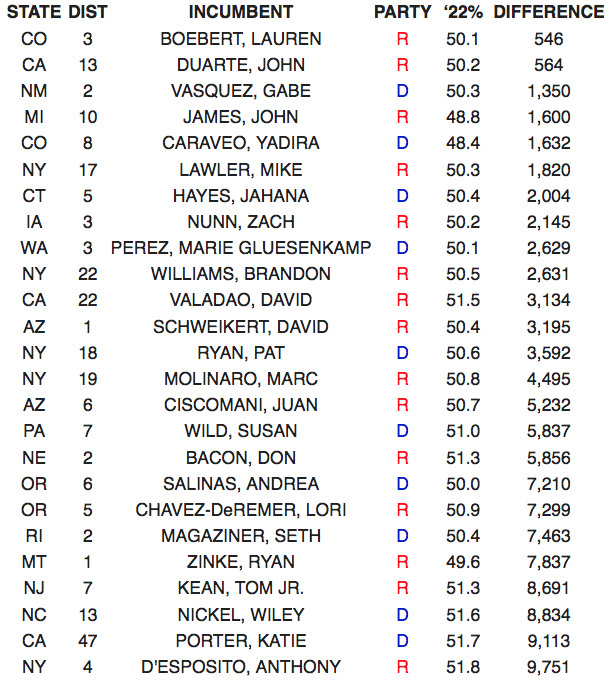
New Members: Congress Convenes Tomorrow with 93 New Members — The 118th Congress is sworn into office tomorrow and like all others, this new assemblage is a unique group.

In the House, we see 85 freshmen members coming to Washington, including the dozen who won special elections during the session just ended. Additionally, one former member, Montana’s Ryan Zinke (R-Whitehall) who also served in the Trump Administration as Interior Secretary, returns to the House.

The Senate, exclusively due to retirements along with one appointed member, California Sen. Alex Padilla (D) seeking a full term, will only welcome eight new freshmen since all incumbents seeking re-election were victorious.

Of the 85 new House members, 46 are Republicans while 39 are members of the Democratic Party. Just over one-third of the incoming group will be serving in their first elected position, a total of 31. Conversely, 37 of the House freshmen have previously been elected to their respective state legislatures. The remaining 17 held other elected positions, typically at the local level as county or city officials.

In the Senate, only two of the eight incoming members have never before served in an elective office: Alabama’s Katie Britt (R) and J.D. Vance (R) of Ohio.

States

Reapportionment: Early Projections — Apparently, it is not too early to begin discussing which states may gain and lose representation in the 2030 census. The first concrete projections have been publicized based upon the country’s current growth trends since the 2020 census was completed.

No real surprises were among the first cut, as eight seats are projected to change states. In the 2020 census, only seven seats changed states. The early estimates suggest that Texas will again be the big gainer, with an additional three seats. This would increase the nation’s second largest population state to 41 seats, if the early guesstimates prove accurate. Florida could gain two seats, with Idaho, Utah, and Washington each gaining one seat.

The losing states would again be familiar, as Illinois and New York could be on a path to lose two seats apiece. Pennsylvania would again be slated to lose one. The new losing states would be Connecticut, New Jersey, and Wisconsin, all possibly losing one of their current districts. None of these projections are firm, and much will happen to change the national and regional growth rates in the coming eight years.

Electoral College — Left Coast, Right Coast; Republicans Choose Nominee in VA-4; North Carolina Supreme Court Rejects Map

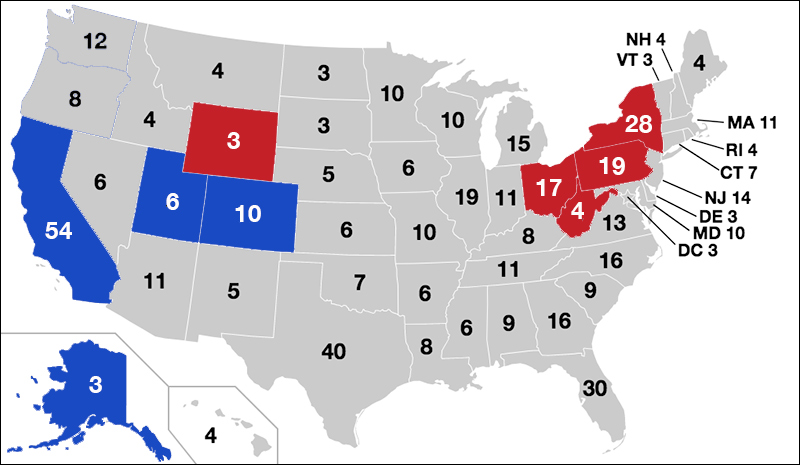
Electoral College Votes Per State, 2022 — blue moving more left, red moving more right


By Jim Ellis — Tuesday, Dec. 20, 2022

President

Electoral College: West Moving Left, East Moving Right — The researchers at the University of Virginia’s Center for Politics have completed a study regarding the country’s ideological shift during the past 20-plus years. Tracking all 50 states’ presidential votes from the 2000-2020 elections, we first see all of the western states now voting Democratic in greater percentages with the exception of Wyoming. The biggest shifts came in Alaska, California, Colorado, and Utah, though two of those four states still regularly produce at least smaller majority or plurality Republican victories.

Conversely, the south and east have trended more Republican with the strongest swings generally occurring in central south with only Maryland, Rhode Island, Vermont, and Virginia becoming more Democratic. Mid-Atlantic states such as New York, Ohio, Pennsylvania, and West Virginia have moved decidedly more Republican, though two of these four continue to regularly deliver clear Democratic majorities. Remaining constant in their voting pattern during this entire 20-year span are Illinois, Maine, Massachusetts, Minnesota, and South Carolina.

House

VA-4: Republicans Choose Special Election Nominee — Republicans re-nominated their 2020 and 2022 candidate in the Saturday, Dec. 17 “firehouse primary” through Ranked Choice Voting. The local 4th District Republican Party leadership did not release the actual results, only to say that pastor and US Navy veteran Leon Benjamin had defeated former Mecklenburg School Board member Dale Sturdifen, and non-profit advocacy organization director Derrick Hollie. Benjamin now advances to the Feb. 21 special general election to replace the late Rep. Donald McEachin (D-Richmond). He will again be a decided underdog in a district that the FiveThirtyEight data organization rates D+30.

The Democratic firehouse primary will be held today. Four candidates filed to run: state Sens. Jennifer McClellan (D-Richmond) and Joseph Morrisey (D-Richmond), former state Delegate Joseph Preston, and businessman Tavorise Marks. While the special election will be held in late February, Gov. Glenn Younkin’s (R) call required the parties to choose nominees by Dec. 23.

In another development, Colette McEachin, the late congressman’s widow, announced her endorsement of Sen. McClellan, joining most of the Virginia Democratic establishment who has already done so.

States

North Carolina: NC Supreme Court Tosses State Senate Map — The North Carolina state Supreme Court, with the 4-3 Democratic majority on the cusp of expiring, rejected the NC Senate map on a partisan vote as a partisan gerrymander. But, the action is likely to be short-lived and adds fuel to the speculation that the new legislature will re-draw all of the state’s redistricting maps after commencement. Doing so may well render moot the partisan gerrymandering case that the US Supreme Court recently heard.

Under North Carolina legislative procedure, the governor has no veto power over redistricting legislation, so whatever the legislature passes will become law. Because of the current court’s farewell action, the state Senate map must be re-configured. Since Republicans gained two seats on the state Supreme Court in the November election and will have a 5-2 majority beginning in January, the likelihood of not only the Senate map being redrawn but also the state House and congressional delegation plans is greater. The latter two maps are court-drawn interim placeholders, which the legislature can replace at any time.

Katie Hobbs Bests Kari Lake in Ariz. Gov Race; Three More House Races Called (2 in AZ; 1 in NY)

By Jim Ellis — Tuesday, Nov. 15, 2022

Governor

Arizona Secretary of State Katie Hobbs

Arizona — In the governor’s race, it has now become official that Democratic Secretary of State Katie Hobbs has defeated former television news anchor Kari Lake, the Trump-supported GOP candidate.

Despite trailing in polling as the race headed into election day, Hobbs was able to secure a tight 50.4 – 49.6 percent win in converting the Arizona governorship to the Democratic column. Nationally, the Democrats gained a net two gubernatorial chairs, winning in Arizona, Maryland, and Massachusetts, and losing in Nevada.

House

Balance of Power — According to the CNN Elections site, 215 seats have now been called for the Republicans as compared to 204 for the Democrats. Fox News has the Republicans at 217 — one seat away from the majority — with a tally of 205 for Democrats. Republicans are now very close to claiming the House majority.

Ten of the still outstanding districts lie in California, and it could be weeks rather than days as to when we will see conclusive results. California election officials have 33 days after the election to receive and count the ballots before certifying a winner. Considering that all mailed ballots, which is how the overwhelming number of people vote in the Golden State, are verified, the count requires an inordinate amount of time to complete.

If the Republican leads hold in the races where their candidate currently has the advantage, the party division will yield a 221R-214D majority. This split would, of course, give the GOP their majority but with a far smaller margin than they had anticipated. With some prognosticators and television commentators having previously believed that the GOP majority could reach well into the 240s, the smaller majority will be viewed as a setback for the party despite them achieving the ultimate goal of wresting control away from the Democrats.

Five of the Republicans’ leads are incumbent races. California Assemblyman Kevin Kiley (R-Granite Bay/Sacramento) is the lone non-incumbent GOP leader and favored to hold his edge in his R+8 rated 3rd District.

Arizona — A trio of House races came off the board last night beginning with Arizona Republican GOP Rep. David Schweikert (R-Fountain Hills) who was projected as a close victor over businessman Jevin Hodge (D) in a Maricopa County district that is much more Democratic than the congressman’s previous seat.

Turning to the Grand Canyon State’s southeast corner, former Hispanic Chamber of Commerce executive and ex-gubernatorial aide Juan Ciscomani (R) has been declared the winner of the open 6th District, thus flipping the seat from which Democratic Rep. Ann Kirkpatrick (D-Tucson) is retiring. Ciscomani defeated former Democratic state Sen. Kirsten Engel.

Along with Republican Eli Crane previously defeating Rep. Tom O’Halleran (D-Sedona) in the new northern Arizona 2nd District, the GOP gains a net two seats in the Grand Canyon State delegation and will hold a 6R-3D advantage in the federal delegation.

New York — Turning to the Syracuse, NY area, first-time candidate Brandon Williams (R), a tech company executive and former Navy veteran, defeated former US Intelligence analyst and previous congressional candidate Francis Conole (D) in the seat that Rep. John Katko (R-Syracuse) has represented for four terms. Katko decided not to seek re-election this year.

Senate Majority Now Decided;
House Majority Continues
To Remain in Limbo

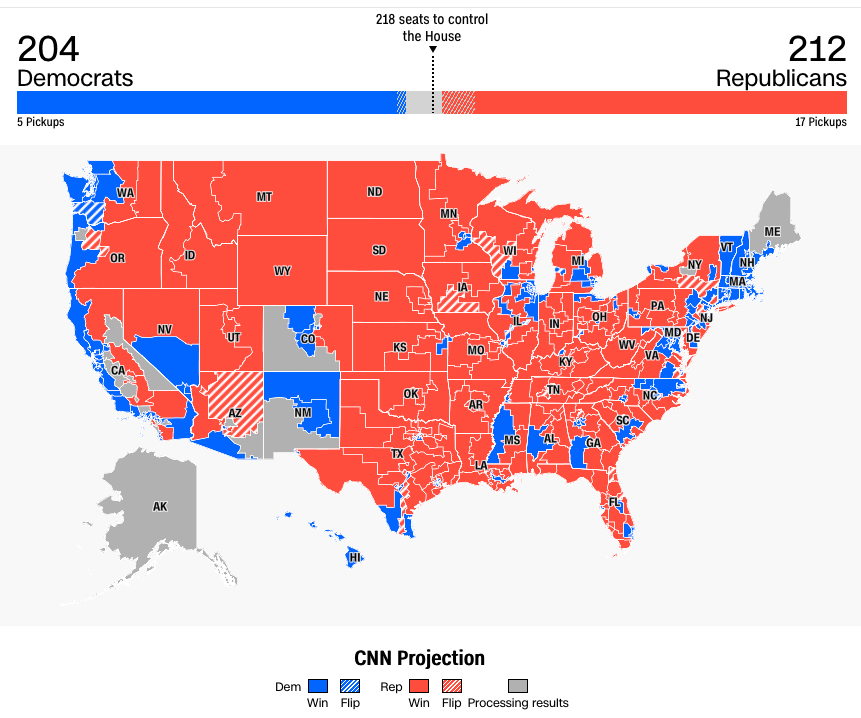
Click on map or here to see CNN’s interactive 2022 elections results House map: CNN

By Jim Ellis — Monday, Nov. 14, 2022

Now, just about a week beyond the 2022 election, each major party still has a chance of controlling the US House, while the Democrats, with late victories in Arizona and Nevada, have secured at least a 50-50 ostensible Senate majority when counting the vice president’s tie-breaking vote.

Senate

Senate: Majority Decided — Just one of the 35 Senate elections still remains undecided: the Georgia race that will head to a post-election runoff on Dec.6. Once the tight Arizona, Nevada, and Wisconsin races were called for incumbents Mark Kelly (D-AZ), Catherine Cortez Masto (D-NV), and Ron Johnson (R-WI) the majority was decided in favor of the Democrats.

The Georgia race unofficially finds incumbent Raphael Warnock (D) holding 49.4 percent of the vote versus Republican Herschel Walker’s 48.5 percent. Libertarian Chris Victor taking 2.1 percent, or just over 48,000 votes, denied both major party candidates the opportunity of reaching the 50 percent plateau. Therefore, the two finalists advance to a new election.

A Warnock win would put the Senate balance of power at 51-49 with the Democrats in control and not needing the vice president to make a tie-breaking vote. A Walker win would leave the Senate without a true majority at 50-50, thus requiring Vice President Kamala Harris’ deciding call on straight party line votes.

The Alaska Senate race is also undecided, but the state’s new electoral system that sends four candidates to the general election won’t be final for another two weeks.

It is obvious that contest will winnow down to a battle between two Republicans, Sen. Lisa Murkowski and former Alaska Director of Administration Kelly Tshibaka. While Tshibaka leads the aggregate vote count, it has become clear that she and Sen. Murkowski will eventually advance into the Ranked Choice runoff.

Though Tshibaka is, and may remain, the vote leader, the RCV runoff system looks to favor Sen. Murkowski. Regardless of which woman is declared the victor when the lengthy process ends, the GOP will retain the Alaska Senate seat.

House

House: Majority Count Remains in Limbo — The House races are still very much undecided with 19 races uncalled. Considering that 10 of those races are in California and one in New York where it will likely take weeks to arrive at final totals, it could be quite some time until we know the ultimate outcome.

According to the CNN election site count, of the 19 uncalled races the Democrats lead in nine, Republicans eight, and two are pure toss-ups, both of which the GOP candidate has a slight count edge. Republicans, however, sitting at 212 called races in their favor versus 204 for the Democrats, need only six of the 19 to fall their way, while Democrats require 14 to claim a bare majority.

It appears the final margin may come down to just one or two seats. The GOP lead seems relatively secure in five of their eight advantage seats, which would give them 217, while the Democrats appear to have solid advantages in another seven of their nine, which puts them at 211.

Therefore, the Republican projection appears to lie in the 217-221 range, while the Democrats’ best-case scenario looks to be scoring a 218-217 slight majority. These predictions, however, are based upon rudimentary projections that could easily change once the actual votes are finally tabulated in all 19 outstanding campaigns.

Governor

Aggregate Governor: Incumbents Dominate — Surprisingly little change occurred in the 36 governors’ races in terms of party change. Democrats, as predicted, easily converted the Maryland and Massachusetts open seats.

The 36 governors’ races are also almost complete, with only Alaska and Arizona uncalled.

In returns that defied polling and thus favor the Democrats, Arizona Secretary of State Katie Hobbs (D) leads former news anchorwoman Kari Lake (R) in the governor’s race, and her advantage may be enough to clinch the office once the state works through its counting delays.

At this point, Hobbs holds a 50.5 – 49.5 percent lead with an estimated 93 percent of the vote counted. This translates into approximately 180,000 votes remaining to be tallied. To win, Lake would have to receive more than 56 percent of the outstanding vote to make up her 26,000-plus vote deficit, which is difficult.

In the only competitive election resulting in a partisan conversion, Republican Clark County Sheriff Joe Lombardo (R) unseated Nevada Gov. Steve Sisolak (D). In races that were largely decided in the states’ respective Democratic primaries, Wes Moore and Maura Healey successfully converted Republican governorships in Maryland and Massachusetts, respectively.

Oregon, the site of perhaps the most interesting governor’s race because it featured a three-way battle, saw former state House Speaker Tina Kotek (D) prevail over ex-House Minority Leader Christine Drazan (R) and former state Sen. Betsy Johnson (I). Polling correctly suggested that Johnson had dropped well off the pace but also largely projected incorrectly that Drazan was positioned for a close upset win. In the end, the election broke 47-44-9 percent in Kotek’s favor with an estimated 93 percent of the all-mail vote counted.

Alaska Republican incumbent Mike Dunleavy looks to be in position to potentially clinch re-election outright, thus exceeding the 50 percent mark within the aggregate vote and avoiding a Ranked Choice Voting instant runoff. With ballots being allowed two weeks to report from the wilderness, it will be just before Thanksgiving when all of the Last Frontier races finally conclude.

Nevada & Georgia Will Decide Senate Majority; House Majority Still in Limbo & Colorado Holds the Key

By Jim Ellis — Thursday, Nov. 10, 2022

Senate

Can former Nevada Attorney General and 2022 Senate candidate, Adam Laxalt (R) pull out a win in the Silver State?

Senate: Nevada & Georgia to Decide Majority — With Sen. Ron Johnson (R) being projected the winner of the Wisconsin Senate race, it means that deciding the Senate majority will likely come down to either the Democrats coming from behind to prevail in Nevada or having to wait to see who wins the Dec. 6 runoff in the Georgia Senate race.

With Sen. Mark Kelly (D) poised to win his yet-to-be-called race in Arizona, whether or not the trends change in Nevada will be the next happening to observe. Currently, former Attorney General Adam Laxalt (R) leads Sen. Catherine Cortez Masto (D) by just under two percentage points, or 15,812 votes with approximately 84 percent of the vote recorded.

CNN has projected that the Georgia race between Sen. Raphael Warnock (D) and Republican Herschel Walker will advance to a secondary runoff election because neither man will reach the 50 percent plateau. Currently, with 99 percent of the votes tabulated, Sen. Warnock’s edge over Walker is 49.2 to 48.7 percent, a margin of 17,500 votes.

House

House: Majority Count in Limbo — Several congressional race projection calls were issued yesterday, and Republicans now have 209 declared seats as compared to the Democrats’ 191. Of the 35 uncalled, 17 are clearly headed to one party or the other. The 18 uncalled campaigns that are purely undecided will put the final touches on the House majority. At this point, the Republicans reasonably look to have clinched 212 seats and the Democrats’ 204 before the final 19 seats are finally declared.

Colorado: Key to Majority — With the House majority definitely on the line, and the winning party ending close to the 218 minimum control mark, two races in the Centennial State of Colorado could be key to determining the final outcome.

In the state’s western slope 3rd District, controversial Rep. Lauren Boebert (R-Silt), who has been trailing her Democratic opponent, former Aspen City Councilman Adam Frisch, since the beginning of the count has now pulled to within just 64 votes with still many votes outstanding. According to the CNN count, five percent of the vote remains.

Colorado received a new district in national reapportionment and the new 8th District is acting just as it was intended, as a toss-up seat. The latest count finds Democratic state Rep. Yadira Caraveo (D-Eastlake) leading state Sen. Barbara Kirkmeyer (R-Weld County) by 899 votes. This race, too, has tightened and CNN reports that only 78 percent of the vote is counted.

New York: Red Wave on Long Island — Though we did not see a “red wave” materialize nationally, we surprisingly saw one on Long Island. In fact, the Island’s two Democratic open seats flipped, the third remained in the Republican column, and Rep. Andrew Garbarino (R-Sayville) was re-elected to a second term.

With Rep. Lee Zeldin (R-Shirley) not seeking re-election in order to campaign for governor, Republican Nick LaLota was declared the winner of his open 1st District, the east Long Island open seat. In the 3rd District, also open because the incumbent, Congressman Tom Suozzi (D-Glen Cove), unsuccessfully ran for governor and lost the Democratic primary to incumbent Kathy Hochul, Republican George Santos was declared the winner.

Finally, in what proved to be the Island’s biggest upset, former Hempstead Town Councilman Anthony D’Esposito will succeed retiring Rep. Kathleen Rice (D-Garden City), who chose not to seek a fifth term. D’Esposito was declared the victor over former Hempstead Town Supervisor Laura Guillen (D), who was considered a big favorite in the D+10-rated district.

Race Roundup: Closing Trends — Volatile and/or Interesting Races to Watch on Election Day

By Jim Ellis — Tuesday, Nov. 8, 2020

With Election Day upon us, we have come to the end of the 2022 cycle; while strategists from both parties are either confidently or reluctantly predicting a Republican victory, not all of the numbers suggest a Red Wave outcome.

Polling generally suggests a good trend for Republicans, but the margin spread is certainly not overwhelming, and under what should be present if this were to become a wave election.

The Biden favorability index is an upside-down 44:53 percent favorable to unfavorable, which is commensurate with Donald Trump’s numbers prior to the 2018 midterm election.

Overall, it does appear that Republicans are well positioned to claim the House majority. The professional and media pollster range is wide and runs from a Republican +14 to +48 seats, but even the low-end prediction would deliver the majority. It is reasonable to believe that the Republican gain factor will be under 30, but this lower number range would still project a comfortable House majority in the new Congress.

The Senate is a flat toss-up with so many races, Arizona, Georgia, Nevada, New Hampshire, Ohio, Pennsylvania, and Wisconsin all polling within a small single-digit margin. Therefore, predicting the eventual outcome has a high difficulty factor. One point that is predictable, though: count on many of these races going into political overtime. This means it could take days if not more than a week to report a final tally on an inordinate number of close races.

With that said, let’s look at the competitive/volatile/interesting races to watch this Election Day:

Senate

Georgia — The Peach State features one of the top US Senate races, and one of only four Republican major conversion targets. Sen. Raphael Warnock (D), who won the special election runoff in 2021, is now running for a full six-year term. His opponent is former University of Georgia and professional football star Herschel Walker (R), and the two will continue to battle until the last vote is counted. Georgia has a majority vote rule, so if neither Sen. Warnock nor Walker reaches 50 percent, the two will advance to a post-election runoff on Dec. 6.

Ohio — The Senate race dominates the Buckeye State political landscape as US Rep. Tim Ryan (D-Warren/Youngstown) and author J.D. Vance (R) battle to the last day of this election cycle. Vance has led in most polls, 15 of the last 19 with two ties, but the Democrats appear to be performing slightly better in early voting. Vance has to be rated at least a soft favorite to win today. Ohio is a must-win for the GOP.

Helping Vance is a strong Gov. Mike DeWine (R) at the top of the ticket who is poised to win a landslide victory. Keeping the DeWine coalition consistent for Vance will be a boost that could well propel him to the victory.

Pennsylvania — Possibly the most publicized Senate race in the country, the open contest between Democratic Lt. Gov. John Fetterman and television’s Dr. Mehmet Oz (R), could well decide the Senate majority. Many believe that the party carrying Pennsylvania punches their majority ticket. Dr. Oz now leads in most polls after the two met in a highly publicized debate on Oct. 25. Early voting patterns, however, appear to favor the Democrats. Remembering that the Republican primary took about a month to decide because the result was so close, it wouldn’t be surprising to see something similar occur for the general election.

Arizona — The Grand Canyon State is one of the hottest political domains in the country. A now toss-up Senate race featuring Sen. Mark Kelly (D) and venture capitalist Blake Masters (R) suggests that this contest will end with a very tight result. Sen. Kelly has a slight lead in polling, but Republicans have the edge in early voting. The governor’s race is also close, but late polls suggest that Republican Kari Lake has late momentum in her race opposite Democratic Secretary of State Katie Hobbs.

Utah — The US Senate race is dominating the Utah political talk as Sen. Mike Lee (R) is on the ballot for a third term, but this time he faces a strong Independent opponent in former presidential candidate (2016) Evan McMullin. Democrats decided not to file their own candidate so they could coalesce behind McMullin and give Sen. Lee a serious challenge. The strategy has worked, as polling shows this race falling into the single-digits. Chances are still good that Sen. Lee pulls away, but this contest has evolved into much more of a serious battle than once believed. Look for a close result.

Nevada — Tough races from the top of the ballot to the bottom face Silver State voters, and the Senate race may yield the Republicans their top conversion opportunity. Polling between former Attorney General Adam Laxalt (R) and Sen. Catherine Cortez Masto (D) has been nip and tuck. With an improved standing among Hispanics, who now are 31 percent of the state’s population, an upset here is possible. Additionally, Democratic Gov. Steve Sisolak is in a toss-up race with Clark County Sheriff Joe Lombardo (R), and this seat could flip, too. Also, in the House races, the new redistricting plan drew three lean Democratic seats in Las Vegas. To gain the majority, Republicans will need to score at least one win here.

Washington — Republicans recruited a strong candidate in former nurse and veterans’ activist Tiffany Smiley. She has become a very good fundraiser and has polled close to veteran Sen. Patty Murray (D). Though Smiley has put forth a strong effort, it will likely not be enough in a strongly Democratic state like Washington. Though she may do well, a close loss is likely on the political horizon for Smiley as opposed to losing big.

Iowa — Sen. Chuck Grassley (R) leads a very busy Iowa ballot. The senator, seeking an eighth term at the age of 89, is in a closer battle than he usually finds, this time against retired Navy Adm. Michael Franken (D). Late polling suggests that Sen. Grassley will still win a comfortable, but not overwhelming victory, meaning he is likely to win in the 50s instead of his customary 60s. Conversely, Gov. Kim Reynolds (R) looks to be cruising to re-election and is expected to easily win a second full term.

North Carolina — The Senate race tops the Tar Heel State ballot this year, and we see another typically tight North Carolina race concluding. US Rep. Ted Budd (R-Advance) looks to have a slight edge over former state Supreme Court Chief Justice Cheri Beasley (D). Early voting is about even between the two parties in terms of past performance, so this is another race that comes down to the wire.

New Hampshire — In what is arguably the most prevalent swing state in the country, the Granite State ballot is filled with competitive races. Gov. Chris Sununu (R) looks set to win a fourth two-year term, but the state’s US Senate race is one of the country’s hottest. Though retired Gen. Don Bolduc (R) was virtually left for politically dead after winning the Sept. 13 primary by a percentage point, he has battled back into competitive status against one-term incumbent and former governor, Sen. Maggie Hassan (D). This race is now in upset alert status.

House

Alaska — The Last Frontier was the host of an interesting special at-large US House election that saw the new Ranked Choice Voting (RCV) system produce state Rep. Mary Peltola (D-Bethel) as the replacement for the late Rep. Don Young (R), even though Republican candidates received an aggregate 60 percent of the vote.

Now, however, it appears Rep. Peltola will win a full term regardless of whether she faces former Gov. Sarah Palin or businessman Nick Begich III, whose late grandfather and uncle served in the House and Senate, respectively, as Democrats. It is further possible that Peltola will win without even being forced into an RCV round because she may garner majority support on the initial vote.

Conversely, Sen. Lisa Murkowski could be forced into a RCV runoff with former State Administration Director Kelly Tshibaka in what would be a double-Republican race. This is a competitive contest, though the Republicans will retain the seat regardless of the outcome.

Iowa — In the state’s four congressional districts, three are highly competitive. In new District 1, freshman Rep. Ashley Hinson (R-Marion/Cedar Rapids) is favored for a second term against state Sen. Liz Mathis (D-Hiawatha). Rep. Mariannette Miller-Meeks (R-Ottumwa), who was a six-vote winner in 2020, looks to be favored over state Rep. Christina Bohannan (D-Iowa City) by more than her previous victory margin, but this contest will still be close in a historically competitive southeastern Iowa district.

The 3rd District battle may be the most competitive within this trio of races. Rep. Cindy Axne (D-Des Moines) is running for a third term having never achieved majority support. State Sen. Zach Nunn (R-Bondurant) is one of the Republicans’ better challenge candidates, and certainly has a strong chance of unseating the congresswoman. This race will draw national attention on election night.

Ohio — In the House races, veteran Cincinnati Rep. Steve Chabot (R) has a much more difficult district (D+3 according to the FiveThirtyEight data organization) than his previous seat. Cincinnati City Councilman Greg Landsman (D) is the Democratic nominee. Rep. Chabot will need a strong turnout model to record another victory in his long 26-year congressional career.

Though veteran Rep. Marcy Kaptur (D-Toledo), the dean of the Democratic conference with 40 years of congressional service, fared poorly in redistricting as her seat went from D+16 to R+6, the Republicans nominating January 6th participant J.D. Majewski has helped paved the path for the congresswoman’s re-election.

The new 13th District, located southeast of Cleveland and anchored in Akron, features a tight contest between Republican attorney Madison Gesiotto Gilbert and Democratic state Rep. Emilia Sykes (D-Akron). In a seat rated R+2, this contest is anybody’s game.

Arizona — Four competitive seats are on tap in the House delegation. Rep. David Schweikert (R-Fountain Hills) face a tough first-time candidate in businessman Jevin Hodge (D) from a new 1st District that is much less Republican than his current 6th CD, a place in which his 2020 re-election percentage did not exceed 52.

Republican Eli Crane, in a new district that is heavily Republican, is favored to unseat Rep. Tom O’Halleran (D-Sedona). Restauranteur Kelly Cooper (R) is challenging Rep. Greg Stanton (D-Phoenix) in a new 4th CD that is now only slightly Democratic. While the congressman is favored, Cooper is a formidable challenger. Rep. Ann Kirkpatrick (D-Tucson) retiring leaves the new 6th CD as a toss-up battleground between former Hispanic Chamber of Commerce executive Juan Ciscomani (R) and ex-state Senator Kirsten Engel (D).

Oregon — Reapportionment delivered a new seat to Oregon, which was placed in the area between Salem and Portland. The primary saw Democratic Rep. Kurt Schrader (D-Canby) lose to newcomer Jamie McLeod-Skinner, who is a former local official in Santa Clara County, Calif. Polling suggests that businesswoman and former local mayor, Lori Chavez-DeRemer (R), has a chance to score an upset win. Competition is also strong in the new 6th District and in the adjacent seat from which veteran Rep. Peter DeFazio (D-Springfield) is retiring.

New Hampshire — The Granite State’s two congressional districts are also highly competitive. Two-term Rep. Chris Pappas’ (D-Manchester) 1st District has defeated more incumbents since 2004 than any seat in the country. Polling has generally posted him ahead of former Trump White House aide Karoline Leavitt (R), but nothing is ever certain in such a volatile political domain.

Rep. Annie Kuster’s (D-Hopkinton/Concord) western state 2nd District is more Democratic than the eastern 1st, but this seat too can record close elections. If what some predict is a coming red wave truly develops, both Democratic incumbents could be unseated.

Governor

Georgia — The governor’s race is also intense, which features a re-match between now-Gov. Brian Kemp (R) and former state House Minority Leader Stacey Abrams (D). Polling suggests that Gov. Kemp will win re-election with a larger vote than the small margin he garnered in 2018, which resulted in his claiming the governorship through a one-point plus win. Though polling is generally looking good for the Republicans here, Democrats are so far exceeding their 2020 early vote performance.

Florida — Florida voters are navigating through a very busy ballot that the governor’s race headlines. Incumbent Gov. Ron DeSantis (R) appears likely to earn a comfortable, low double-digit victory over former governor and resigned congressman, Charlie Crist (D). The late-cycle polling, early voting matrix, and turnout model looks to favor Republicans, which will allow Sen. Marco Rubio (R) to turn back a strong challenge from US Rep. Val Demings (D-Orlando).

Michigan — Inconsistent polling suggests at least a semi-competitive governor’s race featuring incumbent Gretchen Whitmer (D) and challenger Tudor Dixon (R), an online radio personality. Early voting reports are heavily Democratic, which could be an indication of an impending Whitmer victory.

Oregon — The Beaver State is one of the 2022 political hotbeds. With an open governor’s race where a strong independent might flip the race to the Republican nominee in a plurality finish, Oregon is certainly a state to watch from the Pacific zone. Sen. Ron Wyden (D) faces only perennial opposition as he is on the ballot for a fifth full term.

New York — This is a close race, and incumbent Gov. Kathy Hochul (D), who ascended to the office when then-Gov. Andrew Cuomo (D) was forced to resign, finds herself in a much more difficult campaign against GOP US Rep. Lee Zeldin (R-Shirley/East Long Island) than she originally anticipated. Polling is now showing that the governor’s race is a potential toss-up. Still, the overwhelming Democratic margin in New York City should be enough to deliver Hochul a close victory at the very least.

Texas — Polling suggests a relatively close race between Gov. Greg Abbott (R) and former congressman and 2020 presidential candidate Beto O’Rourke (D). Texas Republicans typically are under-counted in polling, so it is likely that Gov. Abbott will score a stronger victory than currently projected.

Wisconsin — The Badger State is a major political battleground as close races for Gov. Tony Evers (D) and Republican Sen. Ron Johnson, are nip and tuck. Both are considered toss-ups, though polling now slightly favors Sen. Johnson in his re-election contest.

Single Digit Difference in Washington Senate Race; Similarly Tight Races in Nevada House Races; NY Gov. Candidates in Close Battle, Too

By Jim Ellis — Thursday, Nov. 3, 2022

Senate

Washington Senate race challenger Tiffany Smiley (R)

Washington: Tight Single Digits Confirmed — We now see two separate polling firms coming to the conclusion that the Washington Senate race, always on the periphery of competitiveness, is closing in challenger Tiffany Smiley’s (R) favor.

The Trafalgar Group poll (Oct. 25-28; 1,207 likely Washington general election voters; multiple sampling techniques) released their results finding Sen. Patty Murray’s (D) lead over Smiley dropping to a bare 49-48 percent. Insider Advantage, in their one-day flash poll on Oct. 31 (550 likely Washington general election voters) sees a very similar 48-46 percent split. The IA polling analysis suggests a post-televised debate surge of independent voters to Smiley accounts for the status change.

House

FL-4: Senate President Pro Tem Cruising in Congressional Race — The Republican-drawn congressional map created a new open seat in the Jacksonville area that is poised to elect a new Republican member. A just-released University of Northern Florida survey (Oct. 20-27; 413 likely FL-4 general election voters) suggests that the draw will remain true. The poll finds state Senate President Pro Tempore Aaron Bean (R-Jacksonville) leading businesswoman LaShonda Holloway (D) by a double-digit margin, 50-38 percent. Bean was an easy winner in the Republican primary and should have little problem adding this seat to the GOP column next week.

Nevada: Underlying House Numbers Looking Good for GOP — We’ve seen a plethora of polling for the Nevada statewide races, and most numbers during the last month has shown the Republican candidates either tied or slightly ahead with the Democratic incumbents below 50 percent. But, we’ve seen very little data concerning the three competitive Las Vegas congressional districts.

Emerson College just released their polling results in the three districts from surveys taken during the Oct. 26-29 period, sampling between 480 to 530 likely voters. In the 1st District, Republican Mark Robertson (R) has a commanding 54-42 percent lead over incumbent Rep. Dina Titus (D-Las Vegas) — a very surprising result. At the time of the legislature passing redistricting, however, Titus warned that the new 1st District draw would endanger her.

In the new 3rd, Republican April Becker has a smaller, but substantial, 52-47 percent lead over two-term Rep. Susie Lee (D-Las Vegas). In the slightly more Democratic 4th CD, incumbent Steven Horsford (D-Las Vegas) claims a slight 51-48 percent edge over Republican businessman Sam Peters.

New Hampshire: Two Latest Polls Flip Races — The latest two polls in New Hampshire’s pair of congressional districts see flipped results in both races. Last week, we reported on the co/efficient research organization’s surveys over the Oct. 25-26 period that saw Democratic Rep. Chris Pappas (D-Manchester) leading Republican Karoline Leavitt in the 1st District race, 48-44 percent, while they found GOP challenger Robert Burns edging Rep. Annie Kuster (D-Hopkinton/Concord), 44-43 percent, in the 2nd District race.

St. Anselm College, a regular New Hampshire polling entity, released the results of their set of Oct. 28-29 surveys earlier this week, and they produce opposite results. In the 1st District, St. A’s sees Leavitt pulling ahead of Rep. Pappas in the district that has defeated more incumbents than any seat in the country since 2004, by a surprising 51-45 percent count. In District 2, St. Anselm posts Rep. Kuster to a 50-42 percent advantage over Burns. Once again, we see different pollsters arriving at differing results for the same races. Compiling the data suggests that both of these swing races are too close to call.

Governor

New York: Seriously Tight — US Rep. Lee Zeldin (R-Shirley/East Long Island) has now clearly made the governor’s race into a tight contest according to a pair of polling firms, although a third disagrees. Three more polls were released testing his candidacy against that of Gov. Kathy Hochul (D), and two of the results find a virtual tie.

KA Consulting (Oct. 27-29; 501 likely New York voters; live interview) finds Gov. Hochul’s lead to be only 46-45 percent, while the Trafalgar Group (Oct. 27-31; 1,198 likely New York voters; multiple sampling techniques) sees Rep. Zeldin actually pulling into a lead by just under one full percentage point. Conversely, Emerson College’s results (Oct. 28-31; 1,000 likely New York voters; multiple sampling techniques) claims that Gov. Hochul maintains a lead well beyond the polling margin of error at 52-44 percent. We will see which firms are closer to the end result in less than a week.