
Tag Archives: New Jersey

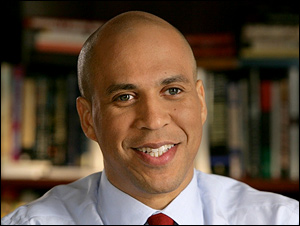
Booker Cruises to a Win

Newark Mayor Cory Booker (D)

Newark Mayor Cory Booker (D)

Yesterday, just 8.8 percent of New Jersey voters went to the polls (481,847 of more than 5.47 million registered with 98 percent of precincts reporting) to participate in the special primary election for US Senate, a process that will prove to be the determinative step in choosing the late Sen. Frank Lautenberg’s (D) successor.

As aggregate polling had almost exactly predicted since the first day of this special election cycle, Newark Mayor Cory Booker commanded the Democratic primary. He racked up 59 percent of the vote compared to second place Rep. Frank Pallone’s (D-NJ-6) 20 percent, third-place finisher Rep. Rush Holt’s (D-NJ-12) 17 percent, with Assembly Speaker Sheila Oliver tallying only 4 percent.

Under Gov. Chris Christie’s (R) special election schedule, the general election vote is Wednesday, Oct. 16, and will officially feature Booker and Republican former Mayor Steve Lonegan (R-Bogota) who easily won the GOP nomination. Lonegan attracted 79 percent of the GOP vote against physician Alieta Eck. Six Independents will also appear on the general election ballot. The national Republican Party apparatus is not expected to actively support Lonegan, virtually conceding the seat to Booker.

The Newark mayor raised close to $10 million for the special primary election ($8.6 million through the final July 24 pre-primary disclosure period) as compared to Pallone’s $729,000 through the same period, though the congressman was able to transfer some $3.3 million from his US House committee. Holt raised over $962,000 during the same time frame and transferred an additional $500,000 from his congressional account to exceed $1.4 million in total Senate campaign receipts. Oliver reported raising less than $12,000.

Of the more than 481,000 people who voted yesterday, 352,120 participated in the Democratic primary. In a state where  Continue reading >

Re-Capping the Senate

Current Senate makeup

Current Senate makeup

With last week’s announcement that Rep. Tom Cotton (R-AR-4) would challenge Sen. Mark Pryor (D), thus setting the Arkansas field for 2014, it is a good time to check the national US Senate picture.

In 2014, 35 Senate races are on tap, including campaigns in Hawaii and South Carolina to affirm political appointments. Of the 35, the following 18 senators currently have little or no pending opposition for 2014:

Jeff Sessions (R-AL), Mark Udall (D-CO), Chris Coons (D-DE), Jim Risch (R-ID), Dick Durbin (D-IL), Pat Roberts (R-KS), Susan Collins (R-ME), Ed Markey (D-MA), Thad Cochran (R-MS), Jeanne Shaheen (D-NH), Tom Udall (D-NM), Jim Inhofe (R-OK), Jeff Merkley (D-OR), Jack Reed (D-RI), Tim Scott (R-SC), Lamar Alexander (R-TN), John Cornyn (R-TX), and Mark Warner (D-VA).

Alaska:
Despite the potential of former Gov. Sarah Palin (R) running here, the likely 2014 pairing is first-term incumbent Sen. Mark Begich (D) and Lt. Gov. Mead Treadwell (R). This will be a tight race, but Alaskans don’t often unseat incumbents.

Arkansas: The match is already set – Sen. Mark Pryor (D) vs. Rep. Tom Cotton (R). Arkansas is now trending Republican, but unseating an incumbent – especially one who ran unopposed in the previous election – is never easy.

Georgia: Michelle Nunn (D), the daughter of former Sen. Sam Nunn (D), will be her party’s nominee. The Republican side is a free-for-all among five candidates, all of whom could conceivably win the nomination. The Republican general election candidate should have the advantage, but this primary battle could turn nasty.

Hawaii: Appointed Sen. Brian Schatz is drawing serious Democratic primary opposition from Rep. Colleen Hanabusa. The Dem primary, which must be rated a toss-up, will determine who wins the  Continue reading >

Louisiana House Vacancy

Two days ago, Rep. Rodney Alexander (R-LA-5) surprisingly announced that he would retire from Congress. Yesterday we find he means to exit right away, leaving mid-term in order to accept a position in Gov. Bobby Jindal’s (R) administration as the state’s Veterans’ Affairs Director.

Jindal (R) has already taken action and defined the 5th District special election calendar. As you most likely remember, Louisiana employs the jungle primary system, which means all candidates appear on the same primary ballot regardless of political party affiliation. If a candidate receives an outright majority of the vote, said individual is elected. If no candidate secures at least 50 percent plus one vote, then the top two finishers advance to a final run-off election.

In this instance, Gov. Jindal has chosen Oct. 19 for the first election, with the run-off to occur on Nov. 16. The candidate filing deadline is a quick Aug. 21, therefore giving prospective candidates little time to decide whether they will make the race.

Already, two state legislators have announced their special election candidacies. Republican state Sen. Neil Riser and Democratic state Rep. Marcus Hunter will both soon form campaign committees. Alexandria Mayor Jacques Roy admits that he is considering running, saying that he believes his “centrist Democrat” philosophy is in line with the majority of the 5th District’s constituency.

The 5th CD consumes all of northeastern Louisiana and then takes the upper half of the state’s eastern tail. The Alexandria and Monroe areas are the largest population centers, but each metropolitan region fails to top 65,000 residents.

Mitt Romney defeated President Obama here 61-38 percent in 2012. John McCain carried the seat 62-37 percent over Mr. Obama in 2008. Republicans are the early favorites to hold the district.

2013 Polling Notes:

Two new polls were released covering northeastern 2013 political action.

New Jersey

In the Garden State, Quinnipiac University (Aug. 1-5; 2,042 registered New Jersey voters) tested the upcoming governor’s race where incumbent Chris Christie (R) appears to be steaming toward re-election.
 Continue reading >

NJ Senate Race: Already Over

Newark Mayor Cory Booker

Newark Mayor Cory Booker

The New Jersey special primary election to replace the late Sen. Frank Lautenberg (D) is scheduled for next Tuesday (Aug. 13), but according to Quinnipiac University’s final poll before the vote, the race is virtually over.

When Lautenberg died in early June and Gov. Chris Christie (R) scheduled the special election to choose a replacement, the early polling showed Newark Mayor Cory Booker with numbers approaching or breaking 50 percent of the Democratic vote with the other candidates, representatives Frank Pallone (D-NJ-6), Rush Holt (D-NJ-12), and state House Speaker Sheila Oliver, barely breaking past 10 percent or registering only in single digits.

In the just-released Q-Poll (Aug. 1-5; 2,042 registered New Jersey voters; 388 likely Democratic primary voters) the results have barely changed. According to the data, Booker commands support from 54 percent of the polling sample versus just 17 percent for Rep. Pallone, 15 percent for Rep. Holt, and only 5 percent for Speaker Oliver. With less than a week to go, it’s hard to conceive of any scenario that does not result in a Booker victory.

Forecasting toward the special general to be held Oct. 16, the Democrat vs. Republican results are similar. With former Bogota Mayor Steve Lonegan enjoying a commanding lead in the special Republican primary, a projected Booker-Lonegan pairing appears to be no contest. According to the Q-Poll, Booker would lead such a campaign 54-29 percent.

Though this primary battle has lacked serious competition, there are still some interesting points to be made. First, as it relates to the Q-Poll, there does appear to be some potential irregularities in the polling sample. With 2,042 people being interviewed, it’s hard to see how only 388 and 267 of them identify themselves as either Democratic or Republican primary voters, respectively. One would expect at least the Democratic number to be much  Continue reading >

A 2014 Senate Re-Set?

As we’re just coming through the off-election year July 4 break, it’s a good time to examine the progression of the current Senate and House political picture. Today, we look at the Senate landscape.

As we know, the current Senate’s party division stands at 54 Democrats and 46 Republicans, with the GOP “renting” the New Jersey seat until voters in the Oct. 16 special election choose a permanent replacement for the late Sen. Frank Lautenberg (D). Though Gov. Chris Christie (R) appointed Republican Jeff Chiesa to serve in an interim capacity, the fact that the new senator didn’t choose to run for the seat leaves the GOP prospects to also-ran candidates who don’t have a realistic chance of defeating the eventual Democratic nominee. This being the case, in order for the Republicans to overtake the Democratic majority, a conversion swing of six seats still is necessary.

Of the 35 Senate seats that comprise the 2014 election cycle, we can segment the competition into three groups of three and two groups of two, for a grand total of 13 political situations that will determine the new majority’s complexion. Right now, the remaining 22 campaigns appear to be safe for the incumbent senator, or his party in the case of open New Jersey and Nebraska (Republican Sen. Mike Johanns retiring).

The three groups of three contain the nine Democratic seats that are fielding varying degrees of competition. All should be strong conversion opportunities, but only six realistically appear that way today.

First Group of Three: D to R

The first group contains the seats most likely to move from Democrat to Republican. The open contests in West Virginia (Sen. Jay Rockefeller retiring) and South Dakota (Sen. Tim Johnson retiring) look to be locks to move Republican in the persons of Rep. Shelley Moore Capito (R-WV-2) and former Gov. Mike Rounds (R-SD). Democrats have yet to recruit a West Virginia candidate and they are already into the second tier in South Dakota. The third state in this category is the open Montana seat (Sen. Max Baucus retiring) where Republican prospects are growing. Though he could quickly up and enter the race without any pre-announcement fanfare, former Gov. Brian Schweitzer (D) is  Continue reading >

New NJ Senate Candidate May Change Things

NJ State Assembly Speaker Sheila Oliver

NJ State Assembly Speaker Sheila Oliver

The New Jersey Senate special election candidates submitted their ballot qualification petition signatures to the state’s Division of Elections, and one of the individuals filing was a bit of a surprise.

State Assembly Speaker Sheila Oliver (D-East Orange) began publicly mulling entering the race just over the weekend, and yesterday she did just that. As the sitting leader of one of the state’s two legislative chambers, and in a situation where everyone knows she will continue in this position even if losing the Senate race, Oliver should be able to raise enough money to compete.

If she can successfully mount a challenge, Speaker Oliver has the potential of hurting Newark Mayor Cory Booker. As the second African-American candidate in the race, Oliver cutting into what should be a solid base vote for Booker could bring all of the Democratic candidates into contention.

Also filing signature petitions yesterday, as expected, were representatives Frank Pallone (D-NJ-6) and Rush Holt (D-NJ-12). One thousand valid signatures from registered voters are required. Holt, in fact, appeared in person at the Division of Elections office in Trenton to deliver petitions containing more than 3,000 signatures.

Republicans Steve Lonegan, the former mayor of Bogota, NJ, and physician Alieta Eck also filed, but neither is expected to be major competition for the eventual Democratic nominee. Therefore, the Aug. 13 Democratic primary vote will effectively elect the next US senator.

Two polls were quickly put into the field, but  Continue reading >

Christie Appoints Chiesa; Holt Joins the Race

Gov. Chris Christie

Gov. Chris Christie

New Jersey Gov. Chris Christie (R) yesterday appointed Attorney General Jeff Chiesa (R) to replace the late Sen. Frank Lautenberg (D) who was laid to rest on Wednesday. Chiesa is a long-time associate of the governor’s, having served with him in a law firm and Christie’s US Attorney’s office before being appointed attorney general. Chiesa said he will not enter the special election, therefore he will serve only through the conclusion of the short special election cycle now scheduled for Oct. 16.

Also yesterday, Rep. Rush Holt (D-NJ-12) sent an email message to supporters announcing himself as a candidate in the New Jersey special Senate election and asking for help in collecting the 1,000 valid registered voter signatures to qualify him for the ballot.

In his email, Holt said his reason for running “is simple.” He believes that he is “… the best candidate to continue the passionate advocacy for progressive values that Sen. Lautenberg exemplified.”

As you will remember, Gov. Christie scheduled the 2013 vote to replace Lautenberg despite the seat being in-cycle during 2014. The governor is now taking political heat because he is spending $24 million in taxpayer dollars to hold a special vote just three weeks before the regular Nov. 5 statewide election, when Christie himself faces the voters. His motive in not joining the two elections is clearly to avoid an increased turnout from Democrats desiring to elect their Senate nominee, and who would likely vote for gubernatorial nominee Barbara Buono while in the voting booth.
 Continue reading >

NJ’s Christie Takes Action

Only a day after New Jersey Sen. Frank Lautenberg (D) passed away, Gov. Chris Christie (R) held a news conference earlier this afternoon to announce his Senate succession plans. While saying he had the legal authority to appoint a successor to serve the balance of Lautenberg’s term, the governor instead called a special election, saying that “18 months was too long a time for an appointed senator to serve.”

Therefore, within the legal time constraints of calling the special election today, the nominating vote will be Aug. 13, with the special general senatorial election following on Oct. 16. The regular general election, featuring Christie himself, is Nov. 5.

Newark Mayor Cory Booker will run for the Democrats. Likely entrants are representatives Frank Pallone (D-NJ-6) and Rush Holt (D-NJ-12). Since the US House members will not have to risk their seats to run in the short special election, some of the Republicans might also enter the race.

Christie’s move is a good one for his own campaign. He allows the people a vote, but avoids a spike in Democratic turnout because the special Senate vote will not conflict with his election.

The governor also said he will soon appoint a replacement to serve until the special election concludes. He stipulated that he will not put a “caretaker” condition upon his eventual selection. Therefore, the person he appoints could also run in the special election.

New Jersey Confusion

New Jersey

New Jersey

Sen. Frank Lautenberg’s (D-NJ) death yesterday illuminated another ambiguity in the New Jersey Election Code. At stake is whether Gov. Chris Christie (R) is forced to schedule a replacement special election this year, or whether his interim appointee can carry serve the remainder of Lautenberg’s current term.

The last time the state had a Senate vacancy occur outside a regular election period was in 2002, when Sen. Bob Torricelli (D) ended his post-nomination re-election bid due to campaign finance irregularities. Six weeks away from the ’02 general election, Torricelli was under heavy media pressure. Several incidents of potential illegality were coming to the forefront, and polls were showing him dropping behind GOP challenger Doug Forrester. With party leaders clearly understanding that the seat slipping through their fingers, Torricelli was forced out. Even though the Garden State election law seemed clear that the time for changing nominees had long since passed, the New Jersey Supreme Court allowed the Democrats to replace Torricelli. The man they had waiting in the wings to do so was none other than former senator Lautenberg, who had retired just two years earlier.
 Continue reading >

Senate Questions

capitol

Within the last week, no fewer than four major potential senatorial candidates have decided not to run. Three sitting members of the House, representatives John Barrow (D-GA-12), Steve King (R-IA-4), and Tom Price (R-GA-6), and one former congresswoman, Stephanie Herseth Sandlin from South Dakota, each announced that they will be doing something other than running for the United States Senate in 2014. With so many potential candidates content to allow their current opportunity to evaporate, what now is the status of the various Senate races?

Both the Republicans and Democrats have, so far, experienced recruitment failures. Democrats see two seats that they currently hold, Jay Rockefeller’s post in West Virginia and Tim Johnson’s position in South Dakota, going by the wayside. Currently, they have no candidate willing to challenge GOP Rep. Shelley Moore Capito (R-WV-2) in the Mountaineer State, and their two strongest South Dakota potential contenders have taken a pass. While they do have a former aide to Sen. Tom Daschle (Rick Weiland) now in the race, it is apparent that he is no match for Republican former Gov. Mike Rounds.

Republicans have yet to field a candidate in Iowa where Sen. Tom Harkin (D) is retiring.  Continue reading >