
Tag Archives: Missouri

Redistricting Becoming Clearer

By Jim Ellis — Tuesday, Dec. 16, 2025

Redistricting

Putting together the redistricting puzzle

The redistricting wars may be coming to a head. Recent action has occurred in several states providing a better national redistricting picture in preparation for the 2026 election.

Below is a synopsis of the latest developments:

California: After a majority of California voters approved the special election redistricting referendum, a racial gerrymandering lawsuit was filed against the state’s new map.

Meanwhile, the US Supreme Court issued a stay on the Texas racial gerrymandering lawsuit, with a rebuke from Justice Samuel Alito to the three-judge panel in El Paso for rendering a decision before the high court ruled on a related Louisiana racial gerrymandering case. Thus, it became clear that all other cases would be held until the high court issues what could be a landmark ruling.

The judicial action likely means the new California map will be in place for the 2026 election. The original map proponents believe the plan will return five more seats for the Democrats, reducing the Republicans to just four of 52 Golden State districts.

Florida: Late last week, Gov. Ron DeSantis (R) said that the state will redistrict the congressional map and do so during the Spring. The Florida primary is not scheduled until Aug. 18, so time remains to complete the redistricting process. It is possible that Republicans could gain two seats from a new map.

Georgia: A new Georgia map has been completed. The legislature made minor changes to the existing plan that will not likely affect the current partisan division (9R-5D).

Indiana: Late last week, the Indiana state Senate defeated a redistricting map that the state House passed. The plan would have converted two Democratic seats to Republican, thus sweeping the nine-member delegation. Unless the Senate reconsiders the action, the current 7R-2D map will remain intact for the 2026 election.

Louisiana: The US Supreme Court is considering the Callais racial gerrymandering case that could become the vehicle for the justices to render a landmark racial gerrymandering decision. A ruling was expected in June, but the justices postponed their opinion and ordered a second round of oral arguments. The subsequent hearing was held Oct. 15, and all await a final determination.

If the court upholds the lower court decision, the current Louisiana map will be invalidated, meaning the Republicans will likely gain one seat. Should this be the Supreme Court’s ultimate decision, then the possibility exists that the Alabama map will also be redrawn because its plan is virtually identical to Louisiana’s.

Maryland: In a situation similar to what is found in Indiana, most of the Maryland Democratic political establishment favors attempting to collapse their one Republican congressional district, but the state Senate leadership refuses to take action. Therefore, unless the Senate President completely reverses himself, a new redistricting map will not be enacted.

Missouri: The Missouri legislature and Governor have enacted a new map that will likely convert the Kansas City anchored 5th CD from Democratic to Republican. Opponents of the map, officially organized under a group name entitled People Not Politicians, have collected double the number of signatures needed to force a special election initiative vote with the goal of repealing the new map. If a ruling is made qualifying the initiative for the ballot, voters will then decide if the new map will stand.

Under Missouri procedure, simply qualifying the initiative will suspend the new map. This means the state would be forced to revert to the 2021 map for the 2026 election. An initiative vote would occur in the regular election cycle. If the voters adopt the new plan, it would take effect in the 2028 election cycle.

North Carolina: The legislature’s new congressional map will almost assuredly stand for the 2026 election. The initial complaint protesting the plan was rejected at the lower court level. The US Supreme Court’s action involving the Texas case suggests that no further judicial movement will occur on the new North Carolina plan before the candidate filing deadline on Dec. 19. Therefore, it is likely that Republicans will gain one seat in the Tar Heel delegation.

Ohio: The bipartisan elected official redistricting commission unanimously agreed upon a new congressional map, one that state law mandated be drawn. Under the Ohio procedure, a unanimous decision from the redistricting panel, which included Gov. Mike DeWine (R), means the map is officially enacted without action from the state legislature. The new plan will likely produce a one seat gain for Republicans in western Ohio, with the outside possibility of a second conversion in Cincinnati.

Texas: As discussed above, the Supreme Court stayed the three-judge panel decision that ruled the new map a racial gerrymander. Candidate filing has concluded, so the new 2025 map will be in place for the 2026 elections. The original map proponents believe the plan will return five more seats for the Republicans.

Utah: A state court ruled that the legislature ignored certain criteria that voters adopted in a previous redistricting initiative. Therefore, the 2021 map was declared invalid, a ruling that the state Supreme Court sustained. The court then adopted a new map that created a Salt Lake City Democratic seat. The new plan will produce a 3R-1D map for the 2026 election, which is a gain of one Democratic seat.

Virginia: The Old Dominion redistricting effort may determine which party wins the national redistricting wars. With the Democrats gaining full control of the state government, the new legislature must pass a referendum for the ballot when they convene in January. The measure will have to fulfill other legal requirements, and a special statewide referendum election is required. Voters would have to approve a new map before the April 2 candidate filing deadline for the June 16 primary election.

Democrats claim they can draw a map that will relegate Republicans to just one seat in the 11-member delegation. Currently, the Virginia congressional districts split 6D-5R. A four-seat swing in this state could tip the balance of power toward the Democrats in their quest for the US House majority.
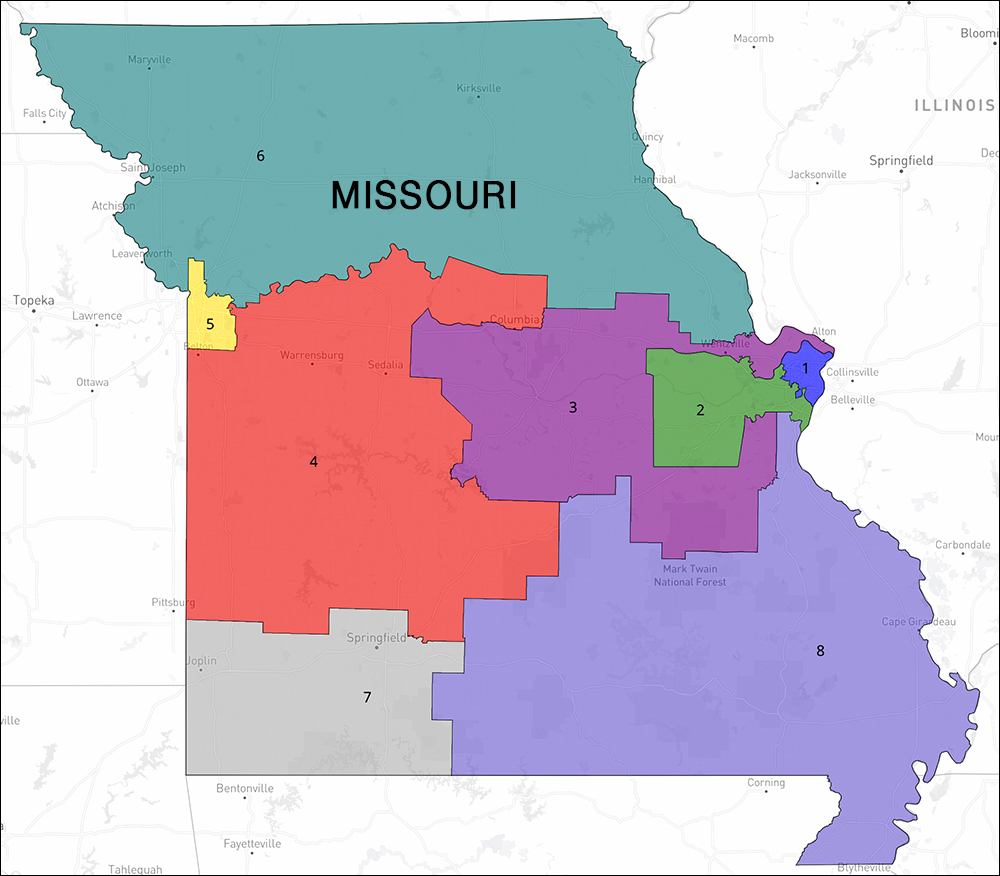
The New Missouri Lines

Missouri Congressional Districts / Click on image to go to Dave’s Redistricting interactive map.


By Jim Ellis — Monday, Oct. 6, 2025

Redistricting

Missouri Gov. Mike Kehoe (R) signed the legislature’s new congressional redistricting map this week, so it appears that the Show Me State delegation will compete in new districts next year.

Naturally, lawsuits are being filed to nullify the new map, and it remains to be seen how the courts will rule through the continuing legal process. Depending upon the lawsuit’s subject matter, the Louisiana racial gerrymandering case before the US Supreme Court could have an effect upon future Missouri map rulings. Oral arguments for the Louisiana case are scheduled for Oct. 15, with a decision to come before the year ends.

The new Missouri map protects all six GOP incumbents, though most shed Republican voters in order to create a new western Republican 5th District. At the heart of the new plan is changing the Kansas City area to create a new Republican leaning seat instead of 11-term Rep. Emanuel Cleaver’s (D-Kansas City) urban downtown district.

To make the plan work for the GOP, the map drawers expanded the 4th District’s Jackson County share, including drawing the seat directly into Kansas City. Previously, the 4th contained part of Jackson County but none of Kansas City. The design then drives the new 5th CD into rural areas, while still keeping a large portion of Kansas City. The new draw then extends the seat east all the way past Jefferson City, meaning the 5th district’s eastern boundary is now closer to St. Louis than Kansas City.

The new partisan lean of 58.4R – 40.1D (Dave’s Redistricting App calculations) is quite different from the previous 5th’s 60.8D – 35.9R division. The difference is a net swing of 43.2 percentage points in the Republicans’ favor.

Though the new 5th District appears reliably Republican, Kansas City Mayor Quinton Lucas (D) indicated he might consider running for Congress there, believing the seat will still be competitive and assuming 80-year-old Rep. Cleaver does not seek re-election. The Mayor indicated he wants to ensure that “Kansas Citians … have a choice at the ballot box that represents Kansas City viewpoints and values.”

The 4th District alterations are also substantial. According to the Dave’s Redistricting App calculations, the new partisan lean is 59.9R – 38.7D. The previous 4th held a partisan break of 66.8R – 29.9D under the same projection formula, so we see a net change of almost 16 percentage points toward the Democratic line.

Rep. Mark Alford’s (R-Lake Winnebago) 4th is still strongly Republican, and the Congressman will be a clear favorite to win re-election, but he may have to wage a more active campaign than he would have from his original 4th CD.

The remaining six districts all keep their population cores though the partisan leans change in some cases.

The 1st District is again largely the city of St. Louis, but the partisan lean has been made just slightly more Democratic. In the 2021 map, the partisan division was projected at 77.1D – 20.4R. The new 1st carries a 77.9D – 20.3R break. Here, we are likely to see a Democratic primary re-match.

Earlier in the week, former Rep. Cori Bush, who lost renomination in 2024, said she will return to face now-Congressman Wesley Bell (D-St. Louis). Irrespective of who prevails in next year’s Aug. 4 Dem primary, the winner will claim the new 1st in the general election.

Another Republican redraw goal was to improve Rep. Ann Wagner’s (R-Ballwin) re-election prospects in her St. Louis suburban 2nd District by adding more Republican voters. According to the Dave’s Redistricting App calculations, the new partisan lean is 54.9R – 43.4D, which is a further cushion of about a point and a half for the seven-term incumbent.

The Republicans from District 3 (freshman Rep. Bob Onder) and 6 (Rep. Sam Graves) both see their respective districts become slightly more Democratic, but the two seats remain firmly in the GOP camp and neither incumbent will have trouble being re-elected.

The two southern Missouri congressional seats, District 7 (Rep. Eric Burlison) and 8 (Rep. Jason Smith), actually see their two safe Republican seats become even more so under the new plan.

Assuming the new map withstands the legal challenges, expect the Republicans to see a net gain of one seat in the Missouri delegation.

Political Roundup

By Jim Ellis — Monday, June 23, 2025

Governor

Virginia  Lt. Gov. Winsome Earle-Sears (R)

Virginia Lt. Gov. Winsome Earle-Sears (R)

Virginia –– Lt. Gov. Winsome Earle-Sears and former Rep. Abigail Spanberger won their respective Republican and Democratic gubernatorial primaries as unopposed candidates.

A pre-primary poll from the co/efficient research firm conducted for the Founders Insight Public Policy Research organization (June 8-10; 1,127 likely Virginia voters) sees Spanberger leading Lt. Gov. Earle-Sears by a 46-43 percent margin. Seven credible polls have been released for the Virginia race and six find Spanberger leading by an average of four percentage points. The other poll found the two candidates locked in a tie. The November 2025 election is expected to be highly competitive.

Kansas — Democrats have their first announced gubernatorial candidate to replace term-limited Gov. Laura Kelly (D) as the party’s 2026 nominee. State Sen. Cindy Holscher (D-Overland Park) declared her gubernatorial candidacy late last week.

Though Gov. Kelly has won two elections as the state chief executive, the eventual GOP nominee will be favored in an open seat contest since the state’s electorate typically votes Republican. For the GOP, former Governor Jeff Colyer and Secretary of State Scott Schwab are the leading contenders.

Michigan — Former state House Speaker Tom Leonard (R) announced that he will enter the open Republican gubernatorial primary. He last ran statewide in 2022 where he came within a 49-46 percent margin of unseating Attorney General Dana Nessel (D). Leonard joins a Republican field that includes Representative and former statewide candidate John James (R-Farmington Hills), ex-Attorney General Mike Cox, and state Senate Minority Leader Aric Nesbitt (R-Paw Paw).

On the Democratic side, the announced candidates are Secretary of State Jocelyn Benson, Lt. Gov. Garlin Gilchrist, and Genesee County Sheriff Chris Swanson. Gov. Gretchen Whitmer (D) is ineligible to seek a third term.

House

AZ-1 — Jimmy McCain, son of the late Sen. John McCain (R), said last week he will not enter the Democratic field to challenge Rep. David Schweikert (R-Fountain Hills) in Arizona’s politically marginal 1st Congressional District. In the race are 2024 Democratic nominee and former state Rep. Amish Shah, who held Rep. Schweikert to a 52-48 percent re-election victory, and ex-TV news anchor and 2024 congressional candidate Marlene Galan-Woods, along with four others. The general election here is expected to hold toss-up status throughout the campaign cycle.

FL-19 — Former New York US Rep. Chris Collins and ex-Illinois state Sen. Jim Oberweis, both former elected officials from other states, have each separately announced their intention to compete in the open southwest Florida congressional primary. Candidates with an actual Florida political history are also expected to enter. FL-19 is a safely Republican district (Dave’s Redistricting App partisan lean: 62.5R – 36.1D), so the eventual GOP nominee will be a lock to win the general election. Incumbent Rep. Byron Donalds (R-Naples) is running for Governor.

IA-1 — Ex-state Rep. Christina Bohannan (D), who has twice run for Congress and held Rep. Mariannette Miller-Meeks (R-Le Claire) to a 799-vote win in 2024, announced that she will return for a third run in 2026. Bohannan will have little trouble securing the Democratic nomination, and we can expect to see another tight general election in this district where Rep. Miller-Meeks has run under the Republican benchmark. President Trump posted a 2024 victory margin of 53.5 – 45.0 percent here over Kamala Harris, while Rep. Miller-Meeks recorded only 48.4 percent.

MO-2 — Retired St. Louis Cardinals pitcher Adam Wainwright said during the week that he will not enter the Democratic primary to challenge Rep. Ann Wagner (R-Ballwin). Democratic leaders had been attempting to recruit Wainwright even though he has never said whether he considers himself a Democrat. Missouri is one of 19 states where political party affiliation is not a stated voter registration condition.

City & State

New York City — An internal campaign poll from Public Policy Polling (for the Mamdani campaign; June 6-7; 573 likely New York City Democratic primary voters; multiple sampling techniques) finds state Assemblyman Zohran Mamdani taking the first ballot lead over former Gov. Andrew Cuomo, 35-31 percent, in the city’s Democratic primary scheduled for tomorrow, June 24. This is the first time a published poll has not shown Cuomo leading.

Conversely, a Cuomo campaign poll from Expedition Strategies (June 3-7; 600 likely New York City Democratic primary voters; live interview & text) sees Cuomo holding a substantial 42-30 percent lead over Mamdani. The Data for Progress polling organization carried the questionnaire through eight RCV rounds and projected Cuomo prevailing over Mamdani, 51-49 percent.

The most recent release, from Marist College (June 9-12; 1,350 likely New York City Democratic primary voters; live interview & text) also projects Cuomo with the lead, 43-31 percent, in this case.

The Ranked Choice Voting system is used for this campaign. The pollsters find Cuomo eventually winning the primary but it will likely take six to seven rounds to determine a winner. Incumbent Mayor Eric Adams is running as an Independent.

Virginia — State Sen. Ghazala Hashimi (D-Richmond) edged Richmond Mayor Levar Stoney and state Sen. Aaron Rouse (D-Virginia Beach) by a 27.4 – 26.6 – 26.3 percent margin to win the Democratic nomination for Lieutenant Governor on June 17. In November, Sen. Hashimi will face Republican radio talk show host John Reid.

In the Attorney General’s primary, we saw another close finish. Former state Delegate and 2023 Attorney General candidate Jay Jones defeated Henrico County Commonwealth Attorney Shannon Taylor, 51-49 percent, to win the Democratic nomination. Jones will now challenge incumbent Attorney General Jason Miyares (R).

All Virginia statewide races, including the gubernatorial battle between Lt. Gov. Winsome Earle-Sears (R) and former Rep. Abigail Spanberger (D), project close finishes in 2026.

Harris Leads Trump by Just One in Virginia; Sen. Hawley Expands Lead in Missouri; Brown Even in Nevada; Sykes Battles in OH-13

By Jim Ellis — Tuesday, Oct. 29, 2024

President

Vice President Kamala Harris / Photo by Gage Skidmore

Virginia Shock Poll: Harris Up by Only One — A new Quantum Insights poll for the Trending Politics news blog released a very surprising poll result, one that found Vice President Kamala Harris leading former President Donald Trump by just one percentage point, 49-48 percent, in the routinely blue Commonwealth of Virginia.

The survey (Oct. 22-24; 725 likely Virginia voters; online) found black voters breaking for Harris with a 77 percent support level, which is under what we typically see for this population segment, while Trump receiving 21 percent is higher than average for a Republican candidate. White voters are moving toward Trump with a 57 percent support factor, and Hispanics divide 55-41 percent in favor of Harris. Isolating the latter group, 41 percent is also an above average support factor for a Republican candidate, but the sample size reflected only half the size of the actual Virginia Hispanic population base.

The Washington Post/George Mason University survey, however, taken within the same time frame (Oct. 19-23; 1,004 likely Virginia voters; multiple sampling techniques), sees Harris holding a 49-43 percent advantage, which is closer to Virginia voting history.

Senate

Missouri: Sen. Hawley Expands Lead — In September, a survey was publicized showing Sen. Josh Hawley (R) topping military veteran and attorney Lucas Kunce (D) by just five percentage points. Money started to come into the Kunce campaign to close the financial deficit and, as a result, the race began attracting some national attention.

The new Emerson College study (for The Hill newspaper; Oct. 22-23; 620 likely Missouri voters; multiple sampling techniques) sees Sen. Hawley rebounding to a full 10-point advantage, 51-41 percent. This suggests a return to a more typical Missouri voting pattern. It is expected that Sen. Hawley will likely continue gaining momentum and win in the mid to high 50s.

Nevada: Brown Pulls Even — Since June began, 26 polls have been conducted of the Nevada Senate race and incumbent Sen. Jacky Rosen (D) has led in all with an average eight percentage point edge. A new OnMessage survey, however, tells a different story. This poll (Oct. 19-22; 600 likely Nevada voters; text to web; part of a three state study) sees Republican challenger Sam Brown pulling into a tie with Sen. Rosen at 48-48 percent.

While the contest has been getting closer with Brown typically shaving half from Sen. Rosen’s previous healthy lead, no other ballot test result has shown the race tied. Therefore, the OnMessage poll could be an outlier, or is possibly detecting the onset of a Republican surge. So far, and for the first time since 2020 early voting, more Republicans have cast their ballots than Democrats. As a point of reference, the presidential ballot test also showed Trump leading, 50-46 percent.

House

OH-13: One Point Poll Released — The Akron-anchored northern Ohio 13th Congressional District was created as an open seat on the 2021 redistricting bill. In ‘22, then-state Rep. Emilia Sykes (D-Akron) defeated Republican Madison Gesiotto Gilbert (R) by a 53-47 percent count in what was a better Democratic performance then initially predicted. This year, former state legislator Kevin Coughlin is the GOP candidate, and a new survey suggests he has moved into ballot test parity with Rep. Sykes even though he is being outspent by better than a 3:1 ratio, including the outside money that has entered for both sides.

The late October co/efficient poll (Oct. 22-24; 707 likely OH-13 voters; live interview & text) gives Coughlin a one-point edge over Rep. Sykes, 46-45 percent. Likewise, former President Trump leads VP Kamala Harris by a single point. In the Senate race, from the district that Sen. Sherrod Brown (D) would represent today if he were a US representative, he leads Republican Bernie Moreno by only three points, 49-46 percent. This is one more House race that will draw attention on election night.

Senate Recap – Part II

By Jim Ellis — Thursday, Oct. 3, 2024

Senate

In our second of a three-part series, we examine another set of seven US Senate races that are either competitive, at least to a degree, or where a new senator will succeed an incumbent not seeking re-election. Today, we provide a quick analysis of the campaigns from Minnesota through New Mexico. Tomorrow, we end with the competitive races from Ohio to Wisconsin.

Minnesota Sen. Amy Klobuchar (D) / Photo by Gage Skidmore

Minnesota — Though the Minnesota Senate race is not particularly competitive, recent polling has suggested that Sen. Amy Klobuchar’s (D) re-election campaign is a bit closer than one would expect in a state that reliably supports its Democratic incumbents. Four polls of the Minnesota Senate contest were released in September, and Sen. Klobuchar’s average advantage is nine percentage points over former professional basketball player Royce White (R). The margin is moderately strong, but not where one would have expected a virtually uncontested senator in the most loyal Democratic state in presidential election years.

The polls also track Vice President Kamala Harris as under-performing in her VP nominee Tim Walz’s (D) home state. The five September polls and two tracking surveys yield Harris an average six-point lead, well below what one would expect in what is perceived as a non-competitive state. Sen. Klobuchar will win re-election, but possibly not in the landslide proportion that most believed would occur.

Missouri — The Show Me State of Missouri has been voting solidly Republican during the Trump years, and Sen. Josh Hawley (R) should easily win another term. There have, however, been two Democrat polls that project the senator’s lead over attorney and military veteran Lucas Kunce (D) to be just four and five points. The Hawley September average through four public polls is nine percentage points, thus reflecting two other surveys yielding the senator 12- and 15-point advantages.

This polling pattern is not much different than what we saw for Sen. Eric Schmitt (R) when he was running in the open seat two years ago. The average of the closing polls posted Schmitt with a lead right around 11 percentage points. In the actual election, he won with a 13-point margin. Expect a similar result this year for Sen. Hawley.

Montana — If the Republicans are to capture the Senate majority, unseating Sen. Jon Tester (D) in Montana becomes a must win. At this point, it appears GOP candidate Tim Sheehy (R), a retired Navy SEAL and aerospace business CEO, is well positioned to convert Big Sky Country to the Republican Senate column. If he does, Montana will become the 51st state in the GOP Conference after West Virginia Gov. Jim Justice’s (R) virtually assured win to even the partisan division at 50-50.

Surprisingly, there have been relatively few polls conducted of the Montana Senate race. One reason could be the pollsters have already seen enough to concede the race to Sheehy. From Aug. 20 to the present, we find just four poll results. Sheehy leads in all, and his polling average is seven-plus points over the three-term incumbent. Though Sen. Tester has a major resource advantage, in a small state campaign spending is typically less important than in major population states. Such appears to be the case in Montana.

Continue reading

Alsobrooks Continues to Lead in Maryland Senate Race; Missouri Shock Poll Released; Democrats Staked to Large Leads in NH; 2026 Rumors Already Abound in Ohio

By Jim Ellis — Thursday, Sept. 19, 2024

Senate

Angela Alsobrooks (D)

Maryland: Alsobrooks Continues to Lead — Emerson College and The Hill newspaper released the results of their latest Maryland US Senate survey (Sept. 12-13; 890 likely Maryland voters; multiple sampling techniques). According to the polling results, Prince George’s County Executive Angela Alsobrooks (D) again tops former Gov. Larry Hogan (R) by a spread beyond the polling margin of error. The ballot test finds Alsobrooks’ advantage at 49-42 percent.

Hogan, while still enjoying very strong personal favorability ratings, even among Democrats, must overcome what will be one of the largest landslide victories for Vice President Kamala Harris of any state. Thus, seeing potentially a 30-point Democratic win at the top of the Maryland ballot makes it extremely difficult for any Republican to overcome such a wave in their down ballot elections.

Missouri: Shock Poll Released — While the Missouri Senate race had been largely ignored for most of the year, we now see three polls released almost simultaneously. The other day, we covered a GQR survey for the Lucas Kunce (D) campaign (Sept. 6-12; 645 likely Missouri voters) which produced a surprisingly close 50-46 percent margin in Sen. Hawley’s favor. (See: Missouri Shock Poll)

Two more surveys followed, each with very different results. Change Research (Sept. 11-13; 1,237 registered Missouri voters; online) sees the Hawley lead at 46-41 percent. Emerson College, polling for The Hill Newspaper (Sept. 12-13; 850 likely Missouri voters; multiple sampling techniques) produced a much different result. This ballot test posts Sen. Hawley to a 12-point lead over Kunce, 52-40 percent.

Based on Missouri’s voting history within the past 12 years, Sen. Hawley still should be favored, but it is clear this race will be drawing increasing attention as Democrats attempt to expand the Senate map.

House

New Hampshire: Democrats Staked to Large Leads — After the late Sept. 10 primary election, St. Anselm’s College went into the field to test both New Hampshire US House seats, the Eastern 1st District featuring incumbent Rep. Chris Pappas (D-Manchester), and the open 2nd District, the seat from which Rep. Annie Kuster (D-Hopkinton) is retiring.

The St. Anselm’s polls (Sept. 11-12; 1,111 likely NH-1 voters; 1,130 likely nh-2 voters; online) find Rep. Pappas leading former executive councilor and ex-state Sen. Russell Prescott (R) by 12 percentage points, 50-38 percent. In the 2nd District, former Biden Administration official Maggie Goodlander, who was an easy Democratic primary winner, led Republican Lily Tang Williams by a similar 49-38 percent margin. At this point, Democrats appear primed to retain both of New Hampshire’s congressional seats.

Governor

Ohio: 2026 Rumors Already Abound — Ohio Gov. Mike DeWine (R) is ineligible to seek a third term in 2026, and already political observers are pointing to meetings and movements from potential candidates. Involving themselves in the Springfield, Ohio Haitian migrant controversy, both former presidential candidate Vivek Ramaswamy (R) and ex-representative and 2018 US Senate candidate Jim Renacci (R) are scheduling meetings to encourage positive dialog within the community. Both are considered potential Republican gubernatorial candidates.

Other potential candidates are Lt. Gov. John Husted (R) and Attorney General Dave Yost (R), along with Democratic state Supreme Court Justice Jennifer Brunner, Columbus Mayor Andy Ginther, and Cincinnati Mayor Aftab Pureval.

Michigan Senate Polls Show Tightening Race; Missouri Shock Poll; Ohio Super PACs Level Financial Field; Nebraska Abortion Initiatives

By Jim Ellis — Wednesday, Sept. 18, 2024

Senate

Michigan Rep. Elissa Slotkin (D-Lansing)

Michigan: Wide Ranging Poll — Since the beginning of September, we’ve seen the release of four non-tracking public polls testing the open Senate race between Rep. Elissa Slotkin (D-Lansing) and former Congressman Mike Rogers (R) who served in the House for 14 years.

The Cygnal, YouGov, co/efficient, and Redfield and Wilton Strategies research firms were in the Michigan field from Aug. 28 – Sept. 9 with sample sizes ranging from 400 to 1,077 Michigan registered and likely voters.

While Rep. Slotkin held significant leads through the month of August, the September polls show a different support level. Slotkin leads in all of the polls, but her margins range from a high of seven points to a low of just a one-point spread that two of the pollsters detected. The four-poll average showed a Slotkin lead at just over three percentage points.

Missouri: Shock Poll Released — The Missouri Senate race has been quiet all year, but a new survey finds the contest closing to within four percentage points. Conversely, two August polls — from YouGov and the Remington Research Group — saw Sen. Josh Hawley (R) leading attorney and Iraq and Afghan War veteran Lucas Kunce (D) with margins of 11 and 15 points. A new GQR survey for the Kunce campaign, however (Sept. 6-12; 645 MO likely voters), finds the margin at 50-46 percent in Sen. Hawley’s favor.

The chances are strong that this latter survey is an optimistic outlier, but the release of such data suggests that the Missouri Senate race is likely to attract greater attention as the election grows closer.

Ohio: Super PACs Equalizing Campaign Spending — According to the latest available Federal Election Commission reports that will soon be updated (filing deadline is Oct. 15), Sen. Sherrod Brown (D) has enjoyed a huge fundraising and spending advantage over Republican businessman Bernie Moreno. Though June 30, Sen. Brown had raised $52.8 million compared to Moreno’s $15.8 million with a spending advantage of $43.4 million to $11.2 million.

Super PACs, however, lessened the resource deficit for Moreno, but now one entity is set to make a further expenditure to help the challenger. According to the OpenSecrets.com organization, the money spent to support Republicans and oppose Democrats in this Buckeye State Senate race was $65 million versus $23 million to support Democrats and oppose Republicans. Now, the crypto currency aligned Super PAC, Defend American Jobs, has upped its spending to a reported $27 million to aid Moreno. Originally, the group announced, according to The Down Ballot campaign analysis website, that it would spend $12 million.

With the Ohio race getting closer, expect much more money to find its way into this race. The most recent poll (Morning Consult tracking survey; Aug. 30-Sept. 8; 1,558 likely Ohio voters; online) finds Mr. Moreno closing to within three percentage points of Sen. Brown, 46-43 percent.

States

Nebraska: Competing Abortion Initiatives — The Nebraska state Supreme Court ruled at the end of last week that two competing abortion-related initiatives could both remain on the ballot. Lawsuits had been filed stating that the two initiatives, one that would allow abortion until fetal viability and under other circumstances, and another that would enshrine Nebraska’s current law that disallows abortions after the first trimester, violated the state’s single-subject initiative law.

The Justices ruled that the initiatives both meet all legal definitions. Addressing the matter as to what happens if both competing measures pass, the ruling is the initiative receiving the most votes would supersede the other.