Tag Archives: Massachusetts

Massachusetts Senate:
Another Noteworthy Challenge

By Jim Ellis — Monday, Dec. 1, 2025

Senate

Massachusetts Sen. Ed Markey (D)

Two new polls were released in the budding Massachusetts Senate Democratic primary, and both suggest that veteran Sen. Ed Markey will find himself in another tough renomination campaign.

The first poll, from the University of New Hampshire, a frequent pollster of New England political races, tested Sen. Markey and Rep. Seth Moulton (D-Salem) who announced his primary challenge in mid-October. The result shows Rep. Moulton in a competitive position in a hypothetical one-on-one challenge race against Sen. Markey.

The second poll, from Suffolk University and the Boston Globe newspaper, tested Sen. Markey, Rep. Moulton, and Rep. Ayanna Pressley (D-Boston) who is considering entering the race. This poll result puts Markey and Pressley in a dead heat, with Moulton well behind. The Suffolk poll, however, does not meet the polling reliability standard as it relates to their Democratic primary cell segment.

The University of New Hampshire survey (Nov. 13-17; 618 registered Massachusetts voters; 343 likely Democratic primary voters; online) posts Sen. Markey to a 34-25 percent lead over Rep. Moulton. While the Senator maintains a lead beyond the polling margin of error, posting a support figure of only 34 percent within his own party certainly reveals a weak standing for a long-time incumbent. Markey was first elected to the Senate in a 2013 special election, but his first election to Congress, for the US House, came in 1976.

The Suffolk University poll (Nov. 19-23; 500 registered Massachusetts voters; live interview), sees Rep. Pressley leading Sen. Markey 35-34 percent with Rep. Moulton only scoring 16 percent. This poll, however, reveals only 144 responses from Democratic primary voters, with another 88 from Independent/Non-Affiliated voters who say they will participate in the Democratic primary. Thus, 232 responses are far below the minimum 300 sample cell standard for a statewide poll in a domain with nine congressional districts. Therefore, these results should be considered unreliable.

Regardless of what early polling may reveal, Sen. Markey is a proven winner over decades of campaigns, and he scored an impressive win in the 2020 Democratic primary. In that election, Sen. Markey defeated then-Rep. Joseph P. Kennedy III, thus defeating a member of the Kennedy family in their home state within the national party that his relatives once led.

Researching the polling archives from the 2020 race, we find that Sen. Markey trailed in the early going then, too.

From February through May of 2020, Sen. Markey fell behind Rep. Kennedy in three publicly released surveys from three different pollsters. The strongest Kennedy lead came from a Boston based Emerson College poll (May 5-6; 620 likely Massachusetts Democratic primary voters) that found a 58-42 percent margin in the challenger’s favor. The others showed the race much closer, but also with Kennedy leading.

In the September 2020 primary, however, Sen. Markey recorded a 55-45 percent victory after running a strong coalition-based campaign that overcame the “Kennedy mystique” in roaring fashion.

The Massachusetts primary is one of the latest in the country. In 2026, the Bay State Democratic voters won’t choose their nominees until Sept. 1. Therefore, this race has a long maturation period during which time we shall see major change.

The key facet may be whether Rep. Pressley decides to enter the Senate race. A member of the House Democratic “Squad” that New York Rep. Alexandria Ocasio-Cortez (D-East Elmhurst) leads, Rep. Pressley identifies as a Democratic Socialist.

She publicly confirms considering the Senate race and still has plenty of time to make a decision with a candidate filing deadline of May 5. The Congresswoman would risk a safe House seat, so the decision to run statewide against a veteran incumbent is major.

Rep. Moulton, who is viewed as being closer to the ideological center, would have a difficult time overtaking Markey in a head-to-head pairing since the Senator’s liberal record is closer to the Democratic base.

In a three-way race with Rep. Pressley added, Moulton’s chances may actually improve since the far left and the liberal left bases would be split between Markey and Pressley. This would give Moulton a better victory path because he could unite a coalition of more centrist Democrats. Though lesser in number, a three-way split would require less votes to win the plurality Democratic primary.

Expect to see a diverse set of released polling results at least through next Spring. Once Pressley makes a decision and we get closer to the election, clearer patterns will emerge. In the end, Sen. Markey will be favored and should record another convincing victory irrespective of who he may ultimately face in the Democratic primary.

Competitive Senate Finance – Part II

By Jim Ellis — Wednesday, Oct. 22, 2025

Senate

Continuing from yesterday’s update, the Federal Election Commission has released new Senate campaign finance numbers, which help us preview the resource standing of the key 2026 US Senate contests. Today’s installment covers the most competitive contests from Massachusetts through Texas.

Massachusetts

Just in the past week we see a Democratic primary emerging between Bay State Sen. Ed Markey and Rep. Seth Moulton (D-Salem). Both men have equivalent cash reserves ($2.7M for Markey; Moulton: $2.1M) but it is clear that Sen. Markey begins as the favorite.

Rep. Moulton will try to make the incumbent’s age (Markey will be 80 years old at the time of the next election) an issue, but it is unlikely that such an attack will dissuade a majority of Democrats from voting for the veteran politician who first came to Congress in 1976.

This primary challenge is a very long shot but the Massachusetts primary cycle is lengthy, and much can change. The nomination election is not scheduled until Sept. 1, 2026.

Michigan

The open Michigan Senate race will be one of the top national contests next year. Republicans have successfully given former US Representative and 2024 US Senate nominee Mike Rogers a clear path to the nomination which helps solve one of their key past problem areas: fundraising. The fact that Rogers does not have to spend much to secure the nomination means virtually all fundraising assets will be directly applied to the general election. At this point, Rogers holds $2.7 million in his campaign account.

The Democrats, on the other hand, are embroiled in a tough primary that won’t be decided until Aug. 4. The three major candidates have equivalent resources. Rep. Haley Stevens (D-Birmingham) holds $2.6 million, state Sen. Mallory McMorrow (D-Royal Oak) reports $1.4 million cash-on-hand, and former Wayne County Health Director Abdul El-Sayed has also proven himself a strong fundraiser. His campaign account reports $1.8 in available resources.

The Democratic primary is a toss-up at this point. Expect a tough campaign before a nominee is crowned and financial resources will be exhausted. Democrats are adept fundraisers, however, so the winner’s campaign treasury will be quickly replenished after the party unites post-primary.

Minnesota

The Land of 10,000 Lakes also features a competitive Democratic Senate primary. In this case, the candidates are vying to replace the retiring Sen. Tina Smith (D). Today, it appears the nomination contest is evolving into a two-way affair between Lt. Gov. Peggy Flanagan and Rep. Angie Craig (D-Prior Lake).

In Minnesota, the state political party endorsements are very influential. Usually, a candidate not obtaining the party endorsement withdraws from the race but is not required to do so. For this Senate primary, it is likely that both of these candidates will advance into the Aug. 11 primary irrespective of the party endorsement process.

According to third quarter (Q3) financial reports, Craig has a significant fundraising advantage. She posts $2.9 million cash-on-hand as compared to just under $836,000 for Lt. Gov. Flanagan.

Nebraska

In 2024, Independent Dan Osborn became the election cycle’s surprise Senate candidate when he took several polling leads over Nebraska Sen. Deb Fischer (R). In the end, Sen. Fischer claimed a six-point win, but Osborn’s strong fundraising effort and populist appeal turned what should have been an easy Fischer win into a competitive contest.

Now, Osborn returns for another Senate campaign, this time against Sen. Pete Ricketts (R). Once again, Osborn is likely to enjoy Democratic Party official support; therefore, the party won’t field its own candidate. Sen. Ricketts is still a strong favorite, but this contest is likely to again draw national attention.

The Q3 financial disclosure reports show Sen. Ricketts holding $1.2 million in his campaign account while Osborn posts just under $517,000.

New Hampshire

Democratic Rep. Chris Pappas (D-Manchester) has successfully defined himself as the consensus party candidate to replace retiring Sen. Jeanne Shaheen (D).

Republicans are likely to soon see a new entry, possibly later this week. Former Sen. John E. Sununu, the son of former Governor and White House chief of staff John Sununu and brother of former four-term Gov. Chris Sununu, is likely to enter the campaign very soon. At this point, the leading Republican is former Massachusetts Senator and 2014 New Hampshire Senate candidate Scott Brown.

Early polling puts Sununu in position to tighten the race against Rep. Pappas, while the Congressman appears poised to easily defeat Brown. Rep. Pappas reports $2.6 million in his campaign account as compared to just under $803,000 for Brown. Since Sununu is not an official candidate, he is not yet required to file a disclosure report.

North Carolina

In what promises to be one of the defining national Senatorial contests, the general election candidates in the Tar Heel State are unofficially set: Democratic Gov. Roy Cooper and former Republican National Committee chairman Michael Whatley are virtually unopposed for their respective nominations.

Cooper has a major fundraising advantage. He already holds $8.6 million in his campaign account. Whatley, who started later, has just $1.1 million. Expect this race to go down to the wire. All North Carolina statewide races are tight, and this one will be no exception.

Ohio

The Ohio special election is another race where the general election is virtually set. Appointed Sen. Jon Husted (R) will run to serve the final two years of the current term. Opposing him will be former Sen. Sherrod Brown (D), who lost his seat in 2024.

This will be an expensive race, since then-Sen. Brown raised over $100 million for his last campaign. At this point, Brown has $5.9 million in cash-on-hand. Sen. Husted posts a similar $5 million. While Sen. Husted has the advantage because Ohio has been moving decidedly rightward in recent elections, we can count on seeing a very competitive contest here next year.

Texas

The Texas Senate situation has recently changed. With Rep. Wesley Hunt (R-Houston) joining the Senate Republican primary, the race is no longer solely a battle between Sen. John Cornyn and Attorney General Ken Paxton. The chances of the Republicans heading to a post-primary runoff are now high.

For the Democrats, former Congressman and 2024 Senate nominee Colin Allred is no longer a lock for the 2026 party nomination. Polling shows him dropping. Announced candidate James Talarico, an Austin state Representative, is making significant gains. Rep. Jasmine Crockett (D-Dallas), while not an announced candidate, is the clear polling leader. Not only is the Republican primary in a state of flux, but now the Democratic nomination battle is as well.

On the financial front, Sen. Cornyn is the strongest among all candidates. He holds $6.0 million in his campaign account, which compares favorably against AG Paxton ($3.2M) and Rep. Hunt ($1.5M).

For the Democrats, it is Talarico who possesses the most money at $4.9 million. Rep. Crockett, again not officially in the race, has $4.8 million, and Allred finds himself trailing in this category too, with $1.8 million. In 2024, Allred was one of the top Democratic fundraisers in the country.

The Texas Senate race will be a race to watch from the March 3 primary until the campaign concludes on Election Day, Nov. 4, 2026.

Premature Polling Results

By Jim Ellis — Monday, March 3, 2025

Polling

President Donald Trump / Photo by Gage Skidmore

There are a number of current political studies surfacing that provide conflicting data or test political campaigns that clearly won’t happen. Yet, they still produce some marginally useful information.

The first set of contradictory surveys pertains to recent job approval ratings for President Donald Trump. The two polls in question produced diametrically opposed results when asking the same question during the same time period.

The American Research Group tested the Trump favorability rating over the Feb. 17-20 period (1,004 registered US voters; live interview) and found the President with an upside-down ratio, 43:51 percent favorable to unfavorable, a negative spread of eight percentage points.

Within the same time frame, Harvard University (HarrisX/Harris Poll; Feb. 19-20; 2,443 registered US voters; online) also tested the American registered voter electorate but found a completely different favorability ratio. According to the Harvard data, Trump has a positive rating spread of nine percentage points, 52:43 percent favorable to unfavorable.

Therefore, the two professionally conducted surveys, executed within the same period (Feb. 17-20), and targeting a like audience (registered voters) for the same purpose (testing presidential job approval) arrive at completely different responses.

It is probable that the more positive Harvard poll is closer to the accuracy mark, as another surveyor, the Morning Consult data organization, conducted a national tracking poll within the same late February period. The MC study (Feb. 21-24; 2,225 registered US voters; online) projects Trump with a plus-3 favorable job approval ratio, 50:47 percent.

The large disparity found within these and other similar conducted surveys over the weeks since President Trump began his second term on Jan. 20, suggest certain polling flaws or that the public is displaying inconsistent hot and cold tendencies toward the former and current chief executive. Even the latter potential conclusion, however, is an improvement when compared to the President’s first term standing when his approval ratings were uniformly negative.

A newly released campaign poll should be ignored, but not because the data results are necessarily wrong. The reason is one of the tested principals has definitively stated he is not running for the Senate.

The campaign in question is the 2026 Massachusetts Senate race featuring incumbent Sen. Ed Markey (D), who has been in Congress since 1976 counting his long career in the House, and former two-term Gov. Charlie Baker (R). Baker, now president of the National Collegiate Athletic Association (NCAA), has repeatedly said that he will not run for the Senate.

The survey, from the University of Massachusetts (YouGov; Feb. 14-20; 700 Massachusetts adults; online), posts Sen. Markey to only a two-point edge over ex-Gov. Baker, 35-33 percent. Aside from testing a candidate who is not running, the sampling universe consists of adults and not likely or even registered voters. Therefore, the poll results, which also appear to under-count each man’s support, are not useful.

Another questionable statewide survey, but one that does monitor candidates who are running, tests the Virginia electorate regarding their open 2025 Governor’s campaign.

The Roanoke College Institute for Policy and Opinion Research, which has been known in the past for releasing certain unusual survey results that were later proven as anomalies, fielded their study of 690 likely Virginia general election voters over the Feb. 17-20 period. The Roanoke ballot test sees former Rep. Abigail Spanberger (D) leading Lt. Gov. Winsome Earle Sears (R) by a 39-24 percent spread, which appears to underestimate not only Sears’ support, but also Spanberger’s.

Furthermore, their ballot test results are inconsistent with the other five Virginia Governor polls conducted and publicized since the 2024 election. The latter surveys, from five different pollsters, cast Spanberger and Sears in a dead heat (co/efficient survey research firm), Spanberger plus-1 (Emerson College), plus-3 (Mason-Dixon Polling & Strategy), plus-5 (Christopher Newport University), and Spanberger plus-10 (Virginia Commonwealth University).

While these polls still provide some useful information, those currently testing political campaigns produce results so early in the election cycle that typically fail to properly capture the studied candidates’ accurate standing in reference to a future final result. This is because polls can only test one point in time.

Therefore, once we see campaigns beginning to spend voter contact money to deliver their message and project a theme, the ballot test results can be more seriously considered and analyzed.

Lara Trump Resigns; Cory Gardner to Chair Senate Leadership Fund; GOP May Have Credible 2026 Candidate in Massachusetts; Oklahoma Rep. Hern Decides Against Gubernatorial Bid

By Jim Ellis — Wednesday, Dec. 11, 2024

Senate

Now former Republican National Committee Co-Chair Lara Trump / Photo by Gage Skidmore

Florida: Lara Trump Resigns RNC Position — Republican National Committee Co-Chair Lara Trump, daughter-in-law to President-Elect Donald Trump, has resigned her party leadership position after serving through the 2024 election. Rumors abound that Ms. Trump is a Senate appointment prospect from Florida once Sen. Marco Rubio (R), the Secretary of State-designate, is confirmed to his new position. Gov. Ron DeSantis (R) will then choose a replacement for Rubio.

Ms. Trump indicates she would be interested in serving, and her RNC move suggests preparation for such an appointment. The person appointed to represent Florida in the Senate will have to run to serve the balance of the term in 2026, and again in 2028 for a full six-year term. Therefore, the appointee will need to be in major fundraising mode for a four-year period considering that two expensive statewide elections will have to be conducted. Certainly, Ms. Trump has demonstrated such fundraising ability.

Senate Leadership Fund: Ex-Senator to Chair — Former Sen. Cory Gardner (R), who may be the last Republican Senator to serve from Colorado for a very long time as the state continues to move toward the political left, has agreed to chair the Board of Directors of the Senate Leadership Fund. This group, founded by supporters of Sen. Mitch McConnell (R-KY) to provide a political foundation his long tenure as Republican Leader, raised more than $292 million for the 2024 election cycle and is the top outside support organization for GOP Senate candidates.

House

MA-4: Republicans May Have a 2026 Candidate — For the first time in literally 100 years, the Fall River, Mass. electorate voted Republican for President in the 2024 election. This, plus former Fall River Mayor Will Flanagan now switching his party affiliation from Democrat to Republican suggests that the former local official may be preparing a bid to challenge Rep. Jake Auchincloss (D-Newton), who was just re-elected to a third term. In 2024, Auchincloss was unopposed in the general election.

Despite the city of Fall River voting Republican in the just completed election, the 4th District is a long way from making such a conversion. The FiveThirtyEight data organization rates the seat as D+28, while The Down Ballot political blog statisticians rank MA-4 as the 95th safest seat in the House Democratic Conference. If the local Republicans convince Flanagan to run, they will have a credible candidate for the first time in many elections, but he would still be considered a major long shot to defeat Rep. Auchincloss from a position on the GOP ballot line.

Governor

Oklahoma: Rep. Hern Decides Against A Gubernatorial Bid — It appeared a near certainty that Rep. Kevin Hern (R-Tulsa), who was just re-elected to a fourth term in the House in November, would soon announce a bid for the impending open Governor’s race in two years. However, citing the small Republican House majority and the major agenda items the party wants to enact, Hern released a statement saying he would forego a statewide run in order to concentrate on his congressional duties.

During the leadership elections, Hern was elected as the Republican Policy Chair, so his increased Conference responsibilities also likely weighed in his decision to remain in the House.

Gov. Kevin Stitt (R) is ineligible to seek a third term. Those viewed as potential Republican candidates include Lt. Gov. Matt Pinnell, Attorney General Gentner Drummond, state School Superintendent Ryan Walters, and state House Speaker Charles McCall (R-Atoka).

One More Race to Go; Miller-Meeks Clinches Victory; Rep. Seth Moulton Under Fire; Alaska Ranked Choice Vote Recount Ordered

By Jim Ellis — Wednesday, Dec. 4, 2024

House

California Assemblyman Adam Gray

CA-13: Race Down to 143 Votes — The agonizingly slow vote counting process in northern California’s 13th Congressional District continues to produce new totals. Now, Rep. John Duarte (R-Modesto) has rebounded slightly and trails former state Assemblyman Adam Gray (D) by just 143 votes. Officials continue to add votes to the aggregate, so it is difficult to say when this contest will be ruled final.

It is now likely, however, that Gray will hold the lead and convert the seat to the Democratic column. It is also probable that should the margin remain this small that a recount will soon follow. If Gray wins, the final House count will be 220R – 215D in a full chamber. When the three Republican vacancies open due to Trump Administration appointments and resignation, the count will drop to 217-215.

IA-1: Rep. Miller-Meeks (R) Clinches Victory — The recount in Iowa’s 1st Congressional District is now complete and the final result ended as expected. Rep. Mariannette Miller-Meeks (R-LeClaire) has now officially won a third term. The recount, requested by opponent Christina Bohannan (D), changed the original vote total by just four votes. Instead of Miller-Meeks winning by 802 votes, the official total will now be adjusted to a 798-vote margin. Interestingly, this is not the closest election of the congresswoman’s career. Her initial victory spread in 2020 was only six votes, so this 798 vote win is a landslide in comparison.

MA-6: Rep. Moulton’s (D) Potential Primary — Massachusetts Rep. Seth Moulton (D-Salem) has been under fire from the far left of his party over comments he made criticizing the practice of allowing biological males to participate in female athletics. The firestorm has caused a possible 2026 Democratic primary opponent to come forward.

Dan Koh, who was chief of staff to former Boston mayor and US Labor Secretary Marty Walsh (D), lost a 3rd District Democratic primary by just 145 votes in 2018 (to current Rep. Lori Trahan) but then rebounded to win a town supervisors race in the Andover locality. Koh was quoted saying he is considering launching a Democratic primary challenge to Rep. Moulton in 2026.

Moulton was first elected in 2014 when he defeated then-Congressman John Tierney in the Democratic primary. He has easily been renominated and re-elected in every succeeding election. In the 2024 cycle, Rep. Moulton faced only write-in candidates in both his primary and general election campaigns. The congressman will be favored in the next election regardless of who opposes him.

States

Alaska: Ranked Choice Recount Ordered — Lt. Gov. Nancy Dahlstrom (R), who is Alaska’s chief elections officer, has indicated that she will order a recount for the very tight Ranked Choice Voting repeal ballot initiative. By just 664 votes, a small majority of the electorate fought back an effort to squelch the state’s Top Four/Ranked Choice Voting primary system that was adopted in 2020.

A total of 320,574 ballots were cast in the election and the vote opposing repeal was 50.1 percent while those favoring repeal recorded 49.9 percent. The vote total is close enough where the recount could conceivably change the outcome.

Presidential Primary Plans in Flux; NV-1 2022 Candidate Files Again;
VA-4 Special Updates;
Gov. Baker Goes to NCAA

By Jim Ellis — Monday, Dec. 19, 2022

President

Primary Schedule: Push-Back Could Change Announced Plan — Apparently, the Democrats haven’t quite settled on the 2024 primary schedule due to objections from certain party leaders about South Carolina being moved to the number one position. Last week, President Biden made a specific schedule change suggestion involving several states that the initial Democratic National Committee policy panel approved. The plan called for South Carolina, New Hampshire, Nevada, Georgia, and Michigan, in that order, being allowed to host primary elections prior to a larger number of states voting on Super Tuesday in early March.

Now, it appears that a move potentially involving Georgia, Nevada, or North Carolina ultimately becoming the first state on the Democratic calendar could potentially alter the not-yet-adopted presidential primary voting schedule. Therefore, while it looked as if the Biden suggestions were headed for full DNC adoption, that might not prove to be the final decision. Stay tuned.

House

NV-1: Challenger Files 2024 Committee — Businessman Mark Robertson (R), who lost to Rep. Dina Titus (D-Las Vegas) by a 52-46 percent count in November, has filed a new congressional committee for 2024. Robertson’s action does not mean he is committed to running again, but certainly leaves the door open for a seamless transition into another campaign. Short-term, it provides a legal fundraising vehicle.

Redistricting changed the 1st District from a D+22 seat, according to the FiveThirtyEight data organization, to its current D+4, thus making it a competitive CD for the next several elections. Whether Robertson again becomes an official candidate or not, Rep. Titus can expect another competitive challenge coming her way in 2024.

VA-4: Democrat Drops Out — Approaching the quickly called Dec. 20 firehouse special election primary, where only five polling stations are open throughout the sprawling district that stretches from Richmond to the North Carolina border, state Delegate Lamont Bagby (D-Richmond), one of the leading candidates, withdrew from the race and endorsed state Sen. Jennifer McClellan (D-Richmond). She now appears as the party leaders’ selected choice.

Republicans voted in their firehouse primary Saturday. The scheduled Feb. 21 special congressional election is on the ballot to replace the late Congressman Donald McEachin (D-Richmond).

States

Massachusetts: Gov. Baker in Line for New Position — Outgoing Massachusetts Gov. Charlie Baker (R) has accepted a new position that takes him both out of politics and the private business sector. Beginning in March, he will become the new President of the National Collegiate Athletic Association (NCAA).

Now that football is administered through the College Football Association, the NCAA has much less influence over the domain of college athletics. His biggest challenge in this new position is making sure the organization does not lose control over the annual national college basketball tournament, which is currently the NCAA’s largest event.

Senate Majority Now Decided;
House Majority Continues
To Remain in Limbo

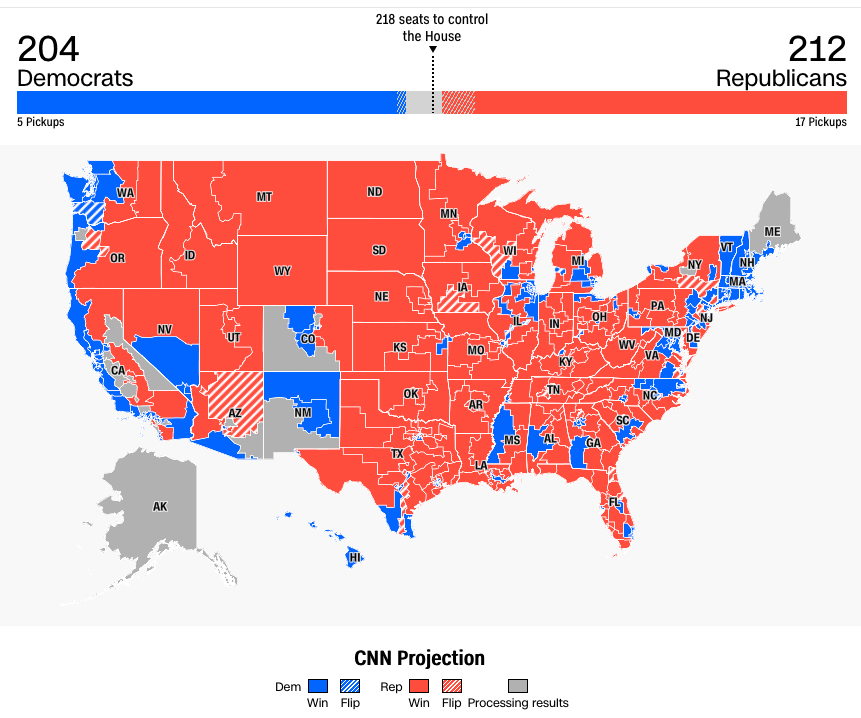
Click on map or here to see CNN’s interactive 2022 elections results House map: CNN

By Jim Ellis — Monday, Nov. 14, 2022

Now, just about a week beyond the 2022 election, each major party still has a chance of controlling the US House, while the Democrats, with late victories in Arizona and Nevada, have secured at least a 50-50 ostensible Senate majority when counting the vice president’s tie-breaking vote.

Senate

Senate: Majority Decided — Just one of the 35 Senate elections still remains undecided: the Georgia race that will head to a post-election runoff on Dec.6. Once the tight Arizona, Nevada, and Wisconsin races were called for incumbents Mark Kelly (D-AZ), Catherine Cortez Masto (D-NV), and Ron Johnson (R-WI) the majority was decided in favor of the Democrats.

The Georgia race unofficially finds incumbent Raphael Warnock (D) holding 49.4 percent of the vote versus Republican Herschel Walker’s 48.5 percent. Libertarian Chris Victor taking 2.1 percent, or just over 48,000 votes, denied both major party candidates the opportunity of reaching the 50 percent plateau. Therefore, the two finalists advance to a new election.

A Warnock win would put the Senate balance of power at 51-49 with the Democrats in control and not needing the vice president to make a tie-breaking vote. A Walker win would leave the Senate without a true majority at 50-50, thus requiring Vice President Kamala Harris’ deciding call on straight party line votes.

The Alaska Senate race is also undecided, but the state’s new electoral system that sends four candidates to the general election won’t be final for another two weeks.

It is obvious that contest will winnow down to a battle between two Republicans, Sen. Lisa Murkowski and former Alaska Director of Administration Kelly Tshibaka. While Tshibaka leads the aggregate vote count, it has become clear that she and Sen. Murkowski will eventually advance into the Ranked Choice runoff.

Though Tshibaka is, and may remain, the vote leader, the RCV runoff system looks to favor Sen. Murkowski. Regardless of which woman is declared the victor when the lengthy process ends, the GOP will retain the Alaska Senate seat.

House

House: Majority Count Remains in Limbo — The House races are still very much undecided with 19 races uncalled. Considering that 10 of those races are in California and one in New York where it will likely take weeks to arrive at final totals, it could be quite some time until we know the ultimate outcome.

According to the CNN election site count, of the 19 uncalled races the Democrats lead in nine, Republicans eight, and two are pure toss-ups, both of which the GOP candidate has a slight count edge. Republicans, however, sitting at 212 called races in their favor versus 204 for the Democrats, need only six of the 19 to fall their way, while Democrats require 14 to claim a bare majority.

It appears the final margin may come down to just one or two seats. The GOP lead seems relatively secure in five of their eight advantage seats, which would give them 217, while the Democrats appear to have solid advantages in another seven of their nine, which puts them at 211.

Therefore, the Republican projection appears to lie in the 217-221 range, while the Democrats’ best-case scenario looks to be scoring a 218-217 slight majority. These predictions, however, are based upon rudimentary projections that could easily change once the actual votes are finally tabulated in all 19 outstanding campaigns.

Governor

Aggregate Governor: Incumbents Dominate — Surprisingly little change occurred in the 36 governors’ races in terms of party change. Democrats, as predicted, easily converted the Maryland and Massachusetts open seats.

The 36 governors’ races are also almost complete, with only Alaska and Arizona uncalled.

In returns that defied polling and thus favor the Democrats, Arizona Secretary of State Katie Hobbs (D) leads former news anchorwoman Kari Lake (R) in the governor’s race, and her advantage may be enough to clinch the office once the state works through its counting delays.

At this point, Hobbs holds a 50.5 – 49.5 percent lead with an estimated 93 percent of the vote counted. This translates into approximately 180,000 votes remaining to be tallied. To win, Lake would have to receive more than 56 percent of the outstanding vote to make up her 26,000-plus vote deficit, which is difficult.

In the only competitive election resulting in a partisan conversion, Republican Clark County Sheriff Joe Lombardo (R) unseated Nevada Gov. Steve Sisolak (D). In races that were largely decided in the states’ respective Democratic primaries, Wes Moore and Maura Healey successfully converted Republican governorships in Maryland and Massachusetts, respectively.

Oregon, the site of perhaps the most interesting governor’s race because it featured a three-way battle, saw former state House Speaker Tina Kotek (D) prevail over ex-House Minority Leader Christine Drazan (R) and former state Sen. Betsy Johnson (I). Polling correctly suggested that Johnson had dropped well off the pace but also largely projected incorrectly that Drazan was positioned for a close upset win. In the end, the election broke 47-44-9 percent in Kotek’s favor with an estimated 93 percent of the all-mail vote counted.

Alaska Republican incumbent Mike Dunleavy looks to be in position to potentially clinch re-election outright, thus exceeding the 50 percent mark within the aggregate vote and avoiding a Ranked Choice Voting instant runoff. With ballots being allowed two weeks to report from the wilderness, it will be just before Thanksgiving when all of the Last Frontier races finally conclude.