
Tag Archives: Gov. Gretchen Whitmer

Michigan Candidate Filing Closes

By Jim Ellis

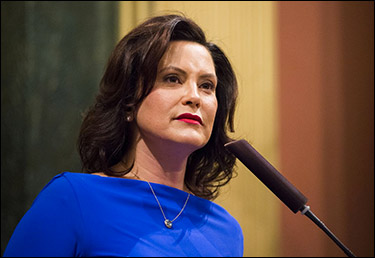
Michigan Gov. Gretchen Whitmer (D)

April 22, 2022 — Major party candidate filing has now closed in the Wolverine State, and we see some highly competitive contests forming for November.

With no senator on the 2022 ballot, the governor’s race tops the ballot. No fewer than 10 Republicans filed in an attempt to oppose Gov. Gretchen Whitmer (D) in the November election. The governor drew no Democratic opposition for the Aug. 2 state primary.

The leading GOP contender appears to be former Detroit Police Chief James Craig, but he must first secure the Republican nomination.

Within the large field, he can expect competition at least from chiropractor and well-known anti-lockdown activist Garrett Soldano, former Berrien County Commissioner and ex-state police captain Mike Brown, and online talk show host Tudor Dixon. The general election yields a race that promises to be one of the top campaigns in the country and polling suggests that the projected Whitmer-Craig contest is already a toss-up.

We will also see serious November competition in most of the state’s 13 congressional districts on a map the Michigan Independent Citizens Redistricting Commission members purposefully drew to feature the maximum number of tight political districts.

In two contests, the major party general election pairings are already set. First District US Rep. Jack Bergman (R-Watersmeet/ Upper Peninsula) must subdue a challenge from Marquette County Medical Director Bob Lorinser (D). In an R+24 district, according to the FiveThirtyEight data organization, where the congressman exceeded 61 percent of the vote in 2020, Rep. Bergman becomes a prohibitive favorite for re-election in November.

What began as an incumbent pairing between Reps. Bill Huizenga (R-Holland) and Fred Upton (R-St. Joseph) because the state lost a seat in national reapportionment, is now a general election that will produce little in the way of political suspense.

With Upton recently announcing his retirement and state Rep. Steve Carra (R-Kalamazoo) deciding to exit the congressional race and seek re-election to his current position, those moves have surprisingly left Rep. Huizenga unopposed for re-nomination in the new 4th CD. His general election opponent will be retail banker Joseph Alfonso (D) in a race that should offer only minimal competition for the six-term incumbent.

Reps. John Moolenaar (R-Midland), Tim Walberg (R-Tipton), Debbie Dingell (D-Dearborn), and Lisa McClain (R-Bruce) face little in the way of competition for both re-nomination and re-election. Rep. Dingell, however, is placed in a new 6th District that contains 44 percent new territory and is without the family’s home base of Dearborn. A member of the Dingell family has represented Dearborn as a part of their district in Congress consecutively since 1933.

Freshman Rep. Peter Meijer (R-Grand Rapids) received one of the tougher draws on the new map. His 3rd District, while still anchored in Grand Rapids, moves from an R+9 rating to D+3. He first must secure re-nomination over former Trump Administration official John Gibbs and attorney Gabi Manolache. Meijer then will again face his 2020 opponent, Democratic attorney Hillary Scholten, who held him to a 53-47 percent victory in the more Republican 3rd District version. The new 3rd contains 50 percent new territory for the congressman, including the Democratic city of Muskegon.

Even though Rep. Elissa Slotkin (D-Holly/Lansing) loses her home base, finds herself in a district with 38 percent new territory, and must compete in an R+7 new 7th District, she actually gains a political point when compared to the current 8th District that she now represents. Still, winning re-election with just a 51-47 percent spread and facing tougher Republican competition from state Sen. Tom Barrett (R-Lansing) means this race will become a top GOP national target.

Continue reading

Michigan Gov. Whitmer
Falters in New Polls

By Jim Ellis

Michigan Gov. Gretchen Whitmer (D)

Sept. 23, 2021 — We have further evidence that the Michigan governor’s race is going to be a highly competitive political contest next year. A pair of new polls, following one in late August, find Gov. Gretchen Whitmer (D) either in a virtual dead heat with, or trailing, former Detroit Police Chief James Craig (R).

The Trafalgar Group and Strategic National, Inc. were both in the Michigan field during virtually the same time realm to test the impending governor’s race. Trafalgar (Sept. 13-15; 1,097 likely Michigan voters; live interview, interactive voice response system, online, and text) actually finds the governor slipping behind Craig by a 50-44% count. Strategic National (Sept. 18-19; 600 likely Michigan voters) arrived at a much tighter contest with the governor still in the lead. Their result projected a razor thin 46.6 – 46.0 percent margin.

Gov. Whitmer has become controversial even nationally through her draconian COVID shut down measures, and then being caught on several occasions as eschewing the dictates for herself and family. As the Strategic National poll shows, however, the governor’s favorable and unfavorable opinions are equivalent … and almost everyone feels strongly about their preference.

In terms of her personal favorability index, the responses divide 50:48 percent favorable to unfavorable. The strongly held position, however, spins toward the negative category. Of those who comprise Gov. Whitmer’s 50 percent positive rating, 35 percent, or 70 percent of those professing a positive opinion, feel strongly.

The negative segmentation is more intense. From the 48 percent who hold a negative view of Whitmer, 42 percent, or 87 percent of those holding an adversarial opinion, believe so strongly. Her job approval rating responses, though a different question, yields an almost identical pattern.

The polarization factor is, unsurprisingly, extreme when it comes to the respondents’ opinion about how she’s handled the coronavirus. By a margin of 52:47 percent, the sampling universe approves of her measures to combat the disease. And, in this instance, those feeling strongly on both sides break about evenly.

Continue reading

Dueling Dual Polls

By Jim Ellis

Detroit Police Chief James Craig

June 14, 2021 — We open the week looking at conflicting polls from two Midwestern statewide races. The Michigan Republican Party published a survey that conflicts with earlier data we’ve seen about their state’s gubernatorial race, and the two leading Ohio Republican Senate contenders both released recent surveys that best tell their own campaign story.

In the Wolverine State, the Competitive Edge Research & Communication firm, polling for the Michigan Republican Party (May 26-June 4; 809 likely Michigan voters), projects retired Detroit Police Chief James Craig (R), who is soon expected to announce his bid for governor, leading incumbent Gretchen Whitmer (D) by a spread beyond the polling margin of error, 45-38 percent.

Curiously, the MIGOP leadership also released the ballot test that featured the party’s 2020 and 2018 US Senate nominee, John James. Here, the CERC finds Gov. Whitmer leading James, 50-45 percent. James has not indicated that he is going to enter the gubernatorial race, so it is surprising to see the Republican Party releasing data that puts one of their top political figures in a weaker position. James lost the 2020 Senate race to incumbent Gary Peters (D) by a tight 50-48 percent count.

In May, the Target Insyght survey research company (May 9-11; 800 registered Michigan voters) painted a different picture, forecasting a 48-42 percent lead for Gov. Whitmer over Craig and 49-39 percent against James.

The difference could be attributed to James retiring as chief of police after the TI poll was conducted and before the CERC survey was taken. Former chief Craig is a well-known and popular figure in Detroit, and the accolades given him for his tenure could certainly have helped his polling data at least on a short-term basis.

Additionally, Gov. Whitmer has been caught in several inconsistencies regarding her COVID shutdown policies, which were some of the most drastic in the country. More than once, she was found not following the letter of her own directives for herself and family.

Continue reading

Another Close Michigan Race

By Jim Ellis

Detroit Police Chief James Craig

May 18, 2021 — As it is becoming clear that retiring Detroit Police Chief James Craig (R) is preparing to challenge Michigan Gov. Gretchen Whitmer (D) next year, Target Insyght, polling for the Michigan Information & Research Service (MIRS), tested the potential general election pairing in a recent study. The results portend another tight Wolverine State campaign.

The TI poll (May 9-11; 800 registered Michigan voters, live interview) finds Gov. Whitmer leading Chief Craig by a six-point, 48-42 percent, spread. More importantly, the survey identified key areas of weakness for the governor, ones that could potentially allow a GOP contender to construct a reasonable path to victory. Chief Craig has not yet announced his candidacy but is expected to do so once he officially retires from the police force on June 1.

Where Chief Craig may have a significant advantage in such a race is his potential ability to draw more votes from the African American community particularly in heavily Democratic Detroit.

While President Biden averaged 79.1 percent of the vote in Congressional Districts 13 and 14 that encompass the city, the Target Insyght poll finds Gov. Whitmer pulling only 64 percent among black voters, while the outgoing police chief attracts 36 percent. In Detroit, 78.3 percent of the population is African American according to the latest publicly available Census Bureau estimates (July 2019).

Gov. Whitmer’s bigger weakness, however, lies in the area of jobs and rebuilding the state’s economy. According to this issue segmentation, voters would favor Chief Craig over Gov. Whitmer by a whopping 63-30 percent margin.

John James, the African American Republican who has run highly competitive campaigns in the last two consecutive Michigan Senate races, was also tested but he doesn’t perform as well as Chief Craig in a general election pairing. While the governor tops Chief Craig by six points, as mentioned above, James trails by 10 percentage points, 49-39 percent.

In the Republican primary, however, it is James who would have a clear advantage. If he and Chief Craig oppose each other for the 2022 GOP gubernatorial nomination, the former man would begin the race with a 36-21 percent advantage in the primary according to this particular survey.

Continue reading

Will Michigan & Wisconsin Voters Determine 2020 Presidential Election?

By Jim Ellis

April 6, 2020 — Polls were just released in both Michigan and Wisconsin, obviously two critically important states that will weigh heavily in determining the final outcome of the next presidential election. While it’s too early to take any general election poll as a true projection of what may happen in November, particularly in light of the current unique situation, the survey did reveal some interesting points.

Progress Michigan’s Lake Effect newsletter: “The governors’ approval ratings pertaining to the [coronavirus] crisis are better than those of the president.”

Public Policy Polling tested the Michigan electorate for the Progress Michigan progressive left organization (March 31-April 1; 1,01 registered Michigan voters) and Marquette Law School just completed their quarterly survey of Wisconsin voters (March 24-29; 81 registered Wisconsin voters). Both made public their results.

We won’t pay too much attention to the ballot tests because it is so far away from the actual vote and the political situation is obviously going to change during the coming months, but the two pollsters found President Trump and former vice president Joe Biden within the margin of error in each state. In both cases, it was Biden who enjoyed a three-point lead.

Within this prism, it is important to recall the 2016 race in which polling badly underestimated Trump’s strength against Hillary Clinton in these two places. According to the 270 To Win organization, which tracked polling throughout that election year, the final averages going into the final weekend found Trump trailing by six points in Michigan and seven in Wisconsin. He won each state by approximately one percentage point, thus proving a large error factor in virtually all of the late polling.

A post-election analysis in which the Pew Research Center and CNN participated, among other firms and media outlets, concluded that a major reason for the flawed projections were the much larger number of Democrats willing to respond to the polling questions than Republicans. Even understanding this was the case at the time, the pollsters’ weighting formulas and algorithms still badly missed the mark throughout the crucial Great Lakes region.

Continue reading