Tag Archives: Georgia

Key Senate Races Taking Shape

By Jim Ellis — Friday, January 16, 2026

Senate

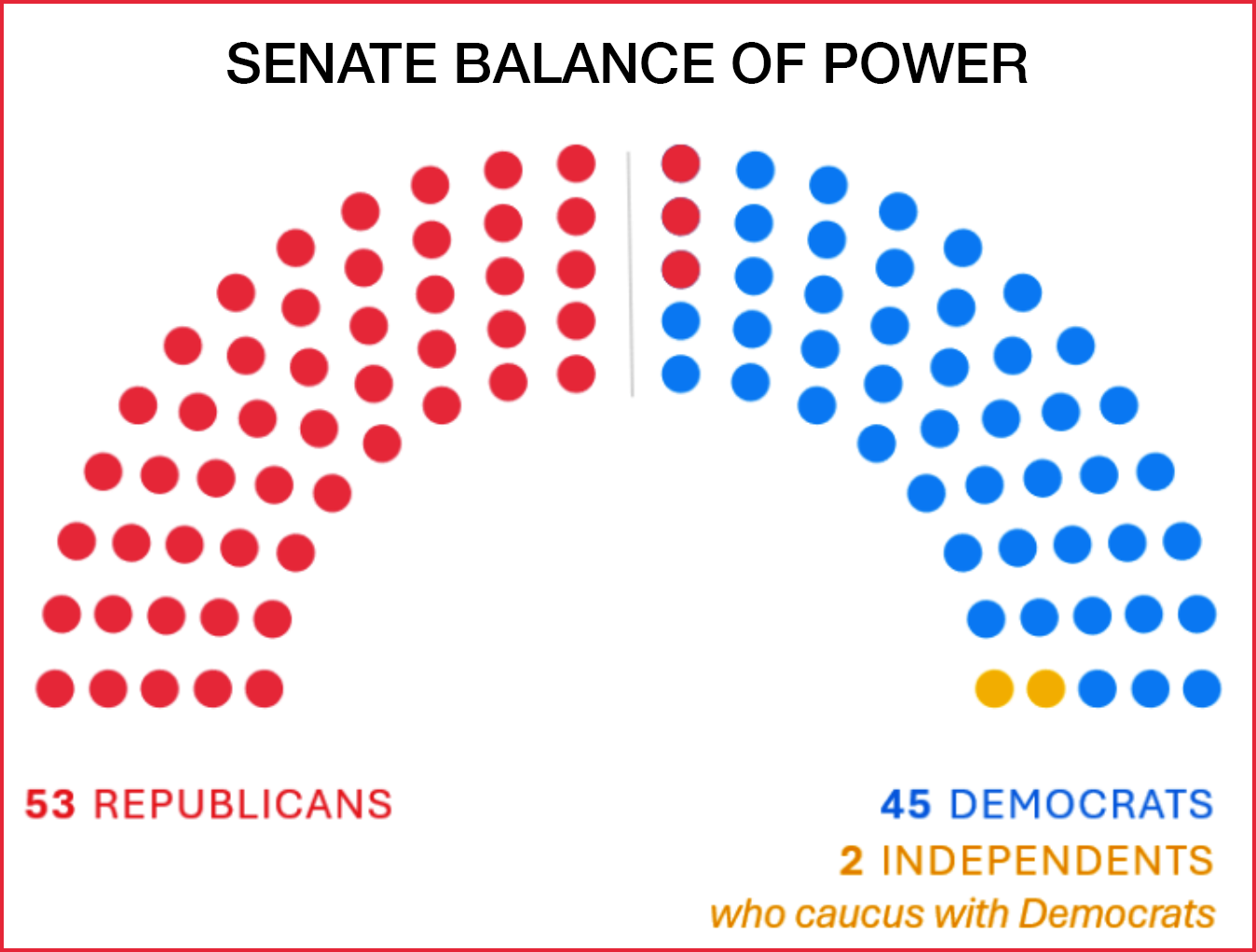
As we know, Republicans currently have a 53-47 Senate majority and the unfolding competitive statewide races suggest that the GOP will retain chamber control, but their margin could lessen.

A total of nine Senate seats are open but only two of those, Michigan and North Carolina, appear hotly competitive for the general election. The remaining seven are projected to retain the party that currently holds the respective seat. Eight of the nine in this group, however, will host highly contested primary elections for at least one party. North Carolina features the only open Senate race where the party nominees already appear set.

Another group of nine seats are contested for the general election, and it is here where Democrats will make a run at taking the Senate majority away from Republicans. To do so, they must reach 51, since Vice President Vance would break a 50-50 tie; Democrats would have to win seven of the nine contested races.

The Republicans are defending seats in Alaska, Iowa, Maine, North Carolina, Ohio, and Texas, while the Democrats must protect Georgia, Michigan, and New Hampshire.

Earlier this week former Alaska at-large Rep. Mary Peltola (D), who lost her seat to current Rep. Nick Begich III (R-Chugiak) in 2024, surprisingly launched a Senate campaign. Most believed she would enter the open Governor’s race where her prospects appear brighter. In the Senate race, she faces an uphill challenge against two-term incumbent Dan Sullivan (R), who has posted an average winning margin of 14.9 percentage points in his two elections including defeating Democratic Sen. Mark Begich in 2014.

Alaska’s unique top four/Ranked Choice Voting system does give Peltola some chance of winning the Senate race in the same manner as how she cobbled together two US House victories. If she can hold Sullivan under 50 percent in the general election, Ranked Choice Voting will begin and then all bets are off. At the outset, however, Sen. Sullivan is favored to win re-election.

Iowa Sen. Joni Ernst (R) is retiring after two terms, and Rep. Ashley Hinson (R-Marion/Cedar Rapids) appears as a consensus 2026 GOP Senatorial candidate. She will be favored to hold the seat probably against the Democratic leadership’s top choice, state Rep. Josh Turek (D-Council Bluffs), though several credible party members are competing for the nomination.

Maine Sen. Susan Collins (R) will defend her seat against either Gov. Janet Mills (D) or oysterman Graham Platner. Platner is the chosen Democratic Socialist candidate and has attracted major far left political figures to his campaign such as Sens. Bernie Sanders (I-VT) and Elizabeth Warren (D-MA). The general election will be close no matter who the Maine Democrats nominate.

North Carolina Republican Sen. Thom Tillis is retiring after two terms, and we will see a tight contest develop between former two-term Gov. Roy Cooper (D) and ex-Republican National Committee chairman Michael Whatley. North Carolina always features tight statewide elections, but for the first time in history Republicans have overtaken Democrats in party registration. This race, however, will likely end in a photo finish.

Appointed Ohio Sen. Jon Husted (R) faces the voters in his new role for the first time (he previously won two statewide races as Secretary of State and was twice on the gubernatorial ticket with Gov. Mike DeWine), and his opposition will be former Sen. Sherrod Brown (D). The fact that ex-Sen. Brown lost his seat in 2024 even though he garnered almost 293,000 more votes than when he last won in 2018 shows strongly the Ohio electorate is moving to the right.

The Texas Republican primary is likely going to a runoff between two of three candidates: Sen. John Cornyn, Attorney General Ken Paxton, and Rep. Wesley Hunt (R-Houston). The Democrats feature a battle between Rep. Jasmine Crockett (D-Dallas) and state Rep. James Talarico (D-Austin). A better general election picture will be drawn once the party nominees are chosen, but Texas Democrats have not won a statewide race since 1994.

Georgia Sen. Jon Ossoff (D) will be seeking a second term, and he already leads the nation in campaign fundraising. Republicans likely won’t have a nominee until a May runoff election concludes. A secondary election campaign potentially between Reps. Mike Collins (R-Jackson) and Buddy Carter (R-Pooler/Savannah) could well determine who challenges Sen. Ossoff in November.

The most vulnerable Democratic Senate seat may lie in Michigan. Here, an open contest between favored Republican Mike Rogers, a former seven-term Congressman and 2024 US Senate nominee, and one of the following: Rep. Haley Stevens (D-Birmingham), state Sen. Mallory McMorrow (D-Royal Oak), or former Wayne County Health Director Abdul El-Sayed, will take place.

The Michigan Democrats not only face a difficult primary campaign, but the nomination election isn’t until Aug. 4. The lengthy Democratic primary means Rogers will enjoy a long period of political open field running where he can build volunteer support and funding reserves.

Should former Sen. John E. Sununu win the New Hampshire Republican Senatorial nomination — and he is favored to do so over former ex-Massachusetts Sen. Scott Brown — the GOP will have a strong candidate to battle presumptive Democratic nominee Chris Pappas, the 1st District Congressman.

Though Pappas will be considered at least a slight favorite to win the general election, the Sununu name in New Hampshire has generally been political magic over the years. The Sununu family, including former Gov. John Sununu, ex-Gov. Chris Sununu, and ex-Senator and former Rep. John E. Sununu, have combined to win 11 major New Hampshire elections.

It remains to be seen if any other Senate contests enter the competitive realm, but electoral history suggests that an unexpected campaign is also likely to reach the political forefront.

Republicans are likely to hold their majority, but all of the aforementioned campaigns should be regularly monitored throughout this election year.

Redistricting Becoming Clearer

By Jim Ellis — Tuesday, Dec. 16, 2025

Redistricting

Putting together the redistricting puzzle

The redistricting wars may be coming to a head. Recent action has occurred in several states providing a better national redistricting picture in preparation for the 2026 election.

Below is a synopsis of the latest developments:

California: After a majority of California voters approved the special election redistricting referendum, a racial gerrymandering lawsuit was filed against the state’s new map.

Meanwhile, the US Supreme Court issued a stay on the Texas racial gerrymandering lawsuit, with a rebuke from Justice Samuel Alito to the three-judge panel in El Paso for rendering a decision before the high court ruled on a related Louisiana racial gerrymandering case. Thus, it became clear that all other cases would be held until the high court issues what could be a landmark ruling.

The judicial action likely means the new California map will be in place for the 2026 election. The original map proponents believe the plan will return five more seats for the Democrats, reducing the Republicans to just four of 52 Golden State districts.

Florida: Late last week, Gov. Ron DeSantis (R) said that the state will redistrict the congressional map and do so during the Spring. The Florida primary is not scheduled until Aug. 18, so time remains to complete the redistricting process. It is possible that Republicans could gain two seats from a new map.

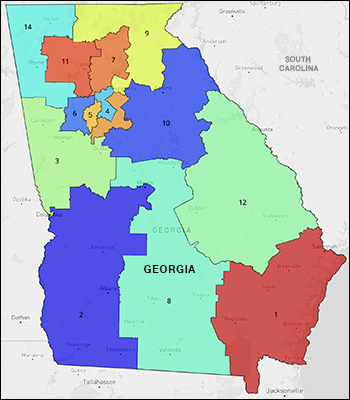
Georgia: A new Georgia map has been completed. The legislature made minor changes to the existing plan that will not likely affect the current partisan division (9R-5D).

Indiana: Late last week, the Indiana state Senate defeated a redistricting map that the state House passed. The plan would have converted two Democratic seats to Republican, thus sweeping the nine-member delegation. Unless the Senate reconsiders the action, the current 7R-2D map will remain intact for the 2026 election.

Louisiana: The US Supreme Court is considering the Callais racial gerrymandering case that could become the vehicle for the justices to render a landmark racial gerrymandering decision. A ruling was expected in June, but the justices postponed their opinion and ordered a second round of oral arguments. The subsequent hearing was held Oct. 15, and all await a final determination.

If the court upholds the lower court decision, the current Louisiana map will be invalidated, meaning the Republicans will likely gain one seat. Should this be the Supreme Court’s ultimate decision, then the possibility exists that the Alabama map will also be redrawn because its plan is virtually identical to Louisiana’s.

Maryland: In a situation similar to what is found in Indiana, most of the Maryland Democratic political establishment favors attempting to collapse their one Republican congressional district, but the state Senate leadership refuses to take action. Therefore, unless the Senate President completely reverses himself, a new redistricting map will not be enacted.

Missouri: The Missouri legislature and Governor have enacted a new map that will likely convert the Kansas City anchored 5th CD from Democratic to Republican. Opponents of the map, officially organized under a group name entitled People Not Politicians, have collected double the number of signatures needed to force a special election initiative vote with the goal of repealing the new map. If a ruling is made qualifying the initiative for the ballot, voters will then decide if the new map will stand.

Under Missouri procedure, simply qualifying the initiative will suspend the new map. This means the state would be forced to revert to the 2021 map for the 2026 election. An initiative vote would occur in the regular election cycle. If the voters adopt the new plan, it would take effect in the 2028 election cycle.

North Carolina: The legislature’s new congressional map will almost assuredly stand for the 2026 election. The initial complaint protesting the plan was rejected at the lower court level. The US Supreme Court’s action involving the Texas case suggests that no further judicial movement will occur on the new North Carolina plan before the candidate filing deadline on Dec. 19. Therefore, it is likely that Republicans will gain one seat in the Tar Heel delegation.

Ohio: The bipartisan elected official redistricting commission unanimously agreed upon a new congressional map, one that state law mandated be drawn. Under the Ohio procedure, a unanimous decision from the redistricting panel, which included Gov. Mike DeWine (R), means the map is officially enacted without action from the state legislature. The new plan will likely produce a one seat gain for Republicans in western Ohio, with the outside possibility of a second conversion in Cincinnati.

Texas: As discussed above, the Supreme Court stayed the three-judge panel decision that ruled the new map a racial gerrymander. Candidate filing has concluded, so the new 2025 map will be in place for the 2026 elections. The original map proponents believe the plan will return five more seats for the Republicans.

Utah: A state court ruled that the legislature ignored certain criteria that voters adopted in a previous redistricting initiative. Therefore, the 2021 map was declared invalid, a ruling that the state Supreme Court sustained. The court then adopted a new map that created a Salt Lake City Democratic seat. The new plan will produce a 3R-1D map for the 2026 election, which is a gain of one Democratic seat.

Virginia: The Old Dominion redistricting effort may determine which party wins the national redistricting wars. With the Democrats gaining full control of the state government, the new legislature must pass a referendum for the ballot when they convene in January. The measure will have to fulfill other legal requirements, and a special statewide referendum election is required. Voters would have to approve a new map before the April 2 candidate filing deadline for the June 16 primary election.

Democrats claim they can draw a map that will relegate Republicans to just one seat in the 11-member delegation. Currently, the Virginia congressional districts split 6D-5R. A four-seat swing in this state could tip the balance of power toward the Democrats in their quest for the US House majority.

Special Elections Update

by Jim Ellis — Thursday, Dec. 4, 2025

Special Elections

With the TN-7 special election now complete, three more contests are pegged for the first quarter of next year. The upcoming special elections will be held in Georgia, New Jersey, and Texas.

TN-7

This week’s Tennessee result saw the 7th District electorate performing as the voting history projected, thus quelling the Democrats’ quest for the upset that certain polls suggested was possible. The 54-44 percent result from what will likely be a touch over 180,000 votes cast when all ballots are counted – a large number for a special congressional election – was equivalent to the Dave’s Redistricting App’s partisan lean calculation of 55.1R – 42.2D.

Most importantly, from the Republicans’ perspective, the party apparatus proved in this instance, that they could turn out the base vote and a sizable number of the casual Trump voters, meaning those who typically only vote when the President is on the ballot. Repeatedly doing so in future elections will be a critical factor in determining whether the party will have success in the regular midterm elections next year.

GA-14

Georgia Rep. Marjorie Taylor Greene (R-Rome) / Photo by Gage Skidmore

Rep. Marjorie Taylor Greene (R-Rome) will resign on Jan. 5. At that point, Georgia Gov. Brian Kemp (R) will schedule the special election to replace the outgoing Congresswoman in the northwestern district. GA-14 the safest Peach State Republican seat. The district stretches from just outside Marietta to the Tennessee border.

It is believed that Gov. Kemp will calendar the jungle primary for a date in March. Under Georgia special election law, all candidates are on the initial ballot with the top two finishers, irrespective of party affiliation, advancing to the runoff election in the likely event that no contender attracts majority support. To comply with state law, the secondary vote must occur within 28 days of the initial election. Therefore, it is probable that this seat will be filled before the end of April.

A total of 13 Republicans and two Democrats have already announced their candidacies, but the two most talked-about potential candidates, state Senate Majority Leader Jason Anavitarte (R-Doraville) and state Sen. Colton Moore (R-Trenton), have yet to formally declare.

It is probable that two Republicans will advance into the special runoff election. Republicans will hold this seat.

NJ-11

Gov.-Elect Mikie Sherrill (D) has resigned her congressional seat, thus leading to Gov. Phil Murphy (D) scheduling a Feb. 5 partisan primary and an April 16 special general election.

Candidate filing has closed, and 13 Democrats will be on the Feb. 5 ballot vying for the party nomination. Within the large group is former 7th District Congressman Tom Malinowski, ex-Lt. Gov. Tahesha Way, and five local officials, with the remainder coming from the private sector or political activist class. Only one Republican filed, Randolph Township Mayor Joe Hathaway, so he is guaranteed to win the party nomination, meaning a ballot slot for the special general election.

The partisan lean (Dave’s Redistricting App calculations) for this district, which redistricting has made much more Democratic in the previous two decades, is 55.6D – 42.5R. Therefore, it is clear the eventual Democratic nominee will have the inside track toward winning the special election and holding the seat for the party.

TX-18

The longest special election cycle to fill a congressional vacancy will culminate with a Jan. 31 runoff contest between Harris County Attorney Christian Menefee (D) and former Houston City Councilwoman Amanda Edwards (D). Since this is a double Democratic runoff, there is no doubt that the party will hold the seat for the duration of the current Congress.

Regardless of whether Menefee or Edwards wins the Jan. 31 vote, they will immediately find themselves embroiled in a new campaign against Rep. Al Green (D-Houston). Since it is likely that the new Texas congressional map will be in effect for the 2026 midterm elections, the Houston area sees a major reconfiguration of its congressional districts.

The new plan collapsed most of Rep. Green’s 9th CD into a new 18th District, with much of the current 18th going into Rep. Sylvia Garcia’s (D-Houston) new 29th CD. The regular cycle Texas primary is scheduled for March 3, so the eventual runoff winner and loser will find themselves immediately competing in a new campaign.

The regular term candidate filing deadline is Dec. 8. At this point, neither Menefee nor Edwards have filed for the new term, but both are expected to do so. This means that the loser of the Jan. 31 runoff could conceivably be an active candidate for the March 3 regular primary election, which could force Rep. Green into a runoff with either the new incumbent or the just-defeated runoff participant.

While the special election will end on Jan. 31, the campaign for a full term will already be entering political prime time.

Two New Special Elections

By Jim Ellis — Wednesday, Nov. 26, 2025

This is our last update for the week. We’ll take a pause for Thanksgiving and pick up again Monday, Dec. 1. Wishing all a very Happy Thanksgiving!


House

Governors in two states are making moves to calendar elections to fill new congressional vacancies in their states. With Rep. Mikie Sherrill (D-NJ) resigning her congressional seat to prepare for her swearing in as the Garden State Governor, and Rep. Marjorie Taylor Greene (R-GA) declaring that she will leave Congress on Jan. 5, two more districts will soon host special elections.

Since this Congress began, we have seen four seats filled in special elections; two more are scheduled, the first on Dec. 2 (TN-7) and the other Jan. 31 (TX-18), and now the Georgia-New Jersey pair open.

Three seats became vacant because the incumbent passed away — Reps. Raul Grijalva (AZ), Sylvester Turner (TX), Gerry Connally (VA); one accepted an appointment from President Trump, Rep. Mike Waltz (FL); three resigned for other opportunities, Reps. Matt Gaetz (FL), Greene (GA), Mark Green (TN); and one, Sherrill, won election to a different office.

NJ-11

Rep. Mikie Sherrill being elected New Jersey Governor on Nov. 4 creates a new vacancy in the Garden State congressional delegation. The 11th District lies in the northern part of the state and is reliably Democratic.

Under previous redistricting plans in the early part of the century, the 11th, which now includes parts of three counties, Essex, Morris, and Passaic, and the population centers of Morristown, Parsippany-Troy Hills, and Gov-Elect Sherrill’s hometown of Montclair, was a Republican district.

The Dave’s Redistricting App partisan lean for the current NJ-11 shows a 55.6D – 42.5R ratio. Kamala Harris carried the district 53.3 – 44.6 percent. Therefore, the stats show that Gov-Elect Sherrill’s successor will very likely be determined in the special Democratic primary.

Gov. Phil Murphy (D) just announced that the District 11 special partisan primaries will be held on Feb. 5, with the special general scheduled for April 16. Candidates must file right after Thanksgiving, on Dec. 1.

A total of 14 Democrats have announced their candidacies, including former 7th District Congressman Tom Malinowski. In 2022, Malinowski, who saw his district become a touch more Republican in 2021 redistricting largely to make the 11th and now-Sen. Andy Kim’s (D) former 3rd District more Democratic. Then-Rep. Malinowski would lose to current Rep. Tom Kean, Jr. (R-Westfield) as a result.

Beyond Malinowski, the Democratic field includes former Lt. Gov. Tahesha Way, five local officials from various townships, and former Obama White House aide Cammie Croft. Only one Republican is in the race, Randolph Town Commissioner and Mayor Joe Hathaway.

GA-14

Rep. Marjorie Taylor Greene’s (R-Rome) surprise resignation means an ensuing special election will be held in northwest Georgia. Reportedly, sources close to Gov. Brian Kemp (R) say he is leaning toward scheduling a March primary.

Under Georgia election law, when special elections are held all candidates are placed on the same ballot regardless of political party affiliation. If a contender receives majority support in the first election, the individual is elected. If no one reaches such a level, the top two finishers, again regardless of political party affiliation, advance to a runoff election within 28 days of the initial vote.

With an overwhelming Republican partisan lean (Dave’s Redistricting App: 69.2R – 28.9D), meaning the 14th District is the safest Georgia Republican congressional district, the possibility of two Republicans advancing to the runoff is relatively high.

A total of six state Senate seats and 17 districts in the state House contain part of the 14th CD. Encompassing all or part of 10 counties, a multitude of Republican state and local officials are likely to enter the congressional campaign.

State Senate Majority Leader Jason Anavitarte (R-Doraville) and state Sen. Colton Moore (R-Trenton), who for a time was in this year’s US Senate campaign, are viewed as potentially strong candidates.

The field will form once Rep. Greene resigns after the first of the year and Gov. Kemp officially calls the special election.

Competitive Senate Finance – Part I

By Jim Ellis — Tuesday, Oct. 21, 2025

Senate

The Federal Election Commission has released new Senate campaign finance numbers and today we begin to preview the resource standing of the key 2026 statewide contests. This Update covers the most competitive campaigns from Alabama through Maine. Tomorrow, we’ll look at Michigan through Texas.

Alabama

Sen. Tommy Tuberville (R) running for Governor has opened the in-cycle Senate contest, and the Republican primary will be the determinative election. Attorney General Steve Marshall, Rep. Barry Moore (R-Enterprise), and retired Navy SEAL Jared Hudson are the major contenders.

Hudson has $357,000 cash-on-hand, while Marshall and Moore each have just over $555,000 in their campaign accounts. It is probable the May 19 primary will end with no candidate having majority support. If such is the case, the top two finishers will advance to a June 16 runoff election.

Florida

Appointed Sen. Ashley Moody (R) must run in 2026 to fill the final two years of the current term. At the end of third quarter 2025, she held $3.6 million cash-on-hand.

The most credible Democrat appears to be technology company executive Hector Mujica. He just announced his candidacy last week; therefore, he is not yet required to file a campaign financial disclosure report. Former Congressman Alan Grayson (D), who has tried and failed several times to win statewide office, holds only $127,000 in his campaign account.

Sen. Moody has won two statewide elections as state Attorney General. In a state turning safely Republican, she is favored to hold her seat.

Georgia

First-term Sen. Jon Ossoff (D) is the 2026 election cycle’s leading fundraiser, having raised more than $54 million. From the gross receipts total, he holds $21.3 million in his account.

The Republicans are headed for a competitive primary, which will likely culminate in a June runoff. Reps. Buddy Carter (R-Pooler/Savannah) and Mike Collins (R-Jackson) along with former University of Tennessee football coach Derek Dooley, son of former University of Georgia legendary coach Vince Dooley, are the top contenders.

Rep. Carter has done best on the fundraising circuit and holds just under $4 million in his campaign account. Rep. Collins has $2.3 million, and Dooley, $1.7 million.

The Republicans’ collective problem is their candidates will have to spend heavily just to win the nomination while Sen. Ossoff can continue to build in unopposed fashion for the general election. Irrespective of who becomes the Republican nominee, the general election promises to evolve into a tight finish.

Illinois

Retiring Sen. Dick Durbin (D) leaves a contested March Democratic primary in his wake, one that will effectively elect the state’s next Senator.

At this point, Rep. Raja Krishnamoorthi (D-Schaumburg) has a commanding lead in fundraising and polling. According to the third quarter FEC report, he has raised just under $25 million and holds a touch over $18 million in the bank.

His two major opponents, Rep. Robin Kelly (D-Matteson/Chicago) and Lt. Gov. Julianna Stratton, are well behind in cash-on-hand. Rep. Kelly reports $2 million in available funds and Stratton just under $1 million. This means that Rep. Krishnamoorthi enjoys a respective 9:1 and 18:1 cash advantage over his two main opponents.

Kentucky

Without Gov. Andy Beshear (D) in the open Senate race, the May Republican primary for all intents and purposes will determine retiring Sen. Mitch McConnell’s successor.

Three candidates are vying for the nomination: Rep. Andy Barr (R-Lexington), former Attorney General and 2023 gubernatorial nominee Daniel Cameron, and businessman Nate Morris. Norris has already been spending heavily and running attack ads, particularly against Rep. Barr.

While Cameron enjoys significant polling leads, it is Rep. Barr who is in the best financial position. He holds $6.7 million in his federal campaign account, while Cameron has just under $630,000. Morris, who is self-financing, reported $1 million at the Sept. 30 disclosure deadline.

Louisiana

Sen. Bill Cassidy (R) may have dodged his toughest general election opponent (former Gov. John Bel Edwards (D) last week announced he would not run for the Senate), but the same can’t be said for the new partisan Republican primary. Louisiana changed its election law, so instead of a jungle primary in November, we will see an April 18 primary followed by a May 30 runoff election if no one reaches the majority support level in the first vote.

At the end of last week, state Rep. Julie Emerson (R-Carencro), who chairs the House Ways and Means Committee, announced her Senate candidacy. This very likely means that Rep. Julia Letlow (R-Start) will not run, as the two were unlikely to oppose each other. Already in the race are State Treasurer, former Deputy White House chief of staff and ex-Congressman John Fleming; state Sen. Blake Miguez (R-New Iberia); and Public Service Commissioner Eric Skrmetta.

Sen. Cassidy is well ahead in fundraising, but President Trump clearly wants to settle a political score with him since the Louisianan was one of seven Republican Senators to vote for impeachment regarding the January 6 US Capitol controversy. Only two of those seven, Sens. Cassidy and Susan Collins, will be on the ballot in 2026. Four are no longer members — Sens. Ben Sasse (NE), Richard Burr (NC), Pat Toomey (PA), and Mitt Romney (UT). Sen. Lisa Murkowski (R-AK) is not in-cycle but is at least a potential gubernatorial candidate.

In terms of fundraising, Sen. Cassidy posts $9.5 million in cash-on-hand. This compares to Sen. Miguez’s $2.5 million and Fleming’s $2.1 million. Rep. Emerson and Skrmetta are not yet required to file disclosure reports.

Maine

Sen. Susan Collins (R) overcame $60 million of spending against her in 2020 and can expect another difficult campaign next year. She is well prepared, with $6.7 million in the bank.

Her principal opponent will be Gov. Janet Mills (D), who just announced her candidacy last week. Like several others in this report, the Governor is not yet required to file a financial disclosure report.

Expect this race to be hot all the way through November and will carry at toss-up rating.

Georgia’s Sen. Ossoff in Dead Heat

See 2026 Georgia Senate poll results: Quantas Insights.

By Jim Ellis — Friday, Sept. 19, 2025

Senate

As we know, the swing state of Georgia will be one of the key battleground 2026 US Senate domains, and a new statewide poll released earlier this week confirms the race will present challenges for both sides.

Georgia Democratic Sen. Jon Ossoff

The Quantus Insights Peach State poll finds first-term Sen. Jon Ossoff (D) falling into a dead heat with one Republican US House member and leads another within the polling margin of error. Yet, as we have seen in some other places, the polling sample shows issue inconsistencies within the electorate.

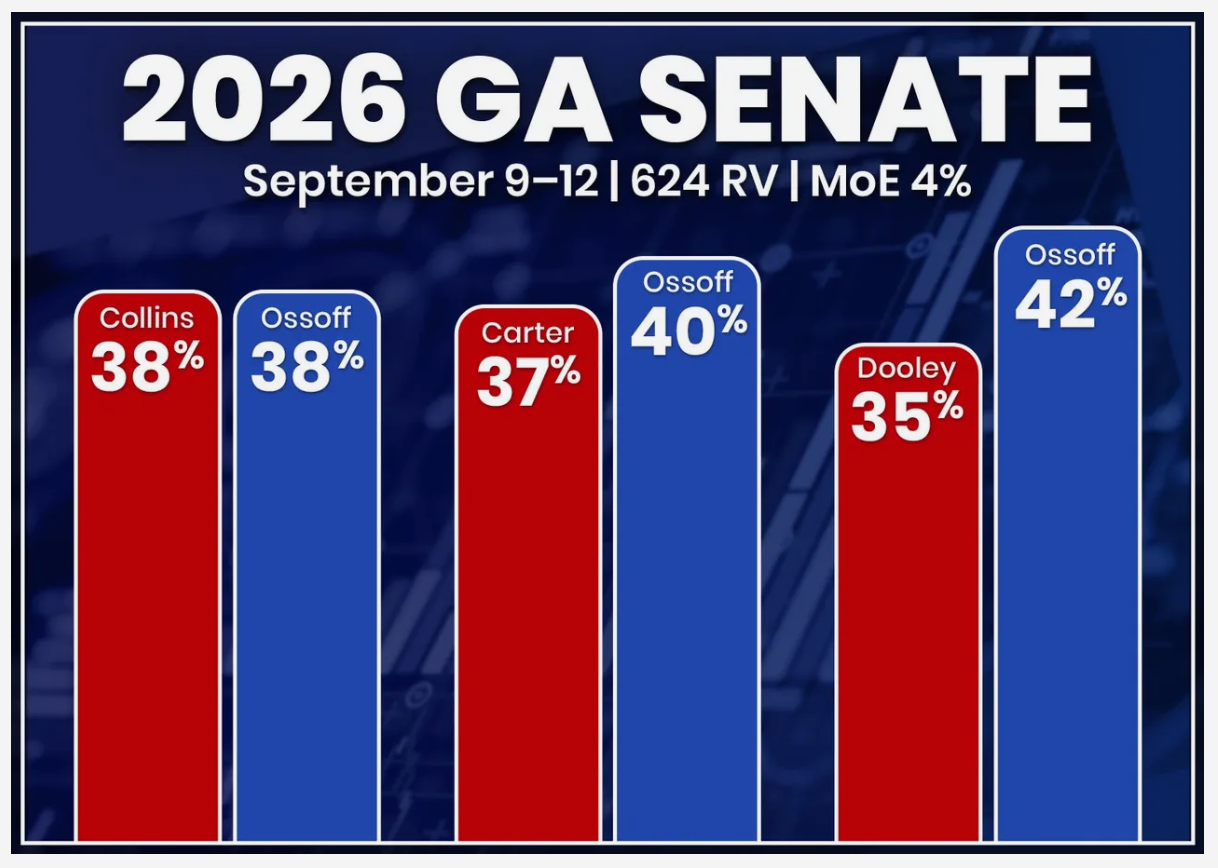
According to the Quantus study (Sept. 9-12; 624 likely Georgia general election voters; online and text), Sen. Ossoff and Rep. Mike Collins (R-Jackson) are tied at 38 percent preference and Rep. Buddy Carter (R-Pooler/Savannah) trails the Senator, 37-40 percent. Former University of Tennessee football coach Derek Dooley, son of long-time University of Georgia football coach Vince Dooley, is definitively behind Sen. Ossoff trailing 42-35 percent.

While other polls have shown similarly close ballot tests, the Quantus survey is interesting in that it delves more deeply into issues and reveals that both eventual nominees will have challenges in attempting to forge a winning coalition.

For example, while President Trump scores a 49 percent job approval score, Sen. Ossoff posts 47 percent, yet the two are virtually diametrically opposed on the issue agenda. Furthermore, while Sen. Ossoff posts a 47:37 percent job approval index, only 36 percent of the same sampling universe believes he deserves re-election, and 49 percent believes it is “time for a change.”

In an overwhelming number (53 percent), the poll respondents cite the cost of living and inflation as the most important issue. Crime and public safety is second (13 percent), with jobs and the economy closely behind (12 percent). The number one response, however, for why costs are rising is President Trump’s tariffs and trade policies (41 percent). The Biden Administration economic policies were the second-most mentioned cause (27 percent).

When asked which party do the Georgia respondents trust more to handle the economic issues, 40 percent said the Democrats and only 39 percent answered Republicans. On bringing down the cost of living, it is again the Democrats holding a slight edge, 36-35 percent.

On crime, however, Republicans are more trusted, 42-29 percent. Same for immigration with a 48-28 percent Republican favorable split. By a 53-40 percent majority, the respondents favor the mass deportation policy, while only 31 percent support Ossoff’s border security position. A total of 76 percent support the crime prevention Laken Riley Act, a Republican bill that Sen. Ossoff supported.

An inconsistency appears when respondents are asked to list what they believe should be the next Senator’s priorities. In order, the responses were reducing taxes for working families (39 percent), cutting wasteful federal spending (24 percent), and reducing regulations that raise prices (21 percent). This is in line with the Republican message, but the sentiment is not fully translating to the Republican candidates, particularly among Independent voters.

While Sen. Ossoff is unopposed for the Democratic nomination, on the Republican side the Quantus poll found Rep. Collins leading Rep. Carter and Dooley, 25-20-7 percent. With a large undecided pool, this campaign will go down to the wire toward the May 19 primary. If no one receives 50 percent, the top two finishers will advance to a June 16 runoff election.

As a reminder for the general election, Georgia is one of two states that also features a runoff election if no candidate receives majority support in the November vote. The post-election runoff was forced in the past two Georgia Senate elections. If this situation presents itself again in 2026, the deciding runoff will be held on Dec. 1.

As is the case in virtually every election, messaging will be key. Republicans must find a way to relate what are typically Georgia voter issue positions directly to the party’s Senate candidate, while Sen. Ossoff must find ways to improve his electoral standing even though his job approval is relatively good. It is important to note that in this poll’s ballot tests, the Senator did not break 40 percent preference against any Republican.

Along with the Senate races in Michigan, North Carolina, and Texas, the Georgia Senate battle will be a premier 2026 electoral contest.

New Georgia Senate Polling

By Jim Ellis — Tuesday, Aug. 12, 2025

Senate

One of the tightest 2026 US Senate races is sure to be found in the Peach State of Georgia and a new statewide poll already confirms a developing toss-up general election.

The TIPP Poll organization released the results of their new survey (July 28-Aug. 1; 2,956 registered Georgia voters; online) that forecasts Rep. Mike Collins (R-Jackson) potentially as Sen. Jon Ossoff’s (D) top challenger. According to the related ballot test, Sen. Ossoff’s edge over Rep. Collins would be a scant 45-44 percent.

The other Republican candidates also poll well against Sen. Ossoff but draw less support than Rep. Collins. Savannah area Congressman Buddy Carter (R-Pooler) would pull within 44-40 percent of Sen. Ossoff. Former University of Tennessee head football coach Derek Dooley, son of legendary Georgia University football coach Vince Dooley, would trail 44-39 percent in a hypothetical general election pairing with the first-term incumbent.

The results are not surprising. The Georgia electorate has returned some of the closest election results in the country since the 2018 Governor’s race that found current incumbent Brian Kemp (R) nipping Democrat Stacey Abrams by just over one percentage point.

The 2020 presidential race saw Joe Biden slipping past President Trump by only 11,779 votes from almost 5 million cast ballots.

Both 2020 Senate races were forced to runoff elections (Georgia had a special election that year to replace Sen. Johnny Isakson (R) who had resigned for health reasons prior to him passing away). Two years later, the race for a full term between Sen. Raphael Warnock (D) and Republican Herschel Walker also moved into a post-election runoff.

In the 2024 presidential vote, Trump defeated President Biden, 50.7 – 48.5 percent by a more comfortable margin of 115,100 votes from more than 5.2 million cast ballots, but still a close final tally.

Additionally, Georgia is also one of the few states that holds a post-general election runoff should no candidate receive majority support (Mississippi is another and Louisiana is changing from their jungle primary/December runoff system to a traditional primary and general election beginning in 2026), and the ’26 Senate race advancing into political overtime is certainly a distinct possibility.

With this backdrop, we can expect another series of close Peach State elections led by its Senate and open Governor races. Therefore, the early TIPP general election poll already showing a dead heat comes with little surprise.

Before the general election begins, Republicans are likely to face a tough primary campaign where the top two finishers in the May 19 GOP nomination contest advance into a June 16 runoff election.

TIPP also surveyed the likely Republican primary voters and found Rep. Collins leading Rep. Carter and Mr. Dooley, 25-19-7 percent. Familiarity with the Republican candidates is not particularly high, however. This means the candidates will have to spend heavily in the primary just to win the right to challenge Sen. Ossoff.

A total of 44 percent of the tested polling sample expressed familiarity with Rep. Carter, 42 percent could identify Rep. Collins, and 37 percent recognized Derek Dooley’s name. The latter man won Gov. Kemp’s endorsement, and the Kemp leadership PAC is pledging to spend early to help educate the voters about Dooley. At this point, President Trump has not endorsed a Republican primary candidate, but all are seeking his support.

Resources in the general election, though both sides can expect millions of outside Super PAC money coming into the state to assist their efforts, will likely favor the incumbent Democrat. Already, Sen. Ossoff is the top fundraiser in the country after the latest disclosure reports became public.

The Senator, since his original election in 2020, has raised almost $42 million, but spent $30.8 million largely to clear expenses from the ’20 campaign and to support his substantial fundraising operation. Still, the Senator holds almost $15.5 million in his campaign account according to the June 30 Federal Election Commission finance report.

Rep. Carter is in the strongest financial position among Republicans. His receipts through the second quarter of 2025 top $3.5 million, but that includes a loan to the campaign of $2 million. His cash-on-hand total exceeds $4 million.

Rep. Collins is considerably behind, raising $745,883 since the beginning of the year and posting just over $1 million in the bank. Dooley, who recently became an official candidate, will file his first campaign financial disclosure report on Sept. 30.

Along with the Michigan and North Carolina Senate races, we can count on the Georgia Senate contest attracting a major share of national political attention next year.

Rep. Collins Expected to Enter
Georgia Senate Race Later This Month

By Jim Ellis — Thursday, July 24, 2025

Senate

Georgia Rep. Mike Collins (R-Jackson)

Reports are surfacing from Georgia that two-term US Rep. Mike Collins (R-Jackson) will announce a US Senate bid before the end of July.

Should Rep. Collins follow through and enter the race, he will join US Rep. Buddy Carter (R-Pooler/Savannah), state Agriculture Commissioner John King, and state Sen. Colton Moore (R-Trenton) as prominent candidates in the GOP primary. The eventual Republican nominee will challenge first-term incumbent Jon Ossoff (D).

According to the latest Federal Election Commission candidate financial disclosure report for the period ending June 30, 2025, Rep. Collins would have just over $1 million to transfer into a Senate race. Rep. Carter is considerably ahead on the money front, reporting a cash-on-hand figure of just over $4 million after raising slightly under $3.6 million for the 2026 election cycle. Commissioner King disclosed only $450,405 in his federal campaign account. State Sen. Moore has yet to file a committee statement with the FEC and is unlikely to become a top-tier contender.

Should the Republican field remain constant, it appears the race could narrow significantly to a battle between the two Congressmen. For his part, Sen. Ossoff, obviously considered highly vulnerable in 2026, leads the nation in fundraising with a whopping $41.97 million since he was originally elected in 2020.

During his term, however, Sen. Ossoff has spent over $30.8 million leaving a reported cash-on-hand figure a touch under $15.5 million. Clearly, the Senator will be financially well-heeled in what could become the most competitive 2026 national Senate race.

In 2020, Ossoff upset then-Sen. David Perdue (R) in a post-general election runoff, from the same November election where Joe Biden was edging President Trump by 11,779 votes statewide. Georgia is one of two states that has a general election run-off law, meaning the top two finishing candidates would advance into a post-election December secondary vote should the first place finisher fail to attract majority support.

Such a scenario occurred five years ago, with Sen. Perdue finishing first in the general election, but who fell 13,471 votes short of securing a majority that would have clinched his re-election. The percentage total for the general election found Sen. Perdue topping Ossoff, 49.7 – 47.9 percent. In the runoff, fortunes turned as Ossoff pushed ahead at the December finish line, 50.6 – 49.4 percent, a margin of 54,944 votes from more than 4.48 million ballots cast.

In 2024, Trump scored a Georgia rebound, topping Kamala Harris, 50.7 – 48.5 percent. Two years earlier in the 2022 midterm election, Gov. Brian Kemp (R) topped former state House Minority Leader Stacey Abrams (D), 53-46 percent, and Republicans won eight of nine Georgia statewide races.

This most recent Peach State voting history creates optimism among the 2026 Republican candidates, thus making the Georgia Senate race the campaign likely to attract the most national political attention and possibly the most combined outside independent expenditure dollars.

The Georgia election system could yield a Republican Senate nomination also advancing into a secondary election. The Georgia primary is scheduled for May 19, 2026, with a runoff, if necessary because the first place finisher does not command majority support, to be scheduled for a Tuesday in June, likely the 16th or 23rd.

Others could still join the GOP race, but as the cycle unfolds and the fundraising leaders continue to pad their accounts further entries become more unlikely. Still said to be considering the race is Secretary of State Brad Raffensperger, among others, but it appears more likely at this point in time that the Secretary will either seek re-election for a third term or run for the open Governor’s position.

In terms of the two House seats that Reps. Carter and presumably Collins will vacate, we can expect crowded Republican primary battles to form in the respective 1st and 10th Districts likely ending in tight results.

Both seats are safely Republican according to the Dave’s Redistricting App partisan lean calculations (GA:1 – 57.3R – 41.1D; GA-10 – 61.2R – 37.2D). In 2024, President Trump captured 57.6 percent in GA-1, and 60.1 percent in GA-10.

Even at this early date, the Georgia voting electorate will again be bombarded with very competitive 2026 campaign efforts over what promises to be a busy ballot from top to bottom.

House, Governor, City & State Wrap up

By Jim Ellis — Thursday, June 12, 2025

House

Virginia Rep. Gerry Connolly passed away Wednesday, May 21, 2025.

VA-11 — Gov. Glenn Youngkin (R) has scheduled the special election to replace the late Rep. Gerry Connolly (D-Fairfax) for Sept. 9. It is now up to the local party congressional district committees to decide upon the type of nomination system to employ. Democrats have chosen the “firehouse primary” option, which features only a few polling places throughout the district. The firehouse special primary is scheduled for June 28. Republicans have yet to decide between a firehouse primary or a party convention.

Democrats will be heavily favored to hold the seat. The leading candidates are Fairfax County Supervisor James Walkinshaw (D) and state Sen. Stella Pekarsky (D-Centreville).

CO-3 — Former Colorado Republican Party Vice Chair Hope Scheppelman announced a primary challenge from the right to freshman Rep. Jeff Hurd (R-Grand Junction). It remains to be seen if this challenge will develop into a serious campaign. Irrespective of the primary situation, Rep. Hurd will be favored for renomination and re-election in a district where the Dave’s Redistricting App statisticians calculate a 52.6R – 43.3D partisan lean.

GA-13 — State Rep. Jasmine Clark (D-Lilburn) has joined the crowded Democratic primary challenging veteran Rep. David Scott (D-Atlanta). Previously announced major candidates are state Sen. Emanuel Jones (D-Decatur) and former Gwinnett County School Board chairman Everton Blair (D). While Rep. Scott says he plans to seek a 13th term in the House, he has major health concerns, and the prevailing political opinion is that he will announce his retirement before the state’s March candidate filing deadline.

MD-5 — Saying the 85-year-old longest-serving House Democrat should retire due to his advanced age, public safety consultant Harry Jarin, 35 years old, announced a Democratic primary challenge against former House Majority Leader Steny Hoyer (D-Mechanicsville). For his part, Rep. Hoyer has yet to say whether he will seek a 24th term, but most expect him to run again. He will be 87 years old at the time of the next general election.

NE-2 — State Sen. John Cavanaugh (D-Omaha), whose father, former US Rep. John J. Cavanaugh, III (D), served two terms in the House during the 1970s, announced that he will run for the congressional seat in 2026. He will face a crowded Democratic primary featuring political consultant Denise Powell, surgeon Mark Johnston, and attorney Van Argyrakis. The eventual nominee will face five-term Rep. Don Bacon (R-Papillion) who says he will announce whether he will seek another term during the summer. Nebraska’s 2nd District continues to be one of the most competitive in the country.

PA-8 — Former six-term Congressman Matt Cartwright (D), who lost his seat last November to freshman Rep. Rob Bresnahan (R-Dallas Township/Scranton), said he will not return for a re-match next year. This leaves the Democrats with no major candidate in a what is projected to be a competitive 2026 congressional race. Republicans ousted two incumbent Pennsylvania House members in 2024, Reps. Cartwright and Susan Wild (D-Allentown). Neither are forging a comeback attempt next year.

WA-9 — Former Seattle City Councilwoman Kshama Sawant, a self-identified socialist, announced that she will challenge veteran Rep. Adam Smith (D-Bellevue) as an Independent in next year’s general election. Sawant served three terms as an at-large City Councilwoman, leaving office in 2023. She survived a recall attempt in a close 2021 vote. Rep. Smith, the Ranking Minority Member of the House Armed Services Committee, is expected to seek a 16th term and will be a prohibitive favorite for re-election.

Governor

Arizona — A new survey that the American Commitment organization sponsored (May 23-25; 1,147 likely Arizona Republican primary voters; online) finds Rep. Andy Biggs (R-Gilbert) moving into a commanding lead over 2022 gubernatorial candidate Karrin Taylor Robson for the state’s Republican gubernatorial nomination. According to the ballot test result, Rep. Biggs would lead Robson, 57-25 percent.

Earlier, Noble Predictive Insights released their general election poll (May 12-16; 1,026 registered Arizona voters; online) and projects Gov. Katie Hobbs (D) to be leading Rep. Biggs 40-38 percent, and Robson by a similar 41-39 percent count. This latter poll confirms what has been expected, that the 2026 Governor’s race will yield another hotly contested political battle.

Connecticut — In a news conference with reporters to discuss the end of the Connecticut legislative session, Gov. Ned Lamont (D) sent clear signals that he is heading toward announcing his candidacy for a third term. The political field has largely been frozen awaiting the Governor’s political decision. Should he announce for re-election, Lamont will be rated as a clear favorite to secure a third term.

Florida — Former Rep. David Jolly, who won a 2014 special election in the Pinellas County seat as a Republican lobbyist but then lost re-election in 2016 to party switcher Charlie Crist (D), became a GOP critic on national news shows. He switched his party identification to Independent after losing the House seat and then moved to the Democratic column.

This week, Jolly announced his candidacy for the Democratic gubernatorial nomination. He becomes the first significant Democrat to enter the race. While Jolly may be competitive for his new party’s nomination, Republicans will be favored to hold the Governorship in an open election. Gov. Ron DeSantis (R) is ineligible to seek a third term. Rep. Byron Donalds (R-Naples) is the leading Republican gubernatorial candidate.

Iowa — While most political observers are watching whether state Attorney General Brenna Bird will join the open Republican gubernatorial primary to battle Rep. Randy Feenstra (R-Hull/Sioux City) for the party nomination, state Rep. Eddie Andrews (R-Johnston) announced that he is joining the race. State Sen. Mike Bousselot (R-Des Moines) is also a GOP gubernatorial candidate. Democrats are coalescing behind their lone statewide elected official, state Auditor Rob Sand. Gov. Kim Reynolds (R) is not seeking a third term.

Maine — A newly published Pan Atlantic research firm poll (May 12-26; 840 likely Maine voters; 325 likely Maine Democratic primary voters; online) finds businessman Angus King, III leading the open Democratic gubernatorial primary with 33 percent preference. In second place is Secretary of State Shenna Bellows at 24 percent. Following is unannounced candidate Hannah Pingree with 20 percent while former state Senate President Troy Jackson posts 13 percent support. King is the son of Sen. Angus King (I-ME), while Pingree is Rep. Chellie Pingree’s (D-North Haven/ Portland) daughter. Gov. Janet Mills (D) is ineligible to seek a third term.

South Carolina — Democratic state Rep. Jermaine Johnson (D-Hopkins), a former basketball star for the College of Charleston, has formed an exploratory committee to test his chances in the open Governor’s race. Rep. Johnson is the first Democrat to make any move toward running for Governor which will be an uphill open general election race against the eventual Republican nominee.

City & State

Detroit — According to a new Detroit News and WDIV-TV poll that the Glengariff Group conducted (May 27-29; 500 likely Detroit mayoral election voters; live interview), City Council President Mary Sheffield (D) has a large lead to replace incumbent Mayor Mike Duggan, who is running for Governor as an Independent. The poll results post Sheffield to a 38-14-9-8 percent advantage over local Pastor Solomon Kinloch (D), former Detroit Police Chief James Craig (R), and ex-City Council President Saunteel Jenkins (D). The city’s jungle primary is scheduled for Aug. 5.

New Orleans — A JMC Analytics poll (May 27-28; 500 likely New Orleans mayoral election voters; live interview) sees New Orleans City Councilwoman Helena Moreno (D) capturing a majority vote for the upcoming open Oct. 11 jungle primary to replace term-limited incumbent LaToya Cantrell (D). According to the polling data, Moreno would lead City Councilman Oliver Thomas (D) 52-23 percent, with no other candidate in close proximity. If no one receives majority support on Oct. 11, the top two finishers will advance to a Nov. 15 runoff election.

Georgia Senate Race:
Carter In; Greene Out

By Jim Ellis — Tuesday, May 13, 2025

Senate

Georgia Rep. Buddy Carter (R-Pooler/Savannah)

Now that Georgia Gov. Brian Kemp has publicly declined to seek the Peach State’s Republican US Senate nomination, the political dominoes are beginning to fall.

Soon after the Kemp announcement at the end of last week, Rep. Buddy Carter (R-Pooler/Savannah), who said he would run statewide if Gov. Kemp did not, announced that he will compete for the party’s Senate nomination. Quickly after the Carter declaration, Rep. Marjorie Taylor Greene (R-Rome) released a written social media statement indicating that she will not enter the Senate campaign.

Despite Ms. can candidates as are state Agriculture Commissioner Tyler Harper and Insurance Commissioner John King.

Secretary of State Brad Raffensperger has also “not closed the door” on running for the Senate, but he is more likely to enter the open Governor’s race if he decides to run for a different statewide position. Attorney General Chris Carr (R) long ago announced his campaign for Governor.

The eventual GOP winner will face first-term Sen. Jon Ossoff (D). The party nomination may not be decided until late June of next year, however, if the multi-candidate May Republican primary evolves into a runoff election between the top two finishers should no one secure majority support.

The Senator has raised almost $32 million during his four-plus years in office and has $11 million in his campaign account. Clearly, the Georgia Senate race will be one of the most hard-fought and expensive campaigns of the 2026 election cycle.

Since President Trump first won here in 2016, the Georgia races, for the most part, have yielded very close results. Previously, the state was reliably Republican, but demographic changes principally due to large numbers of African Americans moving from other southern states to the Atlanta metro area for better job opportunities, according to a Pew Research study, have made the Democrats much more competitive. Thus, the state is now viewed as politically purple, meaning their elections routinely fall into the toss-up category.

In 2016, Donald Trump defeated Hillary Clinton, 50.7 – 45.6 percent. Two years later, then-Secretary of State Brian Kemp won a close 50.2 – 48.8 percent gubernatorial victory against Democrat Stacey Abrams. Four years afterTrump’s initial close Georgia victory, he would lose to Joe Biden in an official margin of 11,779 votes statewide, or just under three-tenths of one percentage point.

In that same 2020 election, Ossoff would score a one-point victory over Sen. David Perdue (R), and Rev. Rafael Warnock (D) would win a two-point special election decision over appointed Republican Sen. Kelly Loeffler.

The irregular election was necessary to fill the balance of the term after veteran Sen. Johnny Isakson (R) had passed away, and Loeffler was appointed to serve until an election was held. Both Senate seats, however, were decided in close post-election runoffs since Georgia is one of only three states that require majority victories in general elections.

Republicans would rebound to a degree in 2022 when Gov. Kemp scored a more decisive 53-46 percent victory over Abrams. Sen. Warnock, however, again recorded a two-point run-off victory to secure a six-year term, this time against former University of Georgia football star Herschel Walker (R) who was routinely characterized as a weak candidate. In 2024, the Georgia electorate again turned to Trump in another tight finish, 50.7 – 48.5 percent, this time over Vice President Kamala Harris.

The recent electoral history sets the stage for what should be another very close 2026 general election. Early polling suggested that Gov. Kemp, if he were to become a candidate, would have enjoyed a small lead over Sen. Ossoff. Sans Kemp, the incumbent begins with more substantial survey margins against any other prospective Republican opponent.

Without Kemp, the Georgia Senate contest won’t have the national political star power that the national media would have focused upon during the midterm election cycle, but this race still has the potential of becoming highly competitive with a different Republican nominee.

Despite the change in status, the Georgia Senate race will remain as one of the keys to determining the size of the next Senate majority.