Tag Archives: Gary Johnson

Confirmation & Conflict

By Jim Ellis

July 15, 2016 — New just-released Senate polls either confirm or contradict other data that we covered earlier in the week.

An unusual identical confirmation occurred in Iowa, where two pollsters arrived at the exact same result when testing the contest between Sen. Charles Grassley (R) and former Lt. Gov. Patty Judge (D). Wednesday, NBC/Wall Street Journal/Marist College released their Hawkeye State poll of 822 registered voters, and the Senate results determined Grassley to be leading Judge, 52-42 percent.

As noted earlier this week, Monmouth University (July 8-11; 401 registered Iowa voters) projected the exact same 52-42 percent spread. This gives us a solid indication that Sen. Grassley has increased his lead to low double-digits after taking a dip over the Supreme Court hearing controversy.

Continue reading

Pew: A Mixed-Message Poll

By Jim Ellis

July 11, 2016 — The Pew Research Center for US Politics and Policy late last week released the results of their major benchmark presidential campaign survey, and found high levels of interest matched with a very low degree of candidate choice satisfaction.

The Abt SRBI data firm, the company that regularly conducts the ABC News/ Washington Post polls, administered the survey that sampled 2,245 adults, 1,655 of whom are registered voters, from all 50 states over the June 15-26 period.

Though the poll directors asked a ballot test query, the questionnaire’s main purpose was to determine issues and attitudes. The 51-42 percent Hillary Clinton over Donald Trump spread, and the 45-36-11 percent margin with Libertarian nominee Gary Johnson included, however, appears to lean a bit more to Clinton’s favor than the average aggregate responses among national polls.

Continue reading

The Minor Influence

By Jim Ellis

July 7, 2016 — National polling shows a clear change in the presidential race when minor party candidates are included, but will they actually be on the ballot?

A new Suffolk University/USA Today poll (June 26-29; 1,000 US registered voters) finds Hillary Clinton leading Donald Trump 46-40 percent, but the contest changes to a 39-35-8-3 percent split when the two outlying candidates, Libertarian Gary Johnson and Green Party candidate Jill Stein, are added to the ballot test questionnaire. Together, they change the contest, routinely driving both major party candidates below 40 percent.

Former New Mexico governor Johnson looks to be assured of 50-state ballot presence. In 2012, he was also the Libertarian nominee and appeared before 49 state electorates and voters in the District of Columbia. He failed to secure ballot access in only one state, Oklahoma. This year, he expects to qualify on all ballots.

Continue reading

The Race Tightens — or Does It?

By Jim Ellis

July 1, 2016 — New recently released national and specific state polls are providing differing views about the presidential campaign’s current status. Though the conclusions vary among the publicly released surveys in terms of margin, all find Hillary Clinton leading Donald Trump nationally and in the key states. It the modern political era the early election cycle has always favored the Democratic presidential candidate so the fact that Clinton has the initial advantage is not unusual or unexpected.

Quinnipiac University (June 21-27; 1,610 US registered voters) just released their latest national survey, and find Clinton’s advantage over Trump and Libertarian Gary Johnson has slipped to just 39-37-8 percent, an indication that the gap is closing even though many establishment Republican leaders continue to make anti-Trump public statements.

The new Fox News poll (June 26-28; 1,017 US registered voters) finds Clinton to be in a bit stronger position than does Quinnipiac, however. Fox forecasts a 41-36-10 percent Clinton edge over Trump and Johnson.

Continue reading

Clinton Up 10 Points, Or One?

By Jim Ellis

June 28, 2016 — Two new national media polls were released over the weekend, and even though they were conducted over the same sampling period their conclusions are quite different.

The Washington Post-ABC News poll (June 20-23; 1,001 adults — undisclosed number of registered voters, 650 certain voters) finds Hillary Clinton leading Donald Trump and Gary Johnson, 47-37-7 percent. But, the NBC/Wall Street Journal survey (June 19-23; 1,000 registered voters) finds only a one-point Clinton edge, 39-38-10 percent, over Trump and Johnson, respectively.

In both cases, Clinton’s lead is stronger without Johnson included. The fact that the Johnson-Weld Libertarian Party ticket will be on the ballot in all 50 states makes the third party inclusion more accurate. Without Johnson, WaPo/ABC finds a 51-39 percent Clinton spread; NBC/WSJ sees a 46-41 percent margin.

Green Party candidate Jill Stein was also added to the mutli-candidate question in both surveys. She scored three percent on the WaPo/ABC study, and six percent from NBC/WSJ. It is unlikely, however, that she will gain 50-state ballot standing. Therefore, her national poll position is largely irrelevant at this time.

Continue reading

Why the Panic?

By Jim Ellis

June 23, 2016 — It is clear that most Republican insiders, and many elected delegates preparing for the national convention in Cleveland, appear terror stricken over the Trump campaign’s current status. Now, a long-shot move is underway to attempt to change the GOP convention rules so all delegates would be free to vote as they choose, thus dissing state laws and binding planks in a last-ditch attempt to deny Donald Trump the nomination.

Trump, himself, is being portrayed as showing signs of panic with his abrupt firing of campaign manager Corey Lewandowski, but this act is likely a response to the poor fundraising operation that came directly under the departed top staff man’s purview. The Trump campaign reports an embarrassingly low $1,289,507 million cash on hand.

But is there reason for such panic? As often seems the case, the people directly involved in the political process appear to pay more attention to media stories than to numbers and maps because the empirical data is telling quite a different story.

Quinnipiac University just released polls in three key states, all taken between June 8-19. Their new Florida poll (975 registered Florida voters) finds Hillary Clinton leading Trump 47-39 percent, a significant gain in this most important of swing states, but the relatively modest eight point spread is her best showing, by far.

Continue reading

New Land of Enchantment Numbers

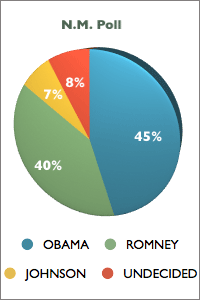
The Albuquerque Journal released the results of their Research & Polling, Inc. survey of 667 likely New Mexico voters over the Sept. 3-6 period, and it reveals an improved position for Republican presidential nominee Mitt Romney. New Mexico, along with New Hampshire and Iowa, has performed as a pure swing state in national elections since 2000, but surveys to date have consistently given President Barack Obama double-digit leads.

In this poll, Obama has only a 45-40 percent advantage over Romney, with former New Mexico governor Gary Johnson, the Libertarian nominee for President, drawing 7 percent. With just a five-point gap now, the results show substantial movement for Romney, who had been trailing by as many as 15 points in previous surveys. The poll also shows that Johnson could play spoiler for Obama and not Romney. According to the Albuquerque Journal, “Johnson gets 12 percent of the Independent vote in the state, leaving Romney with a 38-35 lead over Obama among the key group.”

The study was conducted after the Republican convention but before the President made his official acceptance speech last week in Charlotte. According to the pollsters, about half of the respondents were questioned subsequent to First Lady Michelle Obama’s address.

In another race, Rep. Martin Heinrich (D-NM-1) leads former Rep. Heather Wilson (R-NM-1) by a 49-42 percent count. This is consistent with other polls that have shown both candidates in the 40-percentile range, with Heinrich leading. The numbers break down regionally as one would expect, except that Wilson, tied with Heinrich in the southwestern corner of the state, should be performing better in the region south of Albuquerque.

This poll suggests that the “lean Democrat” rating assigned to this campaign is correct, but also shows a growth pattern available to Wilson. The fact that she leads Heinrich 53-37 percent among Independents is highly encouraging for her campaign effort.

Polls In Sync

We often bring polling inconsistencies to light and analyze why a particular survey may be more accurate than another. Right now, however, four diverse pollsters all are showing virtually the same result in the presidential race. The conclusion: The presidential campaign, in mid-May, between President Obama and Mitt Romney, is a virtual tie.

Our first comparison is between the two polling firms that track the national race on a daily basis: Gallup and Rasmussen Reports. The latest published Gallup numbers (April 15-May 6; 3,050 registered voters grouped in five-day tracking segments) show Obama and Romney with the exact same level of support, 45-45 percent. Rasmussen, which calls 500 people every night and then groups them in three-day tracking segments, arrives at virtually the same conclusion as Gallup, but their data has Romney grabbing the smallest of leads, 46-45 percent.

Next comes TIPP, the regular polling partner of Investor’s Business Daily and the Christian Science Monitor. TIPP is the acronym used for the polling section of the TechnoMetrica Market Intelligence corporation, which claims the mantra of “America’s most accurate pollster” based upon their presidential track record in 2004 and 2008 as compiled by Real Clear Politics. According to their traditional polling interview method conducted during the May 9-16 period of 778 registered voters, the President has a slight 43-40 percent lead, certainly consistent in margin of error terms with the other pollsters just cited.

Finally, Zogby Analytics, which has in the past been criticized for being among the least accurate of pollsters, and in this case polling for the Washington Times, also returns current data that agree with the rest. According to their traditional live interview survey May 11-12 of 800 likely voters, Romney has the one-point lead, 44-43 percent. Zogby also went one step further. They asked this particular sampling segment a second ballot test question that included Libertarian candidate Gary Johnson, the former New Mexico Republican governor, who will likely be on the general election ballot in many states. When adding Johnson to the mix, the result slightly changed the Romney-Obama split; the returned result showed a consistent 44-43-2 percent division, but this time in the President’s favor.

What this tells us – because the results from four such different pollsters each with their own methodological approach pertaining to sample selection and interview philosophy – is that at the present time, the national race deserves an unequivocal toss-up rating.

New Hampshire Debate: One More Enters

At the Republican presidential candidate debate last night in Manchester, N.H., Rep. Michele Bachmann (R-MN-6) made it known that she will become an official presidential candidate. Previously, she was only in the exploratory stage. She joins a field that now includes Massachusetts ex-Gov. Mitt Romney, former Minnesota Gov. Tim Pawlenty, ex-House Speaker Newt Gingrich, Rep. Ron Paul (R-TX-14), ex-Sen. Rick Santorum (PA), and businessman Herman Cain. Former New Mexico Gov. Gary Johnson is also a candidate, but was not invited to participate in the New Hampshire debate sponsored by CNN and the Manchester Union Leader newspaper.

Notable about this particular debate, which broke no new campaign ground with the exception of the Bachmann announcement, was who didn’t attend. The biggest potential name still not yet in the race is, of course, former vice-presidential nominee Sarah Palin. Also, don’t forget former New York City Mayor Rudy Giuliani who could become a factor later in the race. A new poll already places him second in New Hampshire, though about 30 points behind Romney. Texas Gov. Rick Perry is another potential late entrant who may have the ability to catch fire and vault into the top tier. And, former Obama Ambassador to China and Utah Gov. Jon Huntsman is also likely to become a candidate but chose not to participate in the New Hampshire debate.

All totaled, the entire field could soon expand to 12 if all of the aforementioned individuals actually become candidates. Though this national political race has been slow to begin, the action will soon become hot and heavy.
___________________________________________________
For further detailed insights, to sign up for my daily email updates, or to sign up to track specific issues or industries, please contact me at PR***@*******************ts.com

Campaign 2012 Officially Begins

Fox News and the South Carolina Republican Party co-hosted a candidates’ debate last night at the Peace Center in Greenville, S.C., that surprisingly served as the official kick-off event for the 2012 presidential campaign. Though it was somewhat of a non-event because the candidates most pundits would describe as being first-tier were not in attendance, the so-called second-tier group did nothing to discourage their supporters and actually managed to motivate the audience on several occasions.

Of the five participants, Rep. Ron Paul (R-TX-14) repeatedly brought the crowd to cheers, particularly so when he answered a question about heroine legalization by saying ” … how many people here would do heroin if it was legal? I bet no one would, so why do we need the government to protect us?” The others who participated in the debate were businessman Herman Cain, former Minnesota Gov. Tim Pawlenty, ex-U.S. Sen. Rick Santorum (R-PA) and former New Mexico Gov. Gary Johnson.

No one bungled a question but none of the participants particularly distinguished themselves either, with the exception of Dr. Paul on several questions and Mr. Cain in the final minutes of the debate. It is also probable that the eventual Republican presidential nominee was not part of this forum, but it is difficult to project just who that Republican winner will actually be, since all of the candidates are closely bunched. Polling shows no clear front-runner or individual capturing more than 20 percent support. Therefore, this may be the most wide-open campaign we have seen in the modern campaign era.

All of the contenders seemed to understand the key fundamental in contrasting themselves with Pres. Barack Obama, especially in light of the Osama bin Laden assassination. All of the candidates gave Obama due praise for his handling of the bin Laden mission, but then quickly pivoted to what they believe are the president’s shortcomings in his managing of the domestic agenda.

Though it is clear Mr. Obama has scored major political points for his action overseas and probably wouldn’t be defeated by anyone if the election were tomorrow, we don’t have to go too far back in history to prompt our memories and recall that foreign affairs victories are often short-lived and quickly crumble in significance when compared to the state of the domestic economy.

Two clear examples of this phenomenon occurred in 1945 and 1992:
• Winston Churchill, whose British Conservative Party was turned out of office in landslide proportions after successfully declaring a clear and stunning victory in World War II just a scant two months earlier.
• George H.W. Bush, who enjoyed 90% approval ratings after successfully guiding America in the Gulf War, only to lose his re-election just 10 months later, capturing a mere 37.5 percent of the national popular vote.

These results clearly show us that economics fundamentally trump foreign affairs.

For the Republicans to get back into the game against the president they will have to focus on the economy as the sole issue of the campaign and drive home their messages about the national deficit and debt, high food and gas prices, and the lack of job creation. It appeared that the five Republicans participating in last night’s debate fully understood this principle, but they and the other candidates have a very long way to go in a short time if the 2012 election is to become legitimately competitive anytime soon.
___________________________________________________
For further detailed insights, to sign up for my daily email updates, or to sign up to track specific issues or industries, please contact me at PR***@*******************ts.com.