Tag Archives: Democratic Congressional Campaign Committee

House Democratic Leadership Sees
No Path to Majority in 2016

Feb. 15, 2016 — The Democratic Congressional Campaign Committee released its early primary and secondary target lists for the 2016 campaign, which is a rather curious grouping. It is already clear that the House Democratic leadership sees no path to the majority in this election, at least during this campaign period.

With the Republican advantage at 247 (once former Speaker John Boehner’s western Ohio seat is filled in special election) to 188, the Democrats would need a net gain of 30 seats just to obtain a one-seat majority. The fact that their primary and secondary target list includes only 24 races suggests that they are nowhere close to putting enough seats in play to seriously challenge the Republican leadership structure.

On the primary list of 16 candidates, two seats are already under Democratic control, CA-24, the Santa Barbara seat of the retiring Rep. Lois Capps, and the FL-18 district of Rep. Patrick Murphy who is running for the Senate. Therefore, what they believe are prime opportunity races number just 14.

Continue reading

The Frontline Candidates

FEB. 13, 2015 — The Democratic Congressional Campaign Committee (DCCC) released its first group of Frontline program incumbents for the 2016 election cycle. These 14 representatives are viewed to be the most vulnerable of Democratic House incumbents, and a group that the DCCC is highlighting for increased outside support.

Some are more endangered than others, in addition to a group of four who is at least entertaining the idea of running statewide next year. Not having an incumbent in these marginal districts may be the Committee leadership’s greatest fear.

Clearly Competitive (in vulnerability order)

NE-2: Rep. Brad Ashford is likely the most endangered Democratic incumbent. The new congressman unseated eight-term Rep. Lee Terry (R-Omaha) in a vote that may have been more about the previous incumbent’s unpopularity than Ashford. The 2016 race, in a year when the district should vote Republican at the presidential level, could be more difficult for Ashford than his original election.

FL-2: Freshman Rep. Gwen Graham ran a strong campaign against a weak Republican incumbent. She will undoubtedly draw strong opposition, and the district will almost assuredly go Republican for president. The national trends at the time of the next election will play heavily upon how this congressional race unfolds.
Continue reading >

Landrieu, McSally Still Seek Final Results; Sights Already Set on Reid for 2016; Leadership Elections Underway

Landrieu: Kicking into high gear for the Louisiana Senate run-off election, Sen. Mary Landrieu (D) is already badly trailing in a new Magellan Strategies poll (Nov. 12; 1,197 registered Louisiana voters via automated response). The survey, conducted for Rep. Bill Cassidy’s (R-LA-6) statewide campaign, finds the congressman leading the endangered senator by a huge 57-41 percent clip.

The Landrieu campaign scoffs at the automated nature of the poll, claiming the methodology is not as accurate as live phoning. While such a premise is certainly the prevailing train of thought among political professionals, the actual reliability numbers suggest something far different: that the automated approach is improving by the day and can be just as accurate as the live “phoner” approach. If that’s so in this case, then Sen. Landrieu is likely headed toward defeat on Dec. 6.

If Cassidy wins, the Senate party division will be 54R-46D, a total gain of nine seats for the Republicans in the 2014 election.

McSally: As predicted yesterday, the final count in the 2nd District of Arizona did yield at least a preliminary victory for challenger Continue reading >

The Dems’ Problem


DCCC Ad “Failure”

While recent polling numbers are improving for Democrats or their allies in a number of key Senate races (North Carolina, Colorado, Louisiana, and Kansas), a look at the party’s new ad buy in congressional races capsulizes their plight in the House.

While Republicans announced electronic ad Continue reading >

DCCC IDs Their Frontline Candidates

DCCC

The Democratic Congressional Campaign Committee released the first of their “Frontline” incumbents, those that will get the most attention from the party as they build for re-election. All are either freshmen from competitive districts, won a tough open seat, or defeated a Republican incumbent in 2012.

Rep. Ron Barber (AZ-02) – Barber, who won a special election to replace resigned Rep. Gabrielle Giffords (D), had a closer than expected general election against former Air Force pilot Martha McSally (R) winning just 50.4 to 49.6 percent. McSally is likely to return in 2014, and with a more favorable turnout model could conceivably score an upset. The fact that Mitt Romney won the seat 50-48 percent bodes well for the challenger, but it didn’t pull her through last November.

Rep. John Barrow (GA-12) – Rep. Barrow drew a second-tier opponent in what should have been a first-tier GOP conversion opportunity. With a projected lower African-American turnout for 2014,  Continue reading >

Schwartz, Peters Likely to Stay

Rep. Schwartz (D-PA-13), Rep. Peters (D-MI-14)

Rep. Schwartz (D-PA-13), Rep. Peters (D-MI-14)

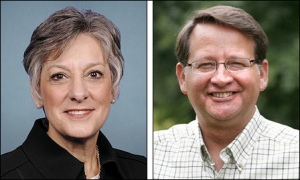
There has been some political speculation of late that Pennsylvania Rep. Allyson Schwartz (D-PA-13) and Michigan Rep. Gary Peters (D-MI-14) will forgo their 2014 re-election campaigns in order to challenge their respective Republican governors.

The new Democratic Congressional Campaign Committee (DCCC) assignments suggest that both of the aforementioned members of Congress will remain in their current positions, however. Schwartz has agreed to become the committee’s National Finance Chair and Peters will serve as the Candidate Recruitment Committee’s Vice-Chairman.

Their willingness to accept high-level House campaign-oriented positions sends the clear signal that both believe their future, at least for the short term, remains in the House and not in running for a state-based office.

Rounding Out the House

Though not covered as extensively as the presidential battle and most Senatorial campaigns, the 435 US House races also figure prominently in next Tuesday’s ballots. While little drama exists concerning these campaigns from an aggregate context, it is still likely that as many as 80+ non-incumbents could win seats for the first time. There are 62 open seats, and easily another 18 to 30 House members could lose their seats.

The current partisan makeup of the House of Representatives is 240 Republicans and 190 Democrats, with five vacancies, three from Democratic seats and two Republican. Today, our House race handicapping chart shows that 229 congressional districts are “safe,” “likely” or “leaning” for the Republican candidate, and 180 districts are “safe”, “likely”, or “leaning” for the Democratic standard bearer, with 26 “tossup” districts that both parties have some chance of winning. In order for the Democrats to re-capture the majority lost two years ago, they would need a net gain of 25 seats from their current level just to reach the bare minimum of 218. With this numerical obstacle standing before them, and in order for the minority party to regain power, they would need a “wave” election, something that has little chance of occurring.

Recent examples of wave elections are the Republican sweep of 2010 and Democratic waves of 2006 and ’08 that drastically changed the composition of the House. Historically, wave elections are driven by the party with a substantial and unparalleled lead going into Election Day. The GOP netted 63 seats in the 2010 midterm election and conversely, Democrats won 31 seats in 2006, followed by another 25 two years later. If campaign historical trends are a true future indicator, as best detected by polling, then 2012 will not be a wave election. As the cycle progressed we have seen a good deal of movement in many races that began as clearly favoring one party or the other. Two contrasting swing races from the west and east are Washington state’s 1st Congressional District and the fast-emerging NY-21.

The Evergreen State has produced a top swing-seat battle in the new 1st Congressional District that was redrawn in a more competitive fashion as part of a deal among the members of the bi-partisan Washington State Redistricting Commission. In exchange for making the previously Democratic 1st District politically marginal and shoring up Republican Jaime Herrera Beutler in the new 3rd District, incumbent Rick Larsen (D) received a safe new 2nd District and the state’s additional seat, the 10th District gained in the national reapportionment formula, was made a Democratic safe haven.

In March of this year, Democratic Rep. Jay Inslee (WA-1) announced his resignation from the House in order to fully focus on his gubernatorial campaign. His vacancy was quickly flooded with interest and, after a hotly contested Democratic primary, former Microsoft executive Suzan DelBene (D) and Snohomish County councilman and ex-state Rep. John Koster (R) won the right to face off against each other in what polling continues to show is a close match-up.

In this key swing seat, a significant amount of money has been spent by outside groups including both the Democratic Congressional Campaign Committee (DCCC) and the National Republican Congressional Committee (NRCC). Recently an independent Survey USA poll (Oct. 19-21; 610 likely WA-1 voters) found DelBene leading Koster by three points, 47-44 percent. The new poll, compared to a previous S-USA study conducted five weeks prior, found that DelBene has increased five points in support, while Koster has lost two points. The results also determined that DelBene has a greater advantage with self-described moderates and independents.

Turning to the St. Lawrence Seaway region along the Canadian border on the north and Lake Champlain to the east is the new NY-21 District and Republican Matt Doheny could be moving into upset position. Lagging behind for most of the race, Doheny has emerged as a serious threat at precisely the right time. Two different polls forecast a closing race. Incumbent Bill Owens released his own data (Global Strategy Group; Oct. 21-23; 403 likely NY-21 voters) staking him to a 47-40 percent lead. But, another independent survey detected a much different result. Siena College (Oct. 29-30; 629 likely NY-21 voters) found the race to be much closer. According to the Siena data, Doheny is up by just one percentage point, 44-43 percent. Clearly, this campaign is very much alive turning into the final weekend.

While a good deal of uncertainty still remains in precisely predicting the composition of the new Congress, it is likely that Republicans will maintain control with their current margin potentially in tact.