Tag Archives: California

Poll: Newsom in Trouble

By Jim Ellis

California Gov. Gavin Newsom (D)

July 30, 2021 — The University of California at Berkeley’s Institute of Governmental Studies released their latest Golden State survey that finds Gov. Gavin Newsom’s (D) strength in the upcoming recall election dissipating.

According to UC Berkeley, among likely voters, 47 percent would vote to recall Gov. Newsom and 50 percent would not, clearly the closest ballot test result seen to date. The recall election is scheduled for Sept. 14, and voters will first choose whether to remove the governor from office before choosing a replacement among 46 ballot qualified candidates. The replacement candidates’ votes count only if a majority supports removing the subject from office, in this case Gov. Newsom.

The Berkeley poll (July 18-24; 5,795 registered California voters; 3,266 likely California recall election voters, online) finds Newsom in trouble only among likely voters, those screened as almost certain to participate in the recall election. Within the entire polling sample, he returns to safe territory as the respondents break only 36-51 percent for removing him from office.

The major difference is partisanship. The parties, as one might guess, break in polarized fashion. A total of 91 percent of Democrats would vote against the recall while 95 percent of Republicans favor removal.

The independent and minor party sectors become interesting, however. Among the large No Party Preference group, 46 percent would vote to recall Newsom and 50 percent would not. The combined minor parties, which only account for approximately six percent of the electorate are breaking hard for the recall position. Within the minor party segment, 68 percent would vote to remove as compared to only 30 percent supporting the retain option.

Among Republicans, 90 percent say they are enthusiastic about the election, while 58 percent of Democrats say the same. Among the substantial segment in the “No Party Preference” or independent category, 53 percent say they are enthusiastic.

The polling analysis suggests that the governor’s fundamental problem is that Democrats are “almost unanimous” in their belief that he will win the recall election. This substantially explains the Democrats’ lack of solid enthusiasm for the irregular Sept. 14 stand-alone election.

Continue reading

House Vulnerables – Part II

By Jim Ellis

July 13, 2021 — On Monday, we began a two-part series on what are arguably the most vulnerable dozen US House seats based upon the individual district’s political performance over the past two elections.

Below is the priority order update covering the second half of the top 12 most vulnerable CDs. As you will continue to see below, all of the seats except one are Republican held.

To refresh, the first six covered were:

• IA-2 (Rep. Mariannette Miller-Meeks, R-Ottumwa)
• IA-1 (Rep. Ashley Hinson, R-Marion/Cedar Rapids)
• IA-3 (Rep. Cindy Axne, D-Des Moines)
• FL-27 (Rep. Maria Elvira Salazar, R-Miami)
• CA-48 (Rep. Michelle Steel, R-Orange County)
• NY-22 (Rep. Cynthia Tenney, R-New Hartford)

Here’s our look at the next six:

UT-4: Rep. Burgess Owens (R-Salt Lake City) – Ave R vote: 48.8%
• Former NFL football star and businessman Burgess Owens defeated freshman Rep. Ben McAdams (D) by one percentage point in 2020, and we can expect another competitive race here again within this mostly suburban Salt Lake City congressional district located in the metropolitan area’s southern sector.

Republicans, who are in full control of the Utah redistricting process, will attempt to improve the district for Owens, which is possible since the 4th CD is the fastest growing district in the fastest growing state over the past decade. The best estimates suggest that the 4th District must shed approximately 50,000 people to other CDs. This should allow map drawers to subtract a substantial number of Democratic voters from the district, thus yielding Burgess a slightly more favorable political domain.

At this point, McAdams, who was the Salt Lake County mayor prior to his election to Congress, has not indicated whether he will return for a re-match.

MN-1: Rep. Jim Hagedorn (R-Rochester) – Ave R vote: 49.3%
• Two-term Rep. Hagedorn just announced that his cancer has returned, meaning an immediate treatment regimen. How this will affect his re-election campaign is yet to be determined. Hagedorn has won two close elections, as has his Democratic colleague in the adjacent district, Rep. Angie Craig (D-Eagan).

Minnesota is the only state in the nation that sees a split control legislature, meaning each party controls one house. Since the state did not lose a congressional district in apportionment as originally projected, it would not be surprising to see a legislative deal made where Democrats and Republicans are flipped between the two adjoining districts. The changes would result in Hagedorn gaining Republicans and Craig adding Democrats. Redistricting will perhaps be the most critical factor in determining the outcome of both districts come 2022 and beyond.

Continue reading

California’s Lost Seat

By Jim Ellis

July 7, 2021 — For the first time in history, California loses a congressional seat in reapportionment, and the public input session that was scheduled to begin yesterday continues the California Citizens Redistricting Commission’s Phase 2 process. This week, the commission members continue listening to testimony about how the districts should be drawn for the state’s congressional delegation and both houses of the Golden State’s legislature.

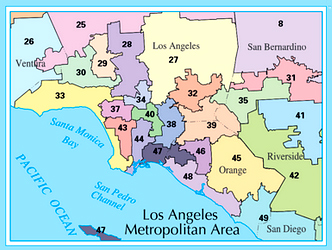
Sitting adjacent to each other are the following California congressional seats: CA-32 (Rep. Grace Napolitano; D-Norwalk), CA-38 (Rep. Linda Sanchez; D-Whittier), CA-40 (Rep. Lucille Roybal-Allard; D-Downey), and CA-44 (Rep. Nanette Diaz-Barragan; D-San Pedro).

After California, along with the other 49 states, receives its census tract information after the Aug. 15 negotiated deadline, the five Democrats, five Republicans, and four non-affiliated CCRC members will study and organize the data until their Phase 3 line drawing process commences in September. The commission was created through a 2010 ballot proposition that removed redistricting power from the legislature and instituted a citizens panel to create the new post-census maps every 10 years. This is the body’s second redistricting cycle.

The commission timeline was crafted after the state of Ohio sued the Census Bureau to force a faster distribution of the state redistricting data. Originally, using COVID as their principal excuse, the Bureau leadership set Oct. 1 as their distribution deadline goal. In typical years, states would have received the census tract information months ago. The Ohio lawsuit was settled with the two sides agreeing on an Aug. 15 deadline that is now in effect for the whole country.

The commission members are now tasked with changing the state’s 53-member congressional delegation into a map that features only 52 seats. And now, the question of just which area will lose the district must be tackled.

Looking at the latest public district data, that through July 1, 2019, we see some patterns providing key clues. It is understood that the last year of the census is not included in these numbers, and reports suggest that the final 12 months of the 10-year cycle resulted in significant change for the state as the number of people leaving for other places substantially increased. In fact, for the first time, California actually has fewer people than it did in a preceding year.

The most significant loss appears to come in central Los Angeles County. Looking at the current 53 districts, the seat with the lowest population is Rep. Adam’s Schiff’s (D-Burbank) San Fernando Valley 28th CD. But the cluster of seats in the heart of Los Angeles suggests an area where two seats can easily be collapsed.

Continue reading

SCOTUS Rules; Calif. Recall Scheduled

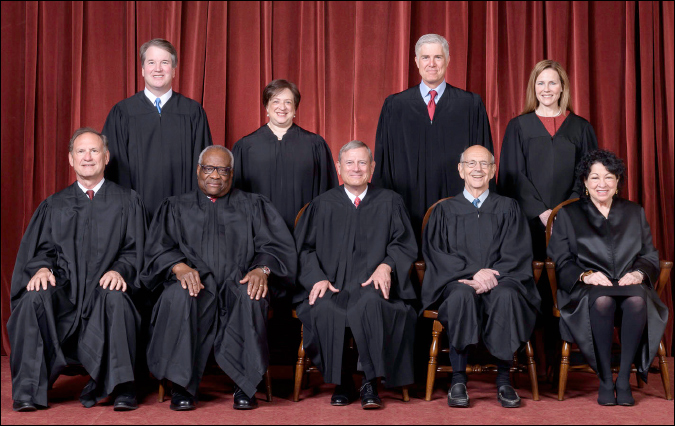
Current US Supreme Court

By Jim Ellis

July 6, 2021 — On their last day of the year’s early session last week, a Thursday, the Supreme Court of the United States issued rulings on the Arizona voting rights case and the California non-profit organization disclosure lawsuit.

In the Democratic National Committee v. Brnovich, the Supreme Court with Justice Samuel Alito writing for the 6-3 majority, ruled that the state of Arizona did not infringe upon minority voting rights or violate Section 2 of the Voting Rights Act in both prohibiting ballot harvesting with certain exceptions, and not counting provisional ballots cast from voters who do not reside in the particular precinct that the polling place covers.

The high court agreed with Arizona Attorney General Mark Brnovich’s (R) arguments that the laws are not racially motivated, nor do they intentionally discriminate against certain segments of the voting population, thus overturning the full 9th Circuit Court of Appeals ruling.

Originally in 2016, Brnovich won at the district court level and on the first appeal to a three-judge panel from the 9th Circuit. The DNC requested an en banc review of the original appellate ruling that agreed with Brnovich, and the entire 9th Circuit membership overturned the decision, siding with the plaintiff. At that point, AG Brnovich petitioned the Supreme Court, which agreed to hear the case. (Hearing cases en banc allows the full circuit court to overturn a decision reached by a three–judge panel. Due to the decreasing probability of U.S. Supreme Court intervention, the circuit court is often the court of last resort in the ordinary life of a case, thereby amplifying the importance of en banc review.)

In his ruling, Justice Alito stated that “every voting rule imposes a burden of some sort,” and that “mere inconvenience cannot be enough to demonstrate a violation of Section 2.” He also cautioned that, “what are at bottom very small differences should not be artificially magnified.”

While agreeing that holding free and open elections is a “valid and important state interest,” he also addressed the voter fraud argument, clearly stating that attempting to prevent such abuses is also a “strong and entirely legitimate state interest.”

In her article discussing these rulings, Supreme Court expert Amy Howe, in her Howe on the Court article that was published on the SCOTUS blog, offered that the Brnovich ruling “will make it more difficult to contest election regulations under the Voting Rights Act,” and thus likely means fewer voting rights cases coming through the courts. She further categorized this decision as a “major ruling.”

Continue reading

Census Delays: Some Ramifications

By Jim Ellis

June 1, 2021 — As we know, the Census Bureau has delayed in meeting its public reporting deadlines, which causes ramifications in the political world. As a result, the state officials responsible for redistricting could well find themselves placed behind the proverbial eight ball as the new year approaches.

Reapportionment is the term used to explain the entire decennial process. Reapportionment, as the US Supreme Court defined it in their 1999 ruling on the US Census Bureau v. House of Representatives case, is basically divided into two parts. The first, which was finally completed and released on April 26, is the allocation of congressional seats to the states. The second is the re-drawing of congressional, state, and local district boundaries most often referred to as redistricting.

To complicate matters even further, the delayed allocation proved much different – affecting six seats to be exact – than predictions. It was believed for at least two years that Texas would gain three seats in the 2020 reapportionment and Florida two, with Arizona, Colorado, Montana, North Carolina, and Oregon adding one seat apiece. The actual numbers found Texas gaining two, Florida one, and Arizona none. The other one-seat gaining states were correctly predicted.

Conversely, Alabama, California, Illinois, Michigan, Minnesota, New York, Ohio, Pennsylvania, Rhode Island, and West Virginia were all expected to lose one seat apiece. The actual report found Alabama, Minnesota, and Rhode Island each retaining the same number of seats they held in the 2010 reapportionment, while the others did lose a single district apiece.

The Census Bureau claims that COVID is largely responsible for their delays, but the state of Alabama, in their pending lawsuit against the federal statistical entity, disagrees. Alabama claims the deadline violations occurred because of the Bureau’s attempt to impose, for the first time in history, differential privacy over the data. This means, under the argument of protecting individual privacy, data would be deliberately scrambled, and certain information not publicly released.

Differential privacy alone would make redistricting extremely difficult for state map drawers because the released census tract numbers, now by definition, wouldn’t equal the state population figures brought forth earlier in the year. The effect would cause political havoc throughout the country. A court ruling on the Alabama case is expected shortly.

Because of a successful legal challenge from Ohio, the Census Bureau has agreed to make the data necessary for redistricting available to the states by Aug. 15 instead of the Oct. 1 date indicated when allocation was announced.

Continue reading

Examining California
Gov. Newsom’s Vulnerabilities

By Jim Ellis

California Gov. Gavin Newsom (D)

May 13, 2021 — The University of California at Berkeley’s Institute for Governmental Studies released another of its periodic polls this week, and while it finds Gov. Gavin Newsom (D) surviving the upcoming recall election it also identifies areas of underlying weakness.

According to the survey (April 29-May 5; 10,289 registered California voters with questions asked in English and Spanish, online), Gov. Newsom would win the impending recall vote as 49 percent of the respondents said they would vote to retain him in office and 36 percent support removal. Regarding his job approval and performance on certain issues, however, the poll identifies what could possibly become an opponent’s path to victory.

The Cal-Berkeley result is very similar to another poll conducted within the same time period. Survey USA went into the field during the April 30 – May 2 time segment and interviewed 750 California registered voters of which 642 were identified as likely to vote in the gubernatorial recall election. S-USA found the sampling universe broke 47-36 percent in favor of Gov. Newsom remaining in office, almost identical to Cal-Berkeley’s tally from their much larger online sample.

Cal-Berkeley delved deeper into how the respondent sample was viewing the governor’s job performance and his standing within the electorate, and its results suggest that a focused opposition campaign could yield a close outcome.

Perhaps most troubling to the Newsom strategy team is the question that tested enthusiasm within the electorate. While Democrats were breaking 75-8 percent to retain the governor, the enthusiasm metric showed that only 36 percent of them have a high interest in the election. Another 30 percent fell into a moderate interest level, and 34 percent of the self-identified Democratic voter base said they had little or no interest.

Republicans, on the other hand, registered a 75 percent high interest level, suggesting that their turnout for the eventual election will be much greater. Though Democrats hold a large 46-24 percent party registration advantage, the interest level suggests the eventual election result could fall into a closer range. Among GOP voters, the governor would be ousted in a whopping 85-8 percent margin.

Those registering under the No Party Preference category, who account for another 24 percent of the California voting universe, would retain the governor with a 45-33 percent margin, while the six percent who identify with a minor party break 48-29 percent for removal.

Overall, Gov. Newsom’s job performance improved from Cal-Berkeley’s late January poll and stands at a 52:43 percent positive to negative ratio. In January, the performance ratio was an upside-down 46:48 percent. This is largely due to improvement regarding his handling of the Coronavirus issue, as 45 percent rate his performance as excellent or good, while 35 percent say poor or very poor. Another 16 percent gave him a fair rating, which on this poll seems to indicate a moderate support level as opposed to leaning in a negative direction as some other pollsters characterize the term.

Continue reading

Apportionment Surprises


By Jim Ellis

April 28, 2021 — In virtually every 10-year apportionment announcement at least one surprise occurs, but the census unveiling Monday contained multiple blockbusters.

For example, two states had their final number of congressional districts determined by less than 90 people. Reportedly, if New York had just had 89 more people, that would have saved an Empire State congressional seat. Minnesota becomes the beneficiary allowing the state to barely hold its eighth district.

Instead of 10 seats changing states as had been forecast, only seven, affecting 13 domains, switched. Perhaps the main reason for the lower number is the decade population growth rate. According to yesterday’s final report, the nation grew at only a 7.4 percent rate, the lowest since the 1930 census’s 7.3 percent. By contrast, the population increase from the 2010 total was 9.7 percent.

Pre-census projections, for better than a year, had been predicting that Texas would gain three seats, Florida two, and Arizona one. The analysts also estimated seat losses for Alabama, Minnesota, and Rhode Island. None of these projections proved accurate.

On the other hand, prognostications for the balance of the map were accurate. Texas, and Florida did gain, but two and one, respectively, instead of three and two seats. Colorado, Montana, North Carolina, and Oregon each added one district apiece as expected. The one-seat losers were California, for the first time in history, Illinois, Michigan, New York, Ohio, Pennsylvania, and West Virginia.

It’s a bit too soon to determine which party will benefit the most from these numbers at the congressional level, though Republicans should be up slightly in the Electoral College for the next presidential campaign. Once we see how the population is distributed within the states will better tell us whether Democrats or Republicans will take the most advantage of the apportionment. This will depend upon how the population spreads through the cities, suburbs, and rural regions.

Continue reading