A New Senate Contender
In Pennsylvania?

By Jim Ellis

May 5, 2017 — There is renewed interest from Republicans in challenging Pennsylvania Sen. Bob Casey Jr., but the Senate campaign is still slow to materialize. Fresh from President Trump’s and Sen. Pat Toomey’s simultaneous but highly different wins in 2016, the GOP now has recent political victory paths from which to chart a new Senate campaign against the two-term Democratic incumbent.

This week, a new potential candidate may be coming onto the scene but, if so, he will have to quickly jump-start his campaign apparatus. Four-term Rep. Lou Barletta (R-Hazelton/Luzerne County) confirms that he is considering entering the Senate race, but his campaign treasury is a long way from being ready for a statewide campaign.

In many ways, President Trump and Sen. Toomey ran strategically opposite campaigns, yet both were able to win close Keystone State elections. The Trump strategy was to increase turnout, meaning the Republican vote in the outer suburbs and the rural areas, in order to counter the substantial Democratic margins coming from the Philadelphia and Pittsburgh metro areas.

Continue reading →

SC Run-off and Outright Win

By Jim Ellis

May 4, 2017
— Voters went to the polls in South Carolina Tuesday to begin the nomination process in the special election to replace Office of Management & Budget director Mick Mulvaney. The results were as predicted.

For the Republicans, the two leading candidates going into the partisan primary, state House Speaker Pro Tempore Tommy Pope and former state representative and 2006 congressional nominee Ralph Norman, virtually tied in the final result. Pope finished first with only a 112-vote margin, scoring 30.5 percent in a field of seven Republican candidates. Norman’s percentage was 30.2.

The 5th District contains all or part of 11 north-central South Carolina counties. Both Pope and Norman hail from York County, the district’s largest population entity. There, Pope outdistanced Norman by 137 votes. That means the difference between the two was just 25 votes in the remaining 10 counties.

Turnout was 38,903 in the Republican primary with the Democrats adding an additional 18,573 who voted in their nomination contest. The total participation factor of 57,476 represented only 12.5 percent of the district’s registered voters. This number pales in comparison to the GA-6 turnout that exceeded 192,000, as we saw on April 18, but was much stronger than the Los Angeles special earlier last month that drew just under 29,000 voters.

Continue reading →

South Carolina Special

By Jim Ellis

May 3, 2017 — Voters in north-central South Carolina’s 5th District cast ballots yesterday in partisan primaries as the people voted to choose a replacement for ex-Rep. Mick Mulvaney (R-Lancaster/Rock Hill), now director of the Office of Management and Budget.

Unlike the four previous special elections in California, Kansas, Montana, and Georgia, the Palmetto State neither holds a jungle primary nor a nominating convention. Just as in the regular election cycle, candidates first run in partisan primaries. If no one secures a majority in the first vote, partisan run-offs occur in a short two-week time frame under South Carolina election law. The eventual nominees then advance to the general election.

In a district that voted 57-39 percent for President Trump, and elected Rep. Mulvaney four times by an average of 57.6 percent of the vote, including his initial percentage when defeating veteran incumbent Rep. John Spratt (D) in 2010, the Republicans were heavy favorites to hold the seat in the current special election process.

Seven Republicans are on the ballot, and most observers agree that former state representative and 2006 congressional nominee Ralph Norman and state House Speaker Pro Tempore Tommy Pope were the two leading candidates. With five others on the ballot, it appeared unlikely that either Norman or Pope would command a majority of the primary vote, hence a May 16 GOP run-off was viewed as the likely outcome of yesterday’s voting.

Norman had the most in the way of funding, securing almost $600,000 according to the pre-primary Federal Election Commission filing report through the period ending April 12. Half of that amount was from a candidate loan, however. State Rep. Pope, who was planning to run for governor had not Lt. Gov. Henry McMaster (R) become the incumbent state chief executive when Gov. Nikki Haley (R) was appointed US Ambassador to the United Nations, had only banked $226,002 during the same period, which was a surprisingly low amount.

Both of these candidates have cut television ads, but more airings have been through the digital medium rather than the airwaves. (See below samples)

https://youtu.be/e22ffDReSxM

https://youtu.be/nBlzlU-DORU

Continue reading →

Why Trump Is Right on the Polls

By Jim Ellis

May 2, 2017 — President Trump’s retaliatory attacks against the latest major media polls may actually be more correct than even he alludes. The nation’s chief executive predictably came out swinging against ABC and NBC News regarding their newly released polls that found just over 40 percent of their sampling groups approve of his job performance, the worst of any president after 100 days in office.

Trump reminded his audience that those two particular polls were wrong in their election predictions, but the survey representatives quickly shot back to point out that their pre-election projection of Hillary Clinton winning the popular vote was in fact accurate. These pollsters are correct in this particular assertion, but we all know that the individual state polling, particularly in the key Great Lakes states like Pennsylvania, Michigan and Wisconsin, was badly flawed and completely missed the mark.

Digging deeper into the current and past election polls does produce a little known factoid, however, and one that the president should find comforting. While the ABC and NBC representatives say their data find Trump to be the most unpopular short-term president, they fail to draw upon a critical comparison factor from their own previous polls.

Continue reading →

Missouri Taking Shape

By Jim Ellis

May 1, 2017 — Sen. Claire McCaskill (D) stands for a third term, and could arguably be the Republicans’ top national conversion target. The senator obviously had a successful first re-election run in 2012 despite Mitt Romney carrying Missouri, a race that was made easier after actively worked to influence Republicans to nominate then-Rep. Todd Akin, a man she was confident of defeating.

Sen. Claire McKaskill (Facebook photo)

Sen. Claire McKaskill (Facebook photo)

Even with a calamitous succeeding Republican campaign, the combined GOP and minor party opposition to McCaskill still netted over 45 percent of the vote. Therefore, adding the more defined Missouri Republican vote trend present since 2012, it is reasonable to project that the eventual GOP nominee likely starts a campaign against McCaskill with a base in the 47-48 percent range.

For a long while, the Missouri electorate proved a reliable bellwether in presidential elections. For 76 years, covering 19 elections (dating back to Franklin Roosevelt’s first election in 1932), Show Me State voters had sided with the winning presidential candidate in every election but one. In 1956, the state went to Adlai Stevenson in the Eisenhower re-election year.

Continue reading →

Another Says No

By Jim Ellis

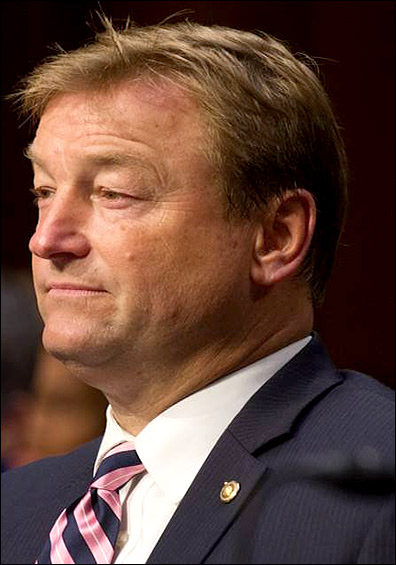
Sen. Dean Heller (R-NV)

Sen. Dean Heller (R-NV)

April 28, 2017 — Democrats face a major problem in the 2018 Senate races that they have no ability to solve. Forced to defend 25 of the 33 in-cycle seats, not counting the new 2017 Alabama special election, there simply aren’t enough viable Republican conversion targets to yield a legitimate run for the majority.

Even in what should be their top conversion target, the Nevada race where GOP Sen. Dean Heller is seeking his second term, the Democrats do not yet have a viable candidate. This week, businessman Steve Cloobeck, who has the ability to self-fund a Silver State campaign, announced that he would not run.

And then, in a move that perplexed the Democratic leadership, Cloobeck went a step further and publicly endorsed Sen. Heller for re-election. While professing not to agree with Heller on core issues, Cloobeck says he appreciates “his (Heller’s) businesslike approach to politics and legislation.”

Continue reading →

Finally, a Montana Poll

By Jim Ellis

April 27, 2017 — While the Montana at-large special election has been heating up with both major party candidates approaching the $2 million mark in campaign receipts and each heavily spending on media, we had surprisingly not seen any polling data … until yesterday.

The lack of polling led some analysts to believe the race was trending toward Republican Greg Gianforte. Democrats, normally quick to release survey numbers that favor their candidate, had been unusually quiet about nominee Rob Quist’s ballot test status. GOP strategists typically tend to play their polling cards closer to the vest, but often publicize survey data in response to what they see as embellished numbers for the opponent.

It’s possible that such an argument scenario has some validity in this instance. The Emerson College Polling Society made public their recent survey totals that post Gianforte to a major advantage over country rock singer Rob Quist (D).

Continue reading →

Dems: Targeting Trouble

By Jim Ellis

April 26, 2017 — Democrats appear encouraged by their early House special election performance, which has spurred some talk about the party’s possibilities of re-claiming the House majority next year.

While the open special election Democratic candidates are of high quality in California, Georgia, and Montana, the early regular cycle contenders are lacking, finding themselves already embroiled in multi-candidate primaries, or not even in existence.

Of the 10 already announced regular cycle open seats six are in Republican districts. All are either categorized as safe or likely Republican, so the prospects for Democratic gains in this important sector appear non-existent at least within the current configuration.

Turning to the challenger races, Democrats are active on the recruiting front but it appears the party leadership efforts, combined with individuals declaring candidacies of their own accord, are resulting in either feast or famine. In each of 36 districts, for example, against Republican incumbents not even considered especially vulnerable, Democrats already have multiple announced candidates.

Continue reading →

Updating the Four Specials

By Jim Ellis

April 25, 2017 — Coming through the highly publicized GA-6 special election, the political overtime campaign season is hitting its stride as we approach May voting. In Georgia, South Carolina, Montana, and California, political action is now in full swing.

The GA-6 contest has eliminated all but finalists Jon Ossoff (D) and Karen Handel (R) in a race well on its way to becoming the most expensive congressional special election in American history. Right after last Tuesday’s vote, the Democratic Congressional Campaign Committee sponsored an initial post-primary $450,000 flash media buy, which was quickly followed by the National Republican Congressional Committee’s $250,000 airtime purchase.

While the two sides exceeded $16 million in pre-primary fundraising, it appears the special general spending pattern is already following suit to no one’s surprise. We can count on seeing very active campaigning here all the way to the June 20th special general vote.

Continue reading →

More Chaffetz Intrigue

By Jim Ellis

Rep. Jason Chaffetz (R-Utah)

Rep. Jason Chaffetz (R-Utah)

April 24, 2017 — House Oversight & Government Reform Committee chairman Jason Chaffetz (R-UT-3) made a great deal of news over the past week. He surprisingly announced that he would not seek re-election in 2018; Chaffetz said he’s been away from his family in Utah too long during his four-plus terms in Congress, and desires to return to the private sector, yet he left the door wide open about running for governor in 2020.

Then, Rep. Chaffetz indicated that he was considering resigning before the term ends. In fact, late last week, rumors were circulating through media outlets that the congressman was going to leave the House as early as Friday.

Then Rep. Chaffetz somewhat clarified the situation saying that while he would not likely serve the remaining 20 months of the current term, he wouldn’t be leaving anytime soon and certainly not within days. The representative told the Salt Lake City Tribune that, “if I do it, it’s going to be months from now.” Chaffetz also disclosed that he is in discussions with an unidentified company about a private-sector position.

Continue reading →