Category Archives: Primary

Rep. Taylor Withdraws From Race

Former Texas Collin County Judge (Executive) Keith Self is now the new 3rd District Republican nominee after north Texas area Congressman Van Taylor (R-Plano) decided to withdraw from the runoff election resulting from Tuesday’s primary.

By Jim Ellis

March 4, 2022 — It was on a somewhat surprising note that north Texas area Congressman Van Taylor (R-Plano) was forced into a runoff from Tuesday’s primary election, but Wednesday’s related events proved astonishing.

Rep. Taylor has announced that he is withdrawing from the runoff, making public an extra-marital affair in which he engaged. Apparently, affair rumors began to surface late in the primary contest. Clearly knowing the story would become public, he admitted the indiscretion and immediately departed the race.

Under Texas election procedure, a candidate qualifying for a runoff election can decline to participate. The concession means the opponent automatically wins the party nomination. Thus, former Collin County Judge (Executive) Keith Self is the new 3rd District Republican nominee with an accompanying ticket to Washington, DC after the Nov. 8 election.

Taylor only secured 48.7 percent of the vote in Tuesday’s primary, meaning that a majority of Republican primary voters chose another candidate. This is never a good sign for any incumbent and the chief reason that most incumbents fail when forced to the secondary election. Adding the personal baggage obviously told Rep. Taylor that his re-election chances were irreparably diminished.

Self is a retired career West Point Academy Army officer who placed second in the primary with 27.1 percent, outlasting third-place finisher Suzanne Harp, a hard-charging businesswoman who proved to be surprisingly strong. The new congressional nominee presided over Collin County, an entity with now more than 1 million people, for three terms and chose to retire in 2018. In the congressional primary, he campaigned to Rep. Taylor’s right.

Continue reading

Texas Primary Results; Reps. Cuellar and Taylor to Runoffs

By Jim Ellis

March 2, 2022 — Both Gov. Greg Abbott (R) and former US Rep. Beto O’Rourke (D) won their respective gubernatorial primary outright last night, the nation’s first nomination contest in the 2022 election cycle.

Gov. Abbott easily captured the nomination to run for a third term, defeating former Texas Republican Party chairman Allen West and ex-state Sen. Don Huffines with 67 percent of the vote. O’Rourke topped a group of Democratic candidates to easily secure his nomination, attracting a whopping 91 percent. Several thousand votes remain to be counted. Gov. Abbott will be favored in the general election.

Lt. Gov. Dan Patrick (R), state Agriculture Commissioner Sid Miller (R), and State Comptroller Glenn Hegar (R) were all easily re-nominated and are prohibitive favorites in the general election.

Attorney General Ken Paxton, as expected, was forced into a Republican runoff election and will face Land Commissioner George P. Bush, son of former Florida Gov. Jeb Bush in what will be a highly competitive contest. AG Paxton recorded 42.7 percent support compared with Bush’s 22.8 percent. Former state Supreme Court Justice Eva Guzman and US Rep. Louie Gohmert (R-Tyler) followed with 17.4 and 17.1 percent, respectively.

Bush’s open Land Commissioner position will also go to a secondary election with state Sen. Dawn Buckingham (R-Lakeway) garnering 41.9 percent. Her runoff opponent will be pastor Tim Westley who appears to have clinched second place with 14.8 percent of the vote. The Texas runoff election is scheduled for May 24.

A pair of incumbents are forced into runoff elections while all other incumbents won their elections outright. The open seat contests also unfolded as expected.

Reps. Henry Cuellar (D-Laredo) will again face opponent Jessica Cisneros in a secondary May 24 election. After trailing all night, Cuellar finished first with 48.5 percent as compared to Cisneros’ 46.8 percent, a difference of 807 votes. Third place finisher Tannya Benavides’ small 4.7 percent share is enough to force the runoff as neither top finisher reached 50 percent.

In north Texas, Rep. Van Taylor (R-Plano) will also be forced to a runoff. He came within 1.3 percentage points of winning outright. Former Collin County Judge (Executive) Keith Self advances but recorded only 26.5 percent of the vote. He outlasted financial executive Suzanne Harp by just over 3,600 votes.

Continue reading

Texas Primary Today

By Jim Ellis

March 1, 2022 — The national primary season begins today in the Lone Star State and some nominees will be chosen outright while others can advance to a May 24 runoff election. The majority of the candidates will be eliminated, however.

Texas has all of their statewide offices on the ballot in 2022, as well as 38 congressional races, two more than in the previous decade since the state earned two new seats in national reapportionment. Neither Texas US senator is in-cycle his year.

This should be a relatively quiet primary day for the top of the ticket candidates as Gov. Greg Abbott and former US Rep. Beto O’Rourke will easily win outright in their respective Republican and Democratic nomination elections. Surveys, however, only show early single-digit leads for Gov. Abbott in general election pairings, which is typical for Texas polling. Often races begin in rather close fashion only to see the Republican nominee pull away at the end.

The race garnering the most attention is the attorney general’s contest, where two-term incumbent Ken Paxton is likely headed to a runoff election against either Land Commissioner George P. Bush, son of former Florida governor and presidential candidate Jeb Bush, or state Supreme Court Justice Eva Guzman. US Rep. Louie Gohmert (R-Tyler), while being part of the equation that likely denies Paxton re-nomination tomorrow night, does not appear in competitive position.

AG Paxton continues to have a 2015 federal indictment hanging over his head without action, former aides levying (at this point unproven) charges that he was involved in a bribery scam, and dealing with an extra-marital affair that has come to the surface. All of this has put him in an obvious vulnerable position for re-election.

Four serious Democratic candidates are vying for their party’s nomination, with ACLU south Texas lawyer Rochelle Garza, civil rights attorney Lee Merritt, who under scrutiny has yet to produce his Texas law license, former Galveston Mayor Lee Merritt, and retired Harris County Judge Mark Fields. Two of these candidates advancing into a runoff is a virtual certainty.

Several primary contests will be decided tomorrow night in congressional races, with the most competitive battles underway in open seats. Twenty of the state’s incumbents seeking re-election have primary opposition, but only two face what can be characterized as serious opponents. Democratic Rep. Henry Cuellar (D-Laredo) has the most serious challenge, and a highly publicized FBI investigation certainly doesn’t help his situation.

The following are the congressional races to watch tomorrow night:

District 1: Rep. Louie Gohmert (R-Tyler) – Open Seat

2022 TX-1: 538 Stat Projection: R+50 | Previous Projection: R+50
2022 TX-1: Dave’s Redistricting App: 72.5% R; 25.6% D

• Percent of Former District 1 in New District 1: 72.4 (Gohmert)
• Percent of Former District 4 in New District 1: 27.6 (Fallon)

With Rep. Gohmert retiring after what will be nine terms, four candidates are battling for the Republican nomination in what is a super-safe east Texas seat for the GOP. Smith County Judge (called County Executives in most states) Nathaniel Moran appears to be the favorite since the Tyler area is the 1st District’s population anchor. Moran is a possibility to win outright, but he is virtually assured of clinching one of the runoff slots.


District 3: Rep. Van Taylor (R-Plano)

2022 TX-3: 538 Stat Projection: R+23 Previous Projection: R+11
2022 TX-3: Dave’s Redistricting App: 58.7% R; 38.6% D

• Percent of Former District   3 in New District 3: 73.3 (Taylor)
• Percent of Former District   4 in New District 3: 18.3 (Fallon)
• Percent of Former District 32 in New District 3:   8.5 (Allred)

Rep. Van Taylor’s top opponent, former Collin County Judge Keith Self, has won three elections in a political entity that houses more than 1 million people, so he is a known figure to north Texas Republican voters. He has not raised much in the way of funding, however, but does have some outside help. There are two other candidates on the ballot, so a runoff is mathematically conceivable but highly unlikely.

Rep. Taylor is the clear favored to win outright. The 3rd District was made much more Republican in redistricting, thus tomorrow night’s election will likely be the determining factor for the entire election cycle.


District 8: Rep. Kevin Brady (R-The Woodlands) – Open Seat

2022 TX-8: 538 Stat Projection: R+26 Previous Projection: R+50
2022 TX-8: Dave’s Redistricting App: 63.5% R; 34.4% D

• Percent of Former District   8 in New District 8: 42.4 (Brady)
• Percent of Former District   7 in New District 8: 30.1 (Fletcher)
• Percent of Former District 10 in New District 8: 19.0 (McCaul)
• Percent of Former District 36 in New District 8:   6.5 (Babin)
• Percent of Former District   2 in New District 8:   1.9 (Crenshaw)

Rep. Kevin Brady is retiring after what will be 26 years in the House, and leaves a Republican primary battle that will likely be decided tomorrow night. Internal polling shows retired Iraq and Afghan War veteran Morgan Luttrell in position to win outright in a field of 11 candidates, which is a difficult feat. Luttrell is the brother of Marcus Luttrell, who came to fame as the “Lone Survivor” in books and a movie about his harrowing experience in Afghanistan.

Consultant and conservative activist Christian Collins, who Sen. Ted Cruz and Texas Reps. Lance Gooden (R-Terrell) and Troy Nehls (R-Richmond) are supporting, appears as Luttrell’s strongest opponent. The eventual Republican nominee will have little trouble in the general election.
Continue reading

Oklahoma Sen. Inhofe to Resign

By Jim Ellis

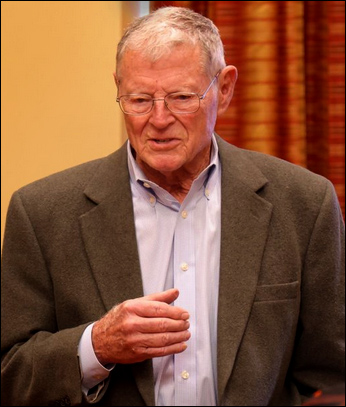
Veteran Oklahoma Sen. Jim Inhofe (R) / Facebook

Feb. 28, 2022 — Veteran Oklahoma Sen. Jim Inhofe (R), who turned 87 years old last November, is reportedly set to announce that he will leave the Senate at the end of this year. He was first elected in 1994 after serving four terms in the US House and six years as mayor of Tulsa prior to coming to Congress.

As of this writing, the senator is expected to sign an irrevocable resignation letter before March 1. If so, he will serve until the end of this year; a special election to replace him will be held concurrently with the 2022 election cycle. His resignation is unexpected, and the reason for his departure has not yet been publicized.

Under the Sooner State special election laws, if a vacancy in the Senate occurs in an even-numbered year, the seat is filled within the regular election schedule. An odd-numbered year vacancy has its own election formula. Oklahoma is one of 13 states that doesn’t fill a Senate vacancy through gubernatorial appointment.

The regular political schedule calls for a primary on June 28, an Aug. 23 runoff if no candidate receives majority support in the first vote, and the general election on Nov. 8. The candidate filing deadline is April 15.

The Inhofe resignation also means that both of the state’s Senate seats will be up for election this autumn since Sen. James Lankford (R) is in-cycle. The special election winner will serve the remaining four years of the Inhofe term and be eligible to run for a full six-year stint in 2026.

While the new Oklahoma Senate race brings the total number of federal statewide campaigns to 35, with Republicans now defending 21, this contest won’t likely alter the aggregate political picture. The GOP should remain safe in both of the Oklahoma general election contests.

The special Republican primary, however, will be a different story. Expect a crowded field and a tough primary campaign and likely runoff, with the eventual winner having an easy ride in the general election.

Already, rumors are flying as to who may run in the special. Names from Gov. Kevin Stitt and Lt. Gov. Mark Pinnell to US Reps. Kevin Hern (R-Tulsa) and Markwayne Mullin (R-Westville) to former state House Speaker T.W. Shannon and ex-US Attorney Trent Shore are already being mentioned.

Continue reading

House Incumbent Primaries, Part II: Democrats

By Jim Ellis

Feb. 21, 2022 — Part II of our incumbents’ primary challenges report concentrates on the Democratic members who find themselves in serious nomination contests. (Note: Part I — the Republicans — was published Friday. Please scroll down to read.) Nine such situations are covered in this update, with one of them, the Texas race of veteran Rep. Henry Cuellar (D-Laredo) to be decided on March 1.


GA-7: Dem Pairing

Primary: May 24
Runoff: July 26

Rep. Carolyn Bourdeaux (D-Suwanee)
Rep. Lucy McBath (D-Marietta)
• Bourdeaux Cash-on-Hand (Dec. 31, 2021): $2,005,771
• McBath Cash-on-Hand (Dec. 31, 2021): $2,452,731
FiveThirtyEight Statistical Rating: D+16
Dave’s Redistricting App Historical Voting: 58.4% D

Republicans held the redistricting pen in Georgia and after losing two Atlanta metropolitan districts in consecutive elections, it was clear the GOP map drawers were going to take one back. That translated into loading Democrats from the previously Republican 6th District into the transitioning 7th CD.

Along with bringing more Democrats into the 7th, the 6th District incumbent, Rep. McBath, decided to join them. Instead of fighting for re-election in a new Republican 6th District (R+24), she moved south to challenge freshman Democrat Carolyn Bourdeaux in the party primary. As you can see from the cash-on-hand totals above, both incumbents are well-heeled financially, so a major campaign is underway.

Also in the Democratic field is state Rep. Donna McLeod (D-Lawrenceville), who points out that she is the only one of the three that actually lives in the 7th CD. Her campaign has been slow to begin, so it is doubtful that she will be much of a factor, and probably will not draw enough support to force the two congressional incumbents into a runoff. Therefore, it is likely that this pairing will be settled in the May 24 primary.

Among carryover constituents Rep. Bourdeaux has a big advantage in seeing a majority of her current 7th District constituency (57 percent) remaining in the new 7th. McBath, however, sees only 12.1 percent carryover from her 6th District. The larger Democratic influx came from Rep. Hank Johnson’s 4th CD, as 26 percent of his constituency was transferred to the new 7th.

On the other hand, the new 7th is overwhelmingly minority: 29.8 percent black, 21.3 percent Hispanic, and 15.8 percent Asian. Thus, the demographics could help Rep. McBath, who is African American. Her strength within the party’s leftward faction is also a benefit in a primary contest. With each incumbent showing similar strength levels, this will be an interesting race to watch on May 24.


GA-13: Rep. David Scott

Primary: May 24
Runoff: July 26
• Scott Cash-on-Hand (Dec. 31, 2021): $1,107,286
FiveThirtyEight Statistical Rating: D+52
Dave’s Redistricting App Historical Voting: 77.9% D

After only scoring 52.9 percent in the 2020 Democratic primary against three opponents, Rep. David Scott’s (D-Atlanta) 2022 race may be even more serious. Opposing him in this election are two candidates with an election track record, former state senator and 2017 Atlanta mayoral candidate Vincent Fort, and South Fulton City Councilman Mark Baker. The latter man bills himself as the “strongest progressive” in the race, but ex-Sen. Fort was well entrenched with the Bernie Sanders campaign.

Therefore, both opponents are attacking Rep. Scott from the left, which should help him split the opposition vote. Whether such a split will be enough to again allow him to capture majority support in the May 24 primary may be another question. Rep. Scott has long been attacked over not being further to the left on the ideological spectrum, which could again be a problem for him in a district that is overwhelmingly Democratic. Neither Baker nor Fort filed an FEC report at the end of the 2021, meaning they are behind on fundraising.

Rep. Scott must still be rated as the favorite to prevail, but this is another contest that will merit attention on May 24.


IL-6: Dem Pairing

Primary: June 28

Rep. Sean Casten (D-Downers Grove)
Rep. Marie Newman (D-La Grange)
• Casten Cash-on-Hand (Dec. 31, 2021): $1,580,171
• Newman Cash-on-Hand (Dec. 31, 2021): $573,120
FiveThirtyEight Statistical Rating: D+6
Dave’s Redistricting App Historical Voting: 51.4% D

The Illinois race is the second of the three Democratic congressional pairings, and it features sophomore Rep. Casten and freshman Rep. Newman. This particular pairing came about because of complaints that a second Hispanic seat should be drawn in Chicago.

Fearing a loss in court, the Democratic legislative leadership acquiesced and drew a new open 3rd District that is 44 percent Hispanic. As a result, Rep. Newman’s home was placed in Rep. Chuy Garcia’s (D-Chicago) 4th District, but she pivoted to run in the 6th against Rep. Casten. Her move made sense because 43 percent of her constituency was drawn into the new 6th District versus just 24 percent coming from Rep. Casten’s current 6th District.

While Casten has a financial advantage and the support of most of the Chicago Democratic establishment, Rep. Newman is a darling of the far left and will likely attract the more ideological voter that tends to dominate primary voting in both parties.

The aspect of this race that attracts little attention is that the pairing winner is not necessarily home free in the general election. With the Illinois gerrymander drawing 14 Democratic seats of 17 total districts, some of the Dem seats are weak. The 6th, with a D+6 rating from the FiveThirtyEight data entity, is one of those. Therefore, a divisive primary could make the eventual Republican nominee even more viable in the general election.

This draw was not favorable to either Democratic incumbent, and we will see a spirited fight between now and the June 28 primary.
Continue reading

An Alabama Barnburner

By Jim Ellis

Alabama US Senate candidate Mike Durant

Feb. 16, 2022 — A trio of polls released in the past three weeks now suggest that any one of the top Alabama US Senate candidates can win the Republican nomination.

With Democrats basically conceding the general election because none of their four filed candidates can be considered a legitimate threat to score an upset win in November, the GOP nomination contest will decide who will succeed retiring Sen. Richard Shelby (R).

The Alabama Republican Senate primary is now turning into a serious three-way affair, as former “Black Hawk Down” pilot Mike Durant apparently has become a legitimate contender. According to most recent three surveys, what originally looked to be a potential outright win for US Rep. Mo Brooks (R-Huntsville) on May 24 now appears surely headed for a June 21 secondary runoff election.

FarmPAC, the political arm of the Alabama Farmers Federation, this week began to publicize their Cherry Communications survey (Feb. 2-6; 600 likely Alabama Republican primary voters, live interview). The results post Congressman Brooks to a tight 34-29-24 percent lead over former Business Council of Alabama president and CEO Katie Britt, whom FarmPAC supports, and Durant, who now runs a defense engineering company headquartered in Alabama. In this survey, Durant again emerges as an additional contender with staying power who can clear a victory path.

As February began, Britt released her internal Deep Root Analytics survey (Jan. 29-31; 2,088 likely Alabama GOP primary voters; live interview, automated response calls and online) that gave her a slight 29-28-23 percent split over Brooks and Durant. Finally, WPA Intelligence, polling for the Club for Growth who supports Rep. Brooks (Jan. 25-27; 513 likely Alabama Republican primary voters live interview), saw the congressman holding a 35-30-25 percent edge over Durant, who vaulted into second place in this poll, and Britt.

All three candidates have strong positives and the financial wherewithal to remain competitive until voters first cast their ballots at the end of May. Two of the three, Brooks and Britt, can expect to benefit from active outside support, while Durant is already funding his effort to the tune of just over $4 million with likely more to come.

Britt is the leading fundraiser. At year’s end, she had raised just under $5 million, all from donors, and reported approximately $4.1 million cash-on-hand. Sen. Shelby has also committed to spending $5 million from his own campaign treasury as an independent expenditure to support Britt, his former chief of staff.

Rep. Brooks, never known as an aggressive fundraiser, had brought in $2.15 million at the end of 2021, with almost $2 million remaining in his treasury. The Club for Growth is likely to spend seven figures in their own independent expenditure to aid the congressman’s statewide effort.

As mentioned above, Durant has invested over $4 million into his effort according to his December year-end financial disclosure report, which represented virtually all of his campaign treasury. He has already spent well over $1 million on a media blitz that has successfully placed him in serious contention.

Continue reading

The Incumbent Pairings

By Jim Ellis

Nov. 30, 2021 — At this point in the national redistricting process, six sets of incumbents have been paired together, mostly in nomination battles, while an additional five incumbent combinations have been averted.

Over half the states have either completed the district re-drawing process or are well down the road to finishing. Illinois leads the nation with two sets of incumbent pairings, one set for each party. An additional four states have single pairings. A total of three Republican primary pairings are on the board, two feature Democratic incumbents, and one, in North Carolina, is a potential pairing with a member from each party.

Retirements have largely averted several more pairings. Reps. Karen Bass (D-CA), Tom Reed (R-NY), Tim Ryan (D-OH) and Anthony Gonzalez (R-OH), and Conor Lamb (D-PA) and Mike Doyle (D-PA), not seeking re-election have likely prevented obvious pairings in their states.

Iowa Rep. Mariannette Miller-Meeks (R-Ottumwa), deciding to seek re-election in the new 1st Congressional District, has avoided a Republican primary pairing with her freshman GOP colleague, Rep. Ashley Hinson (R-Marion/Cedar Rapids).

Below, we review the individual pairings.


GA-7:

• Rep. Carolyn Bourdeaux (D) vs. Rep. Lucy McBath (D)
Candidate Filing: March 11
Primary: May 24
Runoff: July 26

The surprise pairing of the early cycle occurs in the Atlanta suburbs. The Republican map drawers changed Rep. McBath’s 6th District back into a seat that favors the GOP, and instead of running an uphill campaign in a general election, McBath immediately announced that she would launch a primary challenge to freshman Rep. Carolyn Bourdeaux in a politically marginal district that was made safely Democratic.

This will be one of the more interesting pairings. Rep. Bourdeaux represents most of the new 7th’s constituency, but Rep. McBath will likely be viewed as the stronger Democratic base candidate. Bourdeaux starts with an early edge, and with each candidate already approaching $2 million in their respective campaign accounts, this primary campaign will be an old fashioned political shoot out. The winner earns a virtual free ride in the general election.


IL-6:

• Rep. Sean Casten (D) vs. Rep. Marie Newman (D)
Candidate Filing: March 14
Primary: June 28

The second Democratic pairing is the result of the party’s map drawers creating a second Chicago Hispanic district. This led to freshman Rep. Marie Newman standing without her own district. Instead of challenging Rep. Jesus “Chuy” Garcia (D-Chicago) in the original urban Hispanic seat, the district in which her La Grange residence was placed, she decided to instead oppose Rep. Sean Casten in the safely Democratic suburban 6th CD.

Though the seat carries Rep. Casten’s 6th, a bit more of the constituency belongs to Rep. Newman. The early resources favor Casten, as his $1 million in the bank is more than double Rep. Newman’s Sept. 30th filing deadline cash-on-hand total. This race will be one that turns sharply left, as both members identify with the party’s leftward faction. Rep. Casten is likely to attract more Chicago establishment support whereas Rep. Newman will get the bulk of leftward social issues coalition backing.

On paper, it appears that Rep. Casten would have at least a slight edge, but we can count on seeing a major campaign contest all the way to the June 28 primary.


IL-12:

• Rep. Mike Bost (R) vs. Rep. Mary Miller (R)
Candidate Filing: March 14
Primary: June 28

The second Land of Lincoln pairing features two Republican incumbents in the state’s southern sector. Typically, in a gerrymandered state the minority party inherits several very safe districts. Such is the case for the GOP in the new IL-12.

Most of Rep. Bost’s current 12th District constituency is in the new 12th, but the eastern part of a district that now encompasses all of the southern Illinois territory currently belongs to freshman Rep. Miller. The early financial edge also goes to Rep. Bost, but the two begin this race separated only by approximately $200,000.

Continue reading