Category Archives: House

Stansbury Wins New Mexico Special

By Jim Ellis

New Mexico state Rep. Melanie Stansbury (D), winner of Tuesday’s special election.

June 3, 2021 — The New Mexico special election went as expected Tuesday, as state Rep. Melanie Stansbury (D-Albuquerque) defeated state Sen. Mark Moores (R-Albuquerque) by a 60-36 percent count, which is consistent with the partisan early vote turnout.

The overall participation factor exceeded 131,000 voters, or 28.2 percent of the district’s registered voter universe, which is relatively high for a special election. It appears that over 70 percent of the people participating in the electoral contest cast an early ballot.

Stansbury, twice elected to the state House of Representatives, was victorious in the special Democratic district convention whose delegates were empowered with choosing a party nominee to replace resigned Rep. Deb Haaland (D-Albuquerque). Haaland vacated the House upon being confirmed as US Interior Secretary in the Biden cabinet.

The Stansbury congressional victory margin came from population-dominant Bernalillo County, where more than 90 percent of the CD-1 residents live. Stansbury captured 61 percent of the vote here. In the smaller rural counties, Moores took three of four, but the aggregate vote total from each of those entities was individually less than 2,500 cast ballots.

The Democratic mean average in the seat since partisan conversion in 2008 is 58.2 percent, so Stansbury ran about two points above the benchmark. The state’s current governor, Gov. Michelle Lujan Grisham, represented the 1st District for three terms and scored the single-highest Democratic election percentage during the 13-year post-conversion period. She tallied 65.1 percent in 2016, the same election in which Hillary Clinton posted a 52-35 percent CD-1 result and 48-40 percent statewide.

Continue reading

NM-1 Special Election Tuesday

New Mexico state Rep. Melanie Stansbury (D)

By Jim Ellis

June 2, 2021 — The latest in the series of special elections to fill US House vacancies was held yesterday, and the race has an obvious favorite.

On the ballot: state Rep. Melanie Stansbury (D-Albuquerque); state Sen. Mark Moores (R-Albuquerque); ex-Land Commissioner Aubrey Dunn, a former Republican who is running as an Independent; and Libertarian Party nominee Chris Manning.

The major parties nominated their candidates in special convention soon after incumbent Rep. Deb Haaland (D-Albuquerque) resigned to accept her appointment as Interior Secretary in President Biden’s cabinet.

Rep. Stansbury prevailed in a close multi-candidate Democratic convention, ultimately defeating state Sen. Antoinette Sedillo Lopez (D-Albuquerque) in a final round of delegate voting. Many believed winning the Democratic convention was tantamount to claiming the special election. Sen. Moores was an easy winner on the Republican side.

All indications pointed to a Stansbury victory, which is what played out last evening. The only recent publicly released poll before yesterday’s election, one that RRH Elections conducted (May 18-21; 555 likely NM-1 voters, interactive voice response system), found the Democratic nominee holding a 49-33 percent lead over Moores.

Secondly, the district has moved sharply to the left over the past decade, as the 2016 and 2020 presidential elections suggest. In the ’16 campaign, Hillary Clinton defeated Donald Trump here, 52-35 percent. This past November, the Biden margin over ex-President Trump soared to 60-37 percent. The last Republican to represent the 1st District was former Rep. Heather Wilson (R-Albuquerque) who left the House in 2008 to run unsuccessfully for US Senate.

Continue reading

Census Delays: Some Ramifications

By Jim Ellis

June 1, 2021 — As we know, the Census Bureau has delayed in meeting its public reporting deadlines, which causes ramifications in the political world. As a result, the state officials responsible for redistricting could well find themselves placed behind the proverbial eight ball as the new year approaches.

Reapportionment is the term used to explain the entire decennial process. Reapportionment, as the US Supreme Court defined it in their 1999 ruling on the US Census Bureau v. House of Representatives case, is basically divided into two parts. The first, which was finally completed and released on April 26, is the allocation of congressional seats to the states. The second is the re-drawing of congressional, state, and local district boundaries most often referred to as redistricting.

To complicate matters even further, the delayed allocation proved much different – affecting six seats to be exact – than predictions. It was believed for at least two years that Texas would gain three seats in the 2020 reapportionment and Florida two, with Arizona, Colorado, Montana, North Carolina, and Oregon adding one seat apiece. The actual numbers found Texas gaining two, Florida one, and Arizona none. The other one-seat gaining states were correctly predicted.

Conversely, Alabama, California, Illinois, Michigan, Minnesota, New York, Ohio, Pennsylvania, Rhode Island, and West Virginia were all expected to lose one seat apiece. The actual report found Alabama, Minnesota, and Rhode Island each retaining the same number of seats they held in the 2010 reapportionment, while the others did lose a single district apiece.

The Census Bureau claims that COVID is largely responsible for their delays, but the state of Alabama, in their pending lawsuit against the federal statistical entity, disagrees. Alabama claims the deadline violations occurred because of the Bureau’s attempt to impose, for the first time in history, differential privacy over the data. This means, under the argument of protecting individual privacy, data would be deliberately scrambled, and certain information not publicly released.

Differential privacy alone would make redistricting extremely difficult for state map drawers because the released census tract numbers, now by definition, wouldn’t equal the state population figures brought forth earlier in the year. The effect would cause political havoc throughout the country. A court ruling on the Alabama case is expected shortly.

Because of a successful legal challenge from Ohio, the Census Bureau has agreed to make the data necessary for redistricting available to the states by Aug. 15 instead of the Oct. 1 date indicated when allocation was announced.

Continue reading

A Special Election Look-In

By Jim Ellis

May 26, 2021 — The Albuquerque, New Mexico vacant US House seat will be filled on June 1, and a new RRH Elections survey finds the Democratic nominee holding a strong advantage. In Texas, There is no mystery as to which party will win the July 27 special runoff election in North Texas to replace the late Rep. Ron Wright (R-Arlington), but which Republican claims the vacant seat is certainly getting more interesting. We take a look at both races.

NM-1

The RRH Elections poll (May 18-21; 555 NM-1 special election voters and those intending to vote, interactive voice response system and online), finds state Rep. Melanie Stansbury (D-Albuquerque) leading state Sen. Mark Moores (R-Albuquerque), 49-33 percent.

The numbers make sense when overlaying the 1st District voting history. Former Rep. Deb Haaland (D-Albuquerque) naturally resigned the seat after being nominated and confirmed as US Interior Secretary in the Biden Administration weeks after winning re-election to a second term. Her victory percentage was 58, after claiming her first term in 2018 with a 59-36 percent margin.

At one time during the century, the 1st was politically competitive – former Rep. Heather Wilson (R-Albuquerque) held the seat for five terms, ending when she ran unsuccessfully for the US Senate in 2008, for example – but a weakened New Mexico Republican Party and a stronger Democratic composition from redistricting has taken the seat off the board.

President Biden carried the district over former President Trump, 60-37 percent, after Hillary Clinton won here in 2016 with a lower but still comparatively strong 52-35 percent spread. Testing President Biden’s current job approval rating, RRH finds him recording a 57:39 percent favorable to unfavorable ratio, which is similar to his 2020 vote performance. This consistency gives the RHH polling data further credibility.

In terms of finances, Stansbury had raised $1.2 million through the May 12 pre-primary reporting period, with $525,000 cash-on-hand as of that date. Sen. Moores, by contrast, had obtained $595,000 with $125,000 in the bank. His receipts total includes a $200,000 personal loan.

Continue reading

New Seat Location in North Carolina

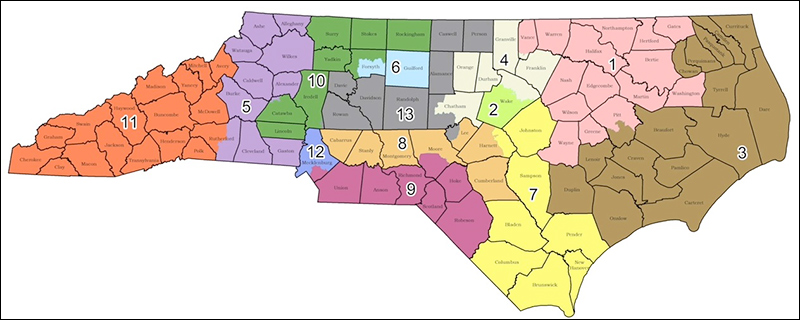
North Carolina’s 12 Congressional Districts

By Jim Ellis

May 21, 2021 — With the new reapportionment map public and the states gaining congressional districts now certain, we can begin to speculate where the new CDs might land. Today, we look at North Carolina, which continues to be one of the most important states from a national redistricting perspective.

The Census Bureau’s apportionment report, released on April 26, almost five months after their Jan. 1 deadline, contained the smallest transfer of congressional seats since the World War II era.

Just seven seats are moving from one state to another. As mentioned above, one of the recipients is North Carolina, the state that came the closest to gaining in the last census, missing by just a few thousand people. Today, we speculate as to how a new North Carolina congressional map might unfold.

The 2020 individual state population data has not yet been distributed and is not expected until October, apparently at the earliest. Once the specific state data is made public, the redistricting process can begin, but for now we can only use the latest available data (July 2019) for estimation purposes.

In examining the population numbers for each of the 13 current North Carolina congressional districts, we see that all must shed population to reach the state’s Census Bureau target number of 746,711 individuals, hence, the reason for the Tar Heel State gaining a new district.

In North Carolina, the state legislature has sole jurisdiction over redistricting. The governor, in this case Democrat Roy Cooper, has no veto power over the maps both houses jointly produce. This means the Republicans will control the process since they hold majorities in both the state House and Senate.

No matter what map is drawn, we can count on seeing post-redistricting litigation. In the previous decade, the courts twice altered the original map because of various lawsuits. The final iteration broke 8-5 in favor of the Republicans after the state Supreme Court redrew sections of the state and in effect awarded two previously Republican seats in Raleigh and Greensboro, respectively, to the Democrats.

Continue reading

Another Florida Twist

By Jim Ellis

Florida Rep. Stephanie Murphy (D-Winter Park)

May 20, 2021 — Last week, a story from the Axios news site reported that Florida Rep. Stephanie Murphy (D-Winter Park) had made the decision to challenge Sen. Marco Rubio (R), and that Rep. Val Demings (D-Orlando) would run for governor. Those suppositions proved premature to say the least.

Quickly, Murphy’s spokespeople denied that the congresswoman had made any final 2022 political decision. Simultaneously, Rep. Charlie Crist (D-St. Petersburg), a former Republican governor, announced that he would run for the Democratic gubernatorial nomination with the goal of challenging incumbent Gov. Ron DeSantis (R) next year. Both Rep. Demings and state Agriculture Commissioner Nikki Fried were then expected to soon follow suit and oppose Rep. Crist for the party nomination.

Politico broke a story Tuesday indicating that Rep. Demings had either changed her mind about running for governor, or the aforementioned Axios story drew the wrong conclusion. Certain supporters, including 2014 gubernatorial nominee Alex Sink (D), are now saying that Demings is a virtual certainty to challenge Sen. Rubio.

Since the 2012 election, Florida Democrats have won only one statewide race, and their record includes two gut wrenching losses of less than a percentage point after being predicted to win both times, so the state party now appears in disarray.

Several things could now be at work if assuming the Axios story about Murphy running for the Senate and Demings for governor was true at the time of publication.

First, Rep. Murphy has secured herself in the 7th District, and it is plausible that her seat will get more Democratic post-redistricting. It is very possible that she simply reconsidered giving up a relatively safe House seat in order to enter a statewide race against Sen. Rubio where she would be a considerable underdog.

Second, the Crist entry could be the wild card catalyst that influenced Rep. Demings to change course. Seeing an expensive Democratic gubernatorial primary developing against both Crist and Fried with no guarantee of victory, and then having to pivot into a race after the late August primary against incumbent Gov. DeSantis would, like Rep. Murphy, mean risking a safe House seat for a very uncertain political future.

Continue reading

Rep. Murphy to Challenge Sen. Rubio

By Jim Ellis

Florida Rep. Stephanie Murphy (D-Winter Park)

May 14, 2021 — According to the Axios news site, insiders close to Florida Rep. Stephanie Murphy (D-Winter Park) say that she has made the decision to challenge Sen. Marco Rubio (R) next year and will formally announce her campaign next month. The move had been expected for some time.

Rep. Murphy, a native of the country of Vietnam, was first elected to the House in 2016, defeating veteran Republican incumbent John Mica after the state Supreme Court had re-drawn the Florida congressional districts and made the 7th CD more Democratic. She unseated Rep. Mica 51-49 percent, and then scored re-election victories of 58 and 55 percent in 2018 and 2020, respectively.

A strong fundraiser, Rep. Murphy obtained over $3 million for both of her incumbent re-election campaigns. She ended the 1st quarter 2021 with a cash-on-hand figure of $1.43 million. Sen. Rubio posted $3.9 million in his campaign account during the same reporting period.

Assuming Murphy does enter the race next month, Democrats will have a credible challenger to Sen. Rubio, but one who still must be considered a decided underdog. In 2010, Sen. Rubio, then a state representative, defeated then-governor Charlie Crist, who was running as an Independent, and Democratic Congressman Kendrick Meek by a 49-30-20 percent margin. He was re-elected in 2016 with a 52-44 percent vote spread over then-congressman Patrick Murphy (D).

Florida races, as we know, are always competitive and usually very close, though the state has been trending more Republican over the past several elections. A Rubio-Stephanie Murphy race promises to become a national campaign.

With the Democrats apparently attracting a strong candidate in Florida, it is a good time to review the other key races.

In Pennsylvania, both parties are headed for very crowded primaries as each works to nominate a candidate to hopefully succeed retiring Sen. Pat Toomey (R). Afghan War veteran Sean Parnell entered the Republican primary earlier this week, but his only venture into elective politics was recording a two-point loss to Rep. Conor Lamb (D-Pittsburgh) last November in an Allegheny County suburban district.

Rep. Lamb, himself, may join the Democratic Senate campaign, meaning both parties are going to host political dogfights for the party nomination. In any event, however, the Pennsylvania race will be a top-tier national campaign.

Continue reading