Category Archives: Election Analysis

The Incumbent Pairings

By Jim Ellis

Nov. 30, 2021 — At this point in the national redistricting process, six sets of incumbents have been paired together, mostly in nomination battles, while an additional five incumbent combinations have been averted.

Over half the states have either completed the district re-drawing process or are well down the road to finishing. Illinois leads the nation with two sets of incumbent pairings, one set for each party. An additional four states have single pairings. A total of three Republican primary pairings are on the board, two feature Democratic incumbents, and one, in North Carolina, is a potential pairing with a member from each party.

Retirements have largely averted several more pairings. Reps. Karen Bass (D-CA), Tom Reed (R-NY), Tim Ryan (D-OH) and Anthony Gonzalez (R-OH), and Conor Lamb (D-PA) and Mike Doyle (D-PA), not seeking re-election have likely prevented obvious pairings in their states.

Iowa Rep. Mariannette Miller-Meeks (R-Ottumwa), deciding to seek re-election in the new 1st Congressional District, has avoided a Republican primary pairing with her freshman GOP colleague, Rep. Ashley Hinson (R-Marion/Cedar Rapids).

Below, we review the individual pairings.


GA-7:

• Rep. Carolyn Bourdeaux (D) vs. Rep. Lucy McBath (D)
Candidate Filing: March 11
Primary: May 24
Runoff: July 26

The surprise pairing of the early cycle occurs in the Atlanta suburbs. The Republican map drawers changed Rep. McBath’s 6th District back into a seat that favors the GOP, and instead of running an uphill campaign in a general election, McBath immediately announced that she would launch a primary challenge to freshman Rep. Carolyn Bourdeaux in a politically marginal district that was made safely Democratic.

This will be one of the more interesting pairings. Rep. Bourdeaux represents most of the new 7th’s constituency, but Rep. McBath will likely be viewed as the stronger Democratic base candidate. Bourdeaux starts with an early edge, and with each candidate already approaching $2 million in their respective campaign accounts, this primary campaign will be an old fashioned political shoot out. The winner earns a virtual free ride in the general election.


IL-6:

• Rep. Sean Casten (D) vs. Rep. Marie Newman (D)
Candidate Filing: March 14
Primary: June 28

The second Democratic pairing is the result of the party’s map drawers creating a second Chicago Hispanic district. This led to freshman Rep. Marie Newman standing without her own district. Instead of challenging Rep. Jesus “Chuy” Garcia (D-Chicago) in the original urban Hispanic seat, the district in which her La Grange residence was placed, she decided to instead oppose Rep. Sean Casten in the safely Democratic suburban 6th CD.

Though the seat carries Rep. Casten’s 6th, a bit more of the constituency belongs to Rep. Newman. The early resources favor Casten, as his $1 million in the bank is more than double Rep. Newman’s Sept. 30th filing deadline cash-on-hand total. This race will be one that turns sharply left, as both members identify with the party’s leftward faction. Rep. Casten is likely to attract more Chicago establishment support whereas Rep. Newman will get the bulk of leftward social issues coalition backing.

On paper, it appears that Rep. Casten would have at least a slight edge, but we can count on seeing a major campaign contest all the way to the June 28 primary.


IL-12:

• Rep. Mike Bost (R) vs. Rep. Mary Miller (R)
Candidate Filing: March 14
Primary: June 28

The second Land of Lincoln pairing features two Republican incumbents in the state’s southern sector. Typically, in a gerrymandered state the minority party inherits several very safe districts. Such is the case for the GOP in the new IL-12.

Most of Rep. Bost’s current 12th District constituency is in the new 12th, but the eastern part of a district that now encompasses all of the southern Illinois territory currently belongs to freshman Rep. Miller. The early financial edge also goes to Rep. Bost, but the two begin this race separated only by approximately $200,000.

Continue reading

PA-Senate: Republicans in Trouble

Former US Ambassador to Denmark, Carla Sands — a Pennsylvania senate candidate to watch.

By Jim Ellis

Nov. 29, 2021 — The Keystone State of Pennsylvania, with an open Senate and governor’s race, will be a focal point of the 2022 election cycle, and last week the Republicans’ early problems grew worse.

The Pennsylvania GOP began this election cycle in a seemingly underdog position as they fought to hold the Senate seat from which two-term incumbent Pat Toomey (R) is retiring; now they are clearly playing from behind.

Iraq War veteran Sean Parnell (R) had former President Donald Trump’s endorsement and was leading the Republican primary in early polling. However, due to losing a child custody judgment rendered at the beginning of this week after a contentious trial in which his ex-wife had accused him of domestic abuse, Parnell withdrew from the Senate contest.

It’s a loss for his party, but Parnell wasn’t even the best of candidates. In his first bid for public office, running for the 17th Congressional District seat against Allegheny County area incumbent Conor Lamb (D-Pittsburgh), now himself a Senate candidate, Parnell came close but lost 51-49 percent. Based upon a close defeat in a winnable district, he decided to make a statewide Senate run.

Two other primary opponents, former lieutenant governor nominee Jeff Bartos and Army veteran, Trump campaign activist, and former congressional candidate Kathy Barnette, also lost their most recent political races. Therefore, the original three leading Republican candidates in either polling or fundraising hadn’t ever won a race and were falling well behind their Democratic counterparts.

The Democrats feature the overall early race leader, Lt. Gov. John Fetterman. He commands first position in primary and general election polling and has raised way more campaign capital than all of his opponents, over $9.2 million through the Sept. 30 financial disclosure period.

John Fetterman, however, isn’t without his own flaws. In 2013, when he was mayor of Braddock, a borough southeast of Pittsburgh in Allegheny County and located on the Monongahela River, Fetterman pulled a loaded weapon on an unarmed African-American jogger after hearing gunshots fired in his neighborhood. The Fetterman campaign has already produced a short video explaining the incident in anticipation of this becoming an issue in his 2022 statewide effort.

Rep. Lamb is running second to Lt. Gov. Fetterman in polling and dollars raised, almost $7 million behind his chief Democratic rival. The latest poll, from the Civiqs organization (Oct. 31-Nov. 1; 929 likely Pennsylvania Democratic primary voters, online) found Fetterman way ahead of Rep. Lamb, 52-12 percent, with other announced and possible candidates, state Rep. Malcolm Kenyatta (D-Philadelphia), Montgomery County Commissioner Val Arkoosh, and potential contender Sharif Street, a state senator and son of former Philadelphia Mayor John Street, all polling at five percent or less.

Continue reading

Welch In; Johnson Out; McBath Switches Districts in Georgia


NOTE: Ellis Insight will be taking a break starting tomorrow through the weekend. We’ll return on Monday, Nov. 29. Happy Thanksgiving to all!


By Jim Ellis

Nov. 24, 2021 — Vermont Congressman Peter Welch announces his Senate candidacy, two-term Georgia Rep. Lucy McBath announces a switch from her GA-6 district to GA-7 as a result of redistricting, and 85-year-old veteran Rep. Eddie Bernice Johnson announces her retirement. Details below:

Vermont Senate

As expected, Vermont at-large Congressman Peter Welch (D-Norwich) announced his US Senate candidacy this week and becomes the prohibitive favorite to succeed retiring Sen. Patrick Leahy (D). With Welch representing the same statewide constituency as a senator, the move to the chamber of the states should be seamless.

It does not appear that Welch will have major opposition. At this point, Sanders for President campaign activist Niki Thran, a physician, is the only announced Democratic candidate. The more serious potential contenders are likely to opt for the now open at-large House seat.

Rep. Welch was first elected to the US House in 2006, and has cruised to re-election ever since. He was originally elected to the state Senate in 1980, and served 10 years. He became the Senate Democratic Leader for one two-year term.

In 1988, Welch ran for the US House, but lost the Democratic primary. He returned in the governor’s race two years later, this time winning the Democratic nomination but losing the general election. He would return to the state Senate in 2001 when then-Gov. Howard Dean (D) appointed him to fill a vacancy. He was then elected as a member of the Vermont legislative body in 2002, and became the Senate’s President Pro Tempore, a position he held until winning his first US House race.

GA-6

In a surprising response to the Georgia state House voting in favor of the new congressional redistricting map, two-term Rep. Lucy McBath (D-Marietta) announced, even before Gov. Brian Kemp (R) approves the final legislation, that she will depart her current 6th District since its new constituency trends strongly Republican.

Instead, she will challenge freshman Rep. Carolyn Bourdeaux (D-Suwanee) in adjacent District 7 in next year’s Democratic primary. McBath will run to the left of her new opponent, who she will attempt to paint as being too conservative before the primary electorate.

Continue reading

Two More Maps Advance

Georgia Congressional redistricting map

By Jim Ellis

Nov. 23, 2021 — The late redistricting season continues to move along at a brisk pace, and two more states are poised to enact new congressional plans this week.

The Georgia state House, after the state Senate passed the proposed congressional map on Friday, was expected to vote on the legislation yesterday and send it to Gov. Brian Kemp (R) for final approval. The Oklahoma legislature, late last week, passed its congressional and state legislative maps in special session and sent them to Gov. Kevin Stitt (R). He is expected to sign the plans into law.

Georgia did not gain a seat in reapportionment despite significant growth in the Atlanta area. In the state’s major metroplex, the congressional districts fully contained within or touching the area counties gained almost 200,000 people dispersed within six districts. The rural CDs, particularly in the southern part of Georgia, however, all needed to gain individuals in order to meet the state population quota of 765,136 individuals per congressional district.

Oklahoma was both a long way from gaining and losing a seat, so the state remains constant with five congressional districts, now three of which come into Oklahoma County, the entity housing the state’s largest metropolis, Oklahoma City.

Continue reading

North Carolina Rep. G.K. Butterfield’s Retirement Leaves a Competitive 2nd

North Carolina Rep. G.K. Butterfield (D-Wilson)

By Jim Ellis

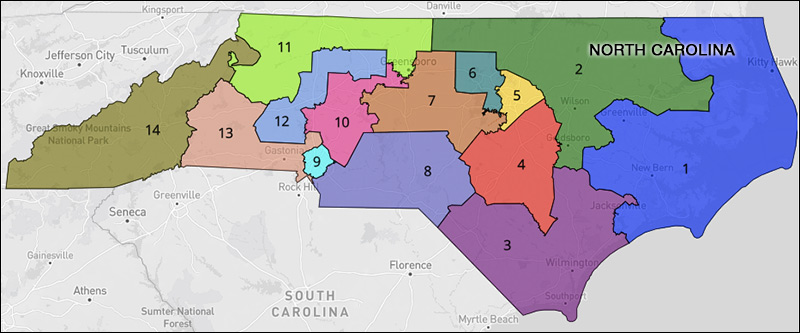
Nov. 22, 2021 — As was suggested earlier in the week, 10-term North Carolina Rep. G.K. Butterfield (D-Wilson) announced late last week that he will not seek re-election next year. He leaves a new 2nd District – his seat had been numbered NC-1 throughout his career – that will be more competitive in 2022.

Rep. Butterfield attacked the Republican-passed redistricting plan as a gerrymander on his way out and says the draw hurts African Americans in his district. He says that largely because an African American section of Pitt County was removed from the district, along with a small conservative county, and replaced with three larger and decidedly more Republican localities along the Virginia border.

North Carolina gained a seat in reapportionment, but the Butterfield seat was the only current Tar Heel State CD that needed to gain residents. The current 1st District was 58,205 individuals short of the state’s new population quota of 745,671 individuals per CD, so the map drawers had no choice but to add people. Virtually all of the surrounding counties are Republican.

The new 2nd District is certainly more competitive. While President Biden carried the current 1st District with a 54-45 percent margin, on par with Hillary Clinton’s 55-44 percent spread in 2016, the new 2nd District would have given Biden only a 51-48 percent vote split.

Though the new 2nd will be more competitive, the current 1st District was beginning to show signs of political change. This somewhat dispels Rep. Butterfield’s gerrymandering argument. While the previous eight elections delivered an average vote of 72.6 percent for Butterfield, his 2020 victory margin dropped to 54-46 percent opposite accountant and political activist Sandy Smith (R).

Though the state Supreme Court changed the North Carolina map for the 2020 election and basically awarded the Democrats two of the Republicans’ seats, the 1st was left largely unchanged. This suggests that the electorate could be transforming naturally, thus alternative reasons exist for the district becoming more conservative than simply altering the district lines.

We can expect to see competitive primaries in both parties, and things will quickly unfold now that the seat is open. Prior to the retirement announcement, Henderson City Councilman Jason Spriggs had announced a Democratic primary challenge to Rep. Butterfield but he was not rated as a serious challenge to the congressman.

Continue reading

Ohio Redistricting Set to Pass

WBNS TV – Channel 10 – Columbus

By Jim Ellis

Nov. 19, 2021 — The Ohio legislature has sent the new congressional and state legislative maps to Gov. Mike DeWine (R) for his approval. Ohio loses one seat in reapportionment.

As expected, the new map radically changes the seats that outgoing members Tim Ryan (D-Warren/Youngstown) and Anthony Gonzalez (R-Rocky River) currently hold. Rep. Ryan, running for the Senate, sees his eastern Ohio 13th District collapsed, with a sizable chunk of Akron remaining in the seat and the remainder going to Rep. Bob Gibbs’ (R-Lakeville) 7th District.

Instead of moving east, as under the current map, the new 13th moves to the west, annexing Medina County and the western part of the Cleveland metro area in Cuyahoga County. Much of this territory comes from the retiring Rep. Gonzalez’s current 16th District, a seat whose territory gets absorbed in several neighboring CDs.

At first glance, the map looks to break 12R-3D, meaning Democrats would take the seat loss in typical election years. Three of the districts, however, two of which Democrats now hold, would become highly competitive.

The members with the most competitive districts would again be Reps. Steve Chabot (R-Cincinnati) in the 1st District, in addition to Marcy Kaptur’s (D-Toledo) 9th CD, and the open 13th District.

The safest members are Reps. Brad Wenstrup (R-Cincinnati), though he loses a significant part of his anchor city, Joyce Beatty (D-Columbus), Jim Jordan (R-Urbana), Bob Latta (R-Bowling Green), Bill Johnson (R-Marietta), Bob Gibbs (R-Lakeville), Warren Davidson (R-Troy), Shontel Brown (D-Cleveland), and Troy Balderson (R-Zanesville).

Reps. Mike Turner (R-Dayton), David Joyce (R-Russell Township, and Mike Carey (R-Columbus) all would get reliable Republican districts, but not overwhelmingly so. Turner’s composite improves his marginal district a net three points in his party’s favor. Rep. Joyce sees his partisan complexion remaining at about a 10-point positive district for him when comparing the composite average to the 2020 presidential results.

Continue reading

California Rep. Jackie Speier to Retire

California Rep. Jackie Speier (D-Hillsborough/San Mateo)

By Jim Ellis

Nov. 18, 2021 — The second congressional retirement of the week was announced Tuesday as veteran California Rep. Jackie Speier (D-Hillsborough/San Mateo), following Vermont Sen. Patrick Leahy’s similar statement Monday, said in a video to her constituents that she will not seek an eighth full term in the House next year.

Speier has a long career in politics that began well before her first election to the San Mateo County Board of Supervisors in 1980. Two years prior, Speier, as a staff member for then-US Rep. Leo Ryan (D-CA), was shot five times on a remote airport runway in Guyana exactly 43 years ago today during the infamous Jim Jones mass murder-suicides of his so-called religious followers. (See this brief article as Speier recounted that day at a National Archives lecture.)

A total of 918 people died during the mass killing, including Rep. Ryan who was on a mission to investigate reports of criminal activity in the commune. Jones had run what was described as a church in the congressman’s district and most of his followers were from the northern California region. Speier, left for dead after being attacked and shot, lay for a reported 22 hours before being rescued and treated.

She obviously recovered from her wounds and was successful in her first run for public office. Six years later, she won a state Assembly seat, and then captured the area state Senate seat before winning a special election to the US House in 2008 after then-Rep. Tom Lantos (D-CA) passed away.

The 14th District contains over 85 percent of San Mateo County, and a portion of south San Francisco, adjacent to Speaker Nancy Pelosi’s 12th District. The seat is safely Democratic, voting in a 78-21 percent clip for President Biden in 2020, and a similar 77-18 percent spread for Hillary Clinton in 2016.

Continue reading