Tag Archives: Sen. Raphael Warnock

New Poll Again Shows Tight
Numbers in Georgia Senate Race

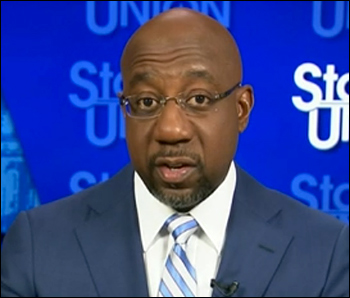
Georgia freshman Sen. Raphael Warnock (D)

By Jim Ellis

Aug. 11, 2021 — Late last week, Public Policy Polling released their new Georgia Senate findings (Aug. 4-5; 622 Georgia voters, interactive voice response system) and the results place the new Peach State Senate race in familiar territory: a virtual tie.

While PPP finds that freshman Sen. Raphael Warnock (D) leads three tested Republican potential nominees, former Sen. Kelly Loeffler, retired football star Herschel Walker, and three-term state Agriculture Commissioner Gary Black, only when paired against Black does Warnock’s edge extend beyond the polling margin of error. This early poll suggests what the conventional political wisdom already predicts, that the 2022 Senate race will again feature a close finish.

To reiterate, Sen. Warnock, though winning his seat only in 2020, must run for a full six-year term next year because he won the special election to fill the unexpired portion of former Sen. Johnny Isakson’s (R) final term. You will remember that Sen. Isakson resigned at the end of 2019 due to health reasons and Gov. Brian Kemp (R) appointed Loeffler to fill the seat until the special election was conducted.

The PPP results find Walker, who has yet to announce (and it’s still even unclear as to whether he will run), in the best position of the three tested potential candidates. In this poll, Sen. Warnock’s edge is 48-46 percent. Loeffler fares comparably with Walker, though slightly worse, trailing 44-47 percent. Commissioner Black, the only officially announced candidate of the group, falls behind by eight percentage points, 38-46 percent.

The favorability indexes provide further clues. Keeping in mind that almost everyone tends to skew negatively on the PPP favorability scores, the two benchmarks, President Biden and former President Trump, score 46:48 percent favorable to unfavorable and 43:48 percent, respectively. Sen. Warnock posts a 43:42 percent job approval score. Walker, obviously exclusively due to the personal recognition coming from both his college and professional football career, has the best result: 41:28 percent. Loeffler fares poorly: 28:47 percent, while Commissioner Black is an even split at 15:15 percent; still, that means 70 percent of the voters don’t have enough information about him to form an opinion.

These numbers provide us with several conclusions: first, Sen. Warnock has yet to establish himself beyond a partisan framework. The 85:8 percent score among Democrats carries his overall positive mark. He records a predictable 6:78 percent mark among Republicans, but perhaps most indicative, just 33:45 percent among those classifying themselves as political Independents.

Continue reading

Rep. Murphy to Challenge Sen. Rubio

By Jim Ellis

Florida Rep. Stephanie Murphy (D-Winter Park)

May 14, 2021 — According to the Axios news site, insiders close to Florida Rep. Stephanie Murphy (D-Winter Park) say that she has made the decision to challenge Sen. Marco Rubio (R) next year and will formally announce her campaign next month. The move had been expected for some time.

Rep. Murphy, a native of the country of Vietnam, was first elected to the House in 2016, defeating veteran Republican incumbent John Mica after the state Supreme Court had re-drawn the Florida congressional districts and made the 7th CD more Democratic. She unseated Rep. Mica 51-49 percent, and then scored re-election victories of 58 and 55 percent in 2018 and 2020, respectively.

A strong fundraiser, Rep. Murphy obtained over $3 million for both of her incumbent re-election campaigns. She ended the 1st quarter 2021 with a cash-on-hand figure of $1.43 million. Sen. Rubio posted $3.9 million in his campaign account during the same reporting period.

Assuming Murphy does enter the race next month, Democrats will have a credible challenger to Sen. Rubio, but one who still must be considered a decided underdog. In 2010, Sen. Rubio, then a state representative, defeated then-governor Charlie Crist, who was running as an Independent, and Democratic Congressman Kendrick Meek by a 49-30-20 percent margin. He was re-elected in 2016 with a 52-44 percent vote spread over then-congressman Patrick Murphy (D).

Florida races, as we know, are always competitive and usually very close, though the state has been trending more Republican over the past several elections. A Rubio-Stephanie Murphy race promises to become a national campaign.

With the Democrats apparently attracting a strong candidate in Florida, it is a good time to review the other key races.

In Pennsylvania, both parties are headed for very crowded primaries as each works to nominate a candidate to hopefully succeed retiring Sen. Pat Toomey (R). Afghan War veteran Sean Parnell entered the Republican primary earlier this week, but his only venture into elective politics was recording a two-point loss to Rep. Conor Lamb (D-Pittsburgh) last November in an Allegheny County suburban district.

Rep. Lamb, himself, may join the Democratic Senate campaign, meaning both parties are going to host political dogfights for the party nomination. In any event, however, the Pennsylvania race will be a top-tier national campaign.

Continue reading

Senate Action

Ohio Rep. Tim Ryan (D-Warren/Youngstown)

By Jim Ellis

April 29, 2021 — While most of the political world was focused on the census’s national apportionment announcement, several Senate moves of merit were also made this week.

In Ohio, US Rep. Tim Ryan (D-Warren/Youngstown) finally made his fledgling US Senate campaign official. Originally saying he would announce sometime in March only to postpone formal entry to an undetermined time, Ryan finally made his declaration on Monday. Once former Ohio Health Director Amy Acton — who was running slightly ahead of Rep. Ryan in early Democratic primary polling — said that she was not going to run, that paved the way for the 10-term congressman to open with an apparently clear path to the Democratic nomination.

Simultaneously, in Georgia, another announcement was made but one that contained a surprising message. Former Rep. Doug Collins (R), who placed third in the 2020 US Senate jungle primary, also declared his political intentions for 2022 on Monday. While observers were expecting the former four-term congressman to enter the current Senate race, he instead said he will not run for any office next year but didn’t close the door on returning to elective politics in another election cycle.

Yesterday, in another largely expected move, former North Carolina state Supreme Court Chief Justice Cheri Beasley (D), who lost her position in November by a scant 401 votes statewide, announced via video that she will enter the open Tar Heel State Senate race.

The three moves help further set the stage for a trio of critical Senate contests that will each contribute mightily toward determining which party breaks the 50-50 tie and assumes control of the body after the next election.

Despite Rep. Ryan looking as the candidate to beat for the Ohio Democratic nomination, the general election won’t be easy. Additionally, this political cycle could be different in terms of political options for Ryan. He has several times dipped his toe in the statewide or national waters only to return to the safety of his House district. With it now a certainty that Ohio will lose another congressional seat, and with at least one scenario suggesting that the eliminated seat could become Rep. Ryan’s 13th District, his usual fail-safe move might not again be available.

Continue reading

Senate Money

By Jim Ellis

April 23, 2021 — Continuing our analysis of early 2022 campaign cycle fundraising based upon the first quarter 2021 Federal Election Commission disclosure reports, today we look at the key US Senate contests.

Tracking the Senate race dollars is much different than the House because the FEC groups incumbent statewide campaigns by election cycle. Therefore, the receipts column covers the period from when the incumbents last ran through March 31, 2021. This means the senators are reporting dollars raised from Jan. 1, 2017 through the first quarter deadline. For candidates just entering the 2022 campaign — those in the open seats for example — the disclosure period begins Jan. 1, 2021.

Therefore, the receipts category is not as telling for Senate campaign standing as it is for the House campaigns. Thus, the key category to gauge where the Senate candidates stand in relation to the 2022 campaign cycle is their cash-on-hand total.

The chart below focuses on the races thought to be competitive for the 2022 election. As we have seen in modern times, the financial aspect of Senate campaigns is less important than for the House in determining or projecting final outcome because so much is now spent on the statewide races even in the smallest of states.

Typically, Senate nominees from both parties consistently have more than adequate financial resources with which to communicate their messages. Furthermore, the current income/spending figures as they relate to candidate committees don’t account for the large amount of outside independent expenditures that now accompany almost all competitive US Senate campaigns, which certainly can alter final outcome.

In terms of clarification, Sen. Raphael Warnock’s (D-GA) total of $27,517,878 includes the amount raised for his statewide runoff campaign that was decided on Jan. 5, 2021. This explains why his receipts total is so high, and far beyond any other incumbent or candidate listed on the chart.

Continue reading

Georgia: New Poll, Same Story

By Jim Ellis

Sen. Raphael Warnock will face an interesting challenge depending upon who emerges from the Republican primary.

March 18, 2021 — The Trafalgar Group and the Insider Advantage entity, both Atlanta-based firms, partnered to test the politically beleaguered Georgia electorate about freshman Sen. Raphael Warnock’s (D) standing as he looks to run for a full six-year term in 2022.

Being one of the top battleground states in the 2020 presidential contest and hosting two US Senate campaigns last year, 56 public polls were conducted of this electorate from July of last year through the Jan. 5 runoff election. Almost all of them repeatedly showed results within the margin of error on the presidential and both US Senate races; and, with the final total showing President Biden and former President Trump separated by just 11,779 votes while the Senate races came down to one and two-point finishes, the polling proved correct.

Now we see Trafalgar and IA beginning the 2022 Georgia election cycle polling. The new survey (March 7-9; 1,093 likely Georgia voters, interactive response system and online) again finds very tight hypothetical Senate race results. Because Sen. Warnock won the special election in January, he must stand for election to a full six-year term in 2022.

Trafalgar and IA tested three Republicans against Sen. Warnock: former Sen. Kelly Loeffler, ex-US Rep. Doug Collins, and the past University of Georgia and NFL football star Herschel Walker. None of the three have announced their candidacies but all confirm they are considering the race.

According to the results, Sen. Warnock fares best against the woman he defeated in January, ex-Sen. Loeffler. In this ballot test, he leads 46-41 percent. Both Collins and Walker perform better, especially the latter. The Warnock edge narrows to one point against Collins, 46-45 percent, and the new incumbent actually drops behind Walker, 46-48 percent. Notice that Sen. Warnock records 46 percent against all three potential opponents suggesting that he is vulnerable heading into what promises to be another hard-fought Peach State US Senate battle.

While the pollsters tested the job approval ratings for both President Biden and Gov. Brian Kemp (R), they surprisingly did not include such a question regarding Sen. Warnock.

The approval ratios were poor for both the president and governor. Biden scored a 41:55 percent favorable to unfavorable job approval rating, with 32 percent strongly approving and a large 46 percent strongly disapproving.

Gov. Kemp continues to show weakness as he heads into what will be a difficult run against his former opponent, ex-state House Democratic Leader Stacey Abrams. The governor is again in upside-down territory, recording a 33:53 percent negative approval rating. Only nine percent responded that they strongly approve of the governor’s performance while 26 percent strongly disapproved.

At this point, the pollsters asked Republican primary questions to those most likely to vote in the 2022 GOP nomination election.

If Loeffler, Collins and Walker were all to oppose each other in the Senate primary, we see the latter two men virtually tied at 32 percent apiece. Loeffler trails with 24 percent support.

A Collins-Loeffler match would favor the former, as the ex-north Georgia congressman would record a strong 52-32 percent lead. Walker would lead Collins 50-36 percent in a one-on-one match-up, and the former football player would hold a commanding 62-26 percent advantage over Loeffler.

The Georgia Republican respondent cell is strongly pro-Donald Trump with 70 percent saying they would “absolutely” vote for the former president if he were to run again. Only 14 percent of this sample cell said they would vote for anyone other than Trump. Another eight percent said they would consider voting for the ex-president.

We can expect another very active Georgia election cycle, with the Senate and governor’s race assuredly being covered as if they are national campaigns.

Perdue Changes Course in Georgia

By Jim Ellis

Former Georgia Sen. David Perdue (R)

Feb. 25, 2021 — Just when former Sen. David Perdue (R) appeared prepared to challenge new Sen. Raphael Warnock (D) in the 2022 general election, he abruptly reversed course and announced Tuesday that he will not run. Perdue had filed a 2022 campaign committee with the Federal Election Commission, but such action does not make one an official candidate.

Without Perdue in the 2022 race, the fight for the Republican nomination becomes a free-for-all. Earlier in the week former Sen. Kelly Loeffler (R), who lost her Jan. 5 Senate runoff election, as did Sen. Perdue, confirmed that she is considering running in 2022 in addition to forming a grassroots organization with the goal of increasing right-of-center voter registration in Georgia.

Former Rep. Doug Collins (R), who lost in the 2020 special Senate election, placing behind Sens. Warnock and Loeffler in the crowded jungle primary, also said that he is considering a new run for the Senate, or even a potential Republican nomination challenge to Gov. Brian Kemp.

Yesterday, Atlanta Journal Constitution political reporter Greg Bluestein listed several more Republicans who apparently have not yet ruled out a Senate bid next year. They are: Lt. Gov. Geoff Duncan, Attorney General Chris Carr, Agriculture Commissioner Gary Black, and former US Ambassador to Luxembourg Randy Evans.

In the Nov. 3 special jungle primary, Rev. Warnock captured the highest vote total, 1,617,035 of 4,914,361 ballots cast from within a field of 20 candidates. Sen. Loeffler placed second, 292,760 votes ahead of third place finisher Collins.

The fact that Loeffler finished substantially ahead of Collins will be one argument she will likely use to convince base voters that she is most able to defeat Sen. Warnock this time around. Collins, conversely, will contend that a Republican primary is very different than a special election in a regular voting schedule, thus suggesting that he is better positioned to win a primary nomination and develop a stronger base from which to oppose Sen. Warnock.

With Georgia changing politically, any Republican nominee is going to have a difficult time unseating Sen. Warnock but doing so is certainly within the realm of possibility. In the Jan. 5 runoff, while both Loeffler and Perdue were losing to their respective Democratic opponents, a third race was also on the ballot.

Continue reading

Perdue Making Moves in Georgia

By Jim Ellis

Former Georgia Sen. David Perdue (R)

Feb. 19, 2021 — Defeated Georgia Sen. David Perdue (R) is taking the first steps toward making a quick political comeback. This week he filed a new 2022 US Senate campaign committee with the Federal Election Commission to explore his prospects against new Sen. Raphael Warnock (D), who will be standing for a full six-year term after winning the 2020 special election. Perdue says he will make a final decision about launching his candidacy next month.

One of the former senator’s arguments to support a new campaign is that he “won” the November general election, which, he points out, drew a record high turnout.

Using the term “won” might be a stretch because we obviously know that Georgia has a runoff system even for the general, which must be satisfied to actually win, but he did finish 88,098 votes ahead of Jon Ossoff in the first election in which 4,952,175 people cast ballots. This total, however, was only enough for 49.73 percent of the vote, a scant 0.27 percent from clinching the seat.

The Jan. 5 runoff turned out differently, as these types of elections often do when an incumbent fails to achieve majority support in the first vote. That is, the second-place finisher frequently wins.

In January, now that the final votes are tabulated and certified, Ossoff produced a 54,944-vote edge from a participation factor of 4,484,902 voters, meaning 467,273 fewer individuals took part in the runoff election. This drop-off rate of only 9.4 percent, however, is the lowest ever for this type of a secondary electoral contest. The typical participation rate falls by at least one-third.

Therefore, Perdue’s argument that he “won” the record turnout election is less credible when understanding that the runoff had a small drop-off rate, and its turnout as part of the super-charged 2020 election cycle is well beyond a standard midterm participation factor.

Additionally, while a Perdue 2022 entry might dissuade other potential Republican nomination contenders such as former Sen. Kelly Loeffler, who campaigned closely with Perdue as part of their Republican team effort, it apparently isn’t yet stopping at least one other potential rival.

Continue reading