Tag Archives: Redistricting

The Redistricting Scorecard

By Jim Ellis

In the trifecta of political parties controlling the House, Senate and Executive branches in a state, how many will really benefit from that power in the redistricting process?

Feb. 11, 2022 — There has been quite a bit of redistricting news surfacing during the past few weeks, with many analysts now reversing their earlier predictions about which party is the clear beneficiary from the re-draw process.

Most said early that the Republicans would benefit the most from redistricting and that map drawing alone would be enough to allow the party to reclaim the House majority. We, on the other hand, were showing that the cut would more than likely be about equal even though the GOP has a major advantage in trifecta states, that is, those where one party controls all three legs of the legislative stool, meaning the state Senate, state House, and the governor’s office.

Though the Republicans control 25 states outright from a redistricting perspective compared to the Democrats’ 15, the number of states where each can draw maps to expand their party’s congressional delegation really comes down to seven where Republicans control and a commensurate four for the Democrats.

What balances the process this year is that Republicans appear to have have only one state where they can gain multiple seats — North Carolina — while Democrats can run the table, and have, in two big states, New York and Illinois.

Where both parties suffer in their trifecta states is the number of places where they already control the maximum number of seats, or redistricting power has been transferred to a commission. Either one party already has all the seats in a state like the Democrats do in Massachusetts and the Republicans have in Arkansas, for example, or the state has only one at-large member.

In one place, West Virginia, even though the Republicans have a legislative trifecta, they will drop a seat post election. Currently, the West Virginia delegation consists of three Republicans, but the state loses a seat in national reapportionment. Therefore, the GOP majority had no choice but to collapse one of their own districts.

Articles are now appearing that suggest it is the Democrats who could end the redistricting process with a net seat advantage rather than the Republicans. This, as it has been from the beginning, is true.

In looking at the states once all 50 have adopted new congressional lines, it projects today that the Republicans would add approximately 13 seats, while the Democrats, with multiple seat additions in Illinois and New York, would gain 11 new members. Seven states remain undecided because their level of political competition is predicted to be intense.
Continue reading

Alabama Map Ruling Stayed; Redistricting Update

By Jim Ellis

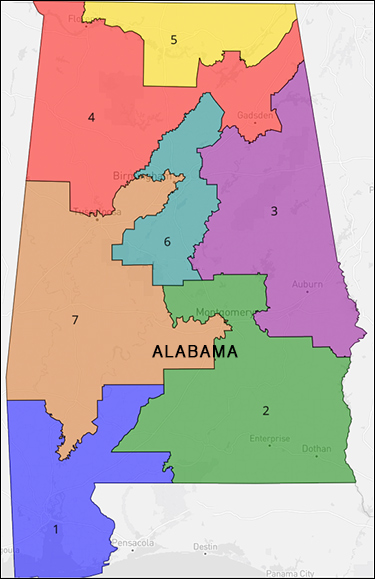
Alabama redistricting map (Click on the map above or go to DavesRedistricting.org to see interactive map)

Feb. 9, 2022 — On a 5-4 vote, the US Supreme Court voted to stay the lower court ruling that invalidated the new Alabama congressional map. A Republican three-judge panel had ruled that a second majority minority district could have been drawn among the state’s seven congressional districts, and thus disqualified the plan on Jan. 23.

Writing a concurring opinion, Justice Brett Kavanaugh stated that the lower court decision was made too close to the 2022 election, meaning that the judicial process would not have proper time to hear the appeal and make an educated ruling prior to the state’s scheduled primary election. The ruling does not mean the appeal was granted, but merely postpones hearing the case to a later date.

Analysts say the stay ensures that the original map will be in place for this year’s election. It does not mean, however, that the map won’t be altered for the 2024 election and beyond.

The new plan is virtually an extension of the current map, which elected six Republicans and one Democrat in the 2020 election. It was a curious original decision, not only because the judges that ruled against the GOP map drawers were appointed by former President Donald Trump (2) and the late President Ronald Reagan (1), but that the same map footprint stood unencumbered for the past 10 years.

The major change made from the current map to the new draw came in the 7th CD, which is the Voting Rights district. The legislature, however, had no choice but to make a substantial change. AL-7 was 53,143 people short of reaching the state’s congressional district population quota of 717,754 individuals.

The previous ruling also postponed the Jan. 28 candidate filing deadline for the Alabama US House candidates. Those running for all other offices have now already filed and been qualified for the respective party primary ballots. The congressional candidates will now file on Feb. 11.

Redistricting Notes

• Summarizing the legal action in other states, the North Carolina map has been disqualified and the legislature will now return to redraw the congressional and state legislative maps. As has been the case throughout the previous decade, the partisan Republican legislature and the partisan Democratic state Supreme Court continue to go back and forth over the issue of partisan gerrymandering.

• The lower court ruling in Michigan rejected the Detroit area Democratic current and former state legislators’ claim that the Michigan Independent Citizens Redistricting Commission members violated the Voting Rights Act in drawing the city of Detroit’s congressional and state legislative maps. Unless an appeal is granted, the new Michigan maps will stand for this year’s elections.

• The Kansas legislature adjourned without voting to override Gov. Laura Kelly’s (D) veto of the state’s congressional map. The hasty adjournment move, however, allows the legislature to reconsider the veto override. Without a successful override vote, the map will go to the courts for a redrawing of the Kansas City metro area.

Continue reading

Redistricting Challenges – Part II

By Jim Ellis

Jan. 26, 2022 — Yesterday, we covered the US House members whose districts have changed to the point of having seats where a majority of their new constituencies are unfamiliar. Today, we delve deeper.

To reiterate, a total of 28 states have now completed their redistricting process, and 41 incumbents seeking re-election in these places will be in new seats where a majority of the electorate has not previously seen their names on the congressional ballot.

Interestingly, many of the changes are positive for some of the members in question, because the new constituents are favorable to the incumbent’s party. Others, however, face potentially tough re-nomination or re-election battles, and some will see challenges coming from both Republicans and Democrats.

In 16 specific instances the outlook is seriously negative as nine Democratic members and five Republicans face major challenges toward continuing their congressional careers.

The members in the worst situations are those paired with another incumbent. Illinois Rep. Sean Casten (D-Downers Grove) faces freshman Rep. Marie Newman (D-La Grange). Casten has only a quarter of the new Chicago suburban constituency as compared to Newman’s 42.9 percent carryover factor. Her home base in La Grange, however, is not included in the new 6th District.

Remaining in Illinois, neither paired Republican Reps. Mary Miller (R-Oakland) nor Rodney Davis (R-Taylorville) have large constituencies in the new 15th CD. Rep. Miller has only a 34.7 percent carryover factor from the current 15th but is larger than her opponent’s, Mr. Davis, 30.8 percent figure coming from his 13th CD.

Michigan Rep. Bill Huizenga (R-Holland) has announced that he will run in his state’s new 4th District, meaning a pairing with veteran Rep. Fred Upton (R-St. Joseph). He has only 25.1 percent of his constituents in the new 4th as compared to Upton’s much stronger 68.8 percent carryover factor. Still, Rep. Upton says he is unsure as to whether he will seek re-election to a 19th term.

Staying in Michigan, Rep. Andy Levin (D-Bloomington Township) has decided to enter in a paired battle with Rep. Haley Stevens (D-Rochester Hills). He has only 26.7 percent of his current 9th District constituency in the new 11th CD as compared to Rep. Stevens’ having 46.1 percent coming from her current 11th District. Her home base of Rochester Hills, however, does not carryover, while Rep. Levin’s base in Bloomington Township becomes the anchor population in the new CD.

Continue reading

Redistricting Challenges – Part I

By Jim Ellis

Jan. 25, 2022 — Today we begin a two-part series about incumbent US House members who could be considered redistricting “victims”, meaning those who find themselves in districts with a largely unfamiliar constituency.

A total of 27 states have completed their redistricting process, and 41 incumbents seeking re-election in these places will be in new seats where a majority of the electorate has not previously seen their names on the congressional ballot.

Interestingly, many of the changes are positive for some of the members in question, because the new constituents are favorable to the incumbent’s party. Others, however, face potentially tough re-nomination or re-election battles, and some will see challenges coming from both Republicans and Democrats.

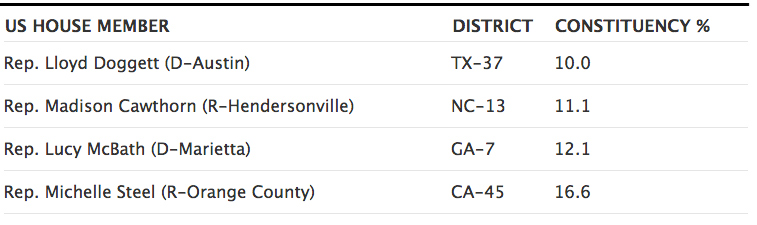
Interestingly, the four incumbents with the most new constituents, those having a district where a range from just 10 to 20 percent of their current electorates are present in the new CD, actually chose to run in the new places. Each eschewed a seat where they have a larger number of current voters.


Texas Rep. Lloyd Doggett (D-Austin) has the least carryover of any member from a redistricting completed state. Moving from his current 35th District into the new 37th CD means just 10.0 percent of his current constituents reside in the succeeding district. Placing Doggett here was not the intent of the map drawers, however, as the 37th was meant to be one of the state’s two new seats, a Democratic district fully contained within Austin’s Travis County.

Doggett’s 35th District is now the open seat, in a domain that again stretches from Austin to San Antonio. Had he stayed in the 35th, a total of 60.7 percent of his constituency would have remained constant, according to the Daily Kos Elections site statisticians who have calculated the redistribution percentages for all of the states that have completed redistricting.

Rep. Doggett faces little in the way of Democratic primary opposition, and the new 37th is a similar Austin-anchored seat to his original 10th District in which he began his US House career back in 1995.

North Carolina Rep. Madison Cawthorn (R-Hendersonville) chose to run in the 13th District, which was designed to be that state’s new seat. Despite having only 11.1 percent of his current constituency in the new district, Rep. Cawthorn likes his chances. The 13th lies closer to the Charlotte metro area in comparison to his current western North Carolina seat.

Continue reading

New York Rep. John Katko to Retire

New York Rep. John Katko (R-Syracuse)

By Jim Ellis

Jan. 18, 2021 — New York Rep. John Katko (R-Syracuse) announced Friday that he will not seek a fifth term later this year, creating a 47th open seat for the 2022 US House elections.

Katko, who indicated that he and his wife buried all four of their parents during the past three years, which he said was “gut-wrenching,” says he now desires more time with his family. He leaves a seat where he has averaged 56.5 percent of the vote as one of only eight Republicans from the 27-member Empire State delegation.

Other factors may also have played a role in his retirement decision. Redistricting appeared to be creating some re-election problems for Rep. Katko, as had former President Donald Trump.

New York lost a seat in reapportionment — a district collapse that will come from the Upstate region. Early maps suggested that Katko’s Syracuse-anchored seat would be combined with Rep. Claudia Tenney’s 22nd District, which would result in a paired incumbent situation before the primary winner likely would face another competitive general election campaign.

In the past two election cycles, Rep. Katko’s opponent was college professor Dana Balter (D), and her challenges resulted in expensive and hard fought 53-43 percent (2020) and 52-47 percent (2018) victories. Balter spent $2.7 million and $3.3 million in her two successive races against Rep. Katko, totaling $6 million, which he countered with a combined $6.3 million. Additionally, both candidates received hundreds of thousands of dollars in support from their respective political parties and outside groups.

The NY-24 seat is one of only nine districts where the electorate supported President Biden and elected a Republican to the House. In the current Congress, the 24th is one of just three districts that Hillary Clinton carried while electing a Republican Representative. Katko had repeatedly proven himself as an effective and successful political candidate.

In a paired 2022 situation against Rep. Tenney, however, the retiring congressman would have faced increasing pressure from his political right largely because of his vote to impeach former President Trump. Additionally, the New York Conservative Party leadership said they would not allow Katko to run with their ballot line in the 2022 general election. In New York, a candidate can run with more than one party designation.

Continue reading

Rep. Hollingsworth to Retire;
Tennessee Map Advances

By Jim Ellis

Indiana Rep. Trey Hollingsworth (R-Jeffersonville)

Jan. 14, 2022 — Three-term Indiana Rep. Trey Hollingsworth (R-Jeffersonville) announced Wednesday that he will not seek re-election in the autumn, becoming the 12th Republican to retire in this election cycle. The congressman’s retirement decision means at least 46 seats will be open in the 2022 House election.

Saying, “I ran for Congress to return this government to the people from the career politicians who had broken it, and I will be damned if I become one in the process,” Hollingsworth will draw his congressional career to a close after six years. When he first ran in 2016, he pledged to serve no more than four terms. He expresses a desire to return to the private sector.

Indiana’s 9th District occupies most of the state’s southern sector and for years was a Blue Dog Democratic area. For 17 terms, Congressman Lee Hamilton (D), who became chairman of the House Intelligence and Foreign Affairs Committees, represented the district. Democrat Baron Hill succeeded him in 1998, and served until his defeat at the hands of Republican businessman Mike Sodrel in 2004. Two years later, Hill recaptured the seat and held it until his second loss in 2010, this time to attorney Todd Young (R) who is now the Hoosier State’s senior senator.

Since the Young victory in 2010, the 9th has performed as a solid Republican district. Donald Trump carried in the seat in 2016 with a 61-34 percent margin, and again in 2020 with a similar 61-37 percent vote spread.

Under the new Indiana congressional map, the new 9th moves to the north and east, but retains its population centers in Jeffersonville, Clarksville, and New Albany, all across the Ohio River from Louisville, KY, and in the college town of Bloomington where the Indiana University resides.

Dave’s Redistricting App rates the new seat as a 59.7 percent Republican domain, while the FiveThirtyEight statistical site projects the new IN-9 with an R+30 rating, up from R+27 on the current map. The Republican primary is expected to be crowded and competitive. The Indiana candidate filing deadline is Feb. 4 for the May 3 statewide primary.
Continue reading

Analyzing Arizona

Click on map to go to Arizona Independent Redistricting Commission’s interactive map.

By Jim Ellis

Jan. 10, 2022 — Now that the new redistricting maps have been finalized in as many as 27 states, analysts can produce more detailed data about how the new seats will perform politically.

Such is the case in Arizona, as the Phoenix-based Data Orbital firm has published a new report about the Grand Canyon State’s congressional and state legislative maps. The DO research paints a more detailed picture of what we might expect in the 2022 elections.

At first glance, it appeared that the Arizona map might be one of the nation’s most competitive. The new Data Orbital information certainly supports such a conclusion, and tells us that two incumbents actually have more difficult situations than suggested at first glance, one a possibly easier road to re-election, and a third district that will likely produce razor-thin margins for either party in at least the decade’s early elections.

It was clear that Reps. David Schweikert (R-Fountain Hills) and Tom O’Halleran (D-Sedona) were placed in more competitive situations than their current CDs yield, but the more detailed historical data finds that their respective roads to re-election are even rockier.

The Data Orbital firm measured each district through five statewide elections from 2020 and 2018, overlaid the partisan registration figures, added the new registration trends, and took into account district electorate performance in high and lower turnout situations.

Using all of this data, we see that Rep. O’Halleran clearly has the worst draw and his chances for re-election this year appear dim. His new 2nd District (previously numbered 1) went Republican in all five of the tested elections; Republicans have the edge in current and new voter registration, and the Republican candidates performed better in both high and low turnout elections.

In all, the Republican nominees averaged vote margins of more than 10 percent over their Democratic counterparts. There is no statistical measure where Democrats outperformed Republicans in the new 2nd District, which places Rep. O’Halleran in the most difficult position of all the incumbents seeking re-election.

Rep. Schweikert, who won his last re-election in the current 6th District with only 52 percent, sees a much tougher road ahead of him in 2022 within the confines of the new 1st District.

In the five tested races — 2020 presidential, 2020 Senate, 2020 congressional, 2018 gubernatorial, and 2018 attorney general — Republicans only won two. The winning percentage for the Republican victories, however, is much higher than the three Democratic victories – the Dems only scored a cumulative winning average of 1.2 percent — so Schweikert certainly has a chance of winning another term. The GOP does score an overall performance margin advantage of 4.1 percent and leads the Democrats in party registration, among new registrants, and in both low and high turnout elections.

At first glance, it appeared that Rep. Greg Stanton (D-Phoenix) would have a more difficult re-election situation than what the deeper dive numbers suggest. Democrats won four of the five tested elections, the overall vote average favors the Democratic candidates by 5.6 percentage points, and while registration breaks almost evenly among the Democrats, Republicans, and Independents, the vote performance figures suggest that the Independent sector clearly leans Democratic. While Independents overwhelming lead the new registration category, the Democrats also outperform the Republicans by 2.4 percentage points.

Continue reading