
Tag Archives: Redistricting

A Pennsylvania Gerrymander or Not?

By Jim Ellis

Feb. 4, 2019 — As more final voting data becomes available about the 2018 electoral patterns, new local analysis articles are being distributed that allow us to better understand why the results unfolded as they did.

Emily Previti published a piece for Pennsylvania’s Keystone Crossroads media site at the end of last week that details just how the congressional outcome might have changed if the state Supreme Court had not altered the Pennsylvania federal map.

The Pennsylvania high court ruled about a year before the last election that the 2011 redistricting legislative package was a political gerrymander in relation to the state’s constitution. The court then instituted new boundaries for the 2018 and 2020 elections, designed to bridge the gap until the next census, reapportionment, and redistricting processes begin again.

The court majority reasoned that the previous congressional map routinely yielding a 13R-5D congressional result was out of sync with a statewide electorate that usually favors Democrats, among other reasons. Yet, according to the Previti article, such may not have been the case.
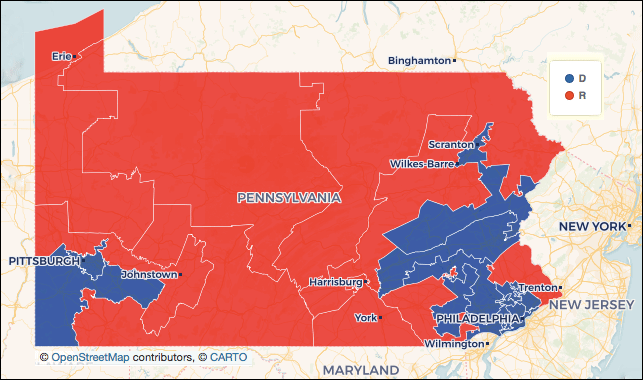
Click on above map to see full story and interactive map at the Keystone Crossroads media site.

After overlaying the new court-imposed 18-district congressional map (above) that returned a 9R-9D result from the previous 12R-6D delegation split (the division changed when Democrat Conor Lamb won an early 2018 special election in a previously Republican 18th CD), Previti concludes that the same 9-9 split we see today may well have occurred even under the previous map.

Continue reading

Another House Retirement

By Jim Ellis

Rep.-Luis-Gutierrez-D-ChicagoNov. 29, 2017 — Two years ago, US Rep. Luis Gutierrez (D-Chicago) announced that he would not seek re-election, only to eventually turn around and file for another term. On Monday, Gutierrez filed paperwork to secure a ballot spot, according to a Chicago Tribune report, but yesterday reversed course and announced for the second time that he would retire. “I’m going to leave Congress at the end of my term in 2019,” he said, “but I’m not retiring.” Once this Congress adjourns, he will have completed 13 full terms in the House.

This could be an example of Chicago machine politics at its best, however. With Gutierrez announcing that he won’t run just a week before the Dec. 4 candidate filing deadline after giving every indication he would seek re-election, it’s possible he could be setting up a designated successor. Already, Cook County Commissioner Jesus “Chuy” Garcia (D) is reportedly circulating petitions to gather signatures for congressional race qualification. We can expect a great deal of political scrambling in the next day or two, since prospective candidates have little time to decide about their individual run for Congress, and then build and command enough of a political organization to meet the ballot qualification requirements.

Illinois’ 4th District is heavily Democratic (Clinton 82.1 percent; Obama ’12: 80.9 percent), so all of the political action will be settled in the March 20th party primary. The seat is 70.1 percent Hispanic, and the state’s only Hispanic majority district.

Continue reading

Action Breaking in Texas

By Jim Ellis

Aug. 24, 2017
— Early last week, the three-judge federal panel considering the Texas redistricting lawsuit issued a ruling, one that contained a rather major surprise.

It was expected that Reps. Blake Farenthold (R-Corpus Christi) and Lloyd Doggett’s (D-Austin) districts would certainly be ordered re-drawn for racial gerrymandering reasons, but it was assumed that Rep. Will Hurd’s (R-San Antonio) 23rd District would also be in the same predicament. In a ruling that certainly caught the Democratic plaintiffs off guard, the court allowed the current 23rd to stand while striking down the other two. The panel also left north Texas in tact, another region the Democrats wanted re-configured.

Now with some certainty that the district will remain intact – though it could tangentially change as a result of re-crafting Doggett’s nearby 35th District – candidates already are starting to make their moves regarding challenging vulnerable two-term incumbent Hurd.

Rep. Will Hurd (R-San Antonio)

Congressman Hurd was first elected to represent his sprawling central-west Texas district, a seat that stretches more than 550 miles from San Antonio to El Paso, in 2014 when he upset then-Rep. Pete Gallego (D-Alpine), 50-48 percent, yielding a margin of just over 2,400 votes. This past November, Rep. Hurd again beat Gallego, this time 48-47 percent, a spread of just over 3,000 votes. Knowing that the turnout would literally double in the presidential year from the previous mid-term, many observers expected Gallego to re-claim the seat and were again surprised when the re-match evolved into a rerun.

Continue reading

The First Midterm: A Deeper Story

By Jim Ellis

July 18, 2017 — Much has been made about a new president’s party failing in the midterm directly after his initial national election, but the statistics aren’t quite what they seem. In the House, the average loss for the new president’s party is 26 seats in first midterm during the modern political era, in addition to dropping two Senate seats. But these numbers are misleading.

Many media stories portray the Democrats on the brink of wresting the House majority away from Republicans, and one factor supporting such a claim is the first midterm historical trend. The stories underscore that the Democrats need a net gain of 24 seats to depose the Republicans, two seats less than the average “out party” gain in similar elections.

The research stops short, however, and omits a very key point. Since President Harry S. Truman assumed office in 1945 and stood for election in his own right in 1948, 11 presidents, inclusive, have seen his party lose House seats in first midterm election. President Gerald Ford, because he was never elected to the office, is not included for purposes of this statistical exercise.

Continue reading

The Florida Switch

Oct. 20, 2015 — Central Florida House Republicans are getting nervous. The new redistricting plan, which the state Supreme Court is likely to soon adopt, is not kind to the middle-state GOP incumbents. In preparation, press rumors are floating that several members will switch districts in order for each to have a winnable place to run next year.

Under the lower court’s proposed map, Rep. Dan Webster (R-FL-10) is the odd man out. His current Orlando-anchored district goes from a 46 percent Obama district to one where the president scored 61 percent. Therefore, the new 10th District becomes unwinnable for Webster even by his own admission.

Ironically, Rep. Alan Grayson’s (D) 9th District, now a 62 percent Obama district becomes even more Republican than the new 10th. The new southeastern Orlando suburban 9th would carry a 56 percent Obama rating, but even this Republican improvement would not yield a GOP victory particularly in a presidential election year. The 9th will be an open seat because Rep. Grayson is running for the Senate.

Rep. John Mica’s (R) 7th District is currently a 47 percent Obama district that would move to 49 percent Obama because the city of Sanford is annexed, which makes it a virtual tie at the presidential level (Mitt Romney also scored 49 percent). The open 6th District, northeast of the 7th that hugs the Atlantic coast from Daytona through Volusia County, is the seat Rep. Ron DeSantis (R) is vacating to run for Senate. This district gets more Democratic, too, but should remain in Republican hands. Originally, the 6th gave 41 percent of its votes to Obama; now, it would be 46 percent.

Continue reading

The Hidden Reason Why McCain is
Being Challenged in Arizona

May 28, 2015 — A surprising story broke in Arizona Tuesday. Rep. Ann Kirkpatrick (D-AZ-1) announced that she will forego her re-election bid and instead challenge Sen. John McCain (R) next year. The congresswoman was included on most “possible candidate” lists, but was not viewed as someone overtly planning to make the jump into the statewide contest. Her move, however, may be a precursor to another decision that will soon enter the public domain.

With McCain’s approval numbers dropping into the dangerously low category (36:51 percent favorable to unfavorable according to Public Policy Polling), Kirkpatrick’s move is not without political reason. The latest PPP survey (May 1-3; 600 registered Arizona voters) finds her trailing the senator only 36-42 percent, certainly suggesting that such a general election pairing would yield a competitive contest.

But, the driving force behind Kirkpatrick may not be McCain’s perceived vulnerability. Rather, since the US Supreme Court is poised to soon render a decision on the Arizona redistricting challenge, it may be this issue that is actually motivating Kirkpatrick to move forward.

The Arizona Republicans are challenging the state’s congressional map on the grounds that the US Constitution only gives federal redistricting power to state legislatures. Before the 2000 reapportionment, voters adopted a ballot proposition that created a redistricting commission empowered to draw congressional and state legislative lines. The crux of the suit argues that a citizens’ commission has no authority to draw congressional lines.
Continue reading >

Developments in MS-1 Special,
Illinois Senate, Virginia Redistricting

April 1, 2015 — Candidate filing closed this past Friday for the MS-1 special election, which Rep. Alan Nunnelee’s (R) death made necessary. Twelve Republicans and one Democrat will be on the May 12 Mississippi jungle primary ballot. With so many candidates qualifying, a June 2 run-off between the top two finishers is a virtual certainty, since it would be very difficult for any one contender to attract a majority of the vote.

One prominent name missing from the list is former Rep. Travis Childers (D), who won the last special election held here, and then claimed a full term later in 2008. He was unseated in 2010, and then lost to Sen. Thad Cochran (R) last November in a statewide general election contest. Though it is always possible lightning could have again struck for him in a special election, the chance of Childers holding this strongly Republican northern Mississippi district for a long duration is an unlikely one, at best. Hence, his decision not to run.

The lone Democrat running is former Jackson mayoral aide Walter Zinn. His prospects of qualifying for the run-off are somewhat realistic because the Republican vote will be split literally a dozen ways. His prospects are thin, however, to capture the seat in the run-off. Aside from being a prohibitive underdog against a Republican in a one-on-one battle, Zinn’s Jackson political base is not even in the 1st District.
Continue reading >