Tag Archives: NJ-11

Special Elections Update

by Jim Ellis — Thursday, Dec. 4, 2025

Special Elections

With the TN-7 special election now complete, three more contests are pegged for the first quarter of next year. The upcoming special elections will be held in Georgia, New Jersey, and Texas.

TN-7

This week’s Tennessee result saw the 7th District electorate performing as the voting history projected, thus quelling the Democrats’ quest for the upset that certain polls suggested was possible. The 54-44 percent result from what will likely be a touch over 180,000 votes cast when all ballots are counted – a large number for a special congressional election – was equivalent to the Dave’s Redistricting App’s partisan lean calculation of 55.1R – 42.2D.

Most importantly, from the Republicans’ perspective, the party apparatus proved in this instance, that they could turn out the base vote and a sizable number of the casual Trump voters, meaning those who typically only vote when the President is on the ballot. Repeatedly doing so in future elections will be a critical factor in determining whether the party will have success in the regular midterm elections next year.

GA-14

Georgia Rep. Marjorie Taylor Greene (R-Rome) / Photo by Gage Skidmore

Rep. Marjorie Taylor Greene (R-Rome) will resign on Jan. 5. At that point, Georgia Gov. Brian Kemp (R) will schedule the special election to replace the outgoing Congresswoman in the northwestern district. GA-14 the safest Peach State Republican seat. The district stretches from just outside Marietta to the Tennessee border.

It is believed that Gov. Kemp will calendar the jungle primary for a date in March. Under Georgia special election law, all candidates are on the initial ballot with the top two finishers, irrespective of party affiliation, advancing to the runoff election in the likely event that no contender attracts majority support. To comply with state law, the secondary vote must occur within 28 days of the initial election. Therefore, it is probable that this seat will be filled before the end of April.

A total of 13 Republicans and two Democrats have already announced their candidacies, but the two most talked-about potential candidates, state Senate Majority Leader Jason Anavitarte (R-Doraville) and state Sen. Colton Moore (R-Trenton), have yet to formally declare.

It is probable that two Republicans will advance into the special runoff election. Republicans will hold this seat.

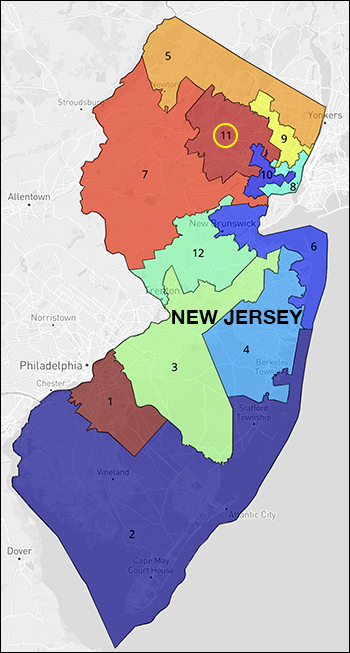
NJ-11

Gov.-Elect Mikie Sherrill (D) has resigned her congressional seat, thus leading to Gov. Phil Murphy (D) scheduling a Feb. 5 partisan primary and an April 16 special general election.

Candidate filing has closed, and 13 Democrats will be on the Feb. 5 ballot vying for the party nomination. Within the large group is former 7th District Congressman Tom Malinowski, ex-Lt. Gov. Tahesha Way, and five local officials, with the remainder coming from the private sector or political activist class. Only one Republican filed, Randolph Township Mayor Joe Hathaway, so he is guaranteed to win the party nomination, meaning a ballot slot for the special general election.

The partisan lean (Dave’s Redistricting App calculations) for this district, which redistricting has made much more Democratic in the previous two decades, is 55.6D – 42.5R. Therefore, it is clear the eventual Democratic nominee will have the inside track toward winning the special election and holding the seat for the party.

TX-18

The longest special election cycle to fill a congressional vacancy will culminate with a Jan. 31 runoff contest between Harris County Attorney Christian Menefee (D) and former Houston City Councilwoman Amanda Edwards (D). Since this is a double Democratic runoff, there is no doubt that the party will hold the seat for the duration of the current Congress.

Regardless of whether Menefee or Edwards wins the Jan. 31 vote, they will immediately find themselves embroiled in a new campaign against Rep. Al Green (D-Houston). Since it is likely that the new Texas congressional map will be in effect for the 2026 midterm elections, the Houston area sees a major reconfiguration of its congressional districts.

The new plan collapsed most of Rep. Green’s 9th CD into a new 18th District, with much of the current 18th going into Rep. Sylvia Garcia’s (D-Houston) new 29th CD. The regular cycle Texas primary is scheduled for March 3, so the eventual runoff winner and loser will find themselves immediately competing in a new campaign.

The regular term candidate filing deadline is Dec. 8. At this point, neither Menefee nor Edwards have filed for the new term, but both are expected to do so. This means that the loser of the Jan. 31 runoff could conceivably be an active candidate for the March 3 regular primary election, which could force Rep. Green into a runoff with either the new incumbent or the just-defeated runoff participant.

While the special election will end on Jan. 31, the campaign for a full term will already be entering political prime time.

Weekly Political Synopsis,
Period Ending May 17, 2019

By Jim Ellis

PRESIDENT
• Gov. Steve Bullock: As has been expected for some time, Montana Gov. Steve Bullock (D) officially announced his presidential effort this week, becoming the 23rd Democratic candidate. Bullock made the argument that he will be an effective national candidate because he’s won two elections in a conservative state and has been able to earn legislative achievements, like Medicaid expansion, in negotiating with Republican leaders.
• Mayor Bill de Blasio: Following Gov. Bullock, New York City Mayor Bill de Blasio released an announcement video at the end of the week making him the 24th Democratic presidential candidate for the 2020 election cycle. His declaration centered around being the candidate for “working families,” and cited the $15 minimum wage, a free pre-K school program, a comprehensive healthcare program that especially covers mental health, and paid sick leave.

• Florida: Former Vice President Joe Biden continues to see strong polling numbers, with the latest data coming from Florida. The Tel Opinion Research organization is reporting its latest results (released May 8; 800 likely Florida Democratic primary voters) that show Biden pulling away from his Democratic opponents on an open-ended ballot test poll. An open-ended ballot test is one where the respondent is not given the candidates’ names. That approach tests for committed strength.
According to Tel Opinion, Biden leads Sen. Bernie Sanders (I-VT), 39-16 percent, with Sens. Elizabeth Warren (D-MA) and Kamala Harris (D-CA) each pulling only five percent support. South Bend (IN) Mayor Pete Buttigieg follows at three percent preference. All of the candidates scored well on the favorability index scale. Biden is viewed positively with an 81:13 percent ratio, where Sen. Sanders’ score is 68:23 percent.

SENATE
• Arizona: Phoenix-based pollster OH Predictive Insights released their latest data from their May 1-2 poll (600 likely Arizona voters) where they queried the respondent universe about the impending Senate race between appointed Sen. Martha McSally (R) and retired astronaut Mark Kelly (D). Though we are more than a year before Arizona’s 2020 late August primary, the chances are strong that the aforementioned will be their respective party standard bearers.
According to the OH poll results, the early race again earns toss-up status. The sample breaks 45-44 percent in Sen. McSally’s favor, which is virtually identical with the firm’s late February poll giving the incumbent a 46-44 percent edge.

Continue reading

NJ-11: Rebounding

By Jim Ellis

Navy veteran and attorney, Mikie Sherrill

Navy veteran and attorney, Mikie Sherrill

Sep. 3, 2018 — A new poll suggests that conventional wisdom about how a northern New Jersey district will vote next month might be inaccurate.

For quite some time, the common belief has been that retiring Rep. Rodney Frelinghuysen’s (D-Morristown) seat will convert to the Democrats in the person of attorney and Naval Academy graduate Mikie Sherrill.

An internal National Strategy poll for the Jay Webber (R) campaign (Sept. 24-27; 400 likely New Jersey voters), however, now finds the GOP nominee drawing much closer to Sherrill, to the point where he is within the polling margin of error. According to National, the ballot test finds Sherrill leading, 46-43 percent.

Published polls here have been few and far between. Right after the primary, the money count so favored Sherrill that the prognosticators began making a Democratic victory in this open Republican district a foregone conclusion.

Sherrill had already raised over $4.2 million before the end of June and held just under $3 million in the bank. This compared to Webber having less than $200,000 cash-on-hand. His fundraising was slow to gain momentum, and he had to spend in order to win the party nomination in the June 5 primary, hence his low post-primary financial total. The dollar count led to the principle idea that Sherrill was becoming a lock. Since that time, Webber’s fundraising has moved well into seven digits.

Continue reading

NJ-11: A Consensus Forming?

By Jim Ellis

Feb. 8, 2018 — House Appropriations Committee chairman and New Jersey Rep. Rodney Frelinghuysen’s (R-Morristown) surprise retirement announcement last week was initially met with cheers from the national Democratic establishment and local rank and file. As an open seat, they believed their conversion chances were growing even stronger. But, it appears that local Republican leaders are very quickly working to build support for a contender who may well become a consensus GOP candidate as soon as next week.

New Jersey Rep. Rodney Frelinghuysen  (R-Morristown)

New Jersey Rep. Rodney Frelinghuysen (R-Morristown)

When Rep. Frelinghuysen decided not to seek a 13th term, state Sen. Joe Pennacchio (R-Montville) immediately indicated that he would become a congressional candidate. Almost as quickly, neighboring Assemblyman Anthony Bucco (R-Randolph) followed suit. But, Assemblyman Jay Webber (R-Parsippany), who also represents the 26th Legislative District (as does Sen. Pennacchio), is now coming to the forefront as the man to beat in the GOP primary.

Upon Assemblyman Webber entering the race — who is a former New Jersey Republican Party chairman — Sen. Pennacchio quickly bowed out; Bucco also is sending signals that he, too, will soon exit. This leaves only attorney and first-time candidate Martin Hewitt remaining as an opponent for Webber.

Democrats were targeting Frelinghuysen, pointing to the fact that President Trump carried only the 11th District — originally drawn to be a decidedly Republican seat — by just a single percentage point, 49-48 percent. The district has been trending a bit more Democratic since it was first drawn. Compare the Trump numbers to both Mitt Romney and John McCain’s identical 52-47 percent showings. (The McCain numbers were re-configured into the territory comprising the current 11th CD, not the one existing in 2008. The previous seat was four points more Republican.)

Continue reading

An Open Review – Part I

By Jim Ellis

Feb. 6, 2018 — With so many House retirements coming into focus within the past several weeks, it is a good time to review the list of 53 districts heading into their next election without an incumbent on the ballot.

Of the 53, Republicans currently hold 37 seats versus just 16 for the Democrats. Here’s the breakdown of how things look regarding all 53 seats right now:

2018-elections-open-seats

  • Safe Republican (19)
  • Likely Republican (6)
  • Likely Democrat (6)
  • Safe Democrat (6)
  • Lean Republican (5)
  • Lean Democrat (3)
  • Toss-up (8)

This configuration could change drastically if the Pennsylvania map is re-drawn in a court-ordered redistricting. The state Supreme Court has declared the Keystone State map a political gerrymander and has ordered a new plan drawn by Feb. 15.

The state Senate President Pro Tempore is responding, however, that the legislature will not comply with the court order to turn over statistical data need to draw a new map because the state court did not cite the legal provisions violated in making the current plan a gerrymander. Additionally, the US Supreme Court is sending signals that it may try to involve itself even though this case is filed against the Pennsylvania Constitution and not its federal counterpart. We can count on major action coming here within the next several days.

Furthermore, the US Supreme Court is in the process of deciding the Wisconsin political gerrymandering case, which will also affect active lawsuits in Michigan, North Carolina, Texas, and Virginia; in Pennsylvania, the political gerrymandering lawsuit realm is not directly part of this group because its case is filed within the state court system. But the Republicans have petitioned the federal high court to look at this case for other legal reasons.

Continue reading