Tag Archives: New Hampshire

Harris: A Tough Road Ahead

Vice President Kamala Harris: a tough path to winning in November. (Photo by Gage Skidmore)

By Jim Ellis — Tuesday, July 23, 2024

President

While Vice President Kamala Harris is well positioned to replace President Joe Biden as the 2024 Democratic presidential nominee, her task of winning the general election is anything but easy. New polls in the key swing states start her in an underdog position in virtually every key place that will determine the final outcome.

As we know, there are six states considered prime swing states: Arizona, Georgia, Michigan, Nevada, Pennsylvania, and Wisconsin. Before Biden announced his exit, another half-dozen surprising domains were showing competitive signs: Maine, Minnesota, New Hampshire, New Jersey, New Mexico, and Virginia. This means that former President Donald Trump was either leading in the most recent state survey or within a point or two of moving ahead. It remains to be seen if any of these second-tier swing states truly become competitive in a Trump-Harris race.

July polling in eight of these states illustrates the Harris difficulty factor in overcoming Trump’s current advantage. None of the states are out of play, since the Trump leads are all in single digits, but the fact that she would have to simultaneously hold nine of 12 domains increases the difficulty factor.

Vice President Harris’ biggest problem is that three of the states, Arizona, Georgia, and Nevada, appear locked for Trump. We have seen 26 publicly released polls from Arizona since January 1, and Trump leads in all. The Public Policy Polling organization conducted a Grand Canyon State survey during the July 19-20 period (736 registered Arizona voters), and Trump holds a six-point, 46-40 percent, advantage against Harris.

In Georgia, 24 Trump-Biden polls were conducted in 2024, and as in Arizona, Trump leads all. Two Trump-Harris polls have been conducted in July. The University of Georgia for the Atlanta Journal-Constitution newspaper (July 9-18; 1,000 likely Georgia voters) finds Trump holding a five-point edge over VP Harris. Insider Advantage (July 15-16; 800 likely Georgia voters) projects an even larger 10-point lead.

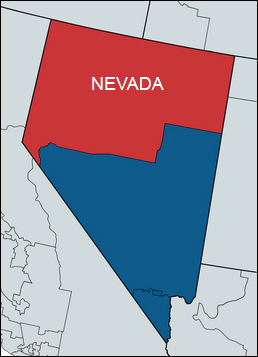
Nevada is turning in similar numbers. In 2024, a total of 22 Trump-Biden polls have been released, and Trump led in 21 with one tie. Insider Advantage conducted the most recent Trump-Harris poll (July 15-16; 800 likely Nevada voters) and Trump holds a 10-point, 50-40 percent, margin over the vice president.

These three states are significant because the data suggests that they are solid for Trump. Should he carry through and win them all, the former president would add 33 electoral votes to his 2020 national total, meaning he would be literally just one state away from winning the national election.

This is what makes Harris’s path difficult. Her margin of error if conceding Arizona, Georgia, and Nevada is just one state.

Therefore, looking at the remaining top-tier swings of Michigan, Pennsylvania, and Wisconsin, Harris would have to sweep them.

Today, she trails Trump in Michigan by five percentage points according to Democratic pollster Public Policy Polling (July 17-18; 650 registered Michigan voters)

The latest Pennsylvania numbers tell a similar tale. SoCal Research (July 20-21; 500 likely Pennsylvania voters) yields Trump a 50-46 percent edge over Harris.

In Wisconsin, Harris fares a bit better, but still could easily lose. The Civiqs research organization, polling for Daily Kos Elections (July 13-16; 514 registered Wisconsin voters), sees Trump and Harris deadlocked at 48 percent apiece.

There is some current data appearing from the second tier, though no July polling has been released for Maine, Minnesota, New Jersey, and New Mexico.

In New Hampshire, a state the former president twice lost to Hillary Clinton and President Biden, a group called Praecones Analytica just tested the electorate (July 19-21; 601 registered New Hampshire voters) and shows Trump holding a one-point, 40-39 percent, edge over VP Harris.

Finally, Florida Atlantic University tested the Virginia electorate with a released small sample survey (July 14-15; 301 registered Virginia voters) and projects Trump with a 41-40 percent lead over Harris.

As you can see, the point deficit in any of the nine first- and second-tier swing and potentially competitive states is not insurmountable in any instance. The vice president’s problem is that she must win all of these swing states, assuming Arizona, Georgia, and Nevada continue their year-long trend of favoring former President Trump. Therefore, of the remaining targets, Vice President Harris must run the table if she is to claim the White House since her margin of error is virtually depleted.

New Hampshire & New Mexico

Could New Hampshire & New Mexico be in play for Republicans?

By Jim Ellis — Friday, July 19, 2024

President

Even before the Trump assassination attempt and the Republican National Convention commenced, polling was beginning to suggest that some unusual states were venturing into the competitive realm.

At this point in the election cycle, it appears that the top conversion targets for the Trump campaign are Arizona, Georgia, and Nevada. Together, these states would deliver 33 of the 35 conversion electoral votes (from those states that voted for President Biden in 2020 but are strong potential Trump states in 2024) the former president would need to win the national election.

In the trio of these states since the beginning of this year, Trump has not trailed in any of the cumulative 62 polls from 15 different pollsters conducted in the three entities. If these states vote Trump in 2024, then the electoral map significantly changes.

Obviously, beyond Arizona, Georgia, and Nevada, the three commonly discussed Great Lakes states are clear battleground regions: Michigan, Pennsylvania, and Wisconsin.

Now, however, cumulative polling suggests other places could be potential Trump conversion opportunities. It is important, however, to determine which might legitimate prospects to flip as compared to those where the newly crowned Republican nominee could do well but might only come close to President Biden’s vote percentage.

The states in question are Maine, Minnesota, New Hampshire, New Jersey, New Mexico, and Virginia. One victory in any of the aforementioned, or converting the 2nd Congressional District of Nebraska (via an Electoral College tie), would award the election to former President Trump, assuming all 25 states that he twice carried return to his column.

While a Trump plurality victory is certainly within the realm of possibility in Maine since polling suggests his lead in the northern ME-2 district is at or near 20 percentage points, his chances of losing the 1st District by less than such a spread are good. Therefore, Trump could reasonably place first in Maine. His problem is the state’s Ranked Choice Voting system. Because it is doubtful he could secure majority support in the state — more than 50 percent — Trump would likely lose to President Biden in the RCV rounds.

Minnesota is the most loyal Democratic state in modern presidential campaign history. The last time the Land of 10,000 Lakes voted for a Republican in the national election came in 1972 when the state chose then-President Richard Nixon over then-Sen. George McGovern (D). Every other state has voted for a Republican at least one time since that election. In 2016, Mr. Trump came within 1.5 points of Hillary Clinton in Minnesota, which is probably the best he could do in 2024.

New Jersey is a state where Republicans poll better than they run, unlike some of the southern states where the opposite is true. The latest publicly released survey (co/efficient; June 26-27; 810 likely New Jersey general election voters; live interview & text) found Trump actually posting a slight 41-40 percent lead over President Biden in the Garden State. Such a margin is unlikely to occur when actual votes are cast, making New Jersey a “fool’s gold” state for Republicans.

Virginia also is unlikely to flip. The Washington, DC metro area in its entirety, meaning the city itself as well as the Northern Virginia and Maryland suburbs, is historically Trump’s worst-performing area in the country. Therefore, looking at the increased population in northern Virginia and Trump’s unpopularity in the region suggests that his three-point deficit spread found in the July 12-15 Florida Atlantic University survey of 918 likely Virginia voters is the closest that Trump will come to victory in the state.

The New Hampshire and New Mexico situations, however, look different. Both states are small, campaigning is relatively cheap, and though they have Democratic voting histories certainly since 2016, both could be seriously in play come November.

New Hampshire has elected a Republican governor in four straight elections and though outgoing Gov. Chris Sununu (R) is no fan of Trump’s, he pledged to vote for him and if the state is in a position to make a national difference, the governor will put the campaign levers in place to help push Trump over the top.

New Hampshire, however, has not been kind to the Republican presidential candidates. Since the 2012 presidential election, national Republican nominees have averaged only 46.1 percent of the vote as compared to the Democratic contenders 50.5 percent. Yet, the Granite State still has swing characteristics.

The New Mexico numbers are slightly worse than those in New Hampshire. The cumulative average in presidential races since 2012, inclusive, finds the Democratic nominee attracting a mean average of 51.8 percent compared to the Republicans’ 42.1 percent. Yet, with a plurality Hispanic Voting Age Population figure (44.3 percent Hispanic; 40.5 percent Anglo), and more Hispanic voters professing openness toward Republicans, the state may well be closer in 2024 than what previous statistics show.

If the Trump campaign is to overcome their electoral vote deficit, they must first expand the playing field, which they appear to be doing, continue to concentrate on Michigan, Pennsylvania, and Wisconsin, and then invest in some longer-shot states in the hope that one comes through. Two such candidates for long-shot victory are clearly New Hampshire and New Mexico.

More States in Play

By Jim Ellis — Wednesday, July 3, 2024

President

MORE SWING STATES IN PLAY: Arizona, Georgia, Michigan, Minnesota, Nevada, North Carolina, Pennsylvania, Virginia, Wisconsin (and possibly Maine, New Hampshire, New Jersey, and New Mexico)

Recent polling data suggests that several surprising states are becoming competitive. In addition to Minnesota and Virginia, the former of which has been close for weeks and the latter showing dead heat signs within the last 14 days, four more states are now returning tight polling numbers.

As has been the case since the beginning of the year, Arizona, Georgia, and Nevada have been reporting strong numbers for former President Donald Trump. In fact, the 19 polls conducted in Arizona since Jan. 1 finds Trump leading in each. The Georgia data projects a similar pattern. There, 16 surveys have been conducted in 2024, again with Trump leading in all. The Nevada numbers report the same pattern as Georgia.

It’s also been common political knowledge that the three key Great Lakes states, Michigan, Pennsylvania, and Wisconsin, have been in the toss-up category throughout the current year. Recently, the three have all leaned towards Trump, and likely will report an exaggerated trend at least for the short-term post-debate period.

If the Arizona, Georgia, and Nevada trends hold through the election, and Trump converts all three, he would only need one more state of any size to win the national election. Now, it appears several others are coming into the observance realm.

New polling finds the race coming into dead heat territory in Maine, New Hampshire, New Jersey, and New Mexico, all of which have been Democratic strongholds for years.

The last time Maine and New Jersey went for a Republican presidential candidate occurred in 1988, when the states’ electorates supported George H.W. Bush over Michael Dukakis. New Hampshire last voted Republican in 2000 for George W. Bush against Al Gore, while New Mexico supported the latter Bush in 2004 opposite John Kerry. The previously mentioned Minnesota hasn’t voted for a Republican presidential candidate since 1972, while Virginia, like New Mexico, also favored then-President Bush over Kerry 20 years ago.

St. Anselm College on Monday released their latest New Hampshire poll (June 28-29; 1,700 registered New Hampshire voters; online) and sees Trump taking a 44-42-4 percent lead over President Joe Biden and Independent Robert F. Kennedy Jr.

The co/efficient firm tested the New Jersey electorate (June 26-27; 810 likely New Jersey voters; live interview & text) and these results also show Trump ahead in an unlikely state, 41-40-7 percent.

The New Mexico data still finds President Biden leading, but barely. The 1892 polling organization (June 19-24; 600 likely New Mexico voters) posts Biden to only a one-point lead, 43-42-8 percent over Trump and Kennedy.

In Minnesota, a place where the two presidential candidates have consistently battled in polls to within three-point margins for most of the year, Emerson College (June 13-18; 1,000 registered Minnesota voters; multiple sampling techniques) recently projected Trump to a one-point edge.

The Critical Insights firm tested the Maine electorate (June 12; 609 registered Maine voters; live interview and online) and found Trump recording a one-point advantage in this state as well, 41-40 percent, with 19 percent going to other candidates. Maine features a Ranked Choice Voting system, so even if Trump manages to secure plurality support in the regular election, he would likely lose in the Ranked Choice rounds.

Fox News conducted the most recent Virginia poll (June 1-3; 1,107 registered Virginia voters; live interview) and this solidly Democratic state, too, turned in a ballot test within dead-heat range. According to the Fox results, Biden would hold a very slim 42-41-9 percent edge.

Typically, a Democratic presidential nominee would not have to exert much effort to hold these aforementioned states in the party column. The fact that they are currently in toss-up range, and all the studies but the New Hampshire poll were conducted before Thursday’s CNN presidential debate, suggests that the electoral map is legitimately becoming more expansive.

At least for the short term, it appears evident that the campaign will expand beyond the traditional seven swing states that have been the deciding factors in the last two elections.

Governors’ Races News — NH, NC, VT; Hollier Disqualified in Michigan

By Jim Ellis — Tuesday, May 28, 2024

Governor

Former US Sen. Kelly Ayotte (R)

New Hampshire: Ayotte Leads in New GOP Primary Survey — The National Journal published a new survey of New Hampshire voters (May 15-20; 420 likely New Hampshire voters; online) that posts to a double-digit Republican primary advantage over former state Senate president and 2022 US Senate candidate Chuck Morse. According to this data, Ayotte’s lead is 50-28 percent.

The survey is comprised of an online panel from Survey Monkey, which is one of the least accurate sources in the polling industry. The sampling universe began with 1,196 New Hampshire adults and then was winnowed to 420 likely GOP primary voters. Therefore, while Ayotte undoubtedly has a lead in the race, it may not be as strong as this poll suggests.

Additionally, with a late Sept. 10 primary election, this race has many weeks to fully develop. The eventual Republican nominee will face the winner of the Democratic primary between former Manchester Mayor Joyce Craig and Executive Council member Cinde Warmington.

North Carolina: Robinson Rebounds — After several consecutive polls found Attorney General Josh Stein (D) beginning to pull away from Lt. Gov. Mark Robinson (R) in the open 2024 governor’s race, a series of new polls are again forecasting a seesaw political battle. From the March 3 to April 8 period, Stein was leading in four consecutive polls from four different polling firms including the April Quinnipiac University survey that posted him to an eight point lead.

Now, we see another four polls conducted from April 8 to May 18, two of which giving each man a slight edge. Looking at the North Carolina voting history, we can expect this race to bounce around from now until Election Day, which will likely culminate in a very close final result.

Vermont: Another Key Democrat Won’t Run — On the heels of former Vermont Gov. Howard Dean (D) announcing that he would not again run for his former position, ex-Burlington Mayor Miro Weinberger (D) early this week made a similar announcement regarding the 2024 gubernatorial campaign.

With the May 30 candidate filing deadline fast approaching, Democrats have yet to recruit a strong opponent for four-term Gov. Phil Scott (R) who is seeking re-election to a fifth term. Despite Vermont’s heavily Democratic voting history, Gov. Scott again is well positioned to defy the odds and win yet another re-election.

House

MI-13: Hollier Disqualified — After the initial clerk staff reports revealed that former state senator and 2022 congressional candidate Adam Hollier (D) failed to submit the required number valid petition signatures for the 2024 congressional election, the Wayne County Clerk has verified that he is disqualified. According to the clerk’s report, Hollier filed only 863 valid registered voter signatures, well short of the needed 1,000. The disqualification is a break for freshman Rep. Shri Thanedar (D-Detroit), who defeated then-Sen. Hollier, 28-23 percent, in the 2022 Democratic primary.

It appeared that Hollier was the congressman’s most serious challenger. Remaining in the race are former state Rep. Mary Waters and resigned Southfield City Clerk Shakira Hawkins. The latter agreed to a plea bargain that required her to admit to criminal misconduct in office. Waters reported just over $5,000 cash-on-hand on her March 31 campaign disclosure report. Therefore, Rep. Thanedar’s political position has greatly improved.

Christie Says No to No Labels; Florida, South Carolina Redistricting; Quick Candidate Filing in New Hampshire

By Jim Ellis — Friday, March 29, 2024

President

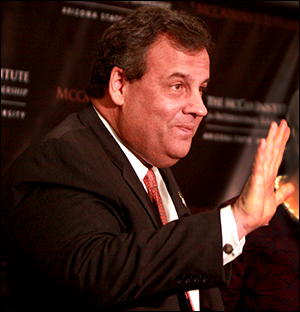
Former New Jersey Gov. Chris Christie (R) says no to No Labels. / Photo by Gage Skidmore

No Labels: Christie Says No — The No Labels Party is seemingly having a difficult time either choosing a presidential nominee or having someone accept their offer to run on their ballot line. A story emerged that former New Jersey governor and ex-presidential candidate Chris Christie (R), after being in negotiations with No Labels, has decided not to pursue entering the 2024 presidential general election as this party’s standard bearer.

Christie, in announcing his decision, said “I also believe that if there is not a pathway to win and if my candidacy in any way, shape or form would help Donald Trump become president again, then it is not the way forward.”

The No Labels membership has voted to field a presidential ticket, but so far, the leadership has not brought forth a national candidate pairing.

House

Florida Redistricting: Federal Judicial Panel Rejects Plaintiffs’ Arguments — A three-judge federal panel has rejected a lawsuit claiming that the Sunshine State congressional map violates the 14th and 15th Amendments to the US Constitution. The ruling’s result means that the current plan will remain in place.

The Florida map, from which the district electorates chose 20 Republicans and eight Democrats, is the Republicans’ strongest, nationally. Therefore, not changing this plan boosts GOP chances of maintaining their small majority.

SC-1: District Looks to Stand — With the South Carolina candidate filing deadline upon us on April 1 and the US Supreme Court so far not ruling on the redistricting case before them, the original three-judge panel has taken action. The federal jurists who initially declared the Palmetto State’s 1st District (Rep. Nancy Mace-R) a racial gerrymander ruled yesterday that the current configuration can stand for the 2024 election. The panel acted because SCOTUS has failed to issue their decision after hearing oral arguments and considering that the filing deadline is Monday.

The fact that the high court has not yet ruled suggests that the district will stand. Though the lawsuit was targeted to the racial complexion of the 1st District, changing this seat will invariably alter at least one other. South Carolina has seven districts that are split in in a 6R:1D ratio.

NH-2: First Candidate Announcement — A day after six-term New Hampshire US Rep. Annie Kuster (D-Hopkinton) announced that she will not seek re-election, a former gubernatorial nominee came forward to declare for the seat. Executive Councilor Colin Van Ostern (D), who held now-Gov. Chris Sununu (R) to an initial 49-47 percent victory in 2016, officially threw his hat into the congressional political ring.

New Hampshire’s 2nd is a politically marginal district that leans Democratic. Republicans will certainly contest the seat, but the quick Van Ostern move suggests he will become the early favorite not only for the Democratic nomination, but to hold the seat in November.

The New Hampshire filing deadline is not until June 14, so potential candidates have considerable time to make their decisions. Crowded fields are expected in both parties, but possibly less so for the Democrats now that Van Ostern has declared his intentions so quickly.

Nevada Poll Showing Tight Races; Menendez May Not Be Done; Wisconsin Looks Close;
New Hampshire Governor’s Race

By Jim Ellis — Friday, March 22, 2024

Senate

Nevada: New Margin of Error Poll — Prolific pollster Emerson College also tested the Nevada electorate and finds the Senate race already becoming a dead heat. The survey results (March 12-15; 1,000 likely Nevada voters; multiple sampling techniques) see Sen. Jacky Rosen (D) leading Afghan War veteran Sam Brown (R) by a slight 41-39 percent split, well within the polling margin of error. In the presidential race, former President Donald Trump slips past President Joe Biden 44-41 percent, a pattern that has been evident for weeks in the Silver State.

Possibly the most encouraging news for Republicans, which helps explain the GOP presidential performance in the poll, is the fact that Hispanics, traditionally heavy Democratic voters, would break for Biden in only a 44-39 percent clip. Hispanics account for just over 30 percent of the Nevada population according to US Census figures. Therefore, this group could become a deciding factor in how the state eventually votes.

New Jersey: Menendez May Not Be Done — While indicted Sen. Bob Menendez (D) has already announced he will not seek re-election as a Democrat this year, the door is apparently open for him to file as an Independent. He would have until June 4 to file 1,000 valid New Jersey voter petition signatures in order to obtain a ballot position.

Though his chances of winning the 2024 general election as an Independent are virtually nil, maintaining candidate status would allow him to use his still substantial campaign funds to pay his legal expenses. At the end of 2023, Sen. Menendez reports having just under $6.1 million cash-on-hand in his campaign account.

Wisconsin: Surprising Poll Result — Perhaps the most surprising recent poll comes from the Badger State of Wisconsin where Emerson College already sees the Senate race in much closer terms than most would have surmised. With Republicans only recently witnessing businessman Eric Hovde come to the forefront to declare his candidacy, Sen. Tammy Baldwin (D) had, for most of the election cycle, been forecast as close to being a sure winner.

The new Emerson poll (March 14-18; 1,000 likely Wisconsin voters; multiple sampling techniques) projects Sen. Baldwin as holding only a 45-42 percent margin, this while Trump posts a consistent three point lead over Biden whether on a direct head-to-head question or when most of the projected independent and minor party candidates are added to the questionnaire.

At this point, the Wisconsin Senate race has been regarded as a second-tier challenge opportunity for the GOP. If poll results like this become consistent over the course of time, the race could move into the top tier and attract greater resources. The Wisconsin electorate has been known for routinely producing close election outcomes.

Governor

New Hampshire: Democrat Releases Poll — Democratic Executive Councilor Cinde Warmington released the results of her GBAO Strategies research study (released March 20; Feb. 22-26; 600 likely New Hampshire Democratic primary voters; live interview & text) that finds her trailing former Manchester Mayor Joyce Craig 37-25 percent in the statewide Democratic primary. When typical push questions are asked, Warmington moves ahead, thus suggesting that this race has the potential of becoming close.

The New Hampshire state primary is not until Sept. 10, so much time remains for the contest to gel. Gov. Chris Sununu (R) is not seeking a fifth term, so the New Hampshire governor’s contest will be highly competitive in the general election.

Trump, Biden Win in New Hampshire; Blood Challenges Flood in NE-1; North Dakota Candidates Line Up for Governor’s Race; Louisiana Redistricting Map Signed Into Law

By Jim Ellis — Wednesday, Jan. 24, 2024

President

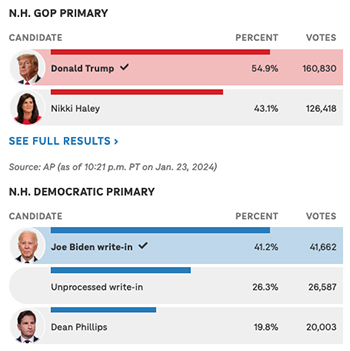
New Hampshire: Trump, Biden Win — Former President Donald Trump successfully won the New Hampshire Republican primary last night and did so by about 12 percentage points, but his performance is apparently not enough to convince former UN Ambassador Nikki Haley to leave the race.

In her concession speech, Haley pledged to continue moving forward and several times referenced going to her home state of South Carolina as a place that could reverse the political tide. Polling, however, suggests that she is not as strong there as she was in New Hampshire.

For the Democrats, President Joe Biden, despite not being on the primary ballot, won the primary with write-in ballots that tallied just over 67 percent of the vote. US Rep. Dean Phillips (D-MN), who said he had no fundamental disagreement with the president over issues but believes Democrats should have a choice particularly with an 81-year old in office, secured just over 20 percent of the vote. Author Marianne Williamson attracted the remaining votes, just under 4 percent.

The New Hampshire primary yielded a record Republican turnout. The final participation count could reach 320,000. The previous record of 284,120 was set in 2016. The final Democratic turnout number will only be in the 100,000 range.

House

NE-1: Gov. Nominee to Challenge Rep. Flood — State Sen. Carol Blood (D-Bellevue), who was the 2022 Democratic gubernatorial nominee and lost to now-Gov. Jim Pillen (R), 59-36 percent, announced that she will now challenge Rep. Mike Flood (R-Norfolk) in the state’s 1st District that surrounds the Omaha metropolitan area on three sides. Flood was elected in a 2022 special election after Rep. Jeff Fortenberry (R) resigned. He won a full term in November with 58 percent of the vote. Blood’s candidacy gives the Democrats a credible challenger in what is considered a safe Republican seat.

Rep. Flood will be favored for re-election. The 1st District carries an R+17 rating from the FiveThirtyEight data organization. Dave’s Redistricting App calculates a partisan lean of 56.7R – 40.4D. The Daily Kos Elections site ranks NE-1 as the 72nd most vulnerable seat in the Republican Conference.

Governor

North Dakota: One In, One Out — After Gov. Doug Burgum (R) on Monday announced that he will not seek a third term, other North Dakota politicos began to make public their own political plans. At-Large US Rep. Kelly Armstrong (R-Bismarck) quickly declared that he will run for governor. Armstrong leaving the House means that 46 seats will be open for the next election.

Conversely, Attorney General Drew Wrigley (R), also viewed as one of the top potential contenders to succeed Gov. Burgum, announced that he will not run for governor, instead opting to seek re-election to his current position. Former state senator and ex-congressional candidate Tom Campbell (R) will also run for governor.

The Republican statewide nominating convention is scheduled for April 6. The ND primary is set for June 11.

States

Louisiana: Redistricting Map Signed Into Law — Meeting the court-ordered requirement to draw a new majority minority seat in Louisiana, Gov. Jeff Landry (R) yesterday signed into law the legislature’s map. The new lines will cost the Republicans one seat, as an African American Democrat will be heavily favored to win a newly drawn 6th District that stretches from Baton Rouge all the way to Shreveport, cutting through the middle of House Speaker Mike Johnson’s (R-Benton) 4th CD.

Current 6th District Rep. Garret Graves (R-Baton Rouge) says he will run for the House, which likely means challenging Rep. Julia Letlow (R-Start) in the state’s newly drawn, and safely Republican, 5th CD. Rep. Graves also says he is considering filing a lawsuit against the new map.