
Tag Archives: Mayor Pete Buttigieg

The “First Four” And The Scramble
For Delegate Apportionment

By Jim Ellis

Sept. 11, 2019 — The YouGov international polling organization conducted four simultaneous surveys in the states whose electorates will cast presidential nominating ballots in February of next year, referred to in the college basketball tournament vernacular as “the First Four”. The quartet of states are Iowa, New Hampshire, Nevada, and South Carolina.

Looking at the polls’ aggregate totals, it appears the contest is already gelling into a three-way race that could meld into a free-for-all should this particular YouGov polling trend translate into actual results.

All of the polling was conducted during the Aug. 28 – Sept. 4 period, and sampled between 492 (New Hampshire) and 785 (South Carolina) likely Democratic primary voters or caucus participants. All four polls found former Vice President Joe Biden, and Sens. Bernie Sanders (I-VT) and Elizabeth Warren (D-MA) occupying the first three positions, but in different orders.

Sen. Kamala Harris (D-CA) and South Bend Mayor Pete Buttigieg placed in the fourth and fifth positions in each entity, again not in the same order in all four states, yet neither reached double-digit percentages in any of the polls. Under this set of data, neither Harris nor Buttigieg would qualify for at-large delegates in any of the First Four states.

To reach the at-large delegate apportionment plateau, a candidate must receive 15 percent of the statewide vote. Candidates can also qualify for individual congressional district delegates, but those projections are not readily available from these polling results.

In Iowa, scheduled for caucus meetings on Feb. 3, Biden begins with a small lead according to the YouGov research. From the 682 individuals surveyed, the former vice president would score 29 percent, with Sanders closely following with 26 percent, and Warren posting 17 percent. Iowa has 41 delegates, and if the congressional district result followed the statewide percentage, Biden would receive 16 delegate votes, Sanders 15, and Warren 10.

Moving to New Hampshire, which will host the first-in-the-nation primary on Feb. 11, 2020, it is Sen. Warren who places first, but the result among the trio is a virtual three-way tie. Warren recorded 27 percent in the YouGov poll, with Biden getting 26 percent, and Sanders 25 percent. Again, assuming New Hampshire’s two congressional districts would vote in the same proportion as the state, each candidate would receive eight delegate votes, equally splitting the state’s 24-person delegation.
Continue reading

Inslee Bows Out of Presidential Race

By Jim Ellis

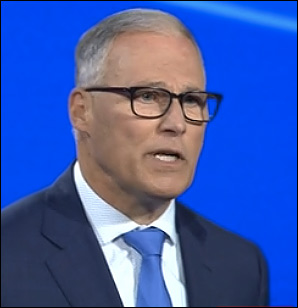
Washington Gov. Jay Inslee (D)

Aug. 23, 2019 — The Democratic National Committee leaders’ strategy to substantially increase the presidential debate qualification requirements in order to decrease the unwieldy and bloated candidate field is working.

The prerequisites to prove that a campaign has more than 130,000 donors and that each candidate reaches a minimum of two percent support from four of eight designated pollsters paid another dividend Wednesday as Washington Gov. Jay Inslee became the third Democratic candidate to officially exit the race.

Not making the debate stage signifies that a candidate has no chance to become a top-tier candidate. Without national exposure, also-ran candidates have little opportunity to increase name identification and familiarity in order to raise enough money to deliver a message, motivate people to work on their campaign, and attract serious media attention both nationally and in the important local markets within key states.

Inslee follows Rep. Eric Swalwell (D-CA) and former Colorado Gov. John Hickenlooper in making the decision to bow out of the race, and there are likely to be several more following suit once it becomes even more evident that the lower-tier candidates will no longer have the opportunity to climb onto the national debate stage.

Gov. Inslee, in an interview on MSNBC’s “The Rachel Maddow Show” Wednesday, stated ” … it’s become clear that I’m not going to be carrying the ball. I’m not going to be the president, so I’m withdrawing tonight from the race.” He is expected to announce that he will seek a third term as Washington’s governor.

The Inslee withdrawal is not a surprise to anyone, apparently even to the candidate himself. He remained non-committal about ruling out running for a third gubernatorial term, which froze most of the Washington Democratic potential aspirants in place. The rhetoric blocked them from overtly assembling a statewide campaign since most correctly interpreted the political tea leaves as meaning that Inslee would, in fact, be back to seek re-election.

With 10 candidates now qualified for the next debate since former HUD Secretary Julian Castro just joined the top-tier candidates of Joe Biden, Bernie Sanders, Elizabeth Warren, Kamala Harris, and Pete Buttigieg who are also joined by Sens. Cory Booker (D-NJ), Amy Klobuchar (D-MN), ex-Rep. Beto O’Rourke (D-TX), and businessman Andrew Yang, it remains to be seen just how many of those who won’t meet the qualifications will continue.

Continue reading

Nevada Looms Large for Biden, Harris

By Jim Ellis

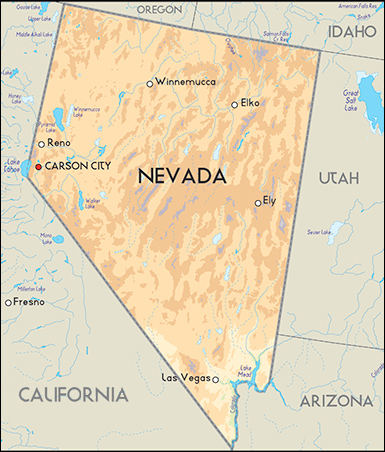
Aug. 22, 2019 — The Nevada Caucus is third on the presidential nomination schedule and it appears the Silver State nomination event will carry more weight than it has in past elections.

After the Iowa Caucus (Feb. 3) and New Hampshire primary (Feb. 11), the candidates will stream into Nevada for the Feb. 22 caucus event that is traditionally held on a Saturday.

Nevada could be critically important for two of the candidates, former Vice President Joe Biden and California Sen. Kamala Harris, should the first two states evolve as currently predicted.

Kicking the cycle off in Iowa, Biden may find himself in a similar position to that of Hillary Clinton in 2016. Coming into the state as the clear front runner, Clinton stumbled in Iowa as she technically won the caucus vote, but only after a series of coin flips were conducted to break ties … and she won them all.

The rules are different in 2020, and it will be easier for more people to participate, but Iowa voters tend to like the Midwestern candidates, something Biden is not. Additionally, with Sen. Sanders proving he has a base in the state and two Midwestern candidates in the field, Minnesota Sen. Amy Klobuchar and South Bend Mayor Pete Buttigieg, the chances of Biden faltering here are actually quite high.

Then the candidates will move to Sens. Bernie Sanders’ (I-VT) and Elizabeth Warren’s (D-MA) New England backyard in New Hampshire. In 2016, Sen. Sanders upended Clinton with a 60 percent victory, so Biden’s ability to derail both Sanders and Warren in this state will prove to be a difficult task. Therefore, it is entirely possible that Biden could move into Nevada in search of a badly needed win.

Sen. Harris has a major advantage in that her home state of California will award 416 first-ballot delegates, a figure 45 percent larger than even the second-largest state, which is Texas. But, in order to maximize this advantage, Sen. Harris will have to be competitive in the First Four states.

Continue reading

The Committed Choices

By Jim Ellis

Aug. 21, 2019 — The Pew Research Center conducted a national poll, of which many Democratic presidential primary questions were asked, but one was particularly interesting.
The survey was taken from a universe of 5,766 panelists who agreed to respond to online Pew polls. For this study, conducted during the July 22 through August 4 period, 4,175 of those individuals did in fact respond, or 72.4 percent of those queried. From this respondent subset, 1,757 individuals who self-identified as Democrats or Democratic-leaning voters were questioned about the presidential primary.

The ballot test was not particularly noteworthy in that the results were mostly in line with other national polls being reported within the same time frame. According to Pew, former Vice President Joe Biden led the group, but with just a 26 percent preference score, followed by Sen. Elizabeth Warren (D-MA) at 16 percent, Sen. Bernie Sanders (I-VT) posting 12 percent, and Sen. Kamala Harris (D-CA) claiming 11 percent support. All others, including South Bend Mayor Pete Buttigieg polled in single digits.

But the most interesting question had to do with the individuals’ committed choices. The group was asked about their enthusiasm toward the candidates and whether they were attracted to only their stated choice or if other Democratic contenders also excited them. This question was asked to gauge strength of support.

The aggregate response showed that 35 percent were only enthused about their candidate of choice, while 63 percent said several of the candidates enthused them. Though he finished a rather distant third on the overall ballot test, it is Sen. Sanders who registers the most committed support.

A majority of the Sanders voters, 51 percent, responded that they are only enthused about his candidacy and feel the same about none of the other Democratic contenders. He is the only candidate to command a such a high committed support percentage.

Biden registered 45 percent who said they are only enthused for him, but 53 percent said others attracted their attention, as well. The candidate who had the least committed support, despite her defined rise in most national polls, was Sen. Warren. Only 19 percent of her voters say they are only committed to her, while 80 percent of her contingent are also enthused by other candidates. Sen. Harris scored slightly better, with 22 percent saying only she enthuses them, while 78 percent of her voters see other candidates they also like.

Continue reading

The September Debate:
Who’s In and Who’s Out

By Jim Ellis

Aug. 16, 2019 — It appears the Democratic National Committee’s move to increase the presidential debate qualifications in order to decrease the number of participants is working.
With the first two debates featuring 20 candidates over a two-night process, party leaders obviously wanted to cull the field in order to attract a large viewership and host a more serious single forum. Thus, the debate qualifications were doubled in order to ensure that only the most competitive candidates would be included in the succeeding candidate events.

Originally, in order to earn a debate podium, the contenders had to recruit 65,000 donors or score at least one percent support within a series of designated polls. For the third debate scheduled over two days — Sept. 12-13 from Houston — the minimum qualification standards were doubled. Now, the candidates must prove they have at least 130,000 donors, 400 of whom come from at least 20 states, and receive two percent support on four of eight designated polls during the period of June 28 and Aug. 28.

At this point, nine candidates have already officially qualified for the September forum and three more have clinched one of the two platforms. Most of the nine were expected to earn their debate positions, but there is at least one major surprise, and some believe two minor ones.

The next debate will feature no fewer than the
following candidates (alphabetically listed):
• Former Vice President Joe Biden
• Sen. Cory Booker (NJ)
• Mayor Pete Buttigieg
• Sen. Kamala Harris (CA)
• Sen. Amy Klobuchar (MN)
• Ex-Rep. Beto O’Rourke (TX)
• Sen. Bernie Sanders (VT)
• Sen. Elizabeth Warren (MA)
• Businessman Andrew Yang

Continue reading

Polling Series: New Pattern Emerges

By Jim Ellis

Aug. 14, 2019 — The HarrisX polling firm just completed conducting three rolling national Democratic presidential primary polls, and while they confirm other data finding former Vice President Joe Biden leading the race, he does so only in the low 30s. This is a number range far below what he needs to win a first-ballot nomination. The data does, however, reveal a new contender consistently placing second.

Sen. Bernie Sanders of Vermont

HarrisX conducted the survey trio from Aug. 7-12 that covered the periods of Aug. 7-10, 8-11, and 9-12. The sample sizes were substantial and almost identical in size, ranging from 1,346-1,350.

The HarrisX findings when compared with other recent polling yield a first-place finish for Biden. The three studies post him to a pair of 30 percent finishes and one 31 percent showing.

But, perhaps the more interesting placement comes in examining who finished second. In contrast with the conclusions of other national polls that show Sen. Elizabeth Warren (D-MA) placing definitively in second place, the HarrisX series finds Sen. Bernie Sanders (I-VT) returning to that position.

The three polls project a consistent Biden-Sanders-Warren finish, with the leader scoring close to a 2:1 margin over his closest rival.

The research trifecta produced the following results:

Aug. 9-12; 1,346 registered or self-identified US Democratic voters
Biden 30%
Sanders 16%
Warren 10%
Harris 6%
Buttigieg 5%
O’Rourke 4%

Continue reading

Biden Rebounding Across the Nation

Former vice president, Joe Biden

By Jim Ellis

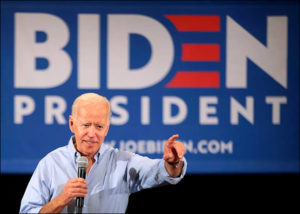
July 25, 2019 — Former Vice President Joe Biden is re-establishing his pre-debate lead in the Democratic presidential race according to a new Morning Consult political survey.

The poll (July 15-21; 17,285 likely Democratic primary voters from an online pool of 5,000 US registered voters), part of a regular ongoing Morning Consult research series, finds Biden registering 33 percent preference. Following with double-digit support are Sens. Bernie Sanders (I-VT), Elizabeth Warren (D-MA), and Kamala Harris (D-CA) at 18-14-13 percent, respectively. South Bend Mayor Pete Buttigieg, who led all of the Democratic candidates in second quarter fundraising with $24 million obtained during the three-month period, posted only five percent support in placing fifth.

Though we see more support for both Warren and Harris than was present in pre-debate polling, the remainder of the field appears to be reverting to their support levels detected prior to the first Democratic presidential forum held in Miami at the end of June.

Results such as those found in this MC study still suggest the pressure is squarely on the former vice president to deliver an improved performance at his next debate scheduled for July 31 from Detroit. While it was clear his support dipped after the last debate, it will now become imperative for him to command the stage in order to re-establish long-lasting confidence from his political base.

The post-debate slippage indicated that much of Biden’s voter base can be described as vacillating, thus identifying a point of weakness. The upcoming national debate will give him the opportunity of cementing his early lead.

With Biden again pitted against Sen. Harris, and this time with Sens. Kirsten Gillibrand (D-NY) and Cory Booker (D-NJ) joining him as part of the 10 candidates appearing on stage, his key opponents make up a formidable presence who will likely seize more than their allotted share of speaking time. Fighting for time could become problematic for Biden, especially if he becomes a joint target as the evening proceeds.

Continue reading