
By Jim Ellis — Tuesday, June 9, 2026
Primaries
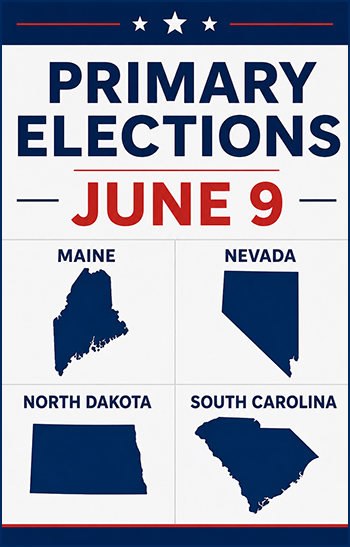 Four states are holding primary elections today – Maine, Nevada, North Dakota, and South Carolina – and each has different ways of managing its votes.
Maine uses a Ranked Choice Voting system, which recent polling suggests could drastically alter the Democratic gubernatorial primary outcome once second- and third-choice preferences are tabulated. North Dakota relies on a strong party endorsement process that often makes the state primary, including today’s, largely a formality.
Nevada employs a straightforward plurality system in which the top vote getter advances regardless of the percentage received. South Carolina, by contrast, requires a runoff if no candidate reaches the 50 percent threshold.
Therefore, in today’s June 9 primary elections, we see nearly every major type of nominating system in use. The only other method, observed last week in California, is the top-two “jungle” primary, in which all candidates, regardless of party preference, appear on a single ballot and the two highest finishers advance to the general election irrespective of the vote percentage attained.
Lively debate often arises in political circles over which nominating system works best. For those who believe it is essential for a party’s nominee to demonstrate majority support, a secondary runoff election is the preferred approach. States such as Alabama and Georgia, which will hold runoffs next week, and South Carolina, which follows on June 23, use this method to ensure the eventual nominee surpasses the 50 percent threshold.
Other states simply rely on a basic plurality system: whoever receives the most votes wins. The drawback, however, is that in a crowded field a candidate can secure a nomination with less than 30 percent support. North Carolina uses a modified approach – its runoff provision is triggered only if no candidate reaches 30 percent. South Dakota and Iowa also hold a secondary process (SD: a runoff; IA: a state party convention) should no candidate receive 35 percent in the primary election.
In addition to North Dakota, several states – most notably Colorado, Michigan, Minnesota, and Utah, with Virginia also having the option of holding a binding nominating convention – conduct important state party endorsement conventions. These gatherings often play a decisive role in shaping the field. Candidates who fail to secure the party’s backing frequently withdraw afterward, and in many cases are expected to step aside if they do not win the delegate vote.
The one procedure that can significantly alter the outcome from the initial vote count is the Ranked Choice Voting system used in Maine. According to a recent Democratic gubernatorial primary poll, it is possible for a candidate who finishes third in the actual vote count to ultimately secure the nomination once all ranked choice votes are distributed.
The poll, conducted by SurveyUSA for the Bangor Daily News and FairVote, the organization that advocates for Ranked Choice Voting, tested both the initial ballot preferences and the subsequent RCV rounds. SurveyUSA (May 28-June 3; 484 likely Democratic primary voters; 466 likely Republican primary voters; multiple sampling techniques) provided a credible model for how the ranked choice tabulation could unfold after the first round vote.
In the Republican gubernatorial primary, the Ranked Choice Voting model closely mirrored the initial ballot test. Former Assistant Secretary of State Bobby Charles placed first among respondents on the ballot test question. Businessman Jonathan Bush, nephew and cousin to Presidents George H. W. and George W. Bush, placed second, followed by former state Senate Majority Leader Garrett Mason, with the remaining candidates trailing well behind.
After three rounds of Ranked Choice Voting, during which voters’ preferences are redistributed as lower finishing candidates are eliminated, the model shows Charles surpassing the 50 percent threshold. Under the RCV rules, reaching a majority in a tabulation secures the nomination.
The Democratic contest presents a very different dynamic, and it is here that critics highlight what they view as a flaw in Ranked Choice Voting. While supporters argue that the system ensures the candidate with the broadest overall backing ultimately prevails, detractors contend that, in practice, it can amplify the influence of the most ideologically extreme voters participating in the primary. They argue that the ranked preferences may elevate a candidate who was not among the top initial vote getters.
When a candidate is eliminated for lack of support, only the voters who ranked that individual first have their subsequent preferences redistributed into the tally. Critics argue that this dynamic can distort the outcome. Opponents of Ranked Choice Voting contend that giving these later round preferences additional weight can allow a small, highly motivated faction to alter the final result to the detriment of the initial top-tier finishers.
In the Maine Democratic example, former Maine Health Department Director Nirav Shah placed first in the initial ballot test, followed by former state Senate President Troy Jackson, ex-state House Speaker Hannah Pingree, businessman Angus King III, and Secretary of State Shenna Bellows.
With no candidate reaching 50 percent, the last-place finisher, in this poll, Secretary of State Shenna Bellows, would be eliminated. Election officials would then identify the ballots on which she was ranked first and redistribute those voters’ next preferences to the remaining candidates. This process continues through successive RCV rounds until one contender attains an adjusted majority.
In the SurveyUSA poll, the Ranked Choice Voting simulation requires four rounds and ultimately elevates the third-place finisher, former state House Speaker Hannah Pingree, daughter of US Rep. Chellie Pingree (D-North Haven/Portland), to the top position, with Dr. Nirav Shah finishing a close second in the adjusted tally.
This example illustrates how a candidate who does not lead in the initial vote count can nonetheless emerge as the nominee once lower ranking preferences are redistributed.
While this is only a poll and not an actual election, the outlined scenario is structurally possible under Maine’s RCV system. We will see how the real results unfold tonight, and in the days ahead, as election officials complete the multi round tabulation that the Ranked Choice Voting system requires.