Three More to Retire From Congress

By Jim Ellis

Sept. 6, 2019 — Yet another Texas Republican House member has decided not to seek re-election next year, but additionally, two representatives from other states, including the second-longest serving member and a 20-year Democratic congresswoman, also made similar announcements late Wednesday.

In Texas, five-term Rep. Bill Flores (R-Bryan) becomes the fifth Lone Star State GOP congressman to voluntarily end his congressional career. Veteran Wisconsin Rep. Jim Sensenbrenner (R-Menomonee Falls), who was first elected in 1978 and is second in seniority only to Alaska Rep. Don Young (R-At-Large), also released a statement saying that he will not seek a 22nd term next year. And 10-term California Rep. Susan Davis (D-San Diego) was the third to delcare retirement. She indicated it is time for her to again live full-time back in the Golden State.

Neither Flores, Sensenbrenner, nor Davis faced difficult re-election campaigns, so electoral politics is certainly not driving these decisions. In his five House victories, Flores averaged 64.8 percent of the vote, including obtaining 62 percent when he ousted veteran incumbent Chet Edwards (D-Waco) back in 2010. Rep. Sensenbrenner posted a 66.5 percent average over the last four elections, while Davis recorded a similar 64.1 percent mean during this decade’s elections.

All three of these districts should remain in the controlling party’s hands. President Trump carried TX-17 with a 56-39 percent margin, though that was down from Mitt Romney’s 60-38 percent victory spread four years earlier. Trump’s victory spread in WI-5 was 57-37 percent, but only 30-64.5 percent in CA-53.

The Central Texas district is home to eight whole counties and parts of four others. The seat has three population anchors, the Waco/McLennan County region, Bryan-College Station, the home of Texas A&M University, and the Pflugerville area of Travis County, just north of Austin. Crawford, Texas, the home site of former President George W. Bush’s ranch, is also found within the district confines and located west of Waco.

Sensenbrenner’s western Milwaukee largely suburban district contains all of Washington and Jefferson Counties, and parts of Waukesha, Milwaukee, Dodge, and Walworth Counties. In addition to what will be 42 years of service in the House at the end of his tenure, Rep. Sensenbrenner also spent four years in the Wisconsin state Senate.

Continue reading

Kennedy Crushing it in Massachusetts Polling

Rep. Joseph Kennedy III (D-)

By Jim Ellis

Sept. 5, 2019 — A just-released Change Research poll of the Massachusetts electorate (Aug. 25-28; 1,008 registered Massachusetts voters; 808 Massachusetts Democratic primary voters, online) conducted for the Commonwealth Magazine finds Rep. Joseph P. Kennedy III (D-Newton) jumping out to a large early lead over Sen. Ed Markey if the two were to face each other in next year’s Democratic primary.

The other two announced candidates, author and corporate executive Steve Pemberton and attorney/activist Shannon Liss-Riordan, were also included on the ballot test.

Change finds Rep. Kennedy topping Sen. Markey by a whopping 17 percentage points, 42-25 percent, including those respondents who say they are “leaning” to one of the candidates. Pemberton and Liss-Riordan are trailing badly with seven and five percent support. Rep. Kennedy has not committed to running but did confirm he is considering doing so and filed a Senate campaign committee with the Federal Election Commission. The filing does not necessarily mean the individual is an official candidate, but the act is a typical first step in running for federal office.

The poll was conducted in an online format, and though the sample size is substantial for a state the size of Massachusetts, particularly in a party primary, the true error factor for this type of study tends to be greater than the stated polling margin of error. In this case, the variance is 3.5 percentage points.

The poll does clearly reveal, or perhaps confirm, legitimate political weakness for Sen. Markey. Originally elected to the US House in 1976, Markey has served in Congress ever since. He won a special US Senate election in 2013 when then-Sen. John Kerry (D-MA) resigned to become US Secretary of State in the Obama Administration. Markey was subsequently elected to a full term in 2014 with a 59-36 percent margin in the general election. He faced no primary opposition in ’14.

Continue reading

Rep. Shimkus to Retire

Illinois Rep. John Shimkus (R-Collinsville)

By Jim Ellis

Sept. 4, 2019 — Twelve-term Illinois Rep. John Shimkus (R-Collinsville), a key member of the House Energy & Commerce Committee, announced over the Labor Day weekend that he will not seek re-election next year, becoming the latest GOP House member to join the increasing line of incumbents voluntarily not returning for the next Congress.

Rep. Shimkus’ retirement makes his IL-15 the 18th open House seat for the next election, including the two September 10th North Carolina special elections. Of this group, Republicans currently hold 14 of the 18 seats, with the vacant NC-9 — one of those currently in special election and the district that featured a disputed 2018 electoral result — previously in the GOP column as well.

Shimkus, in his written statement, said, “[A]s Illinois candidates begin to circulate petitions next week, now is the time for me to announce that I will not be seeking re-election.

“It has been the honor of my lifetime to be asked by the people of Illinois to represent them in our nation’s capital. Each day I have tried to do this as best as I possibly could, and my success lies squarely at the feet of my incredible staff in Illinois and Washington, DC.”

IL-15 is a safe Republican district. President Trump carried the seat, 71-24 percent, in 2016. Four years earlier, Mitt Romney’s margin was 64-34 percent, and John McCain won here 55-43 percent in 2008. Therefore, over the course of time, the 15th has become more Republican. In his four elections in this district configuration, Shimkus has averaged 78.6 percent of the general election vote.

The district is predominantly located in the eastern sector of the state, hugging the Indiana border and traveling due south all the way to Kentucky. It then stretches west to almost the other side of the state in order to annex the Collinsville area, an outer St. Louis metro area community where Shimkus resides.

Continue reading

Ex-Rep. Issa Forms Exploratory Committee For Crowded CA-50

Ex-California US Rep. Darrell Issa

By Jim Ellis

Sept. 3, 2019 — Ex-California US Rep. Darrell Issa, who represented the state’s 49th CD for 18 years, just filed a new congressional exploratory committee with the Federal Election Commission. But he is not looking to run in his former seat. Rather, the exploratory committee is organized to survey his chances of winning the adjacent 50th CD, the district that indicted Rep. Duncan D. Hunter (R-Alpine) currently represents.

This congressional district’s political soap opera continues to unfold. Hunter is facing a trial after the first of next year to defend himself against campaign finance charges, certain ones for which his estranged wife and former campaign manager have already negotiated a plea agreement with the government. And, with the early March 3 state primary scheduled concurrently with the presidential Super Tuesday vote, candidates are already announcing their intentions.

Anticipating that the court case will go against the congressman, five Republicans have announced their candidacies. And, with the trial now postponed until after the first of the year (it was originally scheduled for mid-September) there is a strong chance that Rep. Hunter will file for re-election before the state’s Dec. 6 candidate filing deadline. Should Issa decide to enter the race, then at least seven Republicans will be competing.

So many are coming forward because the 50th is one of the safest Republican seats in California, a state that now has a congressional delegation of 46 Democrats and just seven Republicans. However, quite possibly, and largely due to the state’s jungle primary law, the seat could fall into Democratic hands under a very realistic scenario.

Under California law, similar to the system in Louisiana and Washington, all candidates appear on the primary ballot regardless of political party affiliation. In the California process, the top two finishers in the first election, which is in reality a qualifying election as opposed to a partisan primary, advance to the general election.

Because there will be seven Republicans or more on the ballot and, at this point, just one Democrat — 2018 nominee Ammar Campa-Najjar, who posted 48.3 percent of the vote against Hunter — Campa-Najjar’s chances of advancing to the general election are quite favorable.

Continue reading

Succeeding Georgia’s Sen. Isakson

By Jim Ellis

Georgia Sen. Johnny Isakson (R)

Aug. 30, 2019 — Georgia Sen. Johnny Isakson (R), first elected to the Senate in 2004 after spending six years in the US House and 18 years in the Georgia legislature, announced Wednesday that he will resign his seat at year’s end due to serious health problems.

The news stories have reported the details surrounding Isakson’s departure and his health status, but the succession situation will be the concentration of this update. The development means that both of Georgia’s Senate positions will be on the ballot in 2020. The two will run only semi-concurrently, however.

The first step is for Gov. Brian Kemp (R) to appoint a replacement for Sen. Isakson. The governor will install an interim senator to serve from Jan. 1 until the appointed individual or another is elected. It is believed that the governor will name his choice quickly so that the person will have a transition time to work with Isakson and his staff before assuming the office.

While Sen. David Perdue stands for a second term in the regular cycle, meaning a May 19, 2020 primary followed by a July 21 run-off if no candidate secures majority support in the initial vote, the special election will follow a different format and slightly altered schedule.

The regular general election is, of course, Nov. 3, 2020, but Georgia is also one of the few states that holds a post-election run-off in case no one receives majority support. That run-off will be held Jan. 5, 2021, but it is unlikely that the Perdue race would advance through to such a process regardless of who wins the November vote.

The Isakson seat, however, will not follow the same calendar or system. Since this is a special election called to fill the balance of the current term, which will last until the beginning of 2023, a jungle primary is to be held concurrently with the November election, and the top two individuals, regardless of political party affiliation, will advance to the Jan. 5 run-off if no one receives a majority vote in the first election. For this seat, the odds of seeing a run-off election intensify because a crowded field is expected, thus making it more difficult for any one individual to secure majority support.

One person who will not be competing is former Democratic gubernatorial nominee Stacey Abrams, the former state House Minority Leader. Abrams indicated that she will not be a Senate candidate in either seat next year, preferring to remain focused in her role of working with voter registration and turnout organizations.

Continue reading

Lt. Gov. Reeves Advances in Mississippi

By Jim Ellis

Mississippi Lt. Gov. Tate Reeves (R)

Aug. 29, 2019 — As expected, Mississippi Lt. Gov. Tate Reeves won Tuesday’s Republican gubernatorial run-off election, defeating former state Supreme Court judge Bill Waller Jr. by a 54-46 percent count. During the Aug. 6 primary, Reeves captured 49 percent of the vote, just one point shy of being nominated outright in the first election.

Lt. Gov. Reeves had the Republican establishment behind him, including public support from term-limited Gov. Phil Bryant and former governor and ex-Republican National Committee chairman Haley Barbour. Additionally, both he and Waller attempted to be viewed as the most conservative candidate in the race and ran as strong supporters of President Trump.

Therefore, a 54-46 percent win appears to be a slight under-performance, particularly when the drop-off turnout rate when compared to the primary election was only 15.3 percent. Tuesday’s turnout reached 324,353 voters, meaning that 58,727 fewer people cast ballots when compared to the early August Republican primary, which is a relatively small number.

Reeves now advances into the Nov. 5 general election where he will face the Democratic nominee, Attorney General Jim Hood. Hood has been commonly referred to as the “most successful Democrat in the South” because he has won four consecutive statewide elections in Mississippi. He was easily nominated in this year’s original gubernatorial primary, winning 69 percent of the vote against seven opponents, but the total vote in the Democratic primary was less – 21,963 votes less — than even last night’s Republican run-off.

The lieutenant governor carried 65 of Mississippi’s 82 counties against Judge Waller, though five of the locality results denoted a winner garnering less than 51 percent of the vote. In one county, Quitman, Reeves’ victory margin was just one vote.

In what could be a rather ominous sign for the general election, Reeves did poorly in and around the state’s capital and largest city, Jackson, its county (Hinds) and the two suburban entities bordering it, Madison and Rankin counties. He lost all three of these counties, though the aggregate vote totals in Hinds were low.

Continue reading

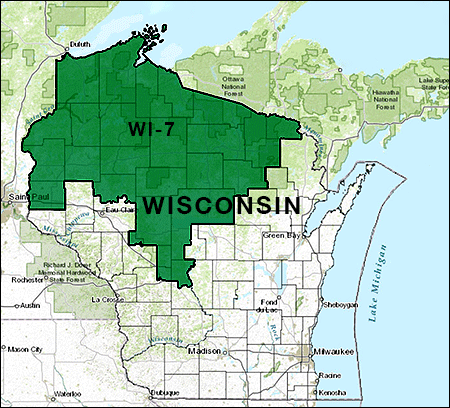
Wisconsin Rep. Sean Duffy to Resign

Wisconsin’s US 7th Congressional District

By Jim Ellis

Aug. 28, 2019 — Five-term Wisconsin Rep. Sean Duffy (R-Wausau) announced Monday that he is resigning from Congress effective Sept. 23. Rep. Duffy indicated his reason for leaving mid-term is that his wife and his expectant child, their ninth, has already been diagnosed with challenging health issues.

Therefore, his 7th Congressional District will go to special election once Gov. Tony Evers (D) sets the schedule. The congressional vote will likely coincide with the state’s spring election, where statewide and district judges are on the ballot and many localities use the dates to hold their own elections. The Wisconsin calendar pinpoints the Spring Primary for Feb. 18, 2020, while the Spring General election will run concurrently with the Wisconsin presidential primary on April 7.

The Badger State’s 7th CD occupies a full quarter of the state’s land area, beginning on the shores of Lake Superior and stretching to Buckhorn State Park close to Wisconsin’s center. The district covers a large land mass and is populated with small towns spread throughout the 26 counties that it covers or touches. WI-7 contains 21 whole counties and parts of five others. Its largest city, Wausau, which is Congressman Duffy’s hometown, has just under 40,000 people.

The district’s electorate now votes solidly Republican but, before Rep. Duffy was elected in 2010, this seat remained in Democratic hands for 41 consecutive years in the person of former Rep. David Obey (D) who first won in a 1969 special election and retired in the 2010 cycle. The district’s pre-Obey history, however, was solidly Republican. A member of the GOP had represented the seat for 82 of its first 96 years of existence.

Since the Duffy resignation was unexpected, no potential successors are being discussed, but that situation will quickly change.

Continue reading