Category Archives: Senate

Pete Buttigieg Leads in Michigan Democratic Primary Senate Poll

By Jim Ellis — Wednesday, Feb. 12, 2025

Senate

Former US Transportation Secretary Pete Buttigieg / Photo by Matt Johnson

A new Michigan Democratic primary poll suggests that former US Transportation Secretary Pete Buttigieg is the man to beat for the party nomination to succeed retiring Sen. Gary Peters (D).

The Blueprint Polling firm tested a likely Michigan Democratic voting segment (Jan. 30-Feb. 2; 536 likely Michigan Democratic primary voters; SMS text) and sees Buttigieg topping Attorney General Dana Nessel 40-16 percent in a hypothetical 2026 primary poll. Reps. Haley Stevens (D-Birmingham), Hillary Scholten (D-Grand Rapids), and state Sen. Mallory McMorrow (D-Royal Oak Township) all trail “in low single digits,” according to the Blueprint analysis.

Sen. McMorrow is the only individual who has formally announced for the Senate from either party, but the aforementioned have all confirmed they are considering entering the race. Lt. Gov. Garlin Gilcrest (D) was included in this poll but last week announced that he will not run for the Senate. He is projected as virtually certain to enter the open Governor’s contest.

Buttigieg has the highest name identification and favorability index of the tested potential contenders within this Democratic sampling universe. He posts 88 percent name recognition with a 77:12 favorable to unfavorable split. Attorney General Nessel is close behind with an 82 percent name recognition score and a similar 72:10 positive index. A total of 56 percent questioned could identify Lt. Gov. Gilcrest, and 45 percent responded with a favorable impression. The remaining potential candidates all had low statewide name ID.

Buttigieg does particularly well with white Democrats (47-16 percent over Nessel), the highly educated (47-15 percent versus Nessel), liberals (47-18 percent against Nessel), and non-union workers (44-14 percent opposite Nessel). The former Transportation Secretary fared poorly with blacks, however, trailing both Nessel and Gilcrest (22-19-16 percent).

Sen. McMorrow and the two Representatives, should either or both enter the statewide race, would have a long way to go in becoming competitive for the nomination. Tested against AG Nessel, Rep. Stevens would even lose her own 11th Congressional District by 15 percentage points, while Rep. Scholten would lead Nessel 28-21 percent in her 3rd CD but trails badly elsewhere. Sen. McMorrow lags seven points behind AG Nessel among those who know and have an opinion of both women.

According to the Blueprint analysis scenarios, Buttigieg would be in an enviable position for the Democratic Party nomination should he become a Senate candidate. The pollsters conclude, “Pete Buttigieg is the overwhelming front-runner. He struggles with Black voters and nearly a third of the electorate remains undecided, but his strength with educated voters and white liberals makes him the odds-on favorite to win the nomination.”

The Blueprint pollsters did not test any of the Democratic candidates against prospective Republican candidates such as former Congressman Mike Rogers, who came within 19,006 votes of winning the state’s other Senate seat in the 2024 election.

With Buttigieg faring poorly with black voters and considering that now-Sen. Elissa Slotkin (D) is more popular than the former Transportation Secretary with the general electorate, it appears Rogers would be in strong position should he mount another attempt in the coming midterm election.

Previously, Republicans as a whole tended to fare better in midterm elections when compared to their presidential year performance, but considering the changing dynamics within the Michigan and national electorates such may no longer be the case. It does appear that the country is entering a realignment phase, but it will take at least two more elections to see if such change becomes a trend or is merely an anomaly found only in 2024.

Irrespective of who becomes the eventual Michigan US Senate nominees, the open Wolverine State race will be one of the top targets for both national parties.
Mississippi’s Sen. Hyde-Smith Favored for Re-Election; DSSC & Primaries; Fine Likely to Replace Waltz in Fla.; A GA-9 Challenge; Conn., NM Governor News

By Jim Ellis — Monday, Feb. 3, 2025

Senate

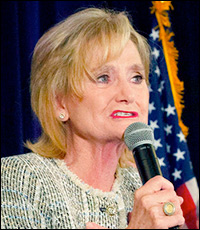
Mississippi Sen. Cindy Hyde-Smith (R)

Mississippi — Ty Pinkins, the 2024 Senate nominee against Sen. Roger Wicker (R) who received 37.2 percent of the vote, says he will challenge Sen. Cindy Hyde-Smith (R) in 2026. Sen. Hyde-Smith was appointed to the chamber when Sen. Thad Cochran (R) resigned due to health issues. She then defeated former US Agriculture Secretary and ex-Congressman Mike Espy (D) in the 2018 special election, and won a full term, again against Espy, in 2020 with a 54-44 percent vote spread. The Senator has announced for a second full term next year and will be the favorite to win re-election.

DSCC — At a fundraising event late this week, new Democratic Senatorial Campaign Committee chair Kirsten Gillibrand (D-NY) broadly hinted that the organization would not back away from getting involved in primaries. She made specific references to targeted contests in Maine, Michigan, and North Carolina. Democrats expect to mount strong challenges against Sens. Susan Collins (R-ME) and Thom Tillis (R-NC), in addition to campaigning to hold their newly open Michigan seat.

House

Florida State Sen. Randy Fine (R-Melbourne)

FL-6 — Though not residing in Florida’s vacant 6th District, state Sen. Randy Fine (R-Melbourne) topped two GOP opponents with 83 percent support to win the special Republican primary to replace resigned Rep. Mike Waltz (R-St. Augustine Beach). Waltz left the House to become President Trump’s National Security Advisor.

Sen. Fine, like Jimmy Patronis in the open 1st District, had the support of President Trump and Sen. Rick Scott. The FiveThirtyEight data organization rates the 6th District as R+28, so Sen. Fine becomes a definitive favorite to claim the seat in the April 1 special general election.

CO-8 — Freshman Rep. Gabe Evans (R-Ft. Lupton/Westminster) has already drawn a Democratic opponent in what will be another very competitive congressional race in northern Colorado’s 8th District. The Colorado Independent Redistricting Commission members drew this CD to be contested in every election, and so far it has performed as designed. Democrat Yadira Caraveo represented the seat in its initial term, only to fall to Evans in the 2024 election.

State Rep. Manny Rutinel (D-Commerce City) announced this week that he will enter the 2026 congressional race thus attempting to limit Rep. Evans to a one-term career. This contest will be a top target 2026 campaign.

GA-9 — Three-term US Rep. Andrew Clyde (R-Athens) has drawn a significant primary challenger. Gainesville Mayor Sam Couvillion announced that he will challenge Rep. Clyde in the 2026 Republican primary.

Clyde, a Freedom Caucus member and one of the more conservative Representatives, has fared well in nomination contests. In his first run back in 2020, Clyde won a GOP runoff with 56 percent of the vote. He defeated four Republicans in 2022 with just over 74 percent and was unopposed for renomination in 2024. The Congressman will remain a heavy favorite for renomination in 2026.

Governor

Connecticut — New Britain Mayor Erin Stewart (R) has filed a 2026 gubernatorial campaign committee. She promises to make a formal announcement by the end of this month, but it is a virtual certainty that she will run. Gov. Ned Lamont (D), who is eligible to run for a third term, says he will make a decision about 2026 after the legislative session ends in June.

New Mexico — Sen. Martin Heinrich (D), just re-elected in November, says he will not run for Governor in 2026. The Heinrich decision makes former Interior Secretary and ex-Rep. Deb Haaland the undisputed front-runner for the Democratic gubernatorial nomination. Haaland is making moves toward entering the race but has not yet officially announced her candidacy.

Virginia: The co/efficient data group released their latest Virginia poll (Jan. 18-20; 867 likely 2025 Virginia general election voters; live interview & text) and again finds a toss-up open 2025 gubernatorial race between Democratic former Congresswoman Abigail Spanberger and Republican Lt. Gov. Winsome Earle-Sears. Both appear to be presumptive nominees of their party at this early point in the election cycle. According to the co/efficient data, Spanberger and Earle-Sears would each command 40 percent support.

Virginia Poll Projects Sen. Warner Leading over Gov. Youngkin

By Jim Ellis — Thursday, Jan. 30, 2025

Senate

Sen. Mark Warner (D) | Gov. Glenn Youngkin (R)

A recent 2026 political survey projects Sen. Mark Warner (D) posting a seven-point lead over Gov. Glenn Youngkin (R) in a hypothetical Senate race poll, but methodological flaws are apparent.

The L. Douglas Wilder School of Government and Public Affairs at Virginia Commonwealth University conducted the survey, but the sampling period consumed almost a month (Dec. 18, 2024 – Jan. 15, 2025), and the sampling universe was comprised of 806 adults over the age of 18. The sampling period’s length reduces the accuracy figure and not segmenting the ample respondent universe into registered and/or likely voters further skews the data.

The methodology notwithstanding, Sen. Warner would lead Gov. Youngkin 45-38 percent on the ballot test according to VCU, but the Republican leads among Independents 37-16 percent. This suggests that Sen. Warner’s support among Democrats is greater than Gov. Youngkin’s backing among Republicans, but even these numbers are not supported in other similar surveys as detected for the open 2025 Governor’s race.

Furthermore, an incumbent Senator only commanding 16 percent of the Independent voting segment is abnormally low, and likely another reason to question the overall reliability of this VCU survey.

It is also important to note that neither Sen. Warner nor Gov. Youngkin have announced their 2026 Senate candidacy. It is presumed that Sen. Warner will seek a fourth term, but no formal announcement has been made to date. Speculation has been relatively heavy about Youngkin running for the Senate, but the Governor has yet to acknowledge interest in such a race. He is also rumored to be looking toward a 2028 presidential run, and if so, challenging Sen. Warner will not likely be his next political move.

The VCU pollsters also tested the open 2025 Governor’s campaign and find former Congresswoman Abigail Spanberger, at this point the consensus Democratic presumptive nominee, and Lt. Gov. Winsome Earle-Sears, the presumptive Republican nominee posting similar partisan numbers as found in the Senate race.

According to the VCU results, Spanberger would lead the Lieutenant Governor, 44-34 percent. It is here where we can draw a direct comparison with other recent surveys. For example, three other polls conducted during the period beginning Jan. 6-20 reveal much different results.

The most recent survey, from the co/efficient polling firm (Jan. 18-20; 867 likely Virginia voters; live interview & text), sees the two gubernatorial candidates tied at 40 percent apiece.

Christopher Newport University tested the Virginia electorate over the Jan. 6-13 period (806 registered Virginia voters; live interview) and found Spanberger recording a five percentage point advantage, 44-39 percent.

Earlier, Emerson College surveyed the Commonwealth just after the first of the year (Jan. 6-8; 1,000 registered Virginia voters; multiple sampling techniques) and they arrived at a ballot test conclusion similar to co/efficient’s results, with Spanberger edging Earle-Sears, 42-41 percent.

Therefore, the VCU survey conducted of adults and not registered or likely voters, seems to be an outlier because three other polls conducted within the same sampling period with more refined respondent universes project much closer results.

Whether a Warner-Youngkin Senate race materializes remains to be seen. If the contest does form, we can count on seeing a much closer contest than the VCU poll suggests, and one that would likely go down to the wire. The current prevailing wisdom among Virginia politicos, however, is that such a challenge campaign is unlikely to form.

The more likely Senate scenario sees Sen. Warner seeking a fourth term and easily winning re-election without facing a major Republican opponent.

Michigan Sen. Gary Peters to Retire; Florida Special Election Results

By Jim Ellis — Wednesday, Jan. 29, 2025

Michigan

Michigan Sen. Gary Peters (D)

Saying, “I always thought there would be a time that I would step aside and pass the reins for the next generation,” Michigan Sen. Gary Peters (D) announced yesterday that he will not seek re-election to a fourth term next year. This is the first surprise political decision of the new political cycle.

The move is reminiscent of the 2024 election cycle, when another Michigan Senator, Debbie Stabenow (D), became the first incumbent to announce that she would retire. Sen. Peters, 66, also said that he “…never saw service in Congress as something you do your whole life.” The Senator’s comments suggest that he would venture into another type of livelihood potentially in the private sector.

The Peters retirement makes Michigan the political hotbed of the early 2026 election cycle. Not only will we see a competitive open Senate race here, as was the case in 2024, but the open Governor’s contest could feature a wild three-way political battle largely because Detroit Mayor Mike Duggan announced his candidacy as an Independent.

The Duggan entry enhances Republican prospects to win the Governor’s race because their nominee could take advantage of a split in the Democratic coalition, thus allowing the GOP candidate to win with plurality support. Until the coming election, Duggan had been a Democrat and is, of course, known as such in the state’s largest city where he has won three at-large elections.

Hosting two major competitive statewide races will certainly change the Michigan political landscape since many officeholders from both parties could enter each of these campaigns. In addition to Duggan entering the Governor’s race, Secretary of State Jocelyn Benson (D) last week declared for the Democratic Party nomination.

Turning to the Republicans, former state Attorney General Mike Cox has been making serious moves to enter the Governor’s race but has yet to formally announce his intentions.

Now, we can expect other statewide officials and US House members to be assessing their chances for what will be two major statewide campaigns with national implications. Watch for Democratic Lt. Gov. Garlin Gilcrest to make a move for one of the two slots, probably Governor. Attorney General Dana Nessel (D) is another who could be well positioned to make a move toward running for Governor or now Senate.

Within the Democratic congressional delegation, look for Reps. Haley Stevens (D-Birmingham), Shri Thanedar (D-Detroit) and possibly Hillary Scholten (D-Grand Rapids) to test the statewide political waters. Early reports suggest that former Transportation Secretary and 2020 presidential candidate Pete Buttigieg is also beginning to study his potential of competing in an open Michigan Senate contest.

On the Republican side, former Congressman Mike Rogers, who lost the 2024 Senate election by just three-tenths of one percentage point must be considered at the top of the 2026 Senate prospect lists. Rep. John James (R-Farmington Hills), who lost to Sen. Peters in 2020 with a small 49.9 – 48.2 percent vote margin and is already being discussed as a possible gubernatorial candidate, is likely to again consider running statewide. Rep. Bill Huizenga (R-Holland) is another GOP House member who will probably analyze his prospects for one of the statewide races.

Sen. Peters began his elected office career by winning a seat on the Rochester Hills City Council in 1991. He was then elected to the state Senate and US House before winning the US Senate seat in 2014, succeeding 36-year veteran Sen. Carl Levin (D) who chose not to seek a seventh term.

Florida Special Election Results

As expected, Florida CFO Jimmy Patronis, bearing endorsements from President Trump and Sen. Rick Scott (R-FL), easily won the 1st District special Republican primary, which is the first step toward replacing resigned Rep. Matt Gaetz (R). Patronis captured 66 percent of the vote against nine Republican opponents. He now becomes the prohibitive favorite to defeat the Democratic nominee, Gay Valimont.

In the Atlantic coastal 6th CD, also as expected, state Sen. Randy Fine (R-Melbourne) was an overwhelming winner in this special Republican primary election. Like Patronis, Sen. Fine had the public support of President Trump and Sen. Scott, among many other GOP leaders. He topped the field of two opponents with an 83 percent vote total. Sen. Fine is now a heavy favorite to win the special general election.

Both the 1st and 6th District special general elections are scheduled for April 1.

South Carolina Sen. Graham’s
Budding Primary Challenge

By Jim Ellis — Wednesday, Jan. 22, 2025

Senate

South Carolina Sen. Lindsey Graham / Photo by Gage Skidmore

Several Republican Senators are already seeing potential GOP primary opponents beginning to make moves to launch their 2026 challenge campaigns.

One such potential primary is developing in South Carolina. Sen. Lindsey Graham said this week that he will seek re-election for a fifth term next year. Concurrently, Rep. Ralph Norman (R-Rock Hill) continues to make public statements confirming that he is testing the political waters for a primary challenge against Sen. Graham.

Rep. Nancy Mace (R-Charleston), who previously ran unsuccessfully against Sen. Graham in 2014, is also says she is considering making another bid but has recently been less vociferous about making such a move.

Rep. Norman was initially elected to his 5th Congressional District position in a 2017 special election to replace then-Rep. Mick Mulvaney (R) who resigned to join the first Trump Administration. Prior to serving in federal office, Norman was elected to six non-consecutive terms in the South Carolina House of Representatives. He unsuccessfully ran for Congress in 2006.

Congressman Norman has averaged 61.1 percent of the vote in his four regular election campaigns after winning the initial special election with just 51 percent. The result was considered an underperformance in a seat that the FiveThirtyEight data organization now rates as R+15, and The Down Ballot data organization ranks as the 90th safest seat in the House Republican Conference.

For his part, Sen. Graham has averaged 62 percent of the vote in his last two Republican primaries (2020 and 2014). In the 2020 general election, despite having an opponent, now current but outgoing Democratic National Committee chairman Jaime Harrison, raise over $132 million against him, or $20 million more than Graham commanded, the Senator won the election by just over ten percentage points in what became a national campaign. Therefore, denying the Senator renomination or re-election in 2026 will be no easy feat.

While Rep. Norman confirmed his interest in a Senate challenge this week he did not commit to running. The Congressman previously stated he also had a potential interest in entering the open race for Governor but is no longer making any comments about this move. While Sen. Graham has over $15.6 million cash-on-hand in his year-end campaign finance report, Rep. Norman ended the 2024 campaign cycle with $601,000 in the bank, approximately $15 million behind the Senator.

Norman has been a strong supporter of President-Elect Donald Trump throughout the latter’s political career and would likely be work for an endorsement if he were to run for the Senate. Sen. Graham, while originally an opponent of Trump in the 2016 Republican presidential primary, has since become one of his stronger supporters in the Senate.

Therefore, it is not out of the realm of possibility that the President would potentially support Graham, or simply stay out of the race. Defeating a Republican incumbent in a primary without a Trump endorsement has proven a very difficult task for GOP intraparty challengers around the country.

Sen. Graham is certainly not the only Republican Senator who may face a primary. Sen. Bill Cassidy (R-LA) will engage in a campaign opposite State Treasurer and former Congressman John Fleming, while simultaneously Sen. John Cornyn (R-TX) may see his state’s Attorney General, Ken Paxton, launch his own campaign.

Talk continues that Sens. Susan Collins (R-ME) and Joni Ernst (R-IA) may also be challenged for renomination, but nothing concrete has yet developed in their states. In Florida, Rep. Cory Mills (R-New Smyrna Beach) says he will oppose whomever Gov. Ron DeSantis appoints to replace Sen. Marco Rubio upon the latter’s confirmation as Secretary of State.

Though we may see a legitimate Republican primary battle evolve in South Carolina next year, Sen. Graham must be rated as the favorite to prevail against any and all GOP opponents. In a strongly conservative state such as South Carolina, the Republican primary is likely the main political battlefield. Whoever earns the GOP nomination will be the prohibitive favorite to hold the seat in November 2026.

Ohio’s Husted Appointed to Senate

By Jim Ellis — Tuesday, Jan. 21, 2025

Senate

Ohio Lt. Gov. Jon Husted (R) / FoxNews photo

On Friday, Gov. Mike DeWine (R-OH) made his long-awaited announcement as to who will replace Vice President J.D. Vance in the US Senate. The Governor chose Ohio Lt. Gov. Jon Husted (R).

Vance resigned his Senate seat on Jan. 10, but DeWine waited until the 17th to make the appointment announcement, yet it was apparent from the start that his first choice was Husted. The question became whether the Lieutenant Governor would accept the appointment.

Husted has been preparing a run for Governor for more than seven years dating back to his time as Ohio’s Secretary of State. In 2018, Husted ran for Governor along with then-Attorney General DeWine and then-Lt. Gov. Mary Taylor.

The three-way Republican nomination race looked close as the candidates headed to the May primary. It appeared that Taylor had a chance to win by moving to the right of both DeWine and Husted, thus making them split the centrist/moderate Republican vote and allowing her to claim victory with plurality support.

Seeing this scenario as a real possibility, Husted went to DeWine suggesting a deal. He would agree to drop out of the Governor’s race and endorse DeWine if the latter would endorse Husted for Lieutenant Governor and the two would run as a team. DeWine accepted and both men would go onto claim the party nomination for their respective offices and then successfully win two succeeding general elections.

As part of the plan, Husted would run for Governor when DeWine served his legally allowed two terms, meaning the Lieutenant Governor would seek the state’s top position in 2026. As Gov. DeWine mentioned in the appointment video, he and the new Senator-Designate have been very close during their time in office and truly operated as a team, just as Husted suggested when offering DeWine the 2018 deal.

The Vance election as Vice President changed the paradigm as did the emergence of Attorney General Dave Yost, who has also already been campaigning for the Republican gubernatorial nomination. Before the Vance national election, it appeared the two, Husted and Yost, were headed toward a very rough 2026 GOP gubernatorial primary battle.

The Senate seat opening changed the situation since appointing one of the two would avoid a potentially bloody primary. Both men, however, indicated they wanted to remain in the Governor’s race. The delay in announcing the appointment was sending signals that DeWine was having trouble convincing Husted to accept the Senate seat but if such were the case, the situation has now been obviously solved.

The downside to the Senate appointment is that whoever was granted the position would have to run to fill the balance of the term in 2026, and then again in 2028 for a full six-year stint. This would mean continual fundraising over a four-year period in a large state that will feature expensive campaigns requiring spending in several expensive media markets.

Additionally, the Democrats will make a major play for the seat especially in 2026, and possibly in the person of former Sen. Sherrod Brown (D) who just lost in November but is claiming his career in elective politics has not drawn to a conclusion. In the 2024 election cycle, Brown attracted a whopping $103 million for his unsuccessful re-election bid and while losing still he proved eminently effective on the fundraising circuit. Ex-Sen. Brown attempting a comeback would mean that Husted would face a major opponent in the ’26 general election.

The appointment, however, may not yet have avoided a messy primary. Over the weekend, Gov. DeWine held a meeting with former presidential candidate and Ohio resident Vivek Ramaswamy, ostensibly about the Senate appointment.

Post-meeting and the Husted announcement, it is being reported that Ramaswamy will not continue with the Trump Administration and has exited his position as co-chair of the Department of Government Efficiency (DOGE). Ramaswamy, instead, is reported to be mulling a run for Governor.

If so, then AG Yost will not have a free ride in the Governor’s race and again be in the situation of facing a major Republican opponent who, in this case, has virtually unlimited personal funds.

Husted will now be sworn into the Senate, along with Florida Attorney General Ashley Moody (R) who will take the Florida Senate seat of Marco Rubio. Last night, Rubio was confirmed as President Trump’s Secretary of State.

Regardless of which candidates ultimately decide to run for what Ohio office, the Buckeye State promises to feature some of the hottest campaigns in the upcoming national election cycle.

DeSantis Appoints Ashley Moody

By Jim Ellis — Friday, Jan. 17, 2025

Senate

Florida Attorney General Ashley Moody

With Sen. Marco Rubio’s (R) confirmation as US Secretary of State virtually assured, Florida Gov. Ron DeSantis made his announcement yesterday as to who will succeed the Senator when he officially resigns.

As expected, based upon recent predictions, Gov. DeSantis selected state Attorney General Ashley Moody (R) to assume the Senate seat once the position officially becomes vacant. President-Elect Donald Trump will nominate his cabinet choices once he is sworn into office; when certain confirmation hearings are completed, we can expect the Senate to take swift action regarding key confirmation votes.

Sen. Rubio is expected to sail through the process, since he is a well known figure to all Senators. Once he is officially confirmed, the new Secretary of State will resign the Senate seat and Moody will likely be on hand to take the oath of office for her new position. This would mean no lapse in Florida Senate representation.

The same cannot be said for the similar situation in Ohio. Vice President-Elect J.D. Vance resigned from the Senate on Jan. 10, but Gov. Mike DeWine has yet to name a replacement.

It’s possible that the Governor is having trouble filling the seat. Lt. Gov. Jon Husted appears to be his first choice, but stories continue to surface indicating that Husted wants to remain in Ohio to fight in a tough open 2026 Republican gubernatorial primary.

A story appeared midweek that former presidential candidate Vivek Ramaswamy met with the Governor last weekend to discuss the Senate position. This is a surprising development, since Ramaswamy, citing his position as co-director of President-Elect Trump’s Department of Government Efficiency (DOGE), withdrew his name from Senate consideration weeks ago.

Though the chosen individual will literally be handed a Senate seat, the long-term path is not without challenges. Former Sen. Sherrod Brown (D), who new Sen. Bernie Moreno (R) unseated in November, says he is not done with public service and is viewed as a possible 2026 contender vying for the right to serve the balance of the current term.

Brown raised a whopping $103 million for his losing 2024 effort. Considering his long record in Ohio politics, any appointed Senator would be forced to conduct an expensive major campaign versus a very formidable opponent.

Even if successful in 2026, the new Senator would again face the voters in 2028 when this particular seat next comes in-cycle. Therefore, whomever is chosen can expect to be in full campaign mode for a four-year period.

Attorney General Moody is close to Gov. DeSantis and has twice proven she can win a Florida statewide election. In 2018, Moody, a former circuit judge, was elected Attorney General with 52.1 percent of the general election vote. In 2022, she increased her vote share to 60.6 percent. As was explained regarding the eventual new Ohio Senator, Moody will run to fill the balance of her new term in 2026, and then have the opportunity of campaigning for a full six-year term in 2028.

Additionally, Moody will apparently face significant opposition in the next Republican primary. Rep. Cory Mills (R-New Smyrna Beach) said earlier in the week that he will enter the Senate primary regardless of whomever Gov. DeSantis appoints.

The current spate of Florida political musical chairs is allowing Gov. DeSantis, who cannot seek a third term in 2026, to continue shaping a large segment of his state’s future government. Not only did he pick Moody for the Senate, but he will now be able to choose a replacement Attorney General.

Furthermore, with former Rep. Matt Gaetz (R) leaving his 1st District seat, current Florida CFO Jimmy Petronis (R) entered the special election field and is widely viewed as the favorite. Under Florida state law, any officeholder running for a different position must resign his current post.

Since the 1st District special election is scheduled for April 1, Petronis announced that he will leave his current position on March 31. Regardless if Petronis wins or loses the congressional seat, the statewide CFO position will be open at the beginning of April, and Gov. DeSantis will then have the opportunity of filling that position, as well.

Looking ahead, the state of Florida will experience a period of significant political change over the course of the next two years, and Gov. DeSantis will have the power to choose his allies to lead the state long after he leaves office.