Category Archives: Senate

In Michigan, Peters Is In

Rep. Gary Peters' (D-MI-14)

Rep. Gary Peters (D-MI-14)

Rep. Gary Peters’ (D-MI-14) anticipated run for the Senate became reality yesterday as the Detroit congressman officially unveiled his statewide campaign. It has been a foregone conclusion that Peters would run since early March when veteran Sen. Carl Levin (D) publicly indicated that he would not seek re-election in 2014.

Peters is serving his third term in the House, originally winning in 2008 when he defeated Joe Knollenberg in an Oakland County seat. Prior to that, he served as the Michigan lottery commissioner, and as a state senator. Now that Debbie Dingell, wife of Rep. John Dingell (D-MI-12), will not become a candidate Peters has a strong chance of quickly evolving into the consensus Democratic nominee long before voters go to the polls in the August 2014 Democratic primary.

The congressman is a strong behind-the-scenes politician. Drawing the short straw in 2011 redistricting, as his seat was collapsed into veteran Rep. Sander Levin’s (D-MI-9) because the reapportionment formula reduced the size of the Michigan congressional delegation, Peters decided to attempt a run at the majority minority African-American seat in Detroit rather than take on a member of the Levin family. Sander Levin is the senator’s older brother. It was long believed that the trio made a political deal: Peters would refrain from  Continue reading >

Markey Wins; Now Faces Investor Gomez

As projected, Rep. Ed Markey (D-MA-5) defeated his House Democratic colleague, Rep. Stephen Lynch (D-MA-8), in last night’s special US Senate party primary election. Markey racked up an expected 57-43 percent margin over Lynch, with a turnout of more than 530,000 Democratic voters. All of the candidates are vying for Secretary of State John Kerry’s Senate seat, now held by interim Sen. Mo Cowan (D).

Both men racked up strong percentages in the congressional districts they represent; Markey in the 5th District north and west of Boston, and Lynch in the 8th CD anchored in the area south of Massachusetts’ capital city including the towns of Quincy, Brockton, and Fall River. Lynch also carried the central region of the state nestled in between the cities of Worcester and Springfield, as well as the area around the city of Lowell and the New Hampshire border territory. Markey was strong in virtually other part of the state, thus accounting for his lopsided victory.

When all of the expenditures are totaled, Markey will have exceeded the $5 million mark in spending; Lynch a little over $2 million.

On the Republican side, private equity investor and former US Navy veteran Gabriel Gomez convincingly won his primary, defeating former US Attorney Michael Sullivan and state Rep. Dan Winslow. Gomez scored 51 percent to Sullivan’s 36 percent and Winslow’s 13 percent. Just over 182,000 Republicans participated in their primary election. Late polling also forecast Gomez to be leading the GOP field, but sample sizes from the public polls were so small as not to be considered reliable.

The Gomez expenditure level is not clear at this point in time, but the other two Republican candidates spent less than $300,000 on their campaigns.

The special general, which is scheduled for June 25, appears to be Markey’s to lose. As we all know, Massachusetts is one of the  Continue reading >

Massachusetts Primary Today

Massachusetts

Bay State voters go to the polls today to choose nominees for Secretary of State John Kerry’s vacant US Senate seat. Since the Democrats are in an overwhelming political position in Massachusetts, it is apparent that the winner of their party contest tonight will become the next senator. The special general election is scheduled for June 25.

The man favored to win is Rep. Ed Markey (D-MA-5) who was first elected to the House in 1976. If victorious, he will be the longest-serving House member ever to enter the Senate. All polls show Markey leading his congressional colleague, Rep. Stephen Lynch (D-MA-8), posting double-digit margins in all surveys with the exception of some Lynch internal polls. It will be a major upset if Lynch manages to eke out a close win. In all likelihood, Markey wins tonight and again on June 25.

For the Republicans, three individuals are vying for a nomination that will immediately cast the standard bearer as the underdog position for the special general. Former US Attorney Michael Sullivan, state Rep. Dan Winslow, and businessman/Navy veteran Gabriel Gomez are the three candidates. Polling, though most of the available data features unacceptably low sample sizes, has shown both Sullivan and Gomez in the lead during the closing days.

Once nominees are secured tonight, the money battle will begin for the special general. Scott Brown’s upset victory in a 2010 Senate special election notwithstanding, proving that a Republican can win under certain circumstances, it is unlikely such a configuration will occur in this situation. In fact, it will even be a surprise if the national and state Republican Party leaders decide to wage a serious fight. Democrats will not allow their candidate to  Continue reading >

Rehberg’s Return? Two Say No

At the end of the 2012 election cycle, then-Rep. Denny Rehberg (R) said his Montana political career was at an end. Losing to Sen. Jon Tester (D) by three points, 45-48 percent, even though Republican presidential nominee Mitt Romney was racking up a 55-42 percent Montana margin over President Obama, the six-term congressman and former lieutenant governor said he would not again seek political office.

Now, with Sen. Max Baucus (D) announcing that he will not run in 2014, Rehberg may be changing his tune. “As to what the future holds, ever since Max (Sen. Baucus) announced his retirement two days ago my phone has been ringing off the hook,” Rehberg said. “The encouragement I’ve been getting from Montanans to take a serious look at this race has been overwhelming. I owe it to them, and to all the folks who I’ve served over the years, to keep listening and see how things develop. I’m not ruling anything out at this point.”

The top potential candidate is former Democratic governor Brian Schweitzer. If he decides to run, with his high favorability ratings that have continued into his retirement, it will be very difficult for Republicans to beat him. Conversely, should Schweitzer not enter the race and Rehberg run for the Republicans, he would likely become the decided favorite and the GOP would be in strong conversion position.

The Baucus retirement has clearly changed the outlook for the Montana Senate race. Until the candidates identify themselves, however, this race will remain in a state of flux.

Schock, Pingree Say No

Two US House members who have been mentioned as potential gubernatorial candidates in their respective states each publicly removed themselves from further talk about a 2014 statewide campaign. Republican Aaron Schock (R-IL-18) and Democrat Chellie Pingree (D-ME-1) both confirmed that they will seek re-election to  Continue reading >

Markey Looking Strong; “Governor” Nelson?

Rep. Ed Markey (D-MA-5)

Rep. Ed Markey (D-MA-5)

As we turn into the home stretch for the special Democratic primary election to fill John Kerry’s vacated Senate seat in Massachusetts on Tuesday, Rep. Ed Markey (D-MA-5) continues to appear well positioned for claiming his party’s nomination over fellow Rep. Stephen Lynch (D-MA-8).

A new Public Policy Polling brushfire survey (April 23-25; 563 likely Massachusetts Democratic primary voters) conducted for the League of Conservation Voters, an organization supporting Markey, continues to show the 36-year congressional veteran with a substantial lead. According to the PPP data, Markey posts a 50-36 percent margin over Lynch. The winner of the Democratic primary becomes the prohibitive favorite in the June 25 special general election.

Both candidates scored strong favorability ratings from the sampling universe. Markey registers 66:23 percent favorable to unfavorable; Lynch 50:32 percent.

Earlier in the week, the Western New England University Polling Institute released their survey (April 11-18; 480 registered Massachusetts voters; 270 Democratic primary voters) that showed  Continue reading >

Brown’s First NH Numbers

Public Policy Polling (April 19-21; 933 registered New Hampshire voters) went to New Hampshire to test former Massachusetts senator Scott Brown’s (R) electability in the Granite State. Two weeks ago, Brown, who was defeated for re-election in Massachusetts last November, indicated that he is considering challenging Sen. Jeanne Shaheen (D) in 2014. Since publicly confirming that the idea is at least a possibility, he has made several appearances in the state.

The early PPP numbers, however, don’t look particularly promising for Brown, but he does fare better than any other Republican against Shaheen. If the election were in the current time frame, the senator would lead him 52-41 percent. Though being 11 points down early in the cycle is not the worst of positions for a challenger, it was believed Brown might fare better because of being so well-known throughout the entire New England region.

But, it’s not the ballot test results that suggest the former senator begins in relatively weak political position in New Hampshire. When asked if the respondents think that Brown should run for Senate in the state next year, only 32 percent said they believe he should as compared to 54 percent who said no.

Turning to whether those in the sampling universe consider Brown a New Hampshirite, only 18 percent said that they did. A full 63 percent said they did not.

As previously stated, Brown does fare better than any other Republican against Sen. Shaheen. Former US congressman Jeb Bradley (R-NH-1), who now is the state Senate Majority Leader, trails the senator 39-54 percent. Manchester Mayor Ted Gatsas (R) is behind 34-53 percent; ex-congressman Frank Guinta (R-NH-1) comes up 18 points short at 37-55 percent. Finally, Executive Councilor Chris Sununu (R), the son of former governor and White House Chief of Staff John Sununu and brother of former senator John E. Sununu, would lose to Sen. Shaheen 39-53 percent.
 Continue reading >

Montana’s Sen. Baucus Retiring

Sen. Max Baucus (D-MT)

Sen. Max Baucus (D-MT)

As was widely reported yesterday, six-term Sen. Max Baucus (D-MT) announced his decision not to seek re-election next year. The decision appears to be a significant change of course for the senator, who was showing every early sign of jump-starting his political machine.

Baucus was actively raising substantial campaign money and, even as late as last week, voted against his party leadership and President Obama on the gun control bill; before that, the Democratic budget. The intent of his gun vote was to correctly position himself before an electorate that is highly sensitive toward 2nd Amendment restrictions.

He also just recently described implementation of the Obamacare legislation, a bill he co-authored and took the lead in passing the bill through the Finance Committee that he chairs and the Senate itself, as a “train wreck.” This move looked to be an effort to distance himself from the new healthcare system that is highly unpopular in Montana.

The Baucus about-face brings the total number of senators either leaving the body since the 2012 election, or saying they will, to 11 (Sen. Daniel Inouye passed away; John Kerry was appointed Secretary of State; Jim DeMint resigned; Saxby Chambliss, Tom Harkin, Carl Levin, Mike Johanns, Frank Lautenberg, Tim Johnson, Jay Rockefeller, and now Max Baucus are all retiring at the end of the current term). This obviously is a  Continue reading >

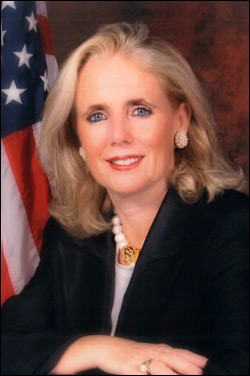
Dingell — Debbie Dingell — Won’t Run

Debbie Dingell

Debbie Dingell (D)

Debbie Dingell, in a posting on her Facebook page over the weekend, said she will not seek retiring Sen. Carl Levin’s (D-MI) open seat next year. She had been actively testing the waters for such a race ever since Levin made known his 2014 political intentions. Dingell is the wife of venerable Rep. John Dingell (D-MI-12) who, first elected in a 1955 special election, is the dean of the House of Representatives.

In an email Mr. Dingell sent to supporters relaying his wife’s statement, Debbie Dingell said in part, ” … when Carl Levin announced he would not seek reelection, those plans (working for Sen. Levin’s re-election and other Democrats’ such as her husband) changed. Close friends, complete strangers, political allies and business colleagues encouraged me to take a long, hard look at running for the Senate myself — and that’s what I have done.”

She then goes onto say, ” … but I think it is critical that Democrats unite behind one candidate for what will be a difficult and expensive race, and it’s one of the reasons I have concluded that now is not the time for me to run for the United States Senate. We have good candidates like Gary Peters already running, and a primary would be divisive at a time that cries out for unity. As someone who has spent much of my career working to bring people together, it just  Continue reading >

Hickenlooper, Udall Cruising in Colorado

Public Policy Polling just completed a survey of the Colorado electorate (April 11-14; 500 registered Colorado voters) and found both Democratic Gov. John Hickenlooper and Sen. Mark Udall in strong position for re-election.

PPP surveys tend to produce more negative numbers of the various politicians tested than most polling firms. The Colorado results are no exception, as all eight tested Republicans registered upside down personal favorability ratings when the respondents were queried about whether they had favorable or unfavorable opinions about each individual. When testing Gov. Hickenlooper and Sen. Udall, the question only pertained to their job performance. On that scale, both men performed well: Hickenlooper scored 53:44 percent positive to negative (though his negative jumped up from 26% as recorded on PPP’s November ’12 Colorado poll); Udall 50:33 percent.

Despite all of the Republicans registering poor favorability ratings, their ballot test standing when paired with either Hickenlooper or Udall are better than one might expect after perusing the initial data.

Former Rep. Bob Beauprez (R-CO-7), who ran unsuccessfully for governor in 2006 after serving two terms in the House from a marginal suburban Denver district, comes within seven points of Hickenlooper, 43-50 percent, in a hypothetical general election. Attorney General John Suthers (R) scores 39-49 percent against the governor. Rep. Cory Gardner (R-CO-4) tallies exactly the same result as Suthers. Rep. Scott Tipton (R-CO-3) also registers in the same range, behind 40-50 percent. Former Rep. Tom Tancredo (R-CO-6) does a bit worse, trailing 41-52 percent.

If these same Republicans were to challenge Sen. Udall, the results prove similar. Despite Beauprez scoring a 15:34 percent personal favorability index and Udall registering a 50:33 percent job approval rating, the Republican trails the senator only 41-48 percent. Suthers is down to Udall 38-50 percent; Gardner 39-49 percent; Tipton 37-50 percent; and Tancredo 39-51 percent.  Continue reading >

Money Talks

The first quarter financial disclosure statements have been filed for House incumbents and challengers and, as always, the fundraising amounts tell many tales. Naturally, the most prolific fundraisers are elected partisan leaders or committee chairmen, but this report is more indicative about those in marginal districts or who are committed to, or considering, a bid for statewide office. The axiom of the most committed candidates being the best early fundraisers again rings true during the current period.

Looking at the rank-and-file House incumbents and candidates, particularly those newly-elected congressmen, it appears that $300,000 raised for the quarter beginning Jan. 1, 2013 is the benchmark. Grading on a curve, anyone attaining or exceeding this level has earned first tier political status.

Best Fundraisers

The top fundraising House district can be found in the Denver suburbs, where 6th District Rep. Mike Coffman (R) and Democratic challenger Andrew Romanoff (D), the former state House Speaker and defeated Senatorial candidate (2010; losing the Democratic nomination to then-appointed Sen. Michael Bennet), both exceeded $500,000 in recorded campaign receipts for the first quarter.

Coffman raised $510,000, just behind Romanoff’s $514,000. The challenger has about a $100,000 edge in cash-on-hand. The court-drawn redistricting map presented Coffman with a much more Democratic district than the one to which he was originally elected in 2008. He was victorious in 2012, obviously, but did not reach the 50 percent plateau, winning re-election with 48 percent of the vote. The mid-term turnout pattern should help Coffman, but Romanoff is likely a stronger opponent than former state Rep. Miklosi, the congressman’s opponent last November.

The runner-up district is New York’s 11th CD, where Rep. Michael Grimm (R)  Continue reading >