Category Archives: Presidential campaign

Colorado Crazy


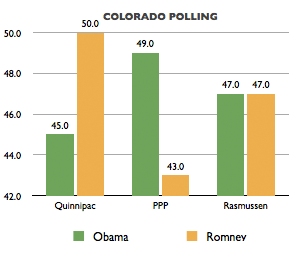
A trio of national pollsters just descended upon the swing state of Colorado and produced wildly divergent presidential campaign results. During the period of July 31 – Aug. 6, three national survey research firms each conducted a separate study of likely Colorado general election voters.

Quinnipiac University (July 31 – Aug. 6) surveyed a sample cell of 1,463 likely voters and actually found Republican Mitt Romney to be leading President Obama 50-45 percent. Public Policy Polling (Aug. 2-5; 779 likely Colorado voters), also in the field during the same period, found the exact opposite result: Obama ahead 49-43 percent. Finally, on Aug. 6, Rasmussen Reports conducted a one-day survey of 500 likely Colorado voters and projected the two candidates to be tied at 47 percent apiece.

The differing results tell us several things. First, the fact that we see the President leading by six in one poll, trailing by five in another, and tied in a third likely tells us that the Colorado electorate is split very finely between the two men. Second, all three polls reveal a very high degree of commitment. Those not expressing a defined choice were only in single-digit percentiles for all three polls. Third, the data also suggests that this state, which typically splits its votes rather evenly between candidates of the two parties, is clearly in play for both presidential contenders. In 2008, then-Sen. Barack Obama carried Colorado over his colleague John McCain by a 54-45 percent margin but, today, it appears the 2012 result will be much closer.

Presidential Popular Vote is Even

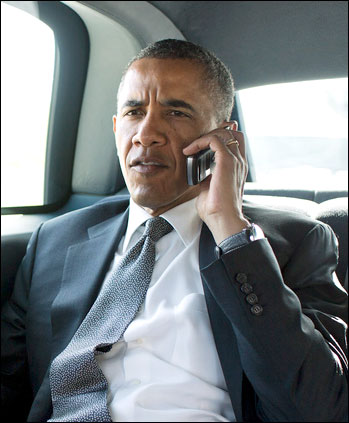
President Obama. / Photo: The White House

A series of new presidential election polls reveals a further tightening of the campaign on the national level, though President Obama maintains a lead over Mitt Romney in the most competitive states.

The two daily tracking pollsters, Gallup and Rasmussen Reports, both give the president only a one-point national lead, 46-45 percent and 45-44 percent, respectively. Looking at an actual benchmark survey, Public Policy Polling, conducting their study (July 19-22; 1,000 registered voters) for the Daily Kos national liberal blog and the Service Employees International Union, projects a flat 46-46 percent tie.

The only national poll not showing a dead heat, taken over virtually the same time frame as PPP’s survey with an identical sample size (July 18-22; 1,000 registered voters) from Republican pollster Bill McInturff and his Democratic counterpart Peter Hart, actually stakes the president to a 49-43 percent advantage. Based upon the available data, though the polling methodology appears sound, the McInturff/Hart result appears to be an outlier.

National Public Radio released their poll of the 12 commonly viewed battleground states (conducted by the Resurgent Republic and Democracy Corps organizations, July 7-12; 1,000 voters nationwide with an oversample of 462 from the battleground states) but its aggregate result is of little consequence. Though this poll, too, shows an Obama-Romney tie at 46 percent, such a figure is virtually useless because the combined popular vote in the most hotly contested states doesn’t translate into specific electoral votes.

What is valuable are battleground voters’ perceptions and attitudes about the candidates. As we have seen for months, there is severe polarization between the two major parties. By almost a 9:1 majority, Democrats believe the president has performed well in office. Conversely, the same virtual ratio of Republicans believes he has not. Independents tend to fall more on the Republican side, slightly rating Obama’s job performance more negative than positive. Also, Independents in these states generally oppose the Obama healthcare law and, by a slight margin, believe that the Supreme Court decision upholding the law is incorrect. This could prove significant as the campaign continues to evolve.

One thing that does deviate somewhat from at least the conventional wisdom, the NPR battleground state poll does show that both candidates have a strong base. Especially for Romney, this is a change. Before, most data indicated weakness among Republicans for their presumptive nominee, but the NPR data gives both contenders right around 90 percent support within their own party voter cell sample. This finding is good news for both men.

New individual key state surveys stack up relatively well for the president in the fact that he leads in most, but in no case is his advantage more than mid-level single-digit numbers.

Rasmussen Reports gives the President a six-point, 48-42 percent advantage in Michigan. Survey USA finds a similar five-point, 48-43 percent margin for Obama in all-important Florida; and We Ask America returns similar 49-42 percent and 49-43 percent spreads (in Obama’s favor) in Wisconsin and Nevada, respectively. Magellan Strategies produced a much closer 50-46 percent Nevada model. Quinnipiac University shows a tie in Virginia, and the Civitas Institute projects Romney to a one point, 49-48 percent razor-thin edge in North Carolina. Though it’s not a battleground state, Survey USA detects only a 46-40 percent advantage for the president in liberal Minnesota, which is a surprise.

The cumulative effect of the most recent survey data makes the president and his advisers uncomfortable. These are not the type of results strong incumbents would be seeing at this point in the election cycle. It’s going to be quite a remainder of the year.

State Presidential Polling Tightens

Photo: The White House

Polling in the presidential race is interesting because the national numbers have been projecting a very tight race, but not particularly so for the key states. Several surveys released yesterday now show a pattern similar to the tight nationwide margins in the core states of Florida, Ohio and Virginia, and second-tier swing state, Colorado.

Nationally, Gallup, Marist College for the McClatchy Newspapers, and the Purple Strategies organizations all give President Obama a two-point lead over presumptive Republican nominee Mitt Romney. But, Rasmussen Reports projects Mr. Romney to be holding the same two-point lead. All of the polls were conducted during the July 9-15 period, though the Rasmussen data is derived from daily tracking surveys.

While the president’s numbers in Florida, Ohio, Virginia and Colorado have exceeded his national performance, such is not the case in the latest wave of studies.

In all-important Florida, Mason-Dixon Polling & Research gives Obama only a one-point, 46-45 percent razor-thin edge, but Purple Strategies (PS) actually detects a three-point Romney lead, 48-45 percent.

Ohio, where the president’s margins have typically been in the high single digits, now brandishes only a three-point Obama lead, 48-45 percent, again according to Purple Strategies.

To the west in Colorado, a state that Obama carried 54-45% in 2008, PS sees the president’s advantage dwindling to just one point, 45-44 percent.

Finally, in Virginia, where the Obama edge has been consistent and relatively strong, Purple Strategies forecasts that his Old Dominion lead is now down to just two points, 46-44 percent.

Major Swing State Polling Figures Show Obama Support

A series of new polls from three major swing states -Florida, Ohio and Pennsylvania – reveals that voters basically support President Barack Obama’s immigration policy, but are split on his handling of the economy.

Quinnipiac University released their research data this week from polls simultaneously conducted in those critical swing states, and the results reveal that the president has a discernible advantage over presumptive Republican nominee Mitt Romney in the three places, the culmination of which could decide the election. The polls, all from the June 19-25 period, report the following ballot test findings:

• Florida: Obama 45 percent – Romney 41 percent (1,200 Florida voters)
• Ohio: Obama 47 percent – Romney 38 percent (1,237 Ohio voters)
• Pennsylvania: Obama 45 percent – Romney 39 percent (1,252 Pennsylvania voters)

Since 1960, history dictates that no one has won the White House without taking at least two of the three aforementioned states. In comparing these results with the similar May 3 Q-Poll findings that gave Obama an eight-point lead in Pennsylvania with Florida and Ohio in virtual dead heats, suggests that the president has gained recent momentum. Today, Obama has clear leads over Romney in the three critically important states and, if such a pattern continues throughout the summer and into autumn, he stands in good position to secure a second term. Keeping in mind that voter disposition over a four-month time period in the modern campaign era can quickly change, this new data again suggests that the 2012 presidential contest will be tight in these three major battleground states.

The polls yield several basic conclusions. Initially, Florida, Ohio and Pennsylvania polling respondents support President Obama’s new immigration policy and are divided over whether he or Romney would be better for the country’s economy and their personal finances.

In Florida, on the heels of the President’s recent decision to prevent deportation of younger Illegal immigrants, Mr. Obama holds a sizable lead among Hispanic voters. Specifically, the Q-Poll indicates an Obama support factor within the Florida Hispanic cell segment at 56-32 percent, compared to 49-39 percent in the May Quinnipiac University poll. The earlier survey was in the field prior to Obama and Romney each making their respective immigration policy speeches. Increasing Republican share of the Hispanic voting block is crucial to a Romney win formula.

Furthermore, Obama leads in other demographic group cell sectors as well, including 85-6 percent support among black voters, which actually could be a low number when compared with voter history from 2008. White voters in Florida back Romney 50-35 percent. Obama also leads among Sunshine State women, 47-40 percent, while men are evenly divided with 43 percent for Obama and 42 percent for Romney.

In Ohio, we find similar results as the Buckeye State Q-Poll reveals 52-38 percent support for the president’s immigration policy. By a margin of 45-38 percent, respondents say he would do a better job than Romney in handling immigration. Obama currently possesses a discernible lead among Ohio Independents, which historically have proven to be a bellwether in determining which way the state will swing.

Pennsylvania women are strongly backing the president according to the Keystone State Q-Poll (48-36 percent), with men tipping 42-41 percent toward Romney. Voters in Pennsylvania don’t necessarily approve of the way Mr. Obama is handling his job as president, split 45-47 percent favorable to unfavorable, but his numbers are better than Romney’s upside down 34:39 percent personal image ratio.

In conclusion, the Florida, Ohio and Pennsylvania polls provide strong indications about which way the country will swing this fall. Today, it is fair to say that this race is still up for grabs, but the president clearly maintains the easier path to ultimate victory in November.

Interesting Details in Arkansas and Kentucky

Presidential and congressional primaries were held in Arkansas and Kentucky last night without major surprises. As predicted, President Obama won two tepid victories in the pair of states, failing to break 60 percent in either place. He opposed an unknown Democratic candidate in Arkansas and was pitted against an uncommitted slate in Kentucky.

John Wolfe Jr., a Chattanooga, Tenn. attorney, scored 42 percent against Obama in the Arkansas Democrat primary. This is the strongest race Wolfe has run. Prior to entering the presidential contest, he twice ran for Congress, and once each for the offices of Tennessee state senator and mayor of Chattanooga. Prior to last night when facing the President of the United States, Wolfe never could top 34 percent in any of his multiple political endeavors.

In Kentucky, Obama also scored an anemic 58 percent of the vote. Here, 42 percent of the Blue Grass State’s Democrats chose an uncommitted slate of delegates to go the party’s national convention in Charlotte.

The results don’t mean much from a national perspective; only that the president will not be re-elected in a 50-state sweep. This is the second and third primaries where an alternative to Obama received substantial votes. West Virginia was the other state where that occurred. It is unlikely that the President will be competitive in any of these places in November, since better than four of six of his own party’s primary voters failed to support him.

In the KY-4 Republican congressional primary race (Rep. Geoff Davis-R, retiring), Lewis County Judge (county executive) and engineer Thomas Massie defeated state Rep. Alecia Webb-Edgington and Boone County Judge Gary Moore. The margin was 45-29-15 percent in what was a poor finish for Moore, who represented more people through his local office than did the other two. It is a boon for the Paul family because both Rep. Ron Paul (R-TX-14) and Sen. Rand Paul (R-KY) endorsed the hard-charging winner. All three of the candidates were approaching financial parity. The Republican nature of the district means that Massie will be the new congressman. He faces Grant County Democratic Chairman Bill Adkins in the fall and what stands to be a non-competitive election.

The closest race of the evening was in Arkansas’ 1st Congressional District where Second Circuit Prosecuting Attorney Scott Ellington came within less than one point of winning the Democratic nomination outright. He will face state Rep. and Marvell ex-mayor Clark Hall in a June 12 secondary vote. The winner will oppose freshman Rep. Rick Crawford (R) in a newly configured 1st District that now has an even higher Democratic baseline than under the current lines, though President Obama could only score 39 percent under each version. This could become a competitive general election battle.

In the south-central 4th District, polling correctly suggested another outcome, as Afghan War veteran and businessman Tom Cotton, who raised more than $1 million for the primary campaign, won the Republican nomination outright with an impressive 57-37 percent win over 2010 congressional nominee and former Miss Arkansas Beth Anne Rankin.

Cotton must now wait until June 12 to see if he will face state Sen. Gene Jeffress or attorney Byrum Hurst, the latter of whom, as the underdog, made a very strong run for the top spot. At the end of the evening, Jeffress totaled 40 percent to Hurst’s 36 percent.

While the 1st District race could be headed to toss-up territory, Cotton figures to be the 4th District general election favorite. AR-4 is a Republican conversion seat because Rep. Mike Ross (D), a Blue Dog Coalition co-chairman, is retiring.

Polls In Sync

We often bring polling inconsistencies to light and analyze why a particular survey may be more accurate than another. Right now, however, four diverse pollsters all are showing virtually the same result in the presidential race. The conclusion: The presidential campaign, in mid-May, between President Obama and Mitt Romney, is a virtual tie.

Our first comparison is between the two polling firms that track the national race on a daily basis: Gallup and Rasmussen Reports. The latest published Gallup numbers (April 15-May 6; 3,050 registered voters grouped in five-day tracking segments) show Obama and Romney with the exact same level of support, 45-45 percent. Rasmussen, which calls 500 people every night and then groups them in three-day tracking segments, arrives at virtually the same conclusion as Gallup, but their data has Romney grabbing the smallest of leads, 46-45 percent.

Next comes TIPP, the regular polling partner of Investor’s Business Daily and the Christian Science Monitor. TIPP is the acronym used for the polling section of the TechnoMetrica Market Intelligence corporation, which claims the mantra of “America’s most accurate pollster” based upon their presidential track record in 2004 and 2008 as compiled by Real Clear Politics. According to their traditional polling interview method conducted during the May 9-16 period of 778 registered voters, the President has a slight 43-40 percent lead, certainly consistent in margin of error terms with the other pollsters just cited.

Finally, Zogby Analytics, which has in the past been criticized for being among the least accurate of pollsters, and in this case polling for the Washington Times, also returns current data that agree with the rest. According to their traditional live interview survey May 11-12 of 800 likely voters, Romney has the one-point lead, 44-43 percent. Zogby also went one step further. They asked this particular sampling segment a second ballot test question that included Libertarian candidate Gary Johnson, the former New Mexico Republican governor, who will likely be on the general election ballot in many states. When adding Johnson to the mix, the result slightly changed the Romney-Obama split; the returned result showed a consistent 44-43-2 percent division, but this time in the President’s favor.

What this tells us – because the results from four such different pollsters each with their own methodological approach pertaining to sample selection and interview philosophy – is that at the present time, the national race deserves an unequivocal toss-up rating.

Why Nebraska’s 2nd District Matters So Much in 2012

The 2nd District of Nebraska, which is basically the Omaha metropolitan area, might matter more than any congressional district in the country during the 2012 election. Nebraska and Maine are the only two states that split their Electoral Votes – both states award two votes for winning statewide and one each for every congressional district carried – and, for the first time in the modern political era, the division actually occurred in 2008. Four years ago, President Obama scored a bare one-point win in NE-2, which gave him one extra Electoral Vote and allowed him to gain from a state he lost.

After this past Tuesday’s Nebraska primary, this district proved it will again be important because both newly crowned Republican Senatorial nominee Deb Fischer and Rep. Lee Terry (R) will need to run well here, as will presidential nominee Mitt Romney. If Romney fails to win this lone congressional district, it could mean carrying another entire state just to compensate. There is one plausible election scenario that gives Romney all four of the top priority conversion states – North Carolina, Virginia, Florida and Ohio – in addition to taking New Hampshire. Should he lose NE-2 in this mix, as John McCain did – the race could end in a tie. Therefore, the voters of this district could very well be choosing more than a congressman and US senator on Nov. 6; they could ultimately decide the presidency.