Category Archives: Polling

Rounds Starting Strong in South Dakota Senate Race

Gov. Mike Rounds

Gov. Mike Rounds

With former South Dakota Gov. Mike Rounds (R) just completing a series of Washington, DC visits to the PAC community drumming up support for his already announced US Senate run, Public Policy Polling released a survey (March 18-19; 1,069 registered South Dakota voters; 501 Republican primary voters; 390 Democratic primary voters) of the state’s electorate that shows early signs of a GOP conversion race.

Sen. Tim Johnson (D) has promised to soon make clear whether he will seek re-election, originally saying he would do so “at the end of March.” Most local and national political observers believe that he will retire for health reasons.

In a hypothetical ballot test between the senator and Rounds, it is the Republican who already holds the strong early lead. According to PPP, Rounds would defeat Sen. Johnson 52-41 percent in a current contest. If Rep. Kristi Noem (R-SD-AL) were the Republican senatorial nominee, she would outpace the incumbent by four points, 49-45 percent.

Should the senator retire, two Democrats are most often mentioned as potential candidates: former Rep. Stephanie Herseth Sandlin and US Attorney Brendan Johnson, the senator’s son. Herseth Sandlin, who held the at-large House seat for three full terms  Continue reading >

Survey Says: Americans Upset With Government

The Gallup organization just reported upon their monthly survey about the issue areas Americans cite as being the most important and, in their analysis reported yesterday, a reading occurred that hadn’t been seen since the Watergate era.

When President Obama took office at the beginning of 2009, according to the regular survey issue project, 86 percent of the respondents said the economy is the “most important problem facing the United States today.” Yesterday, though the economy was still mentioned more than any other issue area, that percentage dropped to 57, the lowest recorded reading since Gallup’s June 2010 polling edition. During the Obama administration, the smallest percentage recorded citing the economy was 55.

The surprising response, however, occurred when the questioners asked the participants to be more specific. The response “economy in general” still topped the charts at 24 percent, down from 25 percent in their February 2013 edition but up from the 21 percent of respondents who answered that way in January. But 20 percent of respondents answered, “dissatisfaction with government” — making it the number two concern; and that type of response factor hadn’t been seen since June of 1974 shortly after Pres. Richard Nixon had resigned. Those answering this way jumped four full points just from last month, and pulled ahead of “unemployment/jobs” (16 percent) and the “federal budget deficit/debt” (13 percent) among the answers most given.

In terms of other issues cited, healthcare dropped to just seven percent and, despite all of the media attention paid to the gun control issue, “guns” was mentioned by just four percent of the respondents, down from six percent in February and returning to its January 2013 level.

Should this trend continue, we could begin to see a new issue discussion come to the forefront in the 2014 election cycle. If — and the Republicans will be the ones most likely  Continue reading >

Booker Cruising in Jersey Senate Poll; Corbett Improves in Pa.

Newark Mayor Cory Booker

Newark Mayor Cory Booker

New Jersey’s Fairleigh Dickinson University, as part of their March 4-10 Garden State survey (702 registered New Jersey voters; 323 Democratic primary voters), studied the upcoming 2014 open Senate race. Their findings present good news for Newark Mayor Cory Booker (D) and suggest that both Rep. Rush Holt (D-NJ-12) and Rep. Frank Pallone (D-NJ-6) have quite a bit of ground to close if they intend to enter the race. Of the two, Pallone is likely to run, while Holt’s candidacy is only a possibility.

According to the FDU results, Booker would lead Holt and Pallone 50-7-4 percent, respectively, if a Democratic primary vote were held during the present period. With such a wide spread, either or both of these potential candidates will have to create a negative image of Booker if they are to substantially gain on him. Typically, big city mayors don’t do particularly well in statewide electoral contests normally because the voters not residing in the largest city, and particularly so for rural voters, often have a negative image of big city politics. Therefore, we can expect to see serious questions raised about the city’s government and state of the local economy before Democratic voters go to the polls in June of 2014.

Booker is in equally good shape for the general election. The only potential GOP  Continue reading >

Va., Pa. Gubernatorial Glimpses

Virginia Lt. Gov. Bill Bolling has decided not to enter this year’s gubernatorial campaign as an Independent candidate. In an email communication sent to his supporters that sounded very similar to one he sent on Feb. 28, Bolling indicated that his decision not to run largely revolved around the ability to raise enough money to run a “winning” campaign for Virginia governor, in addition to his distaste for what he terms the “rigid ideology” of today’s modern politics.

“In many ways I fear that the ‘Virginia way’ of doing things is rapidly being replaced by the ‘Washington way’ of doing things and that’s not good for Virginia. As a result, the political process has become much more ideologically driven, hyper-partisan and mean-spirited. Rigid ideologies and personal political agendas are too often placed ahead of sound public policy and legitimate policy disagreements too quickly degenerate into unwarranted personal attacks. This makes it more difficult to govern effectively and get things done,” Bolling wrote as part of his message.

The development should result as a big plus for consensus Republican gubernatorial candidate Ken Cuccinelli, the state’s attorney general. Though polling generally indicated that Bolling’s entry really didn’t move the race dramatically toward presumed Democratic nominee Terry McAuliffe, over the course of the campaign that would likely have been the result. Without Bolling in the race trying to chip away moderate Republican support from Cuccinelli, the attorney general will have a better chance of unifying his party’s support for the general election campaign.

Polling has shown that the McAuliffe-Cuccinelli race begins as a dead heat and there is a good chance that the campaign will remain in such a mode all the way through Election Day.

Corbett Down

Pennsylvania Gov. Tom Corbett (R) appears  Continue reading >

Michigan Gov. Snyder Looks Vulnerable Early

Public Policy Polling just released its new survey of the Michigan electorate (March 2-4; 702 registered Michigan voters) and, after showing Gov. Rick Snyder (R) with poor job approval ratings (a 37:54 percent favorable to unfavorable ratio), the survey shows Detroit Congressman Gary Peters (D-MI-14) to be the Democrat with the best potential to unseat the one-term incumbent. According to their data, Peters would lead Snyder 44-37 percent in a hypothetical ballot test question. At the current time, no challenger from either party has announced an official campaign for governor.

When paired with the man he beat 58-40 percent in 2010, Gov. Snyder trails Lansing Mayor Virg Bernero 38-43 percent. Finally, against former Rep. Mark Schauer (D-MI-7), who was defeated in 2010 after serving one term in office, the potential challenger leads this ballot test, too, but by a smaller 40-36 percent.

Though these numbers clearly show that Snyder has political weakness, he is far from moribund status for next year’s re-election contest. Single-digit leads change frequently, and polling more than 19 months from the election doesn’t mean a great deal. Still — and even more so when considering Michigan’s voting history — the numbers do yield trends and they reasonably tell us to expect a competitive statewide campaign in 2014.

Though Snyder’s job approval is poor, such a conclusion must also be qualified. PPP tends to poll this question in a way that typically registers negative job approval responses for almost every public official. Even here, the very Democratic potential candidates who lead Snyder in their latest poll, also produce upside down favorability ratings about themselves.

Bernero scores a 20:26 percent ratio when asked if the respondents have a favorable or unfavorable opinion of him. This result is actually a bit worse than the spread  Continue reading >

Virginia Lt. Gov. Bolling Still Lingering

Virginia Lt. Gov. Bill Bolling (R) still says he’s deciding whether to run as an Independent for governor but a communication to previous political supporters “seeking [their] advice” clearly indicates a preference to join the battle. Bolling was originally planning to challenge Attorney General Ken Cuccinelli in the Republican primary but, when the voting format was changed to a statewide convention, it became clear even to Bolling that he had little chance of prevailing.

Upset at being dashed by the Republican brass for a second time (four years ago Bolling stepped aside so that then-Attorney General Bob McDonnell could run for governor, with assurances that he would be next in line come 2013) he started publicly contemplating about running in the general election as a third candidate. He states that he would enter the race as an “Independent Republican” and it is clear to him “… that there is a great deal of uneasiness about the candidates the two major political parties appear poised to nominate, and a lot of people in our state are looking for a better option.”

Bolling also released his internally commissioned McLaughlin & Associates poll (released Feb. 26; 400 registered Virginia voters) that shows an overwhelming number of people would consider voting for an Independent candidate, but one that also projects him to be faring poorly against Cuccinelli and consensus Democratic candidate Terry McAuliffe.

According to the McLaughlin data, Bolling enjoys a 44:11 percent favorability index. This compares to Cuccinelli’s 41:27 percent, and McAuliffe’s rather poor 25:22 percent ratio. In his analysis, chief pollster John McLaughlin then points to results saying that 67 percent of the survey sample would consider voting for an “Independent candidate running for governor.”
 Continue reading >

Iowa’s Latham a No-Go for Senate Race

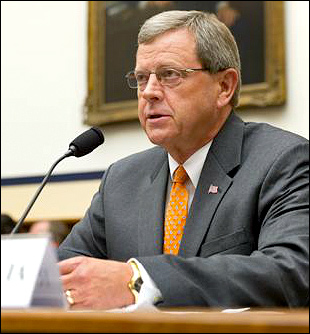
Rep. Tom Latham

Rep. Tom Latham

Rep. Tom Latham (R-IA-3) announced yesterday that he will not seek the open Iowa Senate seat next year. His decision is not particularly surprising. Iowa insiders had been indicating for more than a week that the 10-term congressman was leaning against launching a statewide bid.

In publicizing his decision, Latham indicated that he had just been re-elected to the House in a much different post-redistricting CD — in fact, 83 percent of the constituents are new to him — and a two-year statewide campaign would take him away from properly fulfilling his current responsibilities.

Politically, though he was commonly seen as the best general election candidate the Republicans could field, he faced a major obstacle in the GOP primary. Rep. Steve King (R-IA-4), fresh from his own convincing re-election victory over a strong and well-known Democratic opponent, commands the inside track to the Senate nomination. King is backed with vigorous Tea Party support and enjoys strong grassroots presence for his Republican nomination campaign, which are major factors.

Late January and early February polling provided us a quick glimpse into how the  Continue reading >