Category Archives: House

Will Miller-Meeks’ 6-Vote Win Stand?

By Jim Ellis

IA-2 Republican congresswoman Mariannette Miller-Meeks

March 12, 2021 — Yesterday, the House Administration Committee met virtually to consider Iowa Rep. Mariannette Miller-Meeks’ (R-Ottumwa) motion to dismiss the Federal Contested Elections Act challenge from Democrat Rita Hart in relation to the state certified results of the 2020 congressional election in Iowa’s 2nd District. The committee voted 6-3 on partisan lines to postpone the dismissal action.

To review, Rep. Miller-Meeks’ victory margin is only six votes of 394,800 ballots cast. Hart is challenging the results before the House Administration Committee claiming that 22 ballots, enough to overturn the final result, were legal but not counted.

Yesterday’s hearing was procedural in that committee chair Zoe Lofgren (D-CA) moved to postpone hearing the dismissal motion in order for the members to fully consider Hart’s argument of contestant. Rep. Lofgren indicated that both the Iowa Republican and Democratic Parties, along with Iowa election officials, will be sent identical questionnaires to fully investigate the matter. This means we can expect a much longer process to fully examine the contested ballots, allow testimony, and review the Iowa recount process.

Committee Minority Ranking Member Rodney Davis (R-IL) countered, indicating that the Iowa officials have twice counted the votes and, as committee member Bryan Steil (R-WI) reported, recount boards in all 24 counties that form the 2nd District – three member panels comprised of a Miller-Meeks’ appointed member, a Hart appointed member, and a county appointed member – all agreed on the final totals in each local entity.

Davis further explained to the committee members and listening audience that Hart, a former Iowa state senator and 2018 nominee for lieutenant governor, had eschewed the available legal process, which is to petition the Iowa court system. Davis said he concludes Hart made the decision to come directly to the House because she knew the courts would reject her legal arguments.

The Iowa recount process changed the original totals. The first reported outcome revealed a 44-vote Miller-Meeks margin. It then dropped to 30 votes during the recount and Scott County (Davenport), the district’s largest entity, reduced the number even further culminating in the current six-vote final result that the Iowa secretary of state certified as official, with which the bipartisan Iowa Election Canvass Board unanimously concurred. On Jan. 3rd, the House voted to provisionally seat Miller-Meeks until the Hart challenge is resolved.

Continue reading

Biden-Trump Swings in 2020

By Jim Ellis

March 9, 2021 — The Daily Kos Elections website completed their analysis of the congressional districts that changed the most when comparing the 2020 presidential vote performance to that of 2016. The list is divided into the top 25 districts from two categories, those that swung the most to Joe Biden from Hillary Clinton and the seats where Donald Trump improved to the greatest degree when compared to his 2016 showing.

Perhaps the more interesting chart is the Trump improvement calculations, because every one of the top 25 D to R swing districts has a substantial minority population, particularly Hispanic. In fact, in these 25 CDs, the average Hispanic population figure is 59.8 percent, and we see a mean average improvement swing of 12.3 percent for Trump in 2020 with a median of 11.5 percent when compared with his 2016 standing in these districts.

DISTRICT | WINNER  |   HOUSE 2020 % | PRES. 2020 % | HOUSE WINNER | HISPANIC %
FL-26 Trump   52-47 52-47 Gimenez 68.6
FL-25 Trump   61-38 Unopposed Diaz-Balart 75.8
TX-34 Biden   52-47 55-42 Vela 83.7
FL-27 Biden   51-48 51-49 Salazar 70.4
FL-24 Biden   75-24 76-20 Wilson 37.0
TX-28 Biden   52-47 58-39 Cuellar 77.4
NY-15 Biden   86-13 89-11 Torres, R. 66.1
TX-15 Biden   50-49 50-48 Gonzalez 81.2
CA-51 Biden   67-31 69-32 Vargas 70.1
CA-40 Biden   77-21 73-27 Roybal-Allard 87.6
TX-29 Biden   66-33 71-27 Garcia 77.1
NY-7 Biden   82-17 85-14 Velazquez 41.8
CA-44 Biden   78-19 68-32* Barragan 70.0
CA-29 Biden   74-24 57-43* Cardenas 68.7
NY-14 Biden   73-26 72-27 Ocasio-Cortez 49.1
NY-13 Biden   88-11 91-8 Espaillat 54.5
CA-19 Biden   70-28 72-28 Lofgren 40.8
FL-23 Biden   58-41 58-42 Wasserman-Schultz 35.5
CA-34 Biden   81-17 53-47* Gomez, J. 64.3
TX-9 Biden   76-23 75-22 Green, A. 38.5
NY-6 Biden   62-37 68-32 Meng 19.2
CA-35 Biden   65-33 69-31 Torres, N. 70.0
CA-46 Biden   64-33 69-31 Correa 66.4
NJ-8 Biden   73-26 74-25 Sires 54.4
PA-2 Biden   70-29 72-28 Boyle 27.9

* Faced another Democrat in general election
• Avg. Swing 12.3 | Median 11.5 | Average Hispanic percent: 59.8%


Biden Swing

Obviously, President Biden still won all but two of these districts, and the vast majority with overwhelming percentages. Even so, the fact that so many of the Hispanic districts were giving former President Trump a double-digit vote total increase is significant, nonetheless. This could be a positive 2020 presidential campaign after-effect upon which the Republican Party can build.

As you will see similarly in the districts below that swung significantly to Biden, only one of the Trump improvement seats performed differently at the House level when compared to that same electorate’s presidential vote. The one CD of the 25 swings that voted Biden for president and a Republican for House was Florida’s 27th District as Maria Elvira Salazar (R) upset incumbent Rep. Donna Shalala (D-Miami).

Of the districts that showed the most significant gain for Trump we look to South Texas. This contrasts greatly with the vote changes in North Texas. As we can see, ex-President Trump showed significant improvement in all of the Texas-Mexican border districts.

The district with the sharpest Trump swing was Florida’s 26th District, with a 21.9 percent factor. The lowest of the 25 were New Jersey’s 8th and Pennsylvania’s 2nd CDs, both with a 7.0 percentage improvement for the Republican former president.

The chart immediately below shows the top 25 districts that produced the sharpest swing for the race winner, President Biden. Remember, the 2016 Democratic number was that of Hillary Clinton.
Continue reading

Louisiana Poll Shows Clyburn in Lead;
Nevada Candidate Shows Up in Texas

By Jim Ellis

Feb. 5, 2021 — In the Baton Rouge area, a pre-election favorite shows a solid lead, and in Texas, a surprise candidate who previously was the NV-3 GOP front-runner in the Las Vegas area enters a Texas race.


LA-2

Louisiana state Sen. Troy Carter (D-New Orleans)

A new survey for the upcoming March 20 special election in the New Orleans-Baton Rouge vacant 2nd Congressional District places the pre-election favorite into a discernible lead.

While state Sen. Troy Carter (D-New Orleans), who House Majority Whip Jim Clyburn (D-SC), the Louisiana Democratic Party, and resigned Rep. Cedric Richmond (D) have all endorsed, posts a 28-19 percent lead over state Sen. Karen Carter Peterson (D-New Orleans), he is nowhere near the 50 percent mark required to elect outright. Therefore, it appears the odds are strong that we will see a secondary runoff election on April 24.

A Silas Lee study of 450 “chronic” LA-2 voters conducted during the February 12-14 period but released only this week, gives Sen. Carter the nine-point advantage within a field of 15 candidates – eight Democrats, four Republicans, two Independents, and one Libertarian – thus, the pair of competing local state senators appear headed toward an April 24 runoff election. Finishing a distant third in the Lee poll with just six percent support is Baton Rouge community activist Gary Chambers, Jr. (D).

While Sen. Carter was dominant in New Orleans, he falls into third position when moving to the district’s Baton Rouge sector. There, Chambers led Sens. Peterson and Carter with a 14-12-7 percent respective spread.

The state’s vacant 5th District also will be settled within the same schedule, but no relevant polling data is readily available for that race. In both contests, early voting begins this Saturday, March 6, and will continue only through March 13, a week before actual Election Day voting takes place.

Continue reading

The Impeachment Ten

By Jim Ellis

Rep. Liz Cheney, (R-WY)

March 4, 2021 — Another credible opponent for Wyoming at-large Rep. Liz Cheney (R-Wilson/Jackson) came forward earlier this week, which continues the onslaught of political activity against the 10 House Republicans who voted in favor of impeaching then-President Donald Trump for his perceived role in the Jan. 6 Capitol uprising.

Already, Rep. Cheney has four credible opponents. The latest to announce is state Rep. Chuck Gray (R-Casper). He joins state Sen. Anthony Bouchard (R-Laramie), former Pavillion mayor Marissa Joy Selvig, and energy consultant Bryan Miller.

Of the four, Sen. Bouchard and Rep. Gray are the most credible, but the large field assembling against her actually helps Rep. Cheney. Considering that Wyoming is a plurality primary state, a person is nominated by simply obtaining the highest number of votes regardless of percentage attained. Therefore, with Cheney’s opposition split among multiple candidates, the chances of her winning re-nomination with less than a majority becomes a plausible outcome.

The other nine pro-impeachment members are in different situations. From this group, only New York Rep. John Katko (R-Syracuse) has not yet drawn Republican primary opposition.

Three others are from states with primary structures that will help them advance into the general election. Reps. David Valadao (R-CA), Jaime Herrera Beutler (R-WA), and Dan Newhouse (R-WA) will file under a top-two qualifying system.

Rep. Valadao represents a Bakersfield-Fresno district that voted heavily in favor of both President Biden and Hillary Clinton, the latter back in 2016. With all candidates on the same ballot, and not being from a strong Trump district, it is less likely that his vote to impeach the sitting Republican president will greatly affect him.

In the race are former Rep. T.J. Cox (D), the man who lost to Valadao by a percentage point in 2020 after defeating him by an even closer split in 2018, former state Assemblywoman Nicole Parra (D), and ex-Fresno City Councilman and 2020 congressional candidate Chris Mathys (R).

Washington Rep. Beutler, under the same top-two primary system as California’s Valadao, has already drawn three Republican opponents, none of whom have held elective office. We can expect a strong Democrat to emerge here, meaning the eventual preliminary vote division should provide Rep. Beutler with a relatively easy road into the general election.

Continue reading

Ryan Hedging on Senate Run

By Jim Ellis

Ohio Rep. Tim Ryan (D-Warren/Youngstown)

March 2, 2021 — Last month, Ohio Rep. Tim Ryan (D-Warren/Youngstown) indicated that he would launch a statewide campaign for retiring Sen. Rob Portman’s (R) open seat in March. Now, he looks to be backpedaling.

In an interview with the Spectrum News Service, Rep. Ryan said, “we’ll make a decision here, I guess, in the coming weeks. I don’t think a March kickoff is going to happen.”

Such equivocation has seemingly been the congressman’s standard operating procedure over the years. Several times before he has been looking seriously at races for the US Senate, governor, and even lieutenant governor, but has always retreated to the relative safety of his House seat.

He did briefly campaign for president in 2020 but dropped out of the race when it was obvious his message was falling on deaf ears, exiting in plenty of time to meet the Ohio candidate filing deadline. Last November, Rep. Ryan went onto win a more competitive House race than he normally sees, defeating former state Rep. Christina Hagan (R), 52-45 percent.

Going back to the House race, if that’s what Rep. Ryan ultimately decides, may look different in 2022. If redistricting actually happens, considering all of the Census Bureau delays, Ohio faces the loss of another congressional seat in reapportionment, and it may well be Ryan’s.

His current 13th District stretches from the Pennsylvania border, encompasses Youngstown and the congressman’s hometown of Warren, and then captures a large part of the Akron metropolitan area. From preliminary census reports, it appears OH-13 will require an influx of more than 75,000 people once the final numbers are calculated. The Ryan district looks to rank 13th in population of the 16 Ohio congressional districts.

Perhaps a bigger problem for the 10-term incumbent, and what makes his 13th District vulnerable to collapse, is the adjacent 11th District that houses the western side of Akron in Summit County, is the least populated seat in Ohio and will need to gain as many as 100,000 individuals.

Therefore, collapsing the 13th District portion of Akron into the 11th in order to keep the city and at least most of the county together would be a sensible draw, thus leaving Rep. Ryan’s eastern district sector as a standing fragment. Since Districts 14 to the north, 6 and 7 to the south, and 16 to the west will all require more population, eliminating District 13 becomes a plausible option.

Continue reading

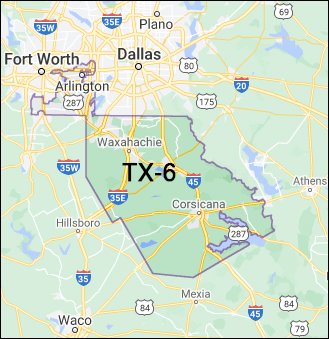
TX-6: Rep. Wright’s Widow to Run

By Jim Ellis

The late Rep. Ron Wright (R-TX) is sworn-into Congress Jan. 3, 2021 by House Minority Leader Kevin McCarthy (left) as Wright’s wife, Susan Wright, holds the Bible. Rep. Wright, 67, had been hospitalized with COVID-19; Susan Wright also had been hospitalized after contracting COVID-19. (Photo/Facebook)

Feb. 24, 2021 — The Texas Tribune newspaper broke the story this week that Susan Wright, widow of deceased Congressman Ron Wright (R-TX), will announce her candidacy as soon as this week for the yet unscheduled special election to succeed her late husband.

Ms. Wright will be the second recent widow running this year. Rep-Elect Luke Letlow’s death has led to a March 20 Louisiana special election in that state’s northeastern 5th District. Julia Letlow (R), the late-congressman-elect’s wife, is a candidate in that race and the favorite to prevail.

In US history, 39 widows have succeeded their late husbands in the House, and another eight in the Senate. One such widow, Doris Matsui (D-CA), is currently serving her ninth congressional term.

A large Republican potential field of candidates was thought to be building for the Texas special election, but with Susan Wright’s intention on becoming a candidate, that may block some of the local officials from the race. Freshman state Rep. Jake Ellzey (R-Waxahachie), who opposed Mr. Wright in the 2018 election and forced him into a runoff, and Katrina Pierson, the former Trump campaign spokeswoman, remain likely candidates, however.

At least two Democrats, 2018 congressional nominee Jana Lynne Sanchez and school district official Shawn Lassiter, have announced their candidacies and both are likely to remain in the race. The 2020 party nominee, Stephen Daniel, has also not ruled out running.

Now that the congressman has been laid to rest, Gov. Greg Abbott (R) will schedule the special election. The most likely date will be May 1st, in order to conform with the Uniform Election Day, which hosts local elections from around the state. All 6th District candidates will be on the same ballot and if any one candidate receives majority support, that individual will be elected outright. Otherwise, the top two finishers will advance to a runoff election that will be part of Abbott’s scheduling pronouncement. Assuming a May 1 special election, the secondary runoff would occur in late June or early July.

Continue reading

Assessing The Cross-Voting Districts

By Jim Ellis

Feb. 23, 2021 — The Daily Kos Elections website staff have just completed the calculations they perform after every presidential election: that is, determining how all 435 congressional district electorates voted for president, and then cross-referencing that result with their US House vote.

In the 2020 election, they find that more than 96 percent of the districts voted for the same party’s candidate for President and US House, thus leaving 16 in the “cross-district” category. Nine of the 16 voted for President Biden but then chose a Republican House member. In seven others, the electorates backed former President Trump but reverted to the Democrat’s column for their US House Representative.


The districts that went for Biden for President
and a Republican for House are:

• CA-21: President Biden: 54.4% – David Valadao (R): 50.5%

It’s not a surprise to see this Bakersfield-Fresno district on the cross-district list. When Valadao first represented the seat, the CD was either the first or second-most Democratic seat in the nation to elect a Republican congressman.

• CA-25: President Biden: 54.0% – Rep. Mike Garcia (R): 50.0%

The more extraordinary vote here was Rep. Garcia overcoming a strong Biden vote in a district that has been trending Democratic for the past several elections. Hillary Clinton also won here with a 50-44 percent margin four years earlier. Garcia survived the 2020 election by a mere 333 votes. This district is likely to change significantly in redistricting.

• CA-39: President Biden: 54.1% – Young Kim (R): 50.6%

Republican Kim returned this Orange/LA County seat to the GOP column after a term under Democratic representation. The voters here also went for Hillary Clinton in 2016 with a 51-43 percent spread even while simultaneously re-electing then-Rep. Ed Royce (R-Yorba Linda), 57-43 percent.

• CA-48: President Biden: 49.7% – Michelle Steel (R): 51.1%

The coastal Orange County district somewhat returned to its Republican roots when the electorate swung back to Republican Michelle Steel after electing Democrat Harley Rouda in 2018. Previously, Rep. Dana Rohrabacher (R) held the district, or those with similar confines, for 30 years. President Biden carried the seat by 1.5 percentage points in November, similar to Hillary Clinton’s 2016 margin.

• FL-27: President Biden: 51.3% – Maria Elvira Salazar (R): 51.4%

The congressional vote was the outlier here as this seat was drawn as a Democratic district as part of the state Supreme Court’s mid-decade re-districting directive. Expect the Republican map drawers to improve this seat for freshman Rep. Salazar (R-Miami).

• NE-2: President Biden: 52.2% – Rep. Don Bacon (R): 50.8%

In a significant way, Nebraska’s 2nd District may have clinched the Presidency for Joe Biden. Nebraska is one of two states that split their electoral votes and when this CD went for Biden, opposite from the rest of the state, it made the Trump national victory path very difficult. Rep. Bacon survived another close election in the Omaha metro district, winning here for the third time with 51 percent or less.

• NY-24: President Biden: 53.4% – Rep. John Katko (R): 53.1%

Despite a nine-point win for President Biden in this Syracuse anchored district (53.4 – 44.4 percent), four-term Rep. Katko recorded a 10-point victory in his own right marking the widest swing of any cross-district.

• PA-1: President Biden: 52.4% – Rep. Brian Fitzpatrick (R): 56.6%

In a similar result to that found in NY-24, third-term Rep. Fitzpatrick was again able to swing the electorate hard in his direction and win a comfortable re-election victory despite the opposite result at the top of the ticket.
Continue reading