Category Archives: House

Oregon’s New Seat

Current Oregon US Congressional Districts Map


By Jim Ellis

July 2, 2021 — Oregon earned a sixth congressional seat in the 2021 apportionment, but exactly where that district will be placed on the Beaver State’s new map is not particularly obvious.

Like most states, Oregon handles redistricting through the legislative process and Democrats have firm control of all three legs of the legislative stool. In addition to Gov. Kate Brown (D), the party has a 18-11 margin in the state Senate with one Independent. Their majority in the state House of Representatives is similarly large, 37-22, with one vacancy. Yet, the partisan breakdown of the state might make drawing a solid 5D-1R map surprisingly somewhat difficult.

Currently, the five congressional districts are not obviously gerrymandered, as the seats are drawn in block form. Naturally, all but two cluster around the Portland metropolitan area, the state’s dominant population region.

The five incumbents are all senior, with Rep. Suzanne Bonamici (D-Washington County) being the most junior with her original election coming in a special 2012 contest. The delegation dean is House Transportation & Infrastructure Committee chairman Peter DeFazio (D-Springfield) who was first elected in 1986.

As you can see from the following chart, using 2019 population numbers since the Census Bureau will not be delivering census tract data to the states until after Aug. 15, the five districts are remarkably equivalent in relation to population size.

DISTRICT INCUMBENT 2020% POPULATION REG. VOTERS
1 BONAMICI 64.6% 858,875 570,186
2 BENTZ 59.9% 841,022 598,375
3 BLUMENAUER 73.0% 853,116 588,614
4 DeFAZIO 51.5% 820,504 588,508
5 SCHRADER 51.9% 844,220 578,609

The population figures suggest that each district will have to shed between 115,000 to 155,000 people in order to create six CDs with equal population, likely a number around 710,000 individuals for this state.

Continue reading

Carey Claims Big Lead in OH-15

Graphic from Ohio Coal Association chairman and congressional candidate Mike Carey’s Facebook page.

By Jim Ellis

June 30, 2021 — Ohio Coal Association chairman Mike Carey (R) released his internal Fabrizio, Lee & Associates survey on Tuesday, which posts him to a big lead for the Aug. 3 special congressional primary in his state’s vacant 15th District. Carey’s advantage widely expands when the Republican primary electorate is aware that he is being endorsed by former president, Donald Trump.

According to the Fabrizio Lee poll (June 23-24; 400 likely OH-15 special Republican primary voters, live interviews), Carey would maintain a 44-10-9-8-5 percent advantage over state Rep. Jeff LaRe (R-Lancaster), former state Rep. Ron Hood, state Sen. Bob Peterson (R-Fayette County), and state Sen. Stephanie Kunze (R-Hilliard), respectively, among those claiming to be familiar with the campaign and candidates.

The original ballot test gave Carey a 20-9 percent lead over Rep. LaRe, who has the backing of resigned Rep. Steve Stivers (R) and is the beneficiary of the former congressman spending some of his substantial leftover campaign war chest as a support independent expenditure. Hood and Sen. Peterson trial with seven percent apiece, followed by Sen. Kunze’s six percent preference. The remaining six candidates individually garner three percent or less.

When all respondents are then informed that the former president has endorsed Carey, however, the candidate’s lead grows to a whopping 60-8-7-7-6 percent margin over Hood, LaRe, Peterson, and Kunze, respectively.

The initial ballot test also identified 44 percent of the respondents who said they are undecided about who to support in the special election. When informed of the Trump endorsement, the undecided segment then broke 46-3 percent for Carey over LaRe. Peterson and Kunze each gained one percent support, with the remainder divided among the minor candidates. This largely accounts for the big swing toward Carey when comparing the initial ballot test to the aided responses.

The poll was conducted during the buildup to Trump’s first public rally since he left the White House, an event held in rural Wellington, OH on Saturday about 40 miles due west of Akron that drew close to 20,000 people according to news estimates.

Continue reading

Colorado Releases First New Map


District 1 – Rep. Donna DeGette (D-Denver)
District 2 – Rep. Joe Neguse (D-Lafayette/Boulder)
District 3 – Rep. Lauren Boebert (R-Silt/Western Slope)
District 4 – Rep. Ken Buck (R-Windsor/East Colorado)
District 5 – Rep. Doug Lamborn (R-Colorado Springs)
District 6 – Rep. Jason Crow (D-Aurora)
District 7 – New Seat
District 8 – Rep. Ed Perlmutter (D-Arvada/Thornton)


By Jim Ellis

June 28, 2021 — The Colorado Independent Redistricting Commission, using only Census Bureau estimates because no state has yet received its census tract information and won’t until at least Aug. 15, released a preliminary new eight-district US House map late last week. Colorado is one of the states that gained a congressional seat under the 2020 national reapportionment.

The published commission map will not be the final version because population estimates and statistical sampling cannot be used for redistricting purposes per a 1999 US Supreme Court ruling (Department of Commerce v. US House of Representatives). Therefore, if this map is to become the basis for the actual plan, it will have to be adjusted after Colorado is presented with its census tract data.

This is the first redistricting cycle where Colorado has opted for the commission process. The new congressional map looks similar to the current seven-district design, in that the basic configurations of the seats and anchor population centers remain consistent with the notable exception of Rep. Ed Perlmutter’s (D-Arvada) current 7th District.

What appears designed as the new seat, District 8, takes a key population center from the 7th, the Arvada-Westminster-Thornton corridor, and makes it the new 8th CD anchor. This means the new 8th begins just north of Denver in Adams County and consumes about 85 percent of the local entity before moving slightly west to capture small Broomfield County and parts of Jefferson and Boulder counties. It then continues northeast to encompass a portion of Weld County.

Continue reading

The Manchin Compromise

By Jim Ellis

West Virginia Sen. Joe Manchin (D)

June 18, 2021 — West Virginia Sen. Joe Manchin (D) offered a detailed compromise Wednesday to the S.1/HR-1 package that will be debated and likely voted upon in the Senate next week.

The controversial legislation would nationalize voting procedures, and Sen. Manchin has said he would not support a final package unless Republican votes could be recruited to break a filibuster. According to news sources, no Republican is currently supportive.

Sen. Manchin released what he terms is a compromise measure, (Voting Legislation For the People Act Compromise), and presumably a substitute for S.1, or “For the People Act,” as it is formally entitled. His proposal includes 26 points in addition to five sub-points.

The chances of the Democratic leadership accepting the Manchin compromise on face value are virtually nil because his measure does not include some of the key planks found in the S.1 language.

For the purposes of this column, let’s look at a few of what could be the more controversial pieces of the Manchin offering both from a political and constitutional perspective.

• Point 3 states that the measure would “ban gerrymandering and use computer models” for redistricting. Accepting this would be difficult since there is no common definition of “gerrymandering.”

Additionally, though computer models are already used in every state to draw districts, Sen. Manchin may be referring to the Iowa process in which the legislature allows the committee staff to draw maps through a specific computer model without regard to an incumbent’s residence but based solely on geographic and some demographic characteristics.

Continue reading

It’s Down to a Dozen in SC-7

By Jim Ellis

South Carolina state Rep. William Bailey (R-Myrtle Beach)

June 17, 2021 — South Carolina state Rep. William Bailey (R-Myrtle Beach), who became the first individual to announce a Republican primary challenge to Rep. Tom Rice (R-Myrtle Beach) has become the first candidate to withdraw, with his announcement this past Tuesday. Bailey initially entered the race immediately after the congressman voted to impeach former President Trump in relation to the Jan. 6 assault on the Capitol.

Rep. Bailey indicated that there are ‘enough conservatives in the race to give Mr. Rice a strong challenge,’ and says he is leaving the congressional race to seek re-election to his state House position.

After Bailey’s departure, and including Rep. Rice, there are a dozen announced candidates for the Republican congressional primary in a 7th District that currently occupies South Carolina’s northeastern sector and includes the cities of Myrtle Beach and Conway. In the two Trump presidential elections, the district’s voters strongly supported the former president and with very consistent margins: 58-39 percent in 2016 and 59-40 percent last November.

Normally, a large field of opponents would help an incumbent, but maybe not under the South Carolina election system. The state, like many others in the south, adopts a secondary runoff election process, meaning the winning candidate must secure an absolute majority. If no one can achieve the mark in the primary election, the top two vote-getters advance to a secondary election.

What makes the Palmetto State’s system different is that the runoff cycle lasts only two weeks. Typically, South Carolina holds its primaries in mid-June with the associated runoffs following in the latter part of the month.

Therefore, an incumbent under attack doesn’t have much time to recover before the next election commences. This calendar likely enhances the most common pattern of incumbents generally losing a runoff election if they are forced into a secondary vote.

The large number of contenders notwithstanding, and without Rep. Bailey in the field, the two most prominent challengers appear to be Horry County School Board chairman Ken Richardson and former Myrtle Beach mayor, Mark McBride, though the latter man was defeated in a runoff election for a third term. McBride was also beaten badly in a 2020 special election for the state House of Representatives.

Continue reading

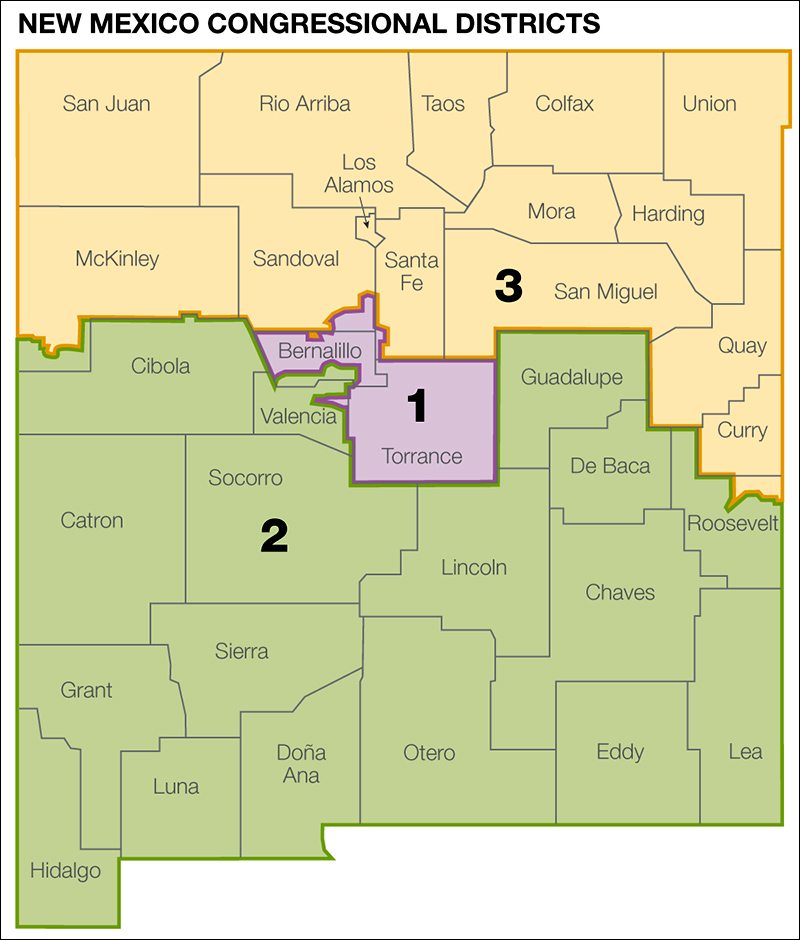
NM-1: A Pattern?

By Jim Ellis

Albuquerque, New Mexico-anchored NM-1 Congressional District

June 4, 2021 — Several media reports — typified by an MSNBC website analysis article that Steve Benen authored after Tuesday’s New Mexico special election — are trying to make the point that Melanie Stansbury’s landslide victory is a potential benchmark for future Democratic victories. Such a conclusion is a stretch.

The two-pronged premise is that Stansbury was so strong that she even ran ahead of President Biden’s performance in the district, and that the Republican campaign’s emphasis on the crime problem and the national effort to defund the police proved a political failure.

While Stansbury, a two-term state representative, scored a 60-36 percent win in the Albuquerque anchored congressional district that former Rep. Deb Haaland (D) resigned to become US Interior Secretary, her performance is not unusual. In fact, her vote total was less than two points above the mean average Democratic congressional percentage since the party converted the seat from the Republicans back in 2008.

To the argument that Stansbury’s victory margin was larger than President Biden’s 60-37 percent spread against then-President Trump, and it was only one percentage point better, it is not unusual for a House campaign to outperform the top of the ticket. In most instances, the congressional winner is better known than his or her competitor, has greater funding and outside support, and is consistently in position to overwhelm the opposition. Such is rarely the case in a national presidential campaign or in a major statewide contest for senator or governor.

The crime issue was certainly a focal point of Republican nominee Mark Moores, an Albuquerque state senator. The national party, however, did very little to support Moores, virtually conceding the race from the outset based upon the voting history here for more than a decade.

For an underdog candidate in Moores position, emphasizing the crime issue, on paper, made sense as a point of attack. Albuquerque, according to FBI statistics has the ninth worst violent crime statistics in the country, meaning 1,352 crimes per 100,000 residents according to the latest available figures (2019). To put this number in perspective, Chicago, which has drawn much national media attention for its high murder rate, ranks 31st on the same scale, at 943 crimes per 100,000 city residents.

Perhaps one reason the crime issue did not propel the Moores candidacy is there was no serious effort to defund the Albuquerque Police Department, nor is there the sharp racial tension that is present in some of the cities where we saw serious problems along with a local movement to reorder policing.

Continue reading

Stansbury Wins New Mexico Special

By Jim Ellis

New Mexico state Rep. Melanie Stansbury (D), winner of Tuesday’s special election.

June 3, 2021 — The New Mexico special election went as expected Tuesday, as state Rep. Melanie Stansbury (D-Albuquerque) defeated state Sen. Mark Moores (R-Albuquerque) by a 60-36 percent count, which is consistent with the partisan early vote turnout.

The overall participation factor exceeded 131,000 voters, or 28.2 percent of the district’s registered voter universe, which is relatively high for a special election. It appears that over 70 percent of the people participating in the electoral contest cast an early ballot.

Stansbury, twice elected to the state House of Representatives, was victorious in the special Democratic district convention whose delegates were empowered with choosing a party nominee to replace resigned Rep. Deb Haaland (D-Albuquerque). Haaland vacated the House upon being confirmed as US Interior Secretary in the Biden cabinet.

The Stansbury congressional victory margin came from population-dominant Bernalillo County, where more than 90 percent of the CD-1 residents live. Stansbury captured 61 percent of the vote here. In the smaller rural counties, Moores took three of four, but the aggregate vote total from each of those entities was individually less than 2,500 cast ballots.

The Democratic mean average in the seat since partisan conversion in 2008 is 58.2 percent, so Stansbury ran about two points above the benchmark. The state’s current governor, Gov. Michelle Lujan Grisham, represented the 1st District for three terms and scored the single-highest Democratic election percentage during the 13-year post-conversion period. She tallied 65.1 percent in 2016, the same election in which Hillary Clinton posted a 52-35 percent CD-1 result and 48-40 percent statewide.

Continue reading