Category Archives: CALIFORNIA

Rep. Issa to Remain in California

By Jim Ellis — Monday, Dec. 8, 2025

US House

California Rep. Darrell Issa (R-San Diego)

There had been some speculation that veteran Rep. Darrell Issa (R-San Diego) was going to travel to Texas to seek re-election in the new TX-32 district since the California redistricting plan has turned his safely Republican CD into one that is highly competitive.

At the end of last week, Rep. Issa announced that he will seek re-election and will do so in CA-48 despite the district now having a Democratic tilt.

The US Supreme Court approved the new Texas map late last week and declared that the 2025 plan will be in place for the 2026 election. The decision also affects the new California map since the pending lawsuits in both cases involved racial gerrymandering claims, meaning the voter-approved new Golden State map will almost assuredly be in place for the 2026 elections.

The justices timed their ruling to allow candidate filing in Texas to conclude today. Several key political determinations dominoes will fall, the most significant of which revolves around Rep. Jasmine Crockett’s (D-Dallas) decision to file for the Senate or House.

In a related choice, Rep. Marc Veasey (D-Ft. Worth), who sees his 33rd District now located wholly within Dallas County thus eliminating his Tarrant County political base, says he will file in Crockett’s District 30 if she announces for the Senate. If Crockett decides to remain in the House, Veasey will either file for District 33 or enter the race for Tarrant County Judge (labeled County Executive in other places).

Freshman Rep. Julie Johnson’s (D-Farmers Branch) 32nd District is transformed into a Republican seat that stretches into East Texas. Her plan is to reportedly file in District 33.

While California’s candidate filing will remain open until March 6 (March 11 if the incumbent in a particular race does not file), individuals are making decisions about where to seek election; hence, Rep. Issa’s plan to run in new District 48.

Under the 2021 California Citizens Redistricting Commission map that the legislature and voters replaced this year, Rep. Issa’s San Diego County-anchored 48th District held a partisan lean (according to the Dave’s Redistricting App organization) of 58.3R – 39.8D. Under the new plan, that ratio moves to 50.6D – 48.7R, a net swing of 20.5 data points in the Democrats’ favor.

Though this makes re-election much more difficult for Rep. Issa, he still has a fighting chance of defeating a Democrat in the general election. Several California districts with more lopsided Democratic partisan leans have elected Republican Representatives. Therefore, this seat likely moves from a Safe Republican rating to Toss-Up.

In comments posted in an X tweet, Rep. Issa also made some suggestions about other members in his delegation, most specifically the proposed pairing between Reps. Ken Calvert (R-Corona) and Young Kim (R-La Habra). At this point, both have announced for new District 40 (DRA partisan lean: 57.0R – 42.3D), but Rep. Issa was suggesting that Rep. Kim instead run in new District 45 where she would challenge freshman Rep. Derek Tran (D-Orange County).

From a Republican Party standpoint, such a move would make sense. Ironically, the state’s two most vulnerable Democratic members, the pair who won the closest US House elections in 2024 — Reps. Adam Gray (D-Merced; winning by 187 votes) and Tran (winning by 653 votes) — actually see their Democratic partisan ratios surprisingly reduced under the new map.

In District 13, Rep. Gray views a partisan swing that moves a net 4.3 data points in the Republicans’ favor, making the partisan lean, according to the Dave’s Redistricting App statisticians, of 52.4D – 46.9R. In 2022, Republican John Duarte won the 13th District that featured a partisan lean of 54.0D – 44.2R.

In southern California’s 45th CD, former Rep. Michelle Steel (R), who earlier announced that she will not return to run again in 2026, carried the seat in 2022 with a DRA partisan lean of 52.2D – 45.9R. The new 45th posts a 51.7D – 47.5R partisan lean, again suggesting that a Republican general election finalist will be competitive.

With the Supreme Court making the political situations clearer in at least the two most populous states, final 2026 electoral decisions in California and Texas can now be made with all candidates confident of which map will be in place. We will carry further analysis of the Texas situation after candidate filing closes later today.

California Numbers:
Some Democrats Actually Fare Worse

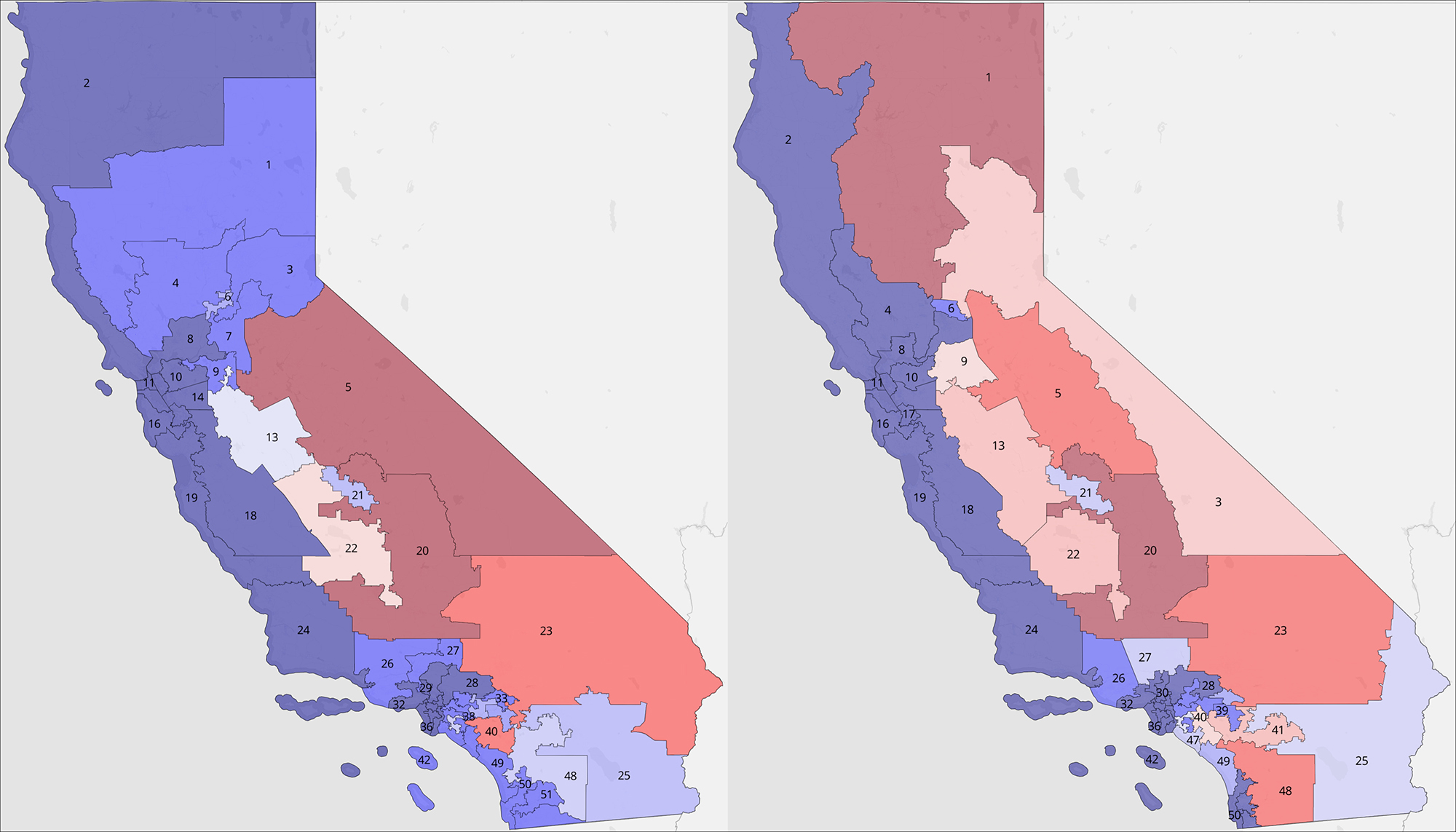
California Congressional redistricting map. Click on image or here to see interactive version: Dave’s Redistricing App.

By Jim Ellis — Monday, Nov. 17, 2025

Redistricting

The Dave’s Redistricting App (DRA) statistical organization released their data figures for the new 52 California redistricted congressional districts, and their non-partisan analysis may not be quite as rosy for the Democrats as Gov. Gavin Newsom and the party leaders have boasted. The DRA is the only data organization that has already calculated a clear partisan division for all of the new Golden State districts.

Several Democratic incumbents, and surprisingly the two considered most vulnerable heading into the 2026 election, actually fare worse when compared to the previous draw. Several Republican districts have no doubt been destroyed, but the situation may not be as dire for the GOP as Gov. Newsom’s media spin leads one to believe.

Starting in Northern California, Rep. Doug LaMalfa’s (R-Oroville) 1st District has been transformed into a Democratic district. According to the DRA partisan lean calculations, the 1st moves from 60.2R – 37.7D to 55.2D – 44.1R. With state Senate President Mike McGuire (D-Sonoma County) positioning himself to challenge Rep. LaMalfa, the Republican Congressman will have a very difficult time winning an eighth term.

Rep. Ami Bera (D-Sacramento) is leaving his Sacramento County 6th District to run in District 3, which is now a point more Democratic than his home district. There, he will ostensibly challenge two-term Rep. Kevin Kiley (R-Rocklin/Sacramento). The move puts Rep. Kiley in a bad position since his 3rd CD has flipped from holding a partisan lean of 52.5R – 45.6D to one having a 53.4D – 45.7R split, a net swing of just under 15 percentage points toward the Democratic segment.

There is some speculation that Rep. Kiley will vacate District 3 and attempt to unseat fellow Republican Tom McClintock (R-Elk Grove) in District 5, one of just four safe Republican seats in the state. The new CA-5 partisan lean: 60.7R – 38.7D.

Rep. Adam Gray (D-Merced) was the closest winner of all 435 districts in the 2024 election, a 187-vote win over then-Rep. John Duarte (R). Surprisingly, the new map makes the latest version of CA-13 slightly less Democratic. The previous partisan lean was 54.0D – 44.2R, yet Duarte won the seat in 2022 and barely lost in 2024. The new partisan lean is a net 4.6 percentage points more Republican (52.4D – 46.9R).

Though the new 13th District remains more Democratic, the congressional voting history shows weakness in the Dem fortress. A strong candidate such as former Stockton Mayor Kevin Lincoln (R), who has already announced that he will run, projects another difficult race for Gray.

Fresno Rep. Jim Costa (D) has averaged only 53.4 percent of the vote in his two elections but his district, just like Rep. Gray’s, actually moves more Republican according to the Dave’s Redistricting App calculations. Instead of seeing a 58.5D – 39.9R partisan lean, the new district records a 54.4D – 45.0R swing, a net gain of 9.2 percentage points in the Republicans’ favor. Though Rep. Costa will still be favored to carry the new 21st CD, seeing a potential Republican upset develop here is not outside the realm of possibility.

Rep. David Valadao (R-Hanford) has always been a major national Democratic target since he represents one of the most Democratic districts to send a Republican to the US House. Despite facing an adverse partisan lean in the previous District 22 version of 55.5D – 42.6R, Rep. Valadao secured two consecutive victories. This is another Central Valley district where the non-partisan calculations find the Republican factor getting better on this new map.

Moving forward, the DRA partisan lean for CD-22 is 52.1D – 47.3R, representing a net Republican gain of 8.1 percentage points. Therefore, with Rep. Valadao securing a 53-47 percent victory under the previous partisan lean, his chances should improve under this new 2026 map.

Seven-term Rep. Raul Ruiz (D-Indio) also sees his sprawling desert district become a bit more Republican. According to the past and present DRA partisan lean calculations, Rep. Ruiz’s 25th District is 5.5 percentage points more Republican. The new partisan lean is 54.2D – 45.3R, which clearly still favors Democrats, but the new draw makes the seat potentially more competitive.

The new 40th District is the final domain conceded to the Republicans. At this point, it appears both Reps. Ken Calvert (R-Corona) and Young Kim (R-La Habra) may be fighting each other to capture this seat. Rep. Calvert has already declared he will run here as his 41st District was transferred to Los Angeles County from Riverside County, and Rep. Linda Sanchez (D-Whittier) has declared her intent to run in that district.

Neither Reps. Calvert nor Kim represent a great deal of the new 40th, so we will see how this paired contest eventually unfolds. It is possible that both could advance to the general election under the state’s jungle primary format so we might see a year-long campaign between the two Republicans.

Another surprising aspect on this new map is the draw for freshman Rep. Derek Tran (D-Orange) in the new 45th District. In 2024, Tran unseated two-term GOP Rep. Michelle Steel (R) by 653 votes, which made it the second-closest congressional race in California and the nation. Yet, under the new map, the partisan lean actually moves slightly more toward the Republicans. When Rep. Tran won, the DRA partisan lean was 52.2D – 45.9R. The new ratio is 51.7D – 47.5R, a net swing of 2.1 percentage points toward the GOP.

While Rep. Tran will still see more Democratic voters in his district than Republican, we can count on the GOP making a major effort here. Under the new draw, this seat could be another option for Rep. Kim.

The final district that was greatly changed is Rep. Darrell Issa’s (R-San Diego) 48th District. The seat flips from having a partisan lean of 58.3R – 39.8D to a new district, largely because of including most of the city of Encinitas, that yields a 50.6D – 48.7R partisan split. Obviously, the district is somewhat more Democratic, but the numbers are close enough that Rep. Issa will have a fighting chance to win again.

While Democrats will very likely gain seats under this new draw and reduce California’s Republican contingent to fewer than the nine seats they currently control, stretching to a Democratic gain of five might not be achieved.

A Democratic Sweep: Sherrill, Spanberger, Mamdani and More All Win

By Jim Ellis — Wednesday, Nov. 5, 2025

Elections

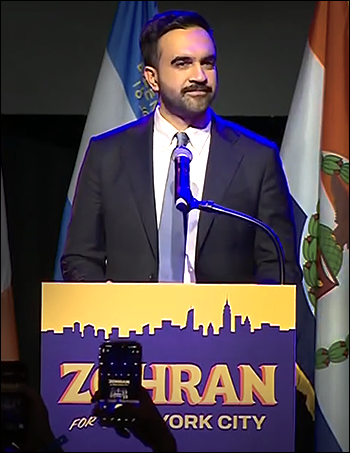
New York City voters elected Democratic Socialist Zohran Mamdani as their next Mayor.

Last night’s election results yielded victories for Democrats across the board and it appears that high prices and the state of the economy are among the top reasons.

Of course, Democrats will argue that their attacks against President Trump compared to the election results is a rejection of the current administration, and the votes provide evidence for such a claim, but New Jersey and New York City are heavily Democratic enclaves, and the Washington, DC metropolitan area, including the Northern Virginia and Maryland suburbs have repeatedly proven itself as the most anti-Trump region in the country.

Therefore, within the partisan context, the election results should not be considered overly surprising.

New York City

As expected, state Assemblyman Zohran Mamdani (Democratic/Working Families) was elected Mayor of New York City last night, capturing what looks to be a bare majority of the vote.

In the end, it appears the self-described Democratic Socialist outpaced former Gov. Andrew Cuomo (Fight and Deliver Party), and Curtis Sliwa (Republican/Protect Animals Party) by a 50.4 – 41.6 – 7.1 percent margin. Polling did not fully capture Mamdani’s strength, nor Republican Sliwa’s weakness. In particular, the latter man polled approximately ten points better on average than his ultimate performance.

Certainly, barely going over the 50 percent mark gives Mamdani the mandate he needs to implement his more radical agenda, and certainly will have support to do so from the New York City Council. Much more to come in the ensuing weeks about this result and the new Mamdani Administration.

New Jersey

This gubernatorial election outcome was one of the most surprising decisions of last night as Rep. Mikie Sherrill (D-Montclair) scored what will likely be a 56-43 percent win over 2021 Republican gubernatorial nominee Jack Ciattarelli despite polling that suggested the race was falling into the toss-up range.

The Sherrill victory represents the first time a political party has won three consecutive New Jersey gubernatorial elections since World War II.

With the Congresswoman’s victory, we will see another special congressional election, this time in her 11th District seat. Sherrill will resign from the House shortly before she assumes the Governorship in mid-January. One of her first duties will be to schedule the special election for voters to elect her successor. Already vying for positioning are former NJ-7 Congressman Tom Malinowski (D) and several local Democratic officials.

Virginia

Polling in this race was spot on, as survey research firms were not only consistently projecting an Abigail Spanberger victory, but they also saw the surge for the Democratic candidates in the final week of early voting and on Election Day. The combination carried not only Spanberger, but also Lt. Gov.-Elect Ghazala Hashmi and Attorney General-Elect Jay Jones to victory as part of the Democratic sweep.

The most surprising result was Jones defeating AG Miyares after the controversy broke several weeks ago about him fantasizing about killing his Republican opponents. Much analysis about the Attorney General’s result will be forthcoming over the next period of days when the actual results can be digested.

California Proposition 50

As expected, last night Golden State special election voters easily adopted the referendum to replace the California Citizens Redistricting Commission congressional map with a plan that Gov. Gavin Newsom had drawn. The redraw gerrymander could net the Democrats five seats and reduce the Republicans to four of the state’s 52 congressional districts.

Whether the map actually produces such results remain to be seen in the 2026 election. We can expect to see legal challenges to the entire process to soon be forthcoming but with a strong public vote, overturning the new map becomes very difficult.

TX-18

The jungle primary for the third of four special congressional elections to fill vacancies was held in Houston last night. The results will go to a runoff election that Texas Gov. Greg Abbott (R) will schedule as soon as the Secretary of State verifies that no candidate received a majority of the vote.

The verification will come quickly, since Harris County Attorney Christian Menefee (D) and former Houston City Councilwoman Amanda Edwards (D) placed first and second with 32 and 25 percent of the vote, respectively. Therefore, no one came close to obtaining majority support.

The problem for whoever wins the runoff election, which will likely be in January, is that he or she will have to turn around and participate in a March 3, 2026, primary in another version of the 18th District and against incumbent Rep. Al Green (D-Houston) under the new Texas congressional map.

The Democrats are assured of keeping the 18th District seat to replace the late Rep. Sylvester Turner (D-Houston), but the prize may be short-lived because the regular primary in the new district will be just weeks after securing victory.

California Redistricting:
The Five Targeted Seats

The proposed congressional map by California Democrats, (left) and the current map (right). Click on map to see larger image. Graphic: Dave’s Redistricting App / Joshua Metcalf)

By Jim Ellis — Tuesday, Aug. 19, 2025

Redistricting

The California proposed retribution redistricting map that key staff members at the Democratic Congressional Campaign Committee (DCCC) drew is now public, and the process to adopt such a plan is beginning this week.

In order for the California Governor and legislators to replace their current congressional map before the 2030 census is completed, the leadership must find a way to usurp the California Citizens Redistricting Commission that the voters instituted through a 2010 ballot measure. The only way to cancel the Commission map, Gov. Gavin Newsom and the majority Democrats believe, is to have another vote of the people to directly adopt a specific new map.

While the Newsom et al interpretation will likely be subject to a lawsuit with the objective of halting the process, the legislature this week will vote on a measure to place a new congressional map on a special election ballot this November. To approve a ballot referendum, each legislative chamber must do so with a two-thirds super majority. Considering the Democrats hold well over two-thirds of the seats in both the state Assembly and state Senate, placing the referendum on the ballot will likely be achieved.

Whether a majority of special election voters will adopt the map is open to question. For years, voters have listened to arguments about enacting “fair” district maps. In fact, this argument was the crux of the 2010 initiative campaign to create the citizens’ commission and 61.3 percent of the voters did so. Yet, in this special election, the message coming from Democratic leaders will now be to ‘vote yes for gerrymandering.’

Therefore, getting a majority vote on such a measure may be a more difficult political task than Gov. Newsom and his cohorts currently believe.

Thanks to the statisticians at The Down Ballot political blog, we see the data behind the proposed district configurations. The very rapidly completed calculations tell us how the 2024 and 2020 presidential elections unfolded in every new district. The statisticians also calculated how much of each current district is included in a new 2026 district.

To put the new map in context, we must remember that the current delegation is comprised of 43 Democrats and just nine Republicans. The new map is projected to possibly take the Republicans down to as few as four seats.

As we know, the DCCC California map is drawn as a retaliatory move against the new Texas redistricting plan that could be adopted this week. Projections suggest that the new map could yield as many as five additional GOP seats.

It remains an important point to underscore that Texas Gov. Greg Abbott (R) added redistricting issue to his special session in response to a US Justice Department directive to redraw the map. The DOJ cited a recent en banc US 5th Circuit Court of Appeals minority districts ruling that now cause some of the state’s congressional districts to become illegal.

The California Republican US House members facing the most difficult re-election situations, should the proposed map become law, are Reps. Doug LaMalfa (R-Oroville; District 1), Kevin Kiley (R-Rocklin/Sacramento; District 3), and Ken Calvert (R-Corona; District 41).

Another GOP member, Rep. Darrell Issa (R-San Diego; District 48), would find himself in a much more competitive re-election campaign, while Rep. David Valadao (R-Hanford; District 22), would see his already Democratic-leaning seat further help a Democratic candidate. President Trump, however, still carried the new District 22.

Rep. LaMalfa’s new 1st District, according to The Down Ballot statisticians, would contain just 43.8 percent of his current constituency and transform from a 61 percent Trump district to a 54 percent Kamala Harris CD.

Rep. Kiley would retain 46.8 percent of his current 3rd CD, and sees the presidential index move from 50 percent Trump to 55 percent Harris. Based upon his residence, he would technically be paired with Rep. Ami Bera (D-Sacramento; District 6), but he would likely seek re-election in CA-3.

Rep. Calvert would find himself in the worst position of all the Republicans. A total of 50.5 percent of his current 41st District constituency would be placed in new District 38, which is 56 percent Harris and could mean a pairing with Rep. Linda Sanchez (D-Whittier; District 38), though it is likely she would run in new District 41. Most of Rep. Sanchez’s constituents are in either District 38 or District 31 that fellow Democrat Gil Cisneros (D-Covina) holds, but District 41 could be open, carries a Kamala Harris percentage of 57, and runs adjacent to her current district.

Rep. Young Kim (R-La Habra) would find most of her constituency in new District 41, but a third of her voters are in new District 40, which is a 56 percent Trump seat and does not have an incumbent. We could see Kim and Calvert both running for this seat.

The Issa 48th CD would keep only 32.3 percent of its current population base, while the presidential index moves from 56 percent Trump to 52 percent Harris.

Finally for the Republicans, the Valadao 22nd District keeps 84.3 percent of its current constituency and moves from 52 percent Trump to 50 percent Trump. Therefore, the region is not as partisan as some other district iterations that Congressman Valadao has previously faced.

The other Democrats most affected would be Reps. Robert Garcia (D-Long Beach; District 42) who would retain only 35.2 percent of his constituency base; Dave Min (D-Irvine; District 47) would lose a majority of his current seat (52.7 percent), but his new territory is much more Democratic; while Scott Peters (D-San Diego; District 50) would keep only 43.5 percent of his current constituency.

While these Democratic members would be in strong shape against a Republican, a series of strong Democratic candidates could pose individual threats to each.

The Redistricting Wars Begin

By Jim Ellis — Monday, July 21, 2025

Redistricting

Texas Gov. Greg Abbott’s (R) call to add congressional redistricting to the special legislative session has already elicited a response from a Democratic adversary.

California Gov. Gavin Newsom (D), has attacked Gov. Abbott’s redistricting move, calling it a partisan power grab, and says he will retaliate with his own legislature redrawing the Golden State congressional map to neutralize any seat gain that the new Republican map yields.

Several points make Newsom’s planned response unrealistic.

First, the California legislature has no redistricting power. In 2008, voters adopted a constitutional ballot proposition that created the California Citizens Redistricting Commission, which took the redistricting pen away from the legislature and awarded it to an appointed panel of individuals who are not in elected office. Therefore, Newsom and the legislators would first have to find a way to disband the Commission in order to proceed with a new map.

According to an article from The Down Ballot political blog that quoted Gov. Newsom from an interview he conducted with the Pod Save America hosts, the California chief executive indicated that he could call his own special session to place a measure on a special election ballot to void the Commission.

Gov. Newsom said on the podcast that he thinks “… we would win that. I think people understand what’s at stake in California. I think we come out in record numbers. I think it would be [an] extraordinary success,” the Governor concluded.

His prediction may or may not be accurate, and Newsom acknowledges that the calendar would be a major obstacle for such a movement because the commission invalidation process would require so much time.

The second option would be to claim, as Newsom said, that the Commission lacks mid-decade redistricting authority. The Governor argued that the ballot proposition awarded the Commission redistricting power after the Census was released and the lines would hold for the full decade. He said answering whether the Commission even has redistricting authority beyond once every 10 years and immediately after a Census should be pursued.

The third obstacle would be simply drawing a map that would give the Democrats five more seats in the California delegation. Gov. Newsom quoted President Trump as saying a new Texas Republican map could provide US House Speaker House Johnson with five additional Republican seats. Therefore, Newsom said California could neutralize such an increase.

The California delegation has 52 members and only nine are Republican. Can the Republicans be reduced to just four seats without endangering some Democratic incumbents? Seems the difficulty factor to avoid such an outcome is high when considering that President Trump received 38 percent of the statewide vote in 2024 and even Gov. Newsom’s own 2022 opponent, then-state Sen. Brian Dahle (R), garnered 41 percent.

Additionally, since the Census was released, Democrats have lost almost a full percentage point in voter registration affiliation and the Republicans have gained a point, not to mention that the overall state population figure is reduced.

According to the latest published voter registration figures (February 2025), Democrats claim 45.27 percent of the affiliations, Republicans 25.22 percent, and the non-affiliated, or Declined to State, option records 25.34 percent. Minor parties absorb the remaining 4.17 percent. Therefore, considering these numbers in trying to reduce the Republicans to just 7.7 percent of the seats (4 of 52), would prove to be quite a mathematical feat.

Additionally, using the Texas Democrats’ argument that the Lone Star State map is already gerrymandered because Republicans control 66 percent of the congressional seats but their presidential nominee only received 56 percent of the vote pales in comparison to the ratios in the current California map. There, Democrats control 83 percent of the districts even though the Democratic presidential candidate, and California winner, garnered only 58 percent.

The Texas map is explained in that President Trump carried all 25 Republican districts and two of the Democratic seats and ran almost four points ahead of the statewide Republican partisan lean calculation. In California, Kamala Harris carried no Republican congressional district and ran five points below the Democratic partisan lean figure.

The Texas legislature convenes today, and a new map will be released soon after since the special session is only 30 days long. At that point, further analysis can be conducted, and Gov. Newsom’s countermove strategy may begin.

California’s Strange Special Election in District 22 Held Yesterday

By Jim Ellis

Connie Conway (R)

April 6, 2022 — Voters in California’s Central Valley region have had their special congressional election wrap up as of yesterday. Former Rep. Devin Nunes (R-Tulare) resigned at the beginning of this year, and Gov. Gavin Newsom (D) scheduled a special election to fill the balance of the term even though this seat will disappear in the next Congress.

The California Citizens Redistricting Commission members significantly re-drew the Fresno area, and Nunes’ 22nd District largely became the new 5th CD that stretches northerly from the Fresno area’s northeast sector to the outer Sacramento suburbs. The new 5th is strongly Republican, and Rep. Tom McClintock (R-Elk Grove) sought re-election from this district. Had Nunes wanted to remain in Congress, this is the seat where he would have run.

Such being the case, the current 22nd District that former President Trump carried 52-46 percent and where Rep. Nunes averaged 61.7 percent of the vote during the five elections of the past decade, is split into four different seats, meaning last night’s special election winner really has no place to run in the general election. Therefore, the new member will serve just the balance of this year and retire.

Despite the lack of a congressional future, the 22nd District special drew four Republicans and two Democratic contenders. The race leader as of this writing is former state Assembly Minority Leader Connie Conway (R), who had said from the beginning that she would only serve the remainder of this term. She currently leads the race with 34.8 percent. It will take a week before results can be finalized due to mail-in votes that still need to be tabulated.

Another Republican, Elizabeth Heng, who held Rep. Jim Costa (D-Fresno) to a 57-43 percent victory in the current 16th CD (Rep. Costa is seeking re-election this year in the new 21st District), was also in the race. She was originally talking about running for the full term in the neighboring 13th District, a marginally competitive open seat, but did not file for the regular election.

The other Republican candidates were former FBI agent Michael Maher and retired Navy officer Matt Stoll. The Democrats were Lourin Hubbard, an operations manager at the California Department of Water Resources, and graduate student Eric Garcia.

In this special election, all of the candidates were placed on one ballot. If a contender received a majority of 50 percent plus one vote, said individual is elected outright and would be sworn into the House upon the California Secretary of State officially certifying the election. If no one received a majority, the top two finishers, regardless of party preference, would advance to a special general election run concurrently with the regular California primary election on June 7; with Conway’s tally currently standing at just 34.8 percent of the vote, it looks like things are headed that way.

Though the seat will be occupied for only a short time, this is an important election. Five seats are currently vacant, the number increasing with the resignations of Reps. Jeff Fortenberry (R-NE) and Filemon Vela (D-TX) last week on March 31, and four are from the Republican side. This reduces the Republican conference temporarily to 209.

If the Republican party holds the 22nd CD in this special election cycle, and a Republican candidate ulitimately will likely win, the conference would grow to 210, with the majority Democrats at 221. If the Republicans hold the AK-at large, MN-1, and NE-1 seats in their own scheduled special elections later in the year, the party will again hold 213 seats. Democrats, on the other hand, look to drop to 220 when Rep. Ted Deutch (D-FL) resigns.

It is possible we will not see special elections in the Texas and Florida Democratic vacancies until the regular general election date. It appears that both Govs. Greg Abbott (R-TX) and Ron DeSantis (R-FL) have the legal leeway to schedule concurrently with the regular general election to fill the Vela and Deutch vacancies.

California’s current 22nd District is comprised of parts of Fresno and Tulare Counties and includes the northeastern portion of Fresno city and the communities of Clovis, Dinuba, Visalia, and Tulare.

DCCC’s Red to Blue Targets

By Jim Ellis

March 14, 2022 — The Democratic Congressional Campaign Committee released their first targets in what they call their Red to Blue program or, in other words, the districts they hope to convert from Republican to Democrat. Curiously, two districts on the list are already blue.

Below is a look at the DCCC’s dozen released targets:


CA-22: Rep. David Valadao (R-Hanford)
2020 Win Percentage: 50.4% in District 21

• FiveThirtyEight: D+10
• Dave’s Redistricting App: 42.3% R / 55.1% D
Endorsed Candidate: State Assemblyman Rudy Salas (D-Bakersfield)

By the numbers, this is one of the Democrats’ best national targets, but Rep. Valadao has consistently won in Democratic seats. He lost in 2018, but won the seat back two years later. Assemblyman Salas is the Democrats’ top recruitment target. Despite the lopsided Democratic numerical advantage, the finish here will again likely be razor-thin.


CA-45: Rep. Michelle Steel (R-Orange County)
2020 Win Percentage: 51.1% in District 48

• FiveThirtyEight: D+5
• Dave’s Redistricting App: 45.8% R / 52.2% D
Endorsed Candidate: Jay Chen – Community College Trustee

Freshman Rep. Steel is another Republican to whom the California Citizens Redistricting Commission members were not kind. Moving into the more inland Orange County district from her coastal seat, Steel has been a well known figure in Orange County politics for many years, particularly with her service time on the Orange County Board of Supervisors before winning the congressional seat.

A D+5 seat is exactly the type the Republicans must win to achieve their goal of re-taking the majority. With national redistricting cutting against them, the GOP must win a sizable number of the 22 seats so far within the Even to D+5 category.


CO-7: Rep. Ed Perlmutter (D-Arvada) – Open Seat
2020 Win Percentage: 59.1%

• FiveThirtyEight: D+6
• Dave’s Redistricting App: 43.8% R / 51.7% D
Endorsed Candidate: State Sen. Brittany Petterson (D-Lakewood)

This district does not really belong on the list since it is already a blue seat. Democrats are favored to hold the seat and Sen. Petterson is clearly their candidate to do so.


IA-1: Rep. Mariannette Miller-Meeks (R-Ottumwa)
2020 Win Percentage: 50.0% (6 votes districtwide) in District 2

• FiveThirtyEight: R+4
• Dave’s Redistricting App: 49.7% R / 46.8% D
Endorsed Candidate: State Rep. Christina Bohannan (D-Iowa City)

Rep. Miller-Meeks won the closest race in the country in 2020, a literal six-vote affair against former state senator and 2018 lieutenant governor nominee Rita Hart (D). This year, the congresswoman will see a different opponent since Hart chose not to return for a re-match. State Rep. Bohannan has two Democratic opponents, but she should have little trouble in winning the party nomination on June 7.

This will be another close eastern Iowa campaign, and this district is actually one point more Democratic than the previous 2nd according to the FiveThirtyEight statistical organization. This is a top Democratic target, but Rep. Milller-Meeks will be favored assuming the political climate remains favorable for Republicans.


IA-2: Rep. Ashley Hinson (R-Marion/Cedar Rapids)
2020 Win Percentage: 50.0% in District 1

• FiveThirtyEight: R+6
• Dave’s Redistricting App: 51.1% R / 45.4% D
Endorsed Candidate: State Sen. Liz Mathis (D-Hiawatha)

In the first redistricting map presented last year, Rep. Hinson would likely have been defeated. With the legislature rejecting that draw, a new one emerged. This gives the congresswoman a more favorable seat but one this is still highly competitive. Democrats have recruited a strong candidate in Sen. Mathis. She has no primary opposition at this time. In a favorable GOP political climate, this seat would become difficult for the Democrats to convert despite its statistical closeness.
Continue reading