Author Archives: Jim Ellis

Pennsylvania’s Importance

Pennsylvania Congressional Districts Map (click on image to enlarge to see detail)

Pennsylvania Congressional Districts Map (click on image to enlarge to see detail)

By Jim Ellis

Oct. 6, 2017 — In every election, it seems one or two states become that cycle’s political focal point and we can already identify which places might serve in such a role for 2018. Along with California for House races, political fortunes in the Keystone State of Pennsylvania could well influence national Senate and House outcomes, while strongly contributing to the national redistricting outlook when the state’s competitive governor’s race is ultimately decided.

Gov. Tom Wolf (D) seeks re-election with improving favorability ratings and will be in a targeted 2018 campaign. Sen. Bob Casey Jr. (D) is running for a third term and drawing considerable opposition, particularly from US Rep. Lou Barletta (R-Hazelton). US House competition is projected for as many as 11 of the state’s 18 congressional districts, some of which coming in primaries, and a live political gerrymandering lawsuit before the state court system could potentially radically change Pennsylvania’s redistricting maps prior to the next election. Therefore, we see a state teeming with political activity in each of its four corners.

Gov. Wolf came from nowhere in 2014 as a successful York business owner to capture the Democratic nomination, and then proved to become the only member of his party to unseat a Republican governor in what was otherwise a Republican wave election year. He will face his own highly competitive re-election battle next year, as the GOP must re-capture this statehouse to protect its congressional and state legislative gains as a new redistricting cycle will begin during this next governor’s term.

Continue reading

Bannon: How Much a Factor?

Steve Bannon (Photo by Gage Skidmore)

Steve Bannon (Photo by Gage Skidmore)

By Jim Ellis

Oct. 5, 2017 — Several articles have appeared in the past few days contemplating former presidential advisor Steve Bannon’s perceived political strength, most specifically regarding his actions involving recruiting Republican primary challengers against Senate Majority Leader Mitch McConnell’s (R-KY) loyalists.

While Bannon appears in good stead vis-à-vis financial backers — with the billionaire Mercer family serving as his monetary base — those running the McConnell-aligned outside political operation downplay just how strong the insurgents might be opposite 2018 Senate GOP incumbents standing for re-election.

Valid points resonate with both sides. Buoyed by Alabama former state Supreme Court Chief Justice Roy Moore’s victory over appointed Sen. Luther Strange in last week’s special Republican run-off election, the Bannon forces, who heaped attack ads on the interim incumbent, were naturally taking a great deal of credit for the victory. And, without doubt, anyone thinking of challenging a sitting senator is greatly encouraged after seeing the Alabama outcome.

Continue reading

First Alabama Poll

By Jim Ellis

Oct. 4, 2017 — The Opinion Savvy research firm went into the field to test the Alabama electorate immediately after last week’s special Republican run-off election, and found the winner of that special primary election, former state Supreme Court Chief Justice Roy Moore, holding only a tenuous lead over his Democrat opponent, ex-US Attorney Doug Jones.

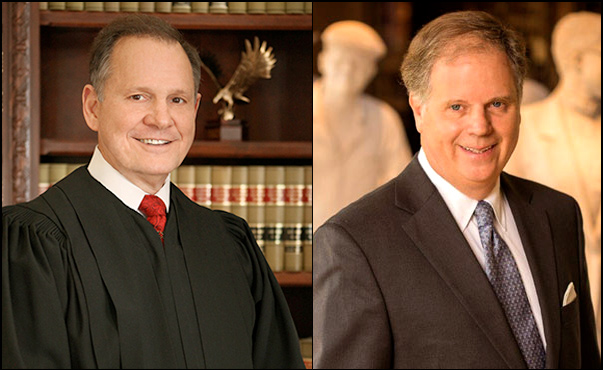
Left: Former state Supreme Court Chief Justice Roy Moore (R) Left: Ex-US Attorney Doug Jones (D)

Left: Former state Supreme Court Chief Justice Roy Moore (R)
Right: Ex-US Attorney Doug Jones (D)

The survey results, which other pollsters will probably soon confirm, should lead to the Democratic leadership launching a major offensive campaign here with the long shot goal of stealing the Republican stronghold seat. They have the resources but are hamstrung in this cycle because few offensive Senate opportunities exist; hence, they must make a serious play for this seat that would not normally be in play.

The Opinion Savvy poll (Sept. 27-28; 590 registered Alabama voters; 514 “definite” Dec. 12 special general election voters; 76 “considering” whether they will vote) finds Judge Moore leading Jones, 50-45 percent. Among the definite voters, Moore’s margin expands slightly to 51-44 percent. Within the lesser-motivated voting group, the Republican’s edge slides to just one point, 46-45 percent.

As we saw during the Republican run-off, a huge split – with diametrically opposite totals – exists between self-described evangelicals and non-evangelicals. Considering that the Census Bureau classifies 49 percent of the entire state population as evangelical, and 55.6 percent of this polling universe, this demographic segment was obviously a crucial block in determining the outcome of the Republican run-off and will have an equally large say in the upcoming special general.

Continue reading

Arizona Rep. Sinema Makes Her Move

Rep. Kyrsten Sinema

Rep. Kyrsten Sinema

By Jim Ellis

Oct. 3, 2017 — It has been apparent for some time that three-term Arizona Rep. Kyrsten Sinema (D-Phoenix) is preparing for a statewide race, and on Friday she officially made her intentions known. Rep. Sinema announced that she will run for Senate, challenging first-term Sen. Jeff Flake (R) or whomever the Republican nominee might be.

Former state senator and US Senate candidate Kelli Ward is Sen. Flake’s current Republican opponent and she leads him in the latest polls, but others could still enter if they continue to see Flake in a prone political position and Ward not perceived as a top-tier candidate. The Arizona partisan primary cycle is a long one. The vote is scheduled for Aug. 28, 2018, and with the filing deadline not until May 30 plenty of time remains for the final candidate field to gel.

It became obvious that Sinema was looking at either the Senate or governor’s race at the beginning of the year when her fundraising increased precipitously even though her Phoenix congressional district is now politically safe. Having more than $3 million in her campaign account by June 30 (the same amount as Sen. Flake, incidentally) became the strongest clue that she would run statewide despite her “announcement” during a Phoenix radio interview that she would seek re-election to the House.

Continue reading

Tennessee in Overdrive

By Jim Ellis

Oct. 2, 2017 — Sen. Bob Corker’s (R) Tuesday retirement announcement has ignited a Tennessee political fire drill.

Several Republican current and former office holders immediately began assessing their own chances of winning the party primary with the hope of succeeding the outgoing senator. For the Democrats, the opposite is occurring as three of the party’s most viable potential candidates quickly declined to run.

For the past several months, Sen. Corker has toyed with the idea of retiring. He would openly contemplate in interviews that he was only assessing whether he should run for a third term and, for a time, appeared to be seriously considering the open governor’s race. He always made a point to say that he hadn’t fully decided to run again, though he always indicated he would likely do so. Early this week, just days after a more conservative candidate who looks to have substantial outside backing formally declared his primary challenge, Sen. Corker announced his ultimate decision to retire.

Continue reading

The Primary Fallout

By Jim Ellis

Sept. 29, 2017 — Former Alabama State Supreme Court Chief Justice Roy Moore’s victory in Tuesday’s special Senate run-off election has created a media narrative suggesting that statewide GOP primary challenges will soon be sweeping the political scene, but such simply won’t happen.

While Judge Moore’s win may give legs to one adjacent budding Senate primary challenge, the number isn’t going expand due to the 2018 electoral set-up. That is, few Republicans, eight to be exact, are in-cycle for the coming election and the two most vulnerable situations already feature incumbents engaged with primary opponents.

Additionally, the Moore-Sen. Luther Strange contest had unique characteristics that made a primary victory over this particular incumbent more likely, if not probable. Strange, then Alabama’s attorney general, receiving the vacancy appointment in “swamp-like” fashion from a governor trying to avoid impeachment, and using the Senate appointment process to game the system so that he could later choose the person who would continue the legal investigation of himself, cast Strange in a negative light from his very first day in Washington.

Furthermore, the new senator attracted only 32 percent in his first election, meaning that two-thirds of his own party’s Aug. 15 primary voters turned away from him at their first opportunity, was a clear signal that Strange’s appointment was met with widespread dissatisfaction and that the former AG wouldn’t last long in his new job.

Continue reading

More on the Moore Win in Alabama;
Tennessee’s Corker to Retire

By Jim Ellis

Sept. 28, 2017 — Former state Supreme Court Chief Justice Roy Moore, twice removed from the court for disobeying federal court orders that violated his conservative principles, scored a robust victory Tuesday night over appointed Sen. Luther Strange in the special Republican Alabama Senate run-off election. Judge Moore now advances to the Dec. 12 special general election against the Democratic nominee, former US Attorney Doug Jones.

Sen. Strange went down to a 55-45 percent crushing defeat, just as pre-election polls predicted.

The Moore victory was expansive in that he took 63 of the state’s 67 counties, losing only in the Birmingham area (Jefferson and Shelby Counties), Huntsville (Madison County), and Sumter County in the western part of the state that hugs the Mississippi border. Moore racked up big wins in Montgomery, Mobile, and Dothan, and scored well over 60 percent in all rural areas.

Turnout was up from the first election. In August, 423,282 people voted in the Republican primary. Tuesday night, more than 480,000 individuals cast ballots in the Moore-Strange race, an increase of 13.5 percent for the run-off. The upsurge is unusual, as run-off participation normally falls below the numbers recorded in the primary.

Continue reading