Author Archives: Jim Ellis

Balderson Wins in OH-12;
Close Primaries Abound

the-primariesBy Jim Ellis

Aug. 8, 2018 — The multiple pollsters who predicted a very tight OH-12 special election finish last night proved correct, as Ohio Republican state Sen. Troy Balderson (R-Zanesville) defeated Franklin county Recorder Danny O’Connor (D) by a scant 50.2 – 49.3 percent margin, or an unofficial spread of 1,754 votes from a turnout universe of 202,521 people.

The turnout was just eight percent less than the number present in the 2014 midterm election, and ranks fourth highest among the 10 special US House elections conducted after the 2016 general election. In four of these contests: AZ-8 (Rep. Debbie Lesko), GA-6 (Rep. Karen Handel), MT-AL (Rep. Greg Gianforte), and PA-18 (Rep. Conor Lamb), special election voter participation actually exceeded the number of people voting in the last midterm.

The 12th District vote again revealed a stark difference in the timing of how the preponderance of Democrats and Republicans cast their ballots. Democrats dominated the early voting, sending O’Conner to an early 8,000-vote lead, but that advantage dissipated when the people who actually visited a polling booth recorded their votes, allowing Sen. Balderson to take the lead and win the campaign.

Balderson carried six of the district’s seven counties, but lost the anchor county, Franklin, by a large 65-35 percent margin. In four of the local entities, the Republican topped 60 percent of the vote.

Other close elections registered across the country:


KANSAS

The Kansas Republican gubernatorial primary is yet to be decided. With 185 precincts in Johnson County still outstanding — the rest of the state is complete — Secretary of State Kris Kobach holds a 40.7 – 40.5 percent lead over Gov. Jeff Colyer, a difference of just 541 votes, statewide. But Colyer’s margin in the Johnson County vote already recorded (43.6 – 36.6 percent) gives the governor a 4,011-vote edge.
Continue reading

The Aug 7 Primaries – Part II

the-primariesBy Jim Ellis

Aug. 7, 2018 — We finish our look at today’s primary elections, covering Michigan and Washington, and the OH-12 special congressional election contest.


MICHIGAN

The US Senate and open governor campaigns lead the Michigan ticket today. Sen. Debbie Stabenow (D) will learn whether she faces venture capitalist Sandy Pensler or retired Army Ranger and manufacturing company owner John James, the latter a President Trump-endorsed candidate, in the fall campaign. The senator begins the general election in the clear favorite’s position.

With Gov. Rick Snyder (R) ineligible to seek a third term, competitive Republican and Democratic primaries will be both settled tonight. For the GOP, Attorney General and former US Congressman Bill Schuette has enjoyed double-digit leads in all polling for several months over Lt. Gov. Brian Calley. On the Democratic side, former state House Minority Leader Gretchen Whitmer has been the clear leader almost since the campaign began, and she is expected to defeat former Detroit Health Commissioner Abdul El-Sayed and businessman Shri Thanedar. The general election promises to be highly competitive in this pivotal redistricting state.

Three open seats are the top attractions in the congressional contests.

In veteran Rep. Sander Levin’s (D-Royal Oak) open seat, it appears the retiring congressman’s son, energy consultant Andy Levin, is the clear favorite in the Democratic primary. The 9th is a decidedly Democratic district meaning Levin’s chances of succeeding his father in the general election are strong.

Rep. David Trott (R-Birmingham) is retiring from Congress after two terms and leaves a toss-up political contest in his wake. Crowded primaries are present for both parties, including a Republican race featuring five candidates, while the Democrats have an additional five people running. Trump state co-chair Lena Epstein has developed a late lead in two Republican primary polls, while former Treasury Department official Haley Stevens and state Rep. Tim Greimel (D-Troy) appear atop of the Democratic contest.

Continue reading

The Aug. 7 Primaries – Part I

By Jim Ellis

the-primariesAug. 6, 2018 — The Aug. 7 primaries that arrive tomorrow decide important nomination campaigns in Kansas, Michigan, and Washington; the Missouri political card is already virtually set. Today, we look at Kansas and Missouri, followed tomorrow by Michigan and Washington.


KANSAS

The Sunflower State governor’s race is the key feature in the Republican primary, as Gov. Jeff Colyer (R) appears to be struggling to cobble together a victory coalition in tomorrow’s primary election. Colyer ascended to the governorship when incumbent Gov. Sam Brownback (R) accepted a position in the Trump Administration. Colyer is attempting to repel a strong challenge coming from activist conservative Secretary of State Kris Kobach, who is leading in the latest polling.

According to the Trafalgar Group (July 30-Aug. 2; 1,546 likely Kansas Republican primary voters), Gov. Colyer trails Secretary Kobach, 43-36 percent. But the Remington Research Group, polling in the same period (Aug. 2; 859 likely Kansas Republican primary voters), sees a tie between the two men with both attracting 32 percent support. Former state Sen. Jim Barnett and State Insurance Commissioner Ken Selzer are at or below 13 percent preference in both polls.

Democrats also see a multi-candidate campaign, and it appears that state Sen. Laura Kelly (D-Topeka), the party activists’ favorite, is positioned to win the nominating election. She faces former Agriculture Commissioner Josh Svaty, and retired Wichita Mayor Carl Brewer, but Sen. Kelly appears to have constructed the appropriate coalition to achieve victory tomorrow night.

Continue reading

Tennessee Primary Election Results

By Jim Ellis

Aug. 3, 2018 — Often in politics when two candidates begin to square off against each other in a multi-candidate field, that pair loses and an opponent coming from the outside walks away with the prize. That model again happened last night in the Tennessee Republican primary.

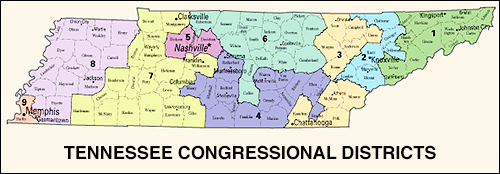
TENNESSEE-CONGRESSIONAL-DISTRICTS-with-citiesBusinessman Bill Lee, the only candidate with no governmental experience, took advantage of his late polling surge and captured the GOP gubernatorial nomination in Thursday’s Volunteer State primary election. Lee’s victory was substantial, winning a 37-24-23-15 percent over businessman and former state Economic Development Commissioner Randy Boyd, US Rep. Diane Black (R-Gallatin), and state House Speaker Beth Harwell (R-Nashville). Lee will now oppose former Nashville Mayor Karl Dean, who easily won the Democratic gubernatorial primary with 75 percent of the vote.

The open governor’s primary had been hotly contested. Rep. Black and Boyd had been leading in most polls, but Lee had made a major final push and became a late factor in the race. Most surveys had Rep. Black holding a slight advantage, but the polls had been hovering within the polling margin of error for several weeks. We saw that play out last night.

Voter turnout heavily favored the Republicans to the point of more than doubling the Democratic participation rate. In the governor’s race, 785,969 Republicans voted as compared to 369,775 Democrats. Lee now becomes the heavy favorite to succeed term-limited Gov. Bill Haslam (R) in the fall general election.

There was no suspense in the open US Senate race because Rep. Marsha Blackburn (R-Brentwood) and former Gov. Phil Bredesen (D) easily won their respective party nominations against only minor opposition, thus officially beginning a general election campaign that has already been proceeding for many weeks.

In the House races, incumbents Phil Roe (R-Johnson City), Chuck Fleischmann (R-Chattanooga), Scott DesJarlais (R-South Pittsburg), and Steve Cohen (D-Memphis) all were easily re-nominated in percentages ranging from 70 (DesJarlais) to 91 (Cohen). Rep. Jim Cooper (D-Nashville) was the only incumbent House member in either party unopposed for re-nomination.

Continue reading

Dead Heats in New Nevada Senate Poll

By Jim Ellis

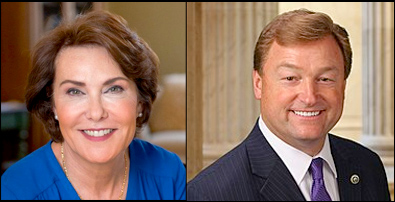
Nevada Senate candidate, Rep. Jacky Rosen (D) and Sen. Dean Heller (R)

Nevada Senate candidates: Rep. Jacky Rosen (D) and Sen. Dean Heller (R)

Aug. 2, 2018 — A new Suffolk University survey (July 24-29; 500 likely Nevada voters) returns numbers that again show Sen. Dean Heller (R) and Rep. Jacky Rosen (D-Henderson) falling within the margin of polling error with neither candidate attracting majority support.

According to Suffolk, Sen. Heller leads Rep. Rosen by a bare 41-40 percent margin, meaning the two are virtually tied. This is the first poll since mid-April that projects the senator to any kind of an advantage, but even the four surveys in between, all of which favored Rep. Rosen, showed margin spreads in the realm of two to six points. Of the eight polls publicized for this race during the entire election cycle, in only one, the April Survey Monkey study, did either candidate ever reach the 50 percent mark (Rosen, 50-44 percent; Survey Monkey; April 2-23; 1,332 Nevada registered voters in the Survey Monkey pool).

Suffolk also tested the state’s open governor’s race, and found an equally tight contest. Here, Republican Attorney General Adam Laxalt posts a 42-41 percent tally over Democratic Clark County Commissioner Steve Sisolak. In the one previously released post-primary general election poll, from Gravis Marketing (June 23-26; 630 likely Nevada general election voters), an almost identical result was projected: Laxalt leading 43-41 percent.

The Nevada Senate race is one of the most important in the nation this year, and one of two main Democratic conversion targets (the open race in Arizona is the other). Winning this race is the only gateway to the Democrats potentially gaining the Senate majority, thus we can expect to see major political action in this state for the remaining prime campaign months.

Continue reading

Playing the Percentages —
Scott Up in Detailed Poll

By Jim Ellis

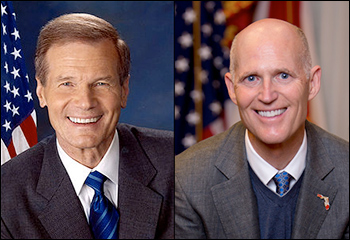
Left: Florida Sen. Bill Nelson (D) | Right: Gov. Rick Scott (R)

Left: Florida Sen. Bill Nelson (D) | Right: Gov. Rick Scott (R)

Aug. 1, 2018 — Another new poll was released yesterday on the Florida Senate race, and the data provides us an in-depth look at where each candidate is strong.

For more than a year, three-term Sen. Bill Nelson (D) and two-term Gov. Rick Scott (R) have traded the polling lead — from the time it became evident that the latter man, ineligible to seek re-election to his own statewide office, would initiate a challenge for the federal position.

Mason-Dixon Polling & Strategy pre-released their new Senate survey results (July 24-25; 625 likely Florida voters) after publicizing their gubernatorial primary data last week. According to their conclusions, Gov. Scott has a 47-44 percent lead over Sen. Nelson. While the two candidates have repeatedly superseded each other in various public surveys, the two have almost always been separated within the polling margin of error.

This is the fourth time since February of 2017 that Mason-Dixon has conducted a Florida Senate poll. But, this is the first where Gov. Scott has led. In their other surveys (Feb 2017, October 2017, February 2018, and the current July 2018), Sen. Nelson held an edge of five points (46-41 percent; Feb 2017) and a margin of one (45-44 percent; February 2018), or the two were tied (44-44 percent; October 2017). As you can see, in all four polls the two men are both in the 40s, with none ever commanding majority support. The current poll is no exception.

Continue reading

The Crystal Ball Comparison

By Jim Ellis

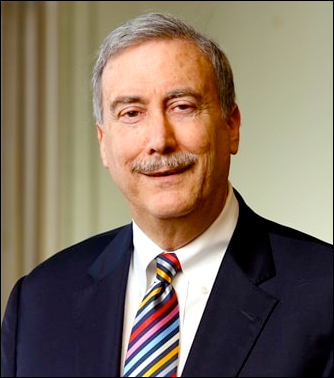
Professor Larry Sabato, University of Virginia

Professor Larry Sabato, University
of Virginia

July 31, 2018 — Last week, University of Virginia professor Larry Sabato released his latest “Crystal Ball” ratings of the current US House races and declared that the Democrats are a “soft favorite” to assume the majority in the coming November elections. There’s more to the story, however.

Dr. Sabato supports his claim for several basic reasons. First, he sites the historic trends that a new president’s party loses seats in the first midterm election, and traces this electoral pattern all the way back to the Civil War era. Second, he turns to the typical polling regularly released that places President Trump’s approval ratings in what he terms “the low 40s”, and includes the generic House ratings, along with the “enthusiasm” analysis. Third, is the Democrats’ record in the current cycle’s federal and state special elections, and fourth is their second quarter fundraising “advantage.”

There are counter arguments that need mentioning for each of these points.

It is questionable to compare electoral trends developed during the 1800s to the elections of today because the world has changed so much. Bringing the analysis to at least the 20th Century and looking just at the post-World War II patterns (from President Harry Truman, inclusive, to today), we find that the average seat loss in the House during a new president’s first midterm is 26 seats. But, this average combines the six Democratic presidents losing 32 seats, and the five Republicans’ dropping 15 districts. Just three elections, 1966 (Johnson; -47 seats), 1994 (Clinton; -54), and 2010 (Obama; -63) have substantially upped the overall average.

Continue reading