Author Archives: Jim Ellis

Giuliani in New Hampshire?

The Manchester, New Hampshire-based American Research Group (ARG) just released the results of their new Granite State poll (April 11-16; 600 likely NH Republican primary voters) and it includes a name not commonly mentioned when discussing 2012 Republican presidential candidates. Tied for third place with 8 percent of the vote is New York City former Mayor Rudy Giuliani, who has been spending much quality time in New Hampshire during the past couple of weeks. When asked if he is considering running again, he basically says “yes,” qualified with a statement that he would support someone else if he believed such person could defeat Pres. Barack Obama.

Former Massachusetts Gov. Mitt Romney captures first place in this new poll, with 32 percent of the respondents. Real estate magnate Donald Trump, who has been receiving a great deal of media attention recently for his proposed presidential run, is second with 17 percent. Tied with Giuliani are ex-House Speaker Newt Gingrich, former Arkansas Gov. Mike Huckabee, and Rep. Ron Paul (R-TX-14), who will officially form a presidential exploratory committee. Sarah Palin only scores a 2 percent preference rating, tied with former Minnesota Gov. Tim Pawlenty, Sen. Rand Paul (R-KY), and businessman Herman Cain. Now that Ron Paul is making moves to get into the race, it is likely that his son, Sen. Paul, will cease his potential presidential activities.

Should Giuliani decide to run and attacks New Hampshire with a grassroots, no frills campaign, and finishes at least a close second, he could again become a serious candidate, particularly within this current field of GOP candidates. It appears that anything can happen in the 2012 Republican presidential contest, so Giuliani entering the fray and doing well is certainly within the realm of possibility.
___________________________________________________
For further detailed insights, to sign up for my daily email updates, or to sign up to track specific issues or industries, please contact me at PR***@*******************ts.com.

Nevada: A Potential GOP Quagmire

Nevada's congressional districts.

Though it appears that Rep. Dean Heller (R-NV-2) is the obvious choice to replace outgoing Sen. John Ensign (R), who will resign May 3rd, the selection will ignite a series of moves that could be troubling for Silver State Republicans. Heller, a three-term congressman from the rural district – Nevada currently has three CDs, two in the Las Vegas metropolitan area, and one, NV-2, that touches a corner of Clark County (Las Vegas) and encompasses the rest of the state – is already the consensus Senatorial candidate for the party to maintain the swing-state Senate seat in 2012.

But, it is Heller’s House seat that could become problematic for the GOP if the congressman immediately replaces Sen. Ensign. Under Nevada law, the state party central committees choose nominees in the event of vacancies, and not the electorate through a direct primary vote. The law, however, is a bit sketchy. It does allow for independents to qualify for the ballot in addition to the major party nominees, and Democratic Secretary of State Ross Miller says he will decide the particulars of gaining ballot access. Miller himself could become a candidate for a different office in 2012, too. He was considering the Senate race, but deferred to Rep. Shelley Berkley (D-NV-1), once she announced for the seat. Running for the US House, however, is a possibility for him because Nevada will have at least two open seats next year. So, it is conceivable his rulings for this special election could in some way affect his own short-term political plans.

Redistricting is yet another factor in this complicated situation. Because Nevada gains a new 4th district from reapportionment, the 2nd district will drastically change. Since the current Clark County population figure is only about 20,000 people short of qualifying for three complete CD’s, it is probable that none of the Vegas area will be in the new 2nd. But, the special general election will be run in the current 2nd, which does include a section of the metro area. Democrats control the legislature and will draw the initial congressional map, but Gov. Brian Sandoval, a Republican, will have veto power over whatever is eventually sent him. If the two sides deadlock, then a court will draw the new congressional and legislative maps. Should the process find its way to federal court, the most liberal 9th Circuit of the Federal District Courts will come into play, as Nevada sits in that particular region. Therefore, even eventual court action is unclear.

Already, Sharron Angle, the controversial 2010 US Senate nominee who lost to Majority Leader Harry Reid 44-50 percent, has announced that she will run for the 2nd congressional district in the regular 2012 election. Back in 2006, Mrs. Angle, then a state assemblywoman, lost the Republican congressional nomination to Heller by just 421 votes. She will not be chosen as the Republican nominee in the special election by the party structure, and Secretary of State Miller’s ballot access rulings could factor prominently into her decision as to whether or not to seek the seat in the special election. Ideally, from a Democratic Party perspective, Miller will want to make it easy for Angle to enter the race. She will be a strong Independent candidate and could split the vote to the Democratic nominee’s advantage.

Democrats looking at the political picture here will certainly want to do what they can to encourage an Angle candidacy, hoping for a similar result as what happened in the Senate race. It is important to note, however, that Angle did beat Sen. Reid in the 2nd district portion of the state, which is a sobering fact for Democratic partisans thinking they can take advantage of a fractured 2nd district GOP and steal a victory. With Democratic control in the legislature, however, the party leadership could definitely draw a new 2nd district that would help Angle win a GOP primary, especially if another Republican wins the special election, thus throwing the seat into further chaos in the 2012 regular campaign.

Events will begin to unfold quickly after Ensign officially leaves office and Heller secures the Senatorial appointment.

No matter what eventually happens here, many twists and turns can be expected before the final votes are cast.
___________________________________________________
For further detailed insights, to sign up for my daily email updates, or to sign up to track specific issues or industries, please contact me at PR***@*******************ts.com.

Nevada Sen. Ensign to Resign; Heller Likely to be Appointed

Sen. John Ensign (R-NV), rocked with a sex and blackmail scandal that made winning re-election impossible, announced that he will resign his seat effective May 3rd. This will give newly elected Gov. Brian Sandoval (R) the opportunity of appointing a successor to serve until the next regular election in November 2012. All indications suggest that Sandoval will appoint Rep. Dean Heller (R-NV-2) as the interim senator. The congressman has already announced his intention to run for the open seat and has become the virtual consensus Republican candidate. Sandoval endorsed Heller for the seat long before it became known that Ensign would not serve the balance of his term.

Appointing Heller would give him incumbency advantage for the 17 months prior to the election. This will undoubtedly help him raise money; though, as a consensus candidate in a competitive U.S. Senate race, money would likely not have been an obstacle. One key difference, however: Upon appointment, Heller will be treated as an incumbent by the National Republican Senatorial Committee, thus making their involvement much easier than if the race happens to evolve into a contested primary. The party and institutional financial backing should give Heller an added boost in the general election as he will square-off with Las Vegas Rep. Shelley Berkley (D-NV-1). Last week Berkley made official her entry into the Senate race.

Nevada, the fastest growing U.S. state during the past decade (35 percent growth over the 10-year period; the national average was 9.7 percent) is a changing region. Previously, a place that leaned more Republican than Democrat, Nevada is now the quintessential swing state. While Senate Majority Leader Harry Reid was re-elected 50-45 percent in a very difficult campaign, Sandoval was simultaneously out-distancing Reid’s son, Rory, in the governor’s race, 53-42 percent. Freshman Rep. Dina Titus (D-NV-3) was also turned out of office by current Rep. Joe Heck (R-NV-3) in the seat that has become the most over-populated congressional district in the nation, housing over one million inhabitants. The strong growth rate awarded the state a new congressional seat, the third consecutive decade such as happened. In 2008, Pres. Obama carried the state over John McCain by a lopsided 55-43 percent mark. Four years earlier, then-President Bush outpaced John Kerry here 50-48 percent.

Thus, the stage is set for another close election, and an incumbency advantage for Heller could be just the impetus he needs to cross the political finish line first.

But, appointing Mr. Heller could cause further controversy at the U.S. House level. Heller actually vacating his congressional seat to finish Ensign’s term, means a special election will be held in NV-2 later this year. Sharron Angle, the Tea Party activist who won the GOP Senate nomination but came up short against Sen. Reid, has already announced that she will run for the open seat in 2012. A special election would hasten the political clock and she will undoubtedly enter the early contest, with a strong chance of winning a split primary. In 2006, when Heller was first elected, Angle only lost the Republican primary to him by 421 votes (39.5 – 39.3 percent). In a crowded field of candidates, which will likely occur, securing a base of +35 percent likely means winning the nomination, and she has previously done better in this very territory. The 2nd district touches a small part of Clark County (Las Vegas), and then occupies the rest of the state, including Angle’s power base of Washoe County (Reno).

In a way, the special election might actually hinder Angle’s chances of winning the primary. In a redrawn 2nd district, the seat will likely lose it’s Clark County portion, a place where Angle performed 11 percentage points under Heller in 2006. But, the special election will occur in the current 2nd district. Originally drawn as a safe Republican seat, the 2nd has become marginal. In fact, Heller only scored a 50-45 percent win over Nevada Democratic Party chair Jill Derby in ’06, followed with a closer-than-expected 52-41 percent victory two years later against the same opponent. Derby may again become a candidate, and could be strong in a special general election particularly if Angle wins the Republican nomination.

It appears evident that Nevadans are headed for another lively and potentially bitter election cycle yet again, and one that will almost assuredly begin early.
___________________________________________________
For further detailed insights, to sign up for my daily email updates, or to sign up to track specific issues or industries, please contact me at PR***@*******************ts.com.
Sen. Ensign to Resign in Nevada

Reports from Nevada are saying that Sen. John Ensign (R) will resign his seat as early as tomorrow. Speculation is rampant that Gov. Brian Sandoval (R) will appoint Rep. Dean Heller (R-NV-2), already a candidate for Senate in 2012, to fill the unexpired portion of Ensign’s term. Sandoval has already endorsed Heller for the open seat campaign.

More in tomorrow’s PRIsm Political Update.

Wisconsin Judicial Race in Official Recount

Normally a state Supreme Court judicial race doesn’t have much national significance, but everything coming from Wisconsin these days does. Assistant Attorney General JoAnn Kloppenburg, yesterday, officially requested a taxpayer financed statewide recount of her election defeat to incumbent Justice David Prosser. The official difference between the two candidates is 7,316 votes. The margin was barely within the 0.05% difference that can trigger an official recount. Any amount over this percentage can be tallied again, but the requesting candidate must finance the action.

This particular race was characterized as a referendum on Gov. Scott Walker’s position opposite the public employee unions in a fight that, for a time, attracted almost non-stop national news media attention. Both the unions and conservative organizations invested big dollars, activated large numbers of people, and expended immense effort into winning the April 5th election for their respective candidate. The winner would tip the conservative/liberal balance on the seven-member court one way or the other; hence, the high political stakes. The new law that now curtails public employee union organizing privileges will eventually come before the high court to finally decide, thus heightening the resolve for both sides in this election.

Most of the electoral controversy comes from Waukesha County, located due west of Milwaukee, where one town of more than 14,000 voters was not included in the original count. On election night, it appeared that Kloppenburg had won the election by a scant 204 votes, and declared victory. It wasn’t until the next day that the Waukesha error was discovered, thus igniting the dispute. Though the election is close, finding 7,400 illegal or missed votes is a very high number. Thus, Prosser’s victory will likely stand and the outcome should be viewed as a huge victory for Walker and his allies.
___________________________________________________
For further detailed insights, to sign up for my daily email updates, or to sign up to track specific issues or industries, please contact me at PR***@*******************ts.com.

House Financials – Analyzing the Numbers

The first quarter in the never-ending political fundraising cycle is in the books, and it appears that 37 incumbent Representatives raised more than $300,000 in the first three months of 2011. Six non-incumbents also posted numbers north of $300K, but in two of those cases the number was achieved with a large personal contribution.

Of the three dozen in the aforementioned group, 10, all Republicans, are freshmen. They are: Reps. Cory Gardner (CO-4), Allen West (FL-22), Joe Walsh (IL-8), Bob Dold (IL-10), Steve Stivers (OH-15), Pat Meehan (PA-7), Tim Scott (SC-1), Diane Black (TN-6), and David McKinley (WV-1).

Forty-seven members, 27 Republicans and 20 Democrats, have more than $1 million cash-on-hand. Ten (six Democrats and four Republicans) have more than $2 million. They are: Reps. Brad Sherman (CA-27), Ed Royce (CA-40), Cliff Stearns (FL-6), Jerry Costello (IL-12), Richard Neal (MA-2), Ed Markey (MA-7), Michele Bachmann (MN-6), Frank Pallone (NJ-6), Lloyd Doggett (TX-25), and Paul Ryan (WI-1). Sherman, Markey, Pallone, and Ryan actually have more than $3 million in the bank. Ryan, with $3,156,814 in his campaign account, has the most of any incumbent congressman.

The most prolific fundraising district is FL-22, as three potential candidates, including freshman Rep. Allen West, all broke the $250,000 mark in money raised. West attracted $452,843. Businessman Patrick Murphy (D) registered $352,449, and former West Palm Beach Mayor Lois Frankel (D) obtained $254,664. The early start here is a bit of a paradox. The 22nd district was represented by both a Republican, E. Clay Shaw, and Democrat, Ron Klein, during the past decade prior to West winning in 2010. With the state gaining two new seats, it is a cinch that this marginal district, currently stretching north to south from West Palm Beach and deep into Broward County as it weaves its way along the coast, will be radically redrawn. Therefore, it is unclear if either of these potential West challengers will even have a base within the new district.

The fundraising numbers can tell individual stories, too. Nevada Rep. Shelley Berkley (D-NV-1) just announced her decision to run for the Senate, but her campaign account suggests she made up her mind weeks ago. The congresswoman raised $694,750 for the first quarter. Though Rep. Todd Akin (R-MO-2) says he has not ruled out a Senate bid in the Show Me State, his early campaign activity suggests that he will get into the race. His first quarter income figure was $458,552, a big number for a member who has traditionally been less than prolific on the fundraising circuit. The same is true for Rep. Vern Buchanan (R-FL-13), who banked $524,757. He has also not yet ruled out a Senate bid. Rep. Tom Latham (R-IA-4), who just announced he will challenge fellow-Rep. Leonard Boswell (D-IA-3) because Iowa loses a seat raised $414,257. Rep. Michele Bachmann (R-MN-6) is gearing up for a potential presidential run, thus explaining her huge $1.75 million quarter. Another potential national candidate, Rep. Ron Paul (R-TX-14) raised almost nothing for his congressional account ($4,430), but has over $1.63 million on hand.

The California delegation is a story, too, as the 53 congressmen await the actions of a new redistricting commission, the members of which will draw the Golden State congressional lines for the first time. This explains a great deal of financial activity here, even though virtually all of the members have safe districts. California does not gain any representation from reapportionment for the first time in history, meaning that a further unknown creeps into the California redistricting mix. Rep. Brad Sherman’s CA-27 could be radically redrawn as Los Angeles County will likely have fewer seats than it does today, losing them to places such as the Inland Empire and desert region. Sherman is one of the members with more than $3 million in the bank, so he is ready for a campaign no matter where his district may land. Seventeen California members have more than $500,000 in their campaign accounts and seven of them are over $1 million.

As so often occurs in modern era politics, the dollars tell much of the story. The first quarter of 2011 appears to be no exception.
___________________________________________________
For further detailed insights, to sign up for my daily email updates, or to sign up to track specific issues or industries, please contact me at PR***@*******************ts.com.

Democratic Senators in Michigan, Pennsylvania, Looking Good

Democrats got two pieces of good news in the past few days from states where they fared poorly in 2010. In Michigan, former Rep. Peter Hoekstra (R-MI-2) closed the door on a potential Senate bid against two-term incumbent Debbie Stabenow (D) by saying he will not run statewide next year. Hoekstra left the House in 2010 to seek the governor’s office, but lost the primary to eventual general election winner Rick Snyder. Stabenow is perceived to be vulnerable in 2012, but so far no strong potential opponent has yet stepped forward to challenge her.

In Pennsylvania, Public Policy Polling (April 7-10; 493 registered Pennsylvania voters) just released a new statewide poll that shows Sen. Bob Casey, Jr. (D) doing very well against all name Republican potential candidates. The person faring best, though giving no indication that he will run again, is former Sen. Rick Santorum (R) who Casey defeated 59-41 percent in 2006. But, even this match-up isn’t particularly close. According to PPP, Casey leads Santorum 49-37 percent. Though he fares well on the ballot test questions, the senator has some potential vulnerabilities. Casey’s job approval index tallies just 39:35 percent, and among Democrats is only 55:22 percent. A long time remains between now and the candidate filing deadline, so expect the action to soon pick up in both of these states.
___________________________________________________
For further detailed insights, to sign up for my daily email updates, or to sign up to track specific issues or industries, please contact me at PR***@*******************ts.com.

Latham will Challenge Boswell in Iowa

Current Iowa congressional districts.

The new Iowa congressional lines have yet to be officially approved but Rep. Tom Latham (R-IA-4), whose district is apparently being collapsed in reapportionment, already has made his electoral decision for 2012. In an email announcement to supporters this past Friday, Mr. Latham said he will challenge Rep. Leonard Boswell (D-IA-3) next year. On paper, the vast majority of Latham’s current seat is in the new 4th CD that map drawers combined with fellow GOP Rep. Steve King’s 5th district; signs pointed to an intra-party face-off. That Latham chose to run against Boswell, even though just three counties carry over from his current district, certainly provides the best move for the Republican Party.

Iowa chooses to redistrict by empowering a legislative committee staff to construct new districts via a mathematical formula without regard to incumbency. Their 2011 work product has resulted in the pairing not only of Latham with now Boswell, but also Democratic members Bruce Braley (D-IA-1) and David Loebsack (D-IA-2), whose homes were placed together in the new 1st district. Loebsack, despite his Linn County (Cedar Rapids) power base being added to IA-1, says he will run in the new 2nd, which has the majority of his current territory.

Latham’s move against Boswell makes sense from several perspectives. First, as previously mentioned, it greatly helps the Republican Party, because a divisive primary is avoided. Second, Latham conceding the GOP nomination in the new northwestern 4th district to King also helps the party prepare for the general election there because this new seat is not as solidly Republican as his (King’s) current 5th district. Third, in the person of Rep. Latham, the Iowa Republican Party now has its strongest possible candidate against Boswell who has been weakened in several close elections but never succumbed to defeat.

Another Latham advantage will be his huge campaign war chest. The asset is more important in a general election than for a primary battle opposite King because spending is less for a nomination battle and the latter has a strong Tea Party grassroots network that can independently turn out its own vote.

The new IA-3 is the Des Moines-Council Bluffs seat. Polk (Des Moines) is the largest county in the district and the biggest population center in Iowa, housing 429,439 people. It is the only county that remains from the current 3rd. Boswell’s present district begins in Polk County and stretches to the northeast. The new 3rd also launches from Polk but stretches to the southwest, all the way to the Nebraska border.

Historically, the 3rd has been a politically marginal district. Former President George W. Bush carried the region in 2004 by just a few votes over John Kerry, but Pres. Barack Obama rebounded to score a much higher 54-44 percent win over John McCain four years later. The new 3rd district becomes even tighter, as it skews approximately three more points in the Republicans’ favor. Obama carried the new configuration 52-46 percent, while Bush would have scored an identical percentage and margin of victory back in ’04. The shift should definitely play to Latham’s favor in 2012.

Rep. Boswell, first elected in 1996, is 77 years old and has had previous health issues. Long speculated about as a potential retirement prospect, the congressman confirmed even before the redistricting process began that he would be a candidate for re-election. He’s averaged 54.2 percent of the vote over eight terms, but hit just 50 percent in 2010. Changing the voting pattern and geography of the district to give the GOP a small boost means the race will begin as a pure toss-up.

Though King dodges a bullet by not having to face Latham, he may not yet be out of the woods. Christie Vilsack, wife of US Agriculture Secretary and former Governor Tom Vilsack, has been saying she will run for Congress in 2012. Because of redistricting it was not clear who she might oppose, especially since the family home is in Rep. Loebsack’s 2nd district. Word is now forthcoming that Mrs. Vilsack is seriously considering hopping into the new 4th district, at the opposite end of the state, to challenge King.

While the new 3rd becomes more Republican in redistricting, the new 4th gets slightly more Democratic. King’s current 5th district gave McCain a 54-44 percent victory, and George W. Bush notched a more impressive 60-39 percent win in 2004. The new 4th brings these numbers closer together. McCain’s performance in the just-configured northwest region was 50 percent as compared to Pres. Obama’s 48 percent. Bush would have carried the seat 55-44 percent. King would be favored against Mrs. Vilsack, but the race certainly has the potential of becoming highly competitive.

Now that redistricting is virtually settled, it is clear that 2012 will feature a very active congressional election cycle in the Hawkeye State.
___________________________________________________
For further detailed insights, to sign up for my daily email updates, or to sign up to track specific issues or industries, please contact me at PR***@*******************ts.com.

The (Way Too) Early Line – Vulnerable or Not?

While it’s far too early to place any value on hypothetical match-ups in a presidential election that’s 18 months away, some preliminary polling numbers are starting to raise eyebrows and interest in the 2012 Presidential sweepstakes.

Some polls released into the public domain do little to enlighten or inform about public opinions because of small or meaningless sampling methodologies or survey techniques. Others, however, provide a snapshot of informed opinion that can influence future outcomes.

A question on the minds of Democrats and Republicans alike is: “Is President Obama vulnerable in 2012?” Since the 1932 Great Depression era election of Franklin Delano Roosevelt, only two incumbent presidents have been beaten by opposing candidates in a general election. Jimmy Carter’s loss to Ronald Reagan in 1980 and George H.W. Bush’s 1992 defeat at the hands of Bill Clinton stand out as the only two examples of incumbent presidents losing a November election during that time span. (Lyndon Johnson’s withdrawal ended his 1968 re-election candidacy during the primary campaign.)

While Pres. Barack Obama continues to enjoy fairly high personal approval ratings from likely 2012 voters, his policy agenda doesn’t command the same level of support. In fact, looking at the trend line from the Rasmussen Reports tracking polls, conducted daily since the presidential inauguration, one sees that Mr. Obama’s overall approval rating has been under 50 percent every day since Feb. 18, while his disapproval score has consistently exceeded 50 percent post-Feb. 10.

These numbers might not mean much taken in and of themselves because Obama won’t be facing a “stay or go” plebiscite in November 2012. Instead, he will square off with a Republican challenger and, perhaps, an independent entry with a stark ideological bent.

During the month of March, Rasmussen conducted a series of presidential ballot test studies that included 10 different hypothetical GOP nominees. The comparison surveys all sampled at least 1,000 (and in some cases 2,000) likely voters and were conducted during the March 6-31 period. The sampling margin of error for surveys of 2,000 is +/- 2 percent with a 95 percent level of confidence; the error rate for surveys of 1,000 is +/- 3 percent with a 95 percent level of confidence.

Interestingly, regardless of who becomes Obama’s Republican opponent, the data shows he garners support between 49 and 42 percent of the respondents. The match-ups project Arkansas former Gov. Mike Huckabee to be running dead even with the president (43-43 percent), while Massachusetts ex-Gov. Mitt Romney trails 40-45 percent. Rep. Ron Paul (R-TX-14) is down 34-42 percent and Mississippi Gov. Haley Barbour lags behind by exactly that same percentage. As you have seen, all of the aforementioned Republicans trail by single-digit margins. GOP potential candidates down double-digits include: former vice-presidential nominee and Alaska Gov. Sarah Palin (38-48 percent), Minnesota former Gov. Tim Pawlenty (35-45 percent), Ambassador to China Jon Huntsman (31-41 percent), former Speaker of the House Newt Gingrich (37-49 percent), Indiana Gov. Mitch Daniels (32-45 percent), and businessman, newspaper columnist and Tea Party activist Herman Cain (25-43 percent).

At this early point in the election cycle, there are few definitive conclusions to draw from the president’s middling approval ratings and his less than dominant showing in these hypothetical horse races. However, there is also little to suggest that Mr. Obama will have the luxury of running a relaxed, Rose Garden re-election strategy either.
___________________________________________________
For further detailed insights, to sign up for my daily email updates, or to sign up to track specific issues or industries, please contact me at PR***@*******************ts.com.

Fayetteville Finger Falls

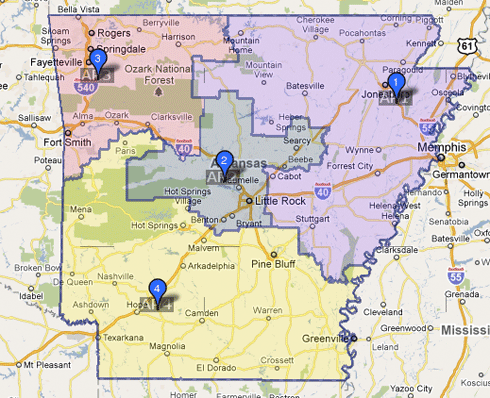
The current layout of Arkansas' congressional districts. (govtrack.us)

The Arkansas legislature officially sent Gov. Mike Beebe (D) a new congressional district map, but the attempt to annex the city of Fayetteville to Democratic Rep. Mike Ross’ 4th district failed. This is a victory for the northwest Arkansas-area legislators who insisted that the city stay as the anchor of the 3rd district. The controversy surrounding Fayetteville erupted because of a proposal that featured a jutting protrusion, dubbed the “finger,” beginning in the southern part of Arkansas and stretching all the way to Fayetteville in the northwest. This was done to put more liberal voters into Rep. Ross’ 4th district to better secure the seat for future Democrats. Ross is expected to run for governor in 2014, thus creating a potentially competitive open seat three years from now. The Fayetteville “finger” would have cemented the seat for the Ds.

The new map secures AR-3 for Republican Steve Womack, but the 4th could now become competitive after Ross departs. The 2nd district remains relatively intact, which is good news for freshman Rep. Tim Griffin (R). The GOP could take a hit, however, in the 1st district that will now cover the entire eastern portion of the state. The inclusion of more Democratic votes in Arkansas’ southeastern delta region will likely make freshman Rep. Rick Crawford’s seat highly competitive. Liberal activists are generally upset with the map, believing that the Democratic legislature and governor should have drawn a plan to return to a 3D-1R advantage, instead of the current split that features the exact opposite 3R-1D division. To summarize, the new Arkansas congressional map has two marginal seats and two that will likely remain Republican, thus the source of angst for the Democratic partisans.
___________________________________________________
For further detailed insights, to sign up for my daily email updates, or to sign up to track specific issues or industries, please contact me at PR***@*******************ts.com.