Monthly Archives: April 2026

Steyer Declares War

By Jim Ellis — Thursday, April 16, 2026

Governor

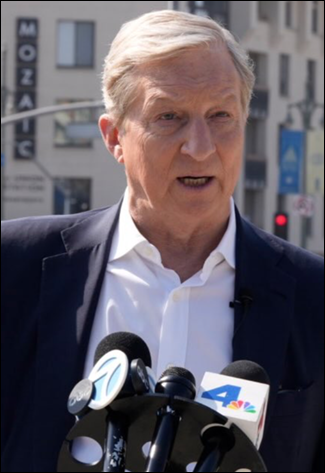
California businessman and investor Tom Steyer / Facebook photo

Just two days after Rep. Eric Swalwell (D) dropped out of the California Governor’s race and then announced his resignation from the US House over sexual assault accusations, Democratic gubernatorial and billionaire businessman and investor Tom Steyer, who could become the race’s leading candidate, made an unorthodox and controversial campaign move.

Steyer, who has already spent over $90 million of his personal wealth to promote his gubernatorial campaign has a chance to become the top Democratic candidate and qualify for the general election in the state’s top two primary system.

Party leaders are concerned that the primary vote would be split among so many Democratic candidates (23) that two Republicans, namely former Fox News host Steve Hilton and Riverside County Sheriff Chad Bianco, could capture first and second place. Such a result would freeze any Democratic candidates from advancing to the general election.

The shutout fear also explains why party leaders were beginning to coalesce around Swalwell, believing he had the best chance of securing a general election qualifying position. Now, without him in the race, the party leaders need to focus on another candidate to avoid the shutout.

Tom Steyer is a former presidential candidate who began as an Independent but later became a Democrat. He is a controversial figure, and one not likely to commit his complete allegiance to party leaders as readily as would many of the other Democratic contenders.

The Steyer new policy objective declares war on ICE and advocates the following principles in his released plan:

  • Abolish ICE – Put ICE agents in jail & “treat them like the mob.”
  • Bring those “kidnapped & detained by ICE back home.”
  • Give the California Attorney General the power to imprison ICE agents & their leadership.
  • Have taxpayer funded legal representation & support for illegal aliens.
  • Ignore a SCOTUS ruling that allows ICE to utilize to use race, language, job, and location to contribute to “reasonable suspicion” for immigration arrests, and instead, California should take matters into our own hands and extend legal protections to its residents, despite the federal government’s failure.

Launching such a controversial policy statement, and one that is extreme even by California standards, may prove the exact wrong strategy to employ just when he could now move to the top of the massive 62-person candidate field.

It is important to remember that all voters are eligible to participate in the June 2 qualifying election, not just Democratic Party members as would be the case in a closed primary; going to extremes on the immigration issue, then, even to the point of basically declaring civil war on the federal government, may not be a successful proposition.

While California is one of the most reliably Democratic states in the country, and a party candidate’s victory in the 2026 general election is already viewed as a foregone conclusion by most political observers, a Democrat finalist’s margin in some statewide campaigns is not insurmountable.

Most Republican candidates attract about 40 percent of the general election vote, and most Democratic winners secure their statewide positions in the high 50s.

Therefore, while the Democratic base is certainly anti-ICE, it may be a stretch for Steyer to assume that the majority of even California Democratic voters want to jail law enforcement officers, bring back deported aliens, ignore the US Supreme Court, and virtually break the state away from the United States.

The Steyer immigration policy document now brings yet another point of controversy into the California Governor’s campaign and may open the door for another Democrat to emerge as the party’s top candidate. Such a Democratic candidate might better attract traditional party support and gain the necessary momentum to overtake Steyer and secure a general election position.

Or, these latest turn of events in the California Governor’s campaign could lend more credence to the idea that a pair of Republicans, Hilton the Fox News host, or Bianco the law enforcement officer, could actually secure both general election slots and shut out the entire Democratic field for the general election.

Two Resignations; NJ-11

By Jim Ellis — Wednesday, April 15, 2026

Resignations

California US Rep. Eric Swalwell (D-Livermore/East San Francisco Bay Area) / Facebook photo

Monday, amid sexual assault and harassment allegations, California US Rep. Eric Swalwell (D-Livermore/East San Francisco Bay Area) announced that he will be resigning his congressional seat. After withdrawing from the Governor’s race the day before and not eligible to seek re-election because the California candidate filing deadline has long since passed, Swalwell’s political career is likely over.

Hours later on Monday, US Rep. Tony Gonzales (R-TX), who was involved in an extramarital affair with a staff member who then committed suicide, also said he will resign his Texas congressional seat. Two other members, both from Florida, Reps. Sheila Cherfilus-McCormick (D) and Cory Mills (R), are also under ethical clouds.

Rep. Cherfilus-McCormick is already under federal indictment for stealing and misusing COVID and government administrative funds, and the House Ethics Committee found her guilty of 25 related ethical violations. Rep. Mills has been accused of similar sexual misconduct as Swalwell though to a lesser degree.

Very likely, the bipartisan move forming in the House to expel the four, two Democrats and two Republicans, was gaining fast support, which undoubtedly led to the quick Swalwell and Gonzales decisions to leave voluntarily rather than experience the humiliation of expulsion.

With the two resignations, it is unclear at this point whether the move to expel the others will continue. What we do know is we will see two more vacant seats in the House.

The New Jersey vacancy was filled Tuesday night, while the California 1st District seat of the late Doug LaMalfa (R) will go to the ballot on June 2. If no candidate receives majority support, a runoff election will occur on August 4th.

Gov. Gavin Newsom (D) will set the special election calendar for District 14 to replace Swalwell for the balance of the term. Under California special election law and depending upon the exact date when the seat comes open, Gov. Newsom could schedule the 14th District special concurrently with the 1st District election calendar.

In Texas, Gov. Greg Abbott (R) has wide latitude in terms of scheduling special elections. With the Republicans being down another seat, Abbott will be under national GOP pressure to schedule the Gonzales replacement special quickly. Again, depending upon the exact day that Gonzales resigns, Gov. Abbott may be able to schedule the 23rd District special election vote concurrently with the May 26 runoff election date.

Under Texas special election procedure, if a candidate receives majority support in the first election, the individual is elected outright. If no one reaches the majority plateau, the Governor will then schedule the runoff election when it becomes official that such an election is necessary.

Republicans already have a 23rd District general election nominee in the person of businessman Brandon Herrera, so it is likely the party leaders will line up to support him in the special election and attempt to dissuade any major contender from running. Doing so would give Herrera the clearest opportunity to win outright.

It remains to be seen if the other two members face an expulsion vote. Since both are from Florida, Gov. Ron DeSantis (R) would determine the special election calendar if one or both seats become vacant. The regular Florida primary is Aug. 18, so this would be the most likely day for a special election vote. It is also possible that he could schedule any necessary runoff concurrently with the general election.

In conclusion, the resignations and possible resignations or expulsions will once again change the size of the House chamber. Because the partisan breakdown is even between the two parties, the latest vacancies are less cumbersome because combined they bring neither party an overt advantage.

NJ-11

Northern New Jersey voters went to the polls yesterday to fill the state’s 11th Congressional District seat; Democratic Socialist and former Sen. Bernie Sanders’ staff member Analilia Mejia won the seat. Her GOP opponent was Joe Hathaway, the Mayor of Randolph Township.

The 11th District that stretches from the northern Newark suburbs and through Morristown is reliably Democratic, and Republicans are not making a concerted effort to compete here. Therefore, last night’s election result was virtually a foregone conclusion.

After the election, the House open seat count drops to 61. With the Swalwell and Gonzales resignations, the open number will not change because neither were running for re-election and were included in the aggregate figure.

California Chaos

By Jim Ellis — Tuesday, April 14, 2026

Governor

Rep. Eric Swalwell (D-Livermore/East San Francisco Bay Area) / Facebook photo

The Democrats are experiencing a bumpy ride in the open California Governor’s race, and the one scenario where a Republican could win the 2026 general election is now within the realm of possibility.

The electoral system is problematic for the Democrats in this particular race. In 2010, California voters passed a ballot proposition that transformed their partisan primary into a top two jungle qualifying election. All candidates are slotted on the same ballot and the top two finishers, regardless of political party affiliation and percentage attained, advance to the general election.

Several polls released during the past months have projected two Republicans, former Fox News television host Steve Hilton and Riverside County Sheriff Chad Bianco, running in first and second position because the Democratic vote was divided among so many contenders.

A total of 62 candidates will be on the California gubernatorial ballot including 24 Democrats, 13 Republicans, 19 under the No Party Preference label, and six more representing minor parties. Also keep in mind that each of California’s 58 counties conducts a random draw for ballot position.

Therefore, all 62 candidates will likely find themselves in a different ballot slot in each county, thus making the already confusing election even more so. And now there’s even another twist.

Rep. Eric Swalwell (D-Livermore/East San Francisco Bay Area) — who had begun to coalesce key Democrats and certain allied groups around his candidacy and was generally running a close second in polling — has ended his candidacy. Not only that, but yesterday, he also resigned his US House seat.

Rep. Swalwell was beginning to become the Democratic candidate most likely to advance, though billionaire Tom Steyer was moving up the polling chart because he is spending so much money on campaign advertising. It is estimated that Steyer has already spent over $90 million of his own funds to advance his candidacy.

However, now Swalwell has found himself in trouble due to sexual harassment and assault accusations coming from former staff interns and ex-staff members. This, on top of the fact that several years ago he was engaged in an alleged affair with an associate who was later outed as a Chinese spy.

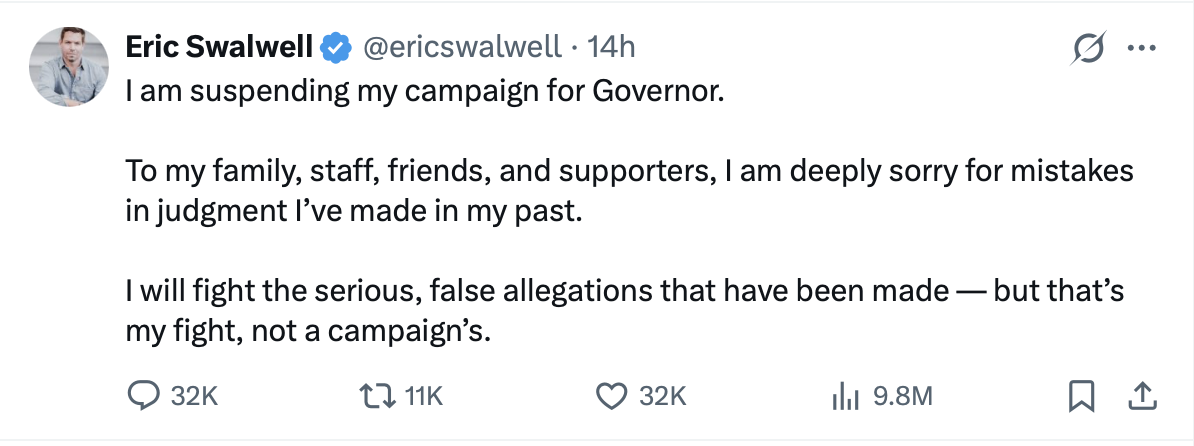
Swalwell suspended his gubernatorial campaign Sunday. “I am suspending my campaign for Governor,” Swalwell announced in a short statement on X. “To my family, staff, friends, and supporters, I am deeply sorry for mistakes in judgment I’ve made in my past.” Swalwell’s campaign co-chair had resigned in the wake of the allegations, and top House Democrats had urged him to drop out of the race.

Click on the image above to see Rep. Swalwell’s post on X.

Former US House Speaker Nancy Pelosi (D-San Francisco) called upon Swalwell to end his gubernatorial campaign as did House Democratic Leader Hakeem Jeffries (D-NY). Rep. Jimmy Gomez (D-Los Angeles), a co-chair of the Swalwell for Governor campaign, withdrew his endorsement and support. Sen. Adam Schiff (D-CA) and California US Reps. Scott Peters (D-San Diego) and Adam Gray (D-Merced), along with Arizona Sen. Ruben Gallego (D) also publicly withdrew their endorsements.

Additionally, the powerful California Teachers Association and a Super PAC formed to support Swalwell also had withdrawn their support, and several Swalwell staff members left the campaign.

The prominent Democrats must now find another candidate with enough political strength to block Hilton and Bianco from gaining both general election positions.

Additionally, since the California candidate filing deadline has long since passed, Rep. Swalwell does not have the option of running for re-election, so his withdrawal from the Governor’s race will likely end his political career.

The question now becomes, who will the establishment Democrats support? If the Democrats secure one of the general election positions, their candidate is virtually assured of winning in November; hence, the importance of the initial June election. Steyer has spent the most on his campaign, but he is not viewed as being a team player, so many of the aforementioned California Democratic Party leaders would probably prefer another option.

The only other Democrat who has earned double-digit support is former Orange County Congresswoman Katie Porter, but a profanity-laced video that was released early in the campaign halted her early momentum and her campaign has not returned to form.

The other recognized Democrats, but who so far have not established momentum, are: former Health and Human Services Secretary, ex-California Attorney General, and former Congressman Xavier Becerra, former State Controller Betty Yee, and ex-Los Angeles Mayor and former state Assembly Speaker Antonio Villaraigosa.

It will be interesting to see what action the Democratic leadership will now take to ensure at least one of their members qualifies for the general election. With Rep. Swalwell’s campaign having ended, the evolving race to replace term-limited Gov. Gavin Newsom (D) will continue to draw major national attention before the June 2 qualifying election.

KY-4: Massie Leading

By Jim Ellis — Monday, April 13, 2026

US House

Congressman Thomas Massie (R-KY)

It is no secret that Kentucky Rep. Thomas Massie (R-Garrison/ Covington) is President Trump’s top adversary among House Republicans and an officeholder Trump has marked for defeat.

Unseating Rep. Massie, however, is a significant challenge. In his seven US House races, the Congressman has averaged 70.8 percent of the general election vote, and 77.4 percent in the three Republican primaries he has faced since his initial victory in 2012.

The President frequently tweets about Rep. Massie, lambasting him for typically voting with the Democrats on serious budget issues irrespective of the Congressman’s reasoning in using his vote to voice objection to the burgeoning federal budget and its huge deficit.

Massie, along with Rep. Ro Khanna (D-CA), also led the successful discharge petition effort for a vote to release the Epstein files. This act also angered Trump and the GOP leadership, but as Rep. Massie reminded the public, the President during the 2024 campaign agreed to release all of the Epstein related files after the election.

The Trump forces have recruited a Republican primary opponent for Massie after the President publicly called for such a candidate to come forward. Therefore, Trump and his political operatives are attempting to “have their cake and eat it, too,” in striving to unseat Massie while keeping the Blue Grass State’s 4th Congressional District in the Republican column.

The Trump-backed candidate is retired Navy SEAL Ed Gallrein, whose previous venture into elective politics was an unsuccessful 2024 bid for a Kentucky state Senate seat. A recently released survey indicates that the task of defeating the seven-term incumbent who served as the Lewis County Judge-Executive before winning his congressional post still contains a high difficulty factor regardless of what effect comes from the Trump attacks.

Quantus Insights released the results of its new poll testing Rep. Massie’s bid for renomination. According to the QI survey (April 6-7; 438 likely KY-4 Republican primary voters; live interview), the incumbent would lead Gallrein by a 47-38 percent clip as the candidates move toward the May 19 Kentucky Republican primary election.

In terms of the personal favorability question, the GOP electorate splits with 51 percent responding they have a positive opinion of the Congressman while 46 percent expressed an unfavorable opinion. Even though he is less well known, Gallrein still posts a lesser positive response than the Congressman. The Gallrein favorability index was only 40:38 positive to negative within the Republican sampling universe.

Gallrein does get a boost from possessing the Trump endorsement, however. Here, we see 38 percent saying they are much more or somewhat more likely to vote for a candidate who the President endorses while 26 percent said they are much less or somewhat less likely to support the Trump-endorsed candidate.

The Quantus poll also tested for voting propensity. The pollsters divided the Republican electorate into segments of respondents who voted in the last four consecutive elections, the last three, the last two, the last one, and none of the previous elections.

In this instance, Gallrein tends to benefit because those voters casting ballots in the last four consecutive elections favor him by a 45-35 percent margin. Rep. Massie performs better with each of the other voting groups, and exceeds majority support within two segments, but the individuals’ vote propensity ranges from participating in most elections to not voting at all.

We can expect a very active final five weeks of the campaign cycle with the challenger needing to make bold moves to overtake the Congressman. While the President is “all-in” trying to defeat Rep. Massie, this poll and the incumbent’s strong voter history performance suggests that the Congressman still maintains significant strength within the district’s Republican voting base and remains the current favorite for renomination.

Kentucky Race Taking Shape

By Jim Ellis — Friday, April 10, 2026

Senate

For months, Rep. Andy Barr (R-Lexington) enjoyed a commanding lead in campaign resources over his principal opponent, former Attorney General and 2023 gubernatorial nominee Daniel Cameron, but not a polling advantage. The situation has now changed.

While Rep. Barr undoubtedly still has more money in his campaign account than does Cameron, he now is forging ahead in polling, too. According to the latest Emerson College survey, conducted for Nexstar and WDKY-TV in Lexington (March 29-31; 400 likely Kentucky Republican primary voters; multiple sampling techniques), Rep. Barr now leads Cameron and businessman Nate Morris by a 28-21-15 percent margin.

While Rep. Barr had placed first in two previous surveys after routinely trailing, both spreads were well within the polling margin of error meaning he was virtually tied with Cameron. The new Emerson College survey is the first publicly released poll to find Rep. Barr inconclusively leading the open Blue Grass State US Senate Republican primary.

According to the Federal Election Commission year-end 2025 filing, Rep. Barr had raised over $6.5 million as compared to Cameron’s $1.6 million. A total of $1.44 million of Barr’s funding came as a transfer from his US House campaign committee. As filing closed at the end of December, Barr reported almost $6.5 million cash-on-hand, while Cameron declared only $630,016 remaining in his campaign account, meaning a 10:1 Barr advantage.

Though no candidate has yet to announce how much their campaigns have raised in the 1st Quarter 2026 (the filing deadline is April 15), it is presumed that the Barr financial lead will have grown larger even though he has been spending a portion of his financial advantage to become better known to Republican primary voters beyond his 6th Congressional District constituency.

The wild card in the race is Morris. A wealthy business owner, Morris has been advertising for months. He is running against the Republican establishment, and repeatedly trashes retiring Sen. Mitch McConnell. Others, even in Republican primaries, have similarly attacked McConnell, but none were running in Kentucky.

The Morris angle of going after McConnell and tying his opponents to the former Senate Majority Leader is a questionable one when campaigning before a Republican electorate that has routinely strongly supported the seven-term incumbent since he first ran for the Senate in 1984.

Morris has already put $5 million of his own money into his statewide campaign, and Elon Musk is reportedly donating $10 million to a Super PAC supporting Morris’ effort. Therefore, he is a serious third candidate but one who still lags considerably behind the two front runners.

While we are still weeks away from the May 19 primary election, the seeds are set for a Barr victory in the plurality Republican primary, meaning beginning the general election cycle with a clear advantage.

Emerson also tested the Democratic side as part of their March 29-31 statewide poll, surveying 549 likely Democratic primary voters. Here we see former Louisville state Rep. Charles Booker topping former US Senate and ex-congressional nominee Amy McGrath, a retired Marine Corps officer, by a 2:1 clip, translating into a 36-18 percent advantage.

McGrath, a proven strong fundraiser, opposed both Sen. McConnell and Rep. Barr in previous elections and fared poorly despite being at parity with her stronger Republican opponents in campaign resources. Regardless of who comes through the Democratic primary, the general election will prove a major obstacle for the individual irrespective of funding, the political climate’s status at the time of the general election, and trends that might be developing in other states.

At this point, it appears Rep. Barr is now in the best position to win the open GOP Senate nomination and carry that momentum through toward winning the general election.

First 2028 Decision Looms

By Jim Ellis — Thursday, April 9, 2026

Super Tuesday

While the 2028 presidential campaign is still almost two full years away, the beginning of an important decision-making process occurs this week.

The Democratic National Committee Rules and Bylaws Sub-committee will meet to hear the first oral presentation from the 12 states applying as candidates for the pre-Super Tuesday window; that is, the states allowed to hold delegate-binding primaries or caucuses prior to the March date that will be selected for Super Tuesday voting events. Though the calendar is not yet officially set, Super Tuesday 2028 will likely be March 7.

Under rules in both parties, as many as five states can be designated for the pre-Super Tuesday voting window. Traditionally, four have held window slots: Iowa, New Hampshire, Nevada, and South Carolina. Republicans kept the traditional calendar in 2024, but Democrats did not.

The DNC dropped Iowa and New Hampshire, though both state Democratic parties held non-binding events (meaning delegates were not apportioned based upon the voting results): Iowa, a caucus, and New Hampshire, a primary. Both states are back again in 2026 applying for an official pre-Super Tuesday window position.

Instead, the 2024 Democratic calendar began in South Carolina, and then went to Nevada. The newcomer in the window became Michigan, which was the first state in the ’24 nominating cycle where both parties held their vote on the same day.

The DNC argument for ejecting Iowa and New Hampshire from their traditional prominent positions was that the two states did not adequately represent the Democratic Party’s vote base because the pair have such low minority populations.

While it is unlikely the two will be restored, both the Iowa and New Hampshire state chairmen say their states will continue to hold early votes regardless of the DNC’s ultimate scheduling decision.

The ultimate early window voting schedule is important not only to the states, but to certain likely presidential candidates, namely Illinois Gov. J.B. Pritzker, currently running for a third term, and Michigan Gov. Gretchen Whitmer, who is in her last year of service. The delegate vote bump from their home states, if in the early window, could give their campaigns a significant early momentum boost directly before Super Tuesday.

The 12 applying states, down from 20 that competed for an early slot in 2024, are, in the East: Delaware and New Hampshire; from the South: Georgia, North Carolina, South Carolina, Tennessee, and Virginia; the Midwest: Illinois, Iowa, and Michigan; and, in the West: Nevada and New Mexico.

The Rules and Bylaws Sub-committee will recommend to the full DNC one state from each geographic region and can choose an at-large entry from the remaining eight applicants.

It would be hard to deny South Carolina, since the state has been historically significant in giving candidates from both parties the critical thrust toward winning the national nomination. The Palmetto State became the deciding factor for Joe Biden’s 2020 campaign, giving him the necessary momentum to succeed on Super Tuesday, which made him unstoppable for the party nomination. He would then, of course, go onto win the Presidency that year.

Since it would be difficult to see this panel reversing the 2024 Iowa-New Hampshire decision, it would appear that Delaware will become the Eastern sector pre-Super Tuesday voting state. Likewise, in the West, Nevada would appear to have the inside track to securing a slot since they were one of the traditional early voting states. New Mexico, a newcomer to the application process, is the only other to come forth from the West.

The Midwest decision will likely come down to a choice between Illinois and Michigan. The committee, however, could install both if they again award Michigan the regional slot and give Illinois the at-large position.

In addition to New Mexico applying for the first time, the other three newcomers are North Carolina, Tennessee, and Virginia.

GA-14 Runoff: Republican Fuller Wins

By Jim Ellis — Wednesday, April 8, 2026

GA-14

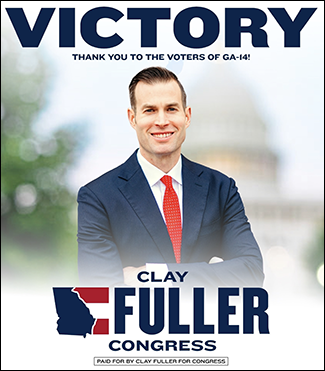
Local District Attorney and Air National Guard officer Clayton Fuller (R) / Facebook photo

Republicans scored a special election victory in Georgia last night as local District Attorney and Air National Guard officer Clayton Fuller (R) defeated retired Army Brigadier General Shawn Harris (D) with a 56-44 percent victory margin.

The Fuller win was expected since Georgia’s 14th Congressional District is the Republican’s safest Peach State seat, but the victory margin was weaker than what we have typically seen from this region.

There are two principal reasons for the lower GOP vote spread. First, the 2024 redrawn District 14 is not quite as solid as the seat to which resigned Rep. Marjorie Taylor Greene (R) was initially elected and, second, the latest available Federal Election Commission financial disclosure reports (pre-election March 18 filing) reveal that Gen. Harris outspent Fuller by a margin of almost 6:1, translating into a $6 million-plus effort for the Democratic candidate.

Georgia’s 14th District covers 10 counties (nine full, and just under 18 percent of Cobb County) in the northwest corner of the Peach State, bordering Tennessee on the north and Alabama to the west. Fuller carried nine of the 10 counties, but lost Cobb County by a significant margin. In order to maximize GOP strength in other districts, the 2024 redistricting map added Democrats from Cobb County to the already Republican-rich 14th, which helped pull Gen. Harris closer.

With the most recent map adding Democrats to the district, expect Rep-Elect Fuller’s future margins to be strong, but not as overwhelming as the previous voter history indicates.

The runoff produced a projected 131,000-plus voters, which is about average for a special general election. In comparison, turnout in the 2024 congressional election during the most recent presidential election featured 378,205 voters. In the 2022 midterm, 258,351 voters participated, or about 32 percent under the presidential election turnout.

The filling of the Georgia US House seat means the open-seat number for the next election recedes to 61. On April 16, New Jersey’s 11th District will be filled in that state’s commensurate special general election thus reducing the open seat count to 60 and bringing the full House to 434 members. The final special election could end on either June 2 or Aug. 4 in California, as voters will choose a replacement for the late Rep. Doug LaMalfa (R).

The Golden State uses a jungle special election format. If a candidate receives majority support in the first election, the individual is elected outright. If not, the top two finishers advance to a special general election.

The New Jersey election is expected to next week produce a Democratic win for former congressional staff member Analilia Mejia. She will replace Gov. Mikie Sherrill (D), who resigned the congressional seat after winning the statewide election in late 2025.

The California special election is largely a battle between former state Senate President Mike McGuire (D-Sonoma County) and state Assemblyman James Gallagher (R-Yuba City), though Democrat Audrey Denney is also on the ballot. The winner will have a short tenure in the House and be simultaneously cast into a general election for a vastly different 1st District under the new California redistricting map.

In actuality, the Golden State candidates will be running in two districts on the same day. One election will be to fill the current term in the previous 1st District, while the other is the regular jungle primary in the new 1st CD.

Virginia’s Twisted Campaign

By Jim Ellis — Tuesday, April 7, 2026

Redistricting

One of the most bizarre campaigns in recent memory is currently unfolding in the Old Dominion. On April 21, Virginians will cast final votes on a congressional redistricting referendum that will change the state’s 6D-5R map into a 10D-1R plan under the guise of “fairness.”

At this point, the Virginia referendum campaign is one of the most disingenuous ever because all sides, including the official Department of Elections, are part of the chaos.

The old saying, “you can’t tell the players without a scorecard,” seems to be applicable here, but even with a political scorecard a voter would be confused.

Let’s begin with the official state approved ballot language, as follows:

“Should the Constitution of Virginia be amended to allow the General Assembly to temporarily adopt new congressional districts to restore fairness in the upcoming elections, while ensuring Virginia’s standard redistricting process resumes for all future redistricting after the 2030 census?”

Restore fairness? The current map is 6D-5R in a state that voted 51.8 – 46.0% for Kamala Harris and, while electing a Democratic Governor in 2025, supported a Republican Governor in the previous election. Yet, the new map would give the Democrats 91 percent of the congressional seats.

The Virginia Supreme Court justices have also been less than forthcoming. They are saying they are still in the process of hearing whether the redistricting process can proceed because a lower court ruling said it cannot; that’s because the legislature itself violated its own rules in passing the referendum legislation, and the justices are allowing the statewide vote to take place. So, if the people vote for the referendum to redraw the districts, is the court going to reject their preference? Simply, no.

The Democratic campaign has been overwhelming so far, dominating the airwaves largely with ads from former President Barack Obama and Gov. Abigail Spanberger talking heroically about how they are “restoring a level playing field” with their 10D-1R map. This, after being on record time after time opposing gerrymandering when it cuts against their own party.

Perhaps the biggest stretch, however, is the Democratic campaign directly tying the abortion issue to passing the redistricting map, saying that “President Trump and the MAGA extremists” are planning to pass a national law to ban abortion. There is no evidence of such and passing this type of bill at least through the Senate is a realistic impossibility under the current filibuster rules. The ad verbiage also presumes the GOP has a majority to pass such a measure, which is also improbable.

The Republican response, which has so far been shockingly minimal despite understanding that the new Virginia map would put the Democrats in a much stronger position to capture the House majority, is also getting into the sleight of hand act.

The Virginians for Fair Maps organization are mailing post cards telling voters to join President Obama and Gov. Spanberger in opposing gerrymandering. They use previous public comments from the two when redistricting in Virginia and other places did not favor Democrats. Then the mailers tell voters to join Obama and Spanberger in opposing gerrymandering by voting “No” in the special referendum election.

One Republican advantage, even with their lackluster campaign, is that the “No” position is typically an easier argument to make in ballot proposition campaign strategy, and the Virginians for Fair Maps organization is using that edge to confuse voters with their Obama/Spanberger gerrymandering boomerang.

The Republicans’ early minimal response to what could be a devastating result for them is even more surprising when looking at the preference data. The Washington Post and the Schar School of Policy and Government at George Mason University just released a new statewide poll (March 26-31; 1,101 registered Virginia voters) finding the referendum passing, but with only a 52-47 percent margin within their response segment of likely voters.

Early voting is already underway. So far, according to the Virginia Public Access Project statistics, 646,493 ballots have been cast for an average turnout in the localities (in Virginia, residents are either in a city or a county but not both) of 11.9 percent. In the 2024 presidential election, as a point of comparison, 4.5 million individuals voted.

Though the campaign has been universally disingenuous to a very high degree, the referendum will likely pass, particularly if the Republican leadership continues to run their minimal response effort. Still, political prime time for this April 21 election is just beginning, so seeing the GOP launch a major ending media blitz remains a possibility.

Cassidy Crushed in New Poll

By Jim Ellis — Monday, April 6, 2026

Senate

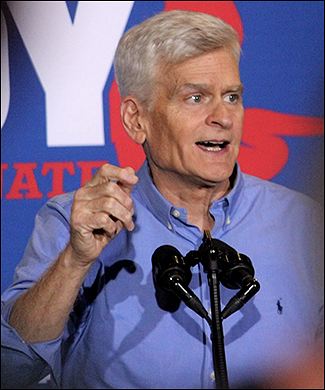
Louisiana Sen. Bill Cassidy (R)

A new American Pulse Research & Polling survey finds Louisiana GOP Sen. Bill Cassidy trending seriously downward in his fight for renomination.

According to the American Pulse data, Sen. Cassidy would be in danger of not even advancing to a runoff against Rep. Julia Letlow (R-Start) and State Treasurer and former Rep. John Fleming. In hypothetical runoff pairings, should Sen. Cassidy rebound, he would individually trail both Letlow and Fleming.

The American Pulse poll (March 20-24; 455 likely Louisiana Republican primary voters) sees Rep. Letlow topping Fleming and Sen. Cassidy, 31-25-21 percent, respectively. In a potential runoff, Rep. Letlow would lead Fleming, 37-34 percent. With 29 percent of the respondents unsure about this race, such a contest would be rated as too close to call.

Paired with incumbent Cassidy, Rep. Letlow would defeat him by a whopping 30 points according to this respondent sample, 54-24 percent. Fleming fares almost as well against the Senator. In a Fleming-Cassidy runoff, the challenger would lead the incumbent, 49-29 percent.

With a sample size of only 455 individuals for a statewide survey, the error factor would be high because of the small universe. These results, however, are so lopsided that even a wide error margin would still send Cassidy packing particularly because he fares so poorly in a runoff against either opponent.

Sen. Cassidy is facing serious obstacles. Obviously, these polling numbers reveal that the Senator is not popular within the Louisiana conservative vote base. Secondly, his vote to impeach President Trump associated with the January 6th conflict at the Capitol obviously put him at odds with the chief executive, though it is likely that the Senator believed doing so would not cause him future political problems because he obviously believed that Trump would never return to the White House.

As a result, President Trump has already endorsed Rep. Letlow, doing so even before she became an official Senate candidate.

Perhaps Sen. Cassidy’s most serious problem, however, is Louisiana’s new nomination structure for federal offices. Since the 1970s, Louisiana has featured a jungle qualification format for all offices. All candidates are placed on the same ballot in an election concurrent with the regular general election. If a candidate records majority support in the first vote, the individual is elected. If not, the top two finishers regardless of political party affiliation advanced to a post-general election runoff.

Under the new Louisiana primary system effective with the 2026 election, registered party members may only vote in their own party primary. If a person is registered as a “No Party” voter, the individual may choose a primary ballot at the polling place. Once selected, the “No Party” voter can then only participate in an associated runoff of the party in which he or she chose for the regular primary election.

In the jungle system, and particularly because the Democrats are currently very weak in Louisiana, Sen. Cassidy was able to attract a segment of their votes. This made him stronger in seeking re-election. In 2026, Democrats will not be allowed to crossover into the Republican primary, just as Republicans will not be allowed to vote in any 2026 Democratic primary.

Therefore, the new partisan primary system gives the Cassidy challengers a boost because endorsements, such as the one from President Trump, will carry more weight within the conservative Republican vote base without any adverse boomerang effect coming from crossover Democrats.

Added together, these obstacles spell trouble for Sen. Cassidy’s re-election chances as the current polls reflect.

The small sample American Pulse survey may not be completely indicative of where the entire Louisiana Republican electorate stands, but the Senator has fared poorly in other statewide polls, as well.

Looking at the last six publicly released Republican primary studies since Feb. 24, Sen. Cassidy has averaged only 26.7 percent support in the surveys testing a three-way contest among the Senator, Rep. Letlow, and Fleming.

As we head toward a May 16 Louisiana Republican primary election and a potential June 27 GOP runoff, Sen. Cassidy today looks to be the Senate incumbent most likely to fail to qualify for the general election.

House Members: 1 for 5

By Jim Ellis — Friday, April 3, 2026

US HOUSE
Of the current 62 open US House seats, 28 of the members are running for a different office, and the combined results of their statewide pursuits are so far underwhelming.

In the five 2026 election cycle contests recorded to date, only one House member, New Jersey Rep. Mikie Sherrill (D), successfully attained her statewide goal. In November of 2025, Sherrill was elected Governor of New Jersey.

Four others lost early primaries and a fifth, Rep. Chip Roy running for Texas Attorney General, advanced to a runoff election after placing second in the March 3 GOP primary. The other four losing statewide primary candidates are Illinois Reps. Robin Kelly and Raja Krishnamoorthi, and Texas Reps. Jasmine Crockett and Wesley Hunt.

Below is a re-cap of the members’ current campaign status:

Alabama

Rep. Barry Moore (R): Currently, Rep. Moore is leading the Senate Republican primary polls and is likely going to a runoff election with Attorney General Steve Marshall. The eventual Republican nominee will succeed Sen. Tommy Tuberville (R), who is running for Governor. The Alabama primary is May 19.

Arizona

Reps. David Schweikert (R) and Andy Biggs (R): Both men are running for Arizona Governor. Currently, Rep. Biggs has a large lead in GOP primary polling. The eventual Republican nominee will challenge Democratic Gov. Katie Hobbs.

California

Rep. Eric Swalwell (D): The Congressman is in a tight race to secure one of two general election ballot positions for the open California Governor position. A Democrat opposing a Republican in the general from the jungle primary will become the prohibitive favorite to succeed term-limited Gov. Gavin Newsom (D). Two Democrats or even two Republicans could conceivably advance to the general election from the huge field of 62 candidates.

Florida

Rep. Byron Donalds (R): Rep. Donalds is the leading candidate in the open Governor’s race. He enjoys large Republican primary leads in a state where the GOP nominee now becomes a strong favorite to win the general election and succeed term-limited Gov. Ron DeSantis (R).

Georgia

GOP Reps. Buddy Carter and Mike Collins: Current polling places Reps. Collins and Carter running 1-2 in the GOP Senate primary. The pair advancing to a June 16 runoff election from the May 19 primary now appears likely. The eventual winner will face Sen. Jon Ossoff (D) in the general election. The Senator begins the general election campaign as at least a slight favorite.

Iowa

Rep. Ashley Hinson (R): Rep. Hinson has positioned herself as the consensus Republican Senate candidate in the open primary. She will face either state Sen. Zach Wahls (D-Des Moines) or state Rep. Josh Turek (D-Council Bluffs). Rep. Hinson will be the general election favorite. The winner replaces retiring Sen. Joni Ernst (R).

Rep. Randy Feenstra (R): Congressman Feenstra finds himself in a tight race in both the Republican gubernatorial primary against four opponents and for the general election against consensus Democratic candidate Rob Sand, the Iowa State Auditor. Rep. Feenstra should prevail in the plurality primary and the early Feenstra-Sand general election will be rated as a toss-up.

Kentucky

Rep. Andy Barr (R): The open Republican Kentucky Senate primary finds Rep. Barr holding a substantial lead in campaign resources but fails to establish a sustained polling advantage against former Attorney General and 2023 gubernatorial nominee Daniel Cameron with wealthy businessman Nate Morris trailing. The Republican nominee will succeed retiring Sen. Mitch McConnell (R). At this point, Rep. Barr will probably prevail in both the GOP primary and general election.

Louisiana

Rep. Julia Letlow (R): Congresswoman Letlow is challenging Sen. Bill Cassidy in the Republican primary along with State Treasurer and former Rep. John Fleming. Louisiana is returning to a partisan primary/runoff system after decades of employing the jungle primary alternative. The change hurts Sen. Cassidy.

Expect the May 16 primary election to end in two of the three candidates advancing to a June 27 runoff election. Sen. Cassidy and Rep. Letlow are the most likely runoff qualifiers. Expect a tight GOP finish. The eventual Republican nominee is a lock in the general election.

Massachusetts

Rep. Seth Moulton (D): Rep. Moulton is engaged in a long-shot challenge opposite Sen. Ed Markey for the Democratic Senate nomination. While polling suggests what could become a competitive Sept. 1 primary campaign, the odds favor Sen. Markey, thus likely ending Rep. Moulton’s congressional tenure.

Michigan

Rep. John James (R): Rep. James is the likely Republican gubernatorial nominee, advancing into a serious three-way general election with Secretary of State Jocelyn Benson (D) and former Detroit Mayor Mike Duggan (I). With Duggan in the race as a competitive non-major party contender, the general election allows each candidate to claim a reasonable victory path. The end result could well be each of the candidates faring well, with the winner obtaining less than 40 percent of the vote.

Rep. Haley Stevens (D): A very tight and intense three-way open Democratic Senate campaign is unfolding featuring Rep. Stevens, state Sen. Mallory McMorrow (D-Royal Oak), and former Wayne County Health Director Abdul El-Sayed.

At this point, the three candidates are in a tight race both for votes and campaign donations with a long way to go. The eventual Democratic nominee will face former Representative and 2024 Senate nominee Mike Rogers (R) in what promises to be a highly competitive general election.

Minnesota

Rep. Angie Craig (D): Craig is in a difficult open primary opposite Lt. Gov. Peggy Flanagan, as both strive to win the Democratic nomination. Flanagan is expected to come away with the party endorsement at the state convention, but Rep. Craig will force an Aug. 11 primary election. The eventual nominee who emerges from what promises to be a close contest will begin as at least a slight favorite over former national sportscaster Michele Tafoya (R), who was a regular on the NBC Sunday Night Football telecasts.

New Hampshire

Rep. Chris Pappas (D): Rep. Pappas is the consensus Democratic Senate nominee, as he is likely preparing to face former Sen. John E. Sununu (R). The latter man has large leads in the GOP primary opposite former Massachusetts Sen. Scott Brown, but the nomination contest here will lag until Sept. 8.

New Hampshire generally favors Democratic candidates, but the Sununu family has done very well in the state especially with Chris Sununu, the Senate candidate’s brother, winning four consecutive gubernatorial elections.

Oklahoma

Rep. Kevin Hern (R): Sen. Markwayne Mullin (R) resigning the Senate seat to become Homeland Security Secretary leaves the seat to appointed incumbent Alan Armstrong (R). Because of Oklahoma’s procedure that requires appointees to pledge not to run for a full term, the door is wide open for Tulsa Congressman Kevin Hern.

Other top Republicans such as Gov. Kevin Stitt and Rep. Stephanie Bice (R-Oklahoma City) have declined to run for the Senate; therefore, Hern is quickly becoming the consensus Republican candidate and a prohibitive favorite for the general election.

South Carolina

Reps. Nancy Mace and Ralph Norman: The two House members joined a crowded Republican gubernatorial field attempting to succeed term-limited Gov. Henry McMaster (R). The latest polling shows a tight field with Rep. Mace near the top and Rep. Norman gaining momentum. Two of the four major candidates, Lt. Gov. Pamela Evette and Attorney General Alan Wilson being the others, will advance to a runoff from the June 9 primary election.

Tennessee

Rep. John Rose (R): Middle Tennessee Congressman John Rose appears to be in one of the longest-shot campaigns of this election cycle. He is risking his safe congressional seat for a run for Governor and badly trails Sen. Marsha Blackburn in the Republican gubernatorial primary. The nomination election is not until Aug. 6, but it would be surprising to see significant changes transpire in this primary campaign.

Wisconsin

Rep. Tom Tiffany (R): At this point in the long Wisconsin primary cycle, Rep. Tom Tiffany (R-Minocqua) looks to have a clear shot for the Republican nomination and is closing in on consensus candidate status. The general election, against the Democratic contender who comes through their crowded and contested Aug. 11 primary campaign, will be rated a toss-up as are most Wisconsin statewide races.

Wyoming

Rep. Harriet Hageman (R): Sen. Cynthia Lummis’ (R) surprise retirement after serving one term opens the door for an easy Harriet Hageman (R-Cheyenne) run. The at-large Congresswoman is already the consensus Republican Senate candidate for the Aug. 18 primary and will be a prohibitive favorite in the general election. The most competitive races in the state will be the open Governor’s race and Rep. Hageman’s open at-large congressional contest, but the Senate campaign looks to be quiet.