Tag Archives: Utah

Redistricting Becoming Clearer

By Jim Ellis — Tuesday, Dec. 16, 2025

Redistricting

Putting together the redistricting puzzle

The redistricting wars may be coming to a head. Recent action has occurred in several states providing a better national redistricting picture in preparation for the 2026 election.

Below is a synopsis of the latest developments:

California: After a majority of California voters approved the special election redistricting referendum, a racial gerrymandering lawsuit was filed against the state’s new map.

Meanwhile, the US Supreme Court issued a stay on the Texas racial gerrymandering lawsuit, with a rebuke from Justice Samuel Alito to the three-judge panel in El Paso for rendering a decision before the high court ruled on a related Louisiana racial gerrymandering case. Thus, it became clear that all other cases would be held until the high court issues what could be a landmark ruling.

The judicial action likely means the new California map will be in place for the 2026 election. The original map proponents believe the plan will return five more seats for the Democrats, reducing the Republicans to just four of 52 Golden State districts.

Florida: Late last week, Gov. Ron DeSantis (R) said that the state will redistrict the congressional map and do so during the Spring. The Florida primary is not scheduled until Aug. 18, so time remains to complete the redistricting process. It is possible that Republicans could gain two seats from a new map.

Georgia: A new Georgia map has been completed. The legislature made minor changes to the existing plan that will not likely affect the current partisan division (9R-5D).

Indiana: Late last week, the Indiana state Senate defeated a redistricting map that the state House passed. The plan would have converted two Democratic seats to Republican, thus sweeping the nine-member delegation. Unless the Senate reconsiders the action, the current 7R-2D map will remain intact for the 2026 election.

Louisiana: The US Supreme Court is considering the Callais racial gerrymandering case that could become the vehicle for the justices to render a landmark racial gerrymandering decision. A ruling was expected in June, but the justices postponed their opinion and ordered a second round of oral arguments. The subsequent hearing was held Oct. 15, and all await a final determination.

If the court upholds the lower court decision, the current Louisiana map will be invalidated, meaning the Republicans will likely gain one seat. Should this be the Supreme Court’s ultimate decision, then the possibility exists that the Alabama map will also be redrawn because its plan is virtually identical to Louisiana’s.

Maryland: In a situation similar to what is found in Indiana, most of the Maryland Democratic political establishment favors attempting to collapse their one Republican congressional district, but the state Senate leadership refuses to take action. Therefore, unless the Senate President completely reverses himself, a new redistricting map will not be enacted.

Missouri: The Missouri legislature and Governor have enacted a new map that will likely convert the Kansas City anchored 5th CD from Democratic to Republican. Opponents of the map, officially organized under a group name entitled People Not Politicians, have collected double the number of signatures needed to force a special election initiative vote with the goal of repealing the new map. If a ruling is made qualifying the initiative for the ballot, voters will then decide if the new map will stand.

Under Missouri procedure, simply qualifying the initiative will suspend the new map. This means the state would be forced to revert to the 2021 map for the 2026 election. An initiative vote would occur in the regular election cycle. If the voters adopt the new plan, it would take effect in the 2028 election cycle.

North Carolina: The legislature’s new congressional map will almost assuredly stand for the 2026 election. The initial complaint protesting the plan was rejected at the lower court level. The US Supreme Court’s action involving the Texas case suggests that no further judicial movement will occur on the new North Carolina plan before the candidate filing deadline on Dec. 19. Therefore, it is likely that Republicans will gain one seat in the Tar Heel delegation.

Ohio: The bipartisan elected official redistricting commission unanimously agreed upon a new congressional map, one that state law mandated be drawn. Under the Ohio procedure, a unanimous decision from the redistricting panel, which included Gov. Mike DeWine (R), means the map is officially enacted without action from the state legislature. The new plan will likely produce a one seat gain for Republicans in western Ohio, with the outside possibility of a second conversion in Cincinnati.

Texas: As discussed above, the Supreme Court stayed the three-judge panel decision that ruled the new map a racial gerrymander. Candidate filing has concluded, so the new 2025 map will be in place for the 2026 elections. The original map proponents believe the plan will return five more seats for the Republicans.

Utah: A state court ruled that the legislature ignored certain criteria that voters adopted in a previous redistricting initiative. Therefore, the 2021 map was declared invalid, a ruling that the state Supreme Court sustained. The court then adopted a new map that created a Salt Lake City Democratic seat. The new plan will produce a 3R-1D map for the 2026 election, which is a gain of one Democratic seat.

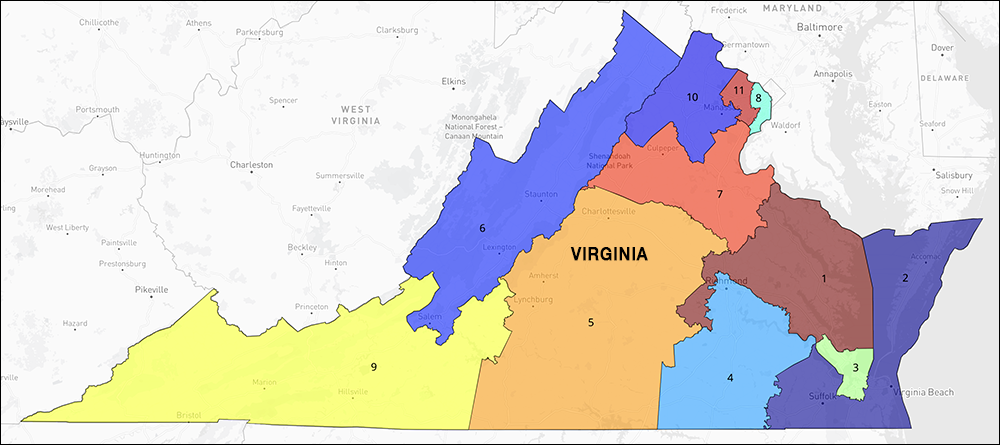
Virginia: The Old Dominion redistricting effort may determine which party wins the national redistricting wars. With the Democrats gaining full control of the state government, the new legislature must pass a referendum for the ballot when they convene in January. The measure will have to fulfill other legal requirements, and a special statewide referendum election is required. Voters would have to approve a new map before the April 2 candidate filing deadline for the June 16 primary election.

Democrats claim they can draw a map that will relegate Republicans to just one seat in the 11-member delegation. Currently, the Virginia congressional districts split 6D-5R. A four-seat swing in this state could tip the balance of power toward the Democrats in their quest for the US House majority.

Utah Redistricts

Watch this report by Fox 13 News|Utah: Utah Redistricting

By Jim Ellis — Thursday, Nov. 13, 2025

Redistricting

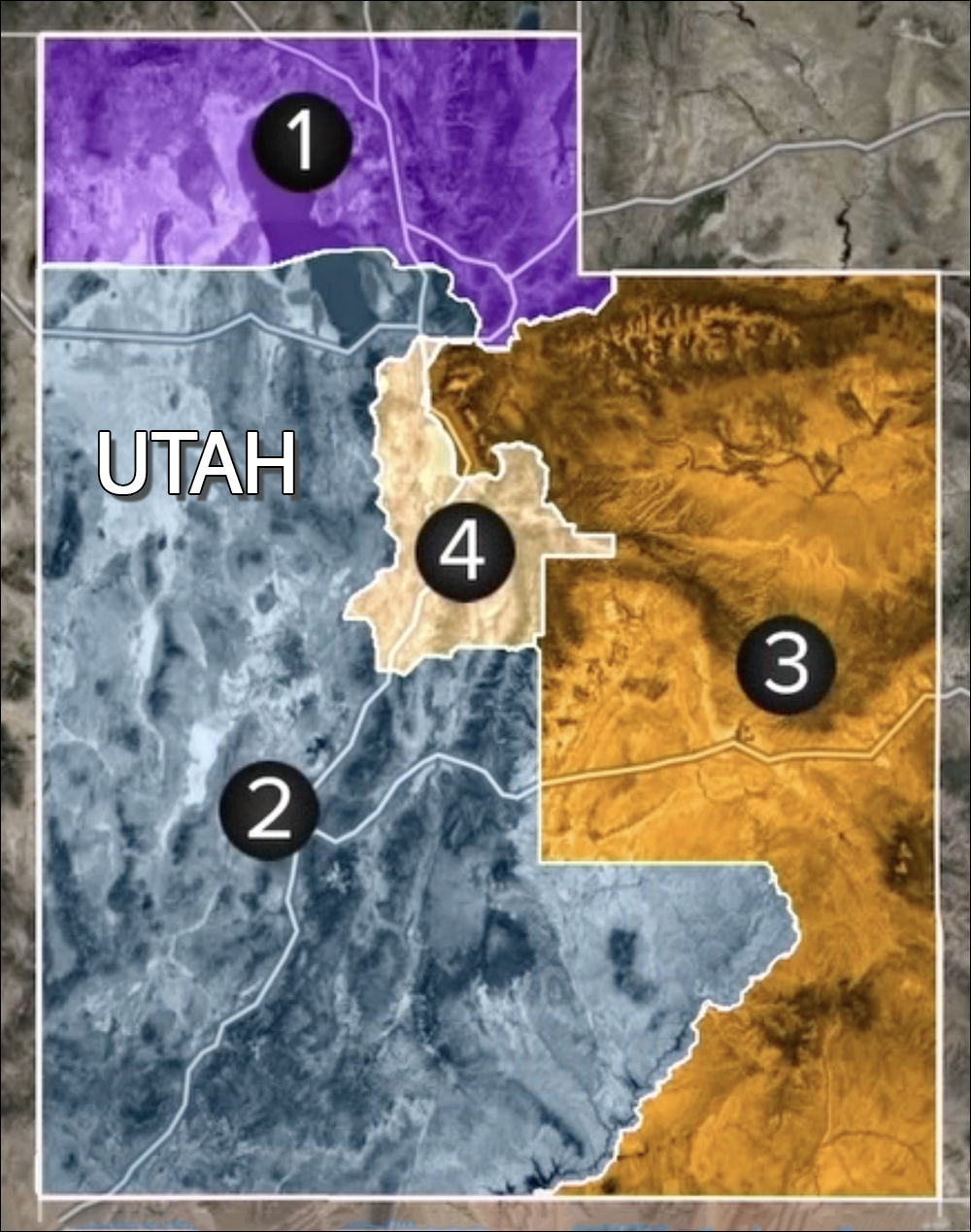
On Monday, the presiding Utah state judge chose a new congressional map that will significantly change the Beehive State delegation.

Previously, Judge Dianna Gibson (D) had invalidated the current map drawn in 2021 because she maintained the legislature ignored criteria that voters approved through a ballot initiative. The Utah state Supreme Court then upheld her opinion.

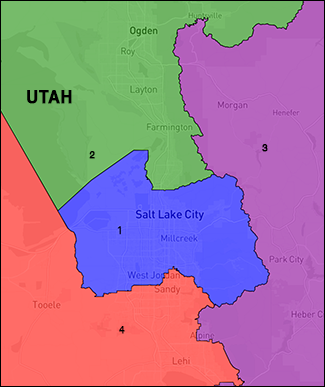
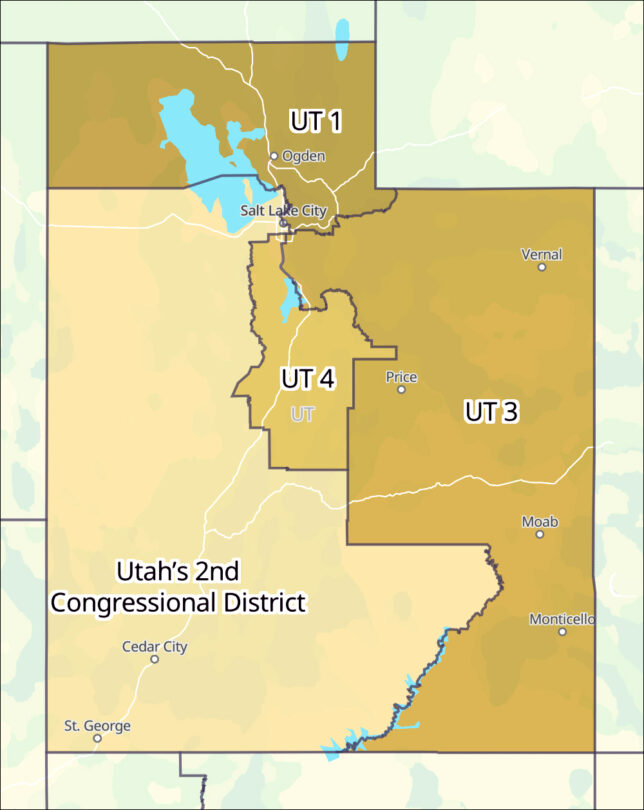
The result included bringing forth maps that adhered to the missing criteria. Judge Gibson chose the version that created a Salt Lake City metro district that will assuredly elect a Democratic Representative and change the Utah delegation from a 4R-0D contingent to 3R-1D.

An alternative plan would have created two Republican seats and two politically marginal districts that both parties would have had a chance of winning. The judge’s decision, however, now gives former one-term Congressman Ben McAdams (D), among others, a chance at winning a Democratic primary, which would punch a ticket to the House of Representatives.

McAdams was elected to the House in 2018, defeating the now-deceased Congresswoman Mia Love (R). He then lost two years later to current Representative and former NFL football player Burgess Owens (R-Draper).

Kamala Harris would have carried the new 1st District by a 60-37 percent count according to the Dave’s Redistricting App statisticians. The remaining three districts are all solidly Republican, featuring Trump victories with spreads from 29 to 41 points in 2024.

With the Democrats gaining a Utah seat, one of the current four Republican Representatives will be out after the 2026 election.

Of the three, Rep. Blake Moore (R-Salt Lake City) appears to have the new northern 2nd District all to himself. Though his home is not in the 2nd, his original hometown of Ogden is one of the key population centers. The other is the city of Logan where Utah State University is located.

The new 3rd CD, which looks like a backwards letter “L”, is the seat that currently would house two Republican incumbents, two-term Rep. Celeste Maloy (R-Cedar City) and freshman Mike Kennedy (R-Alpine). The district begins in the Provo area, moves south all the way to Arizona along the Colorado border, and then west to Nevada, the area that encompasses Rep. Maloy’s home turf.

Rep. Owens’ home is in the new 4th CD, which covers the west-central part of the state. This district contains a significant portion of Rep. Maloy’s constituency, which means she could also run in new District 4.

If all four Republican incumbents seek re-election, then the Maloy-Kennedy pairing is the most likely outcome. Rep. Maloy is the weakest politically in the delegation. She won the 2024 Republican primary by just 176 votes (50.1 percent) after barely securing 43 percent of the nominating convention vote. Not opting to circulate petitions, Maloy could have lost her seat in the convention had she slipped below the primary qualifying 40 percent delegate vote factor.

Rep. Kennedy is much stronger. He won the five-way Republican primary with almost 40 percent of the vote after demonstrating dominance in the nominating convention with 61.5 percent of the delegate vote.

Another scenario suggests that three-term Rep. Owens, who will be 75 years. old at the next election, could retire. If this were his decision, Rep. Maloy would likely run in the 4th District, thus leaving the 3rd CD to Kennedy.

Most of the delegation has little in the way of available campaign funds. The exception, Rep. Moore, holds almost $2.2 million in his campaign account, which compares very favorably against Rep. Kennedy’s $240,000, Rep. Maloy’s $201,000, and $167,000 for Rep. Owens. The fundraising figures are from the members’ Sept. 30 Federal Election Commission quarterly report and could have changed significantly since the totals were made public.

The new judicial map will almost assuredly be in place for the 2026 election. Since the state Supreme Court has already ruled earlier in the process, any lawsuit filed to overturn the map would have very little chance of succeeding.

Therefore, the bottom line on the just completed Utah redistricting process is a one seat Democratic gain.

Utah Joins Redistricting Wars

By Jim Ellis — Friday, Aug. 29, 2025

Redistricting

Utah Congressional Districts (click on image to go to interactive map)

A new court decision has thrust another state to the forefront of the mid-decade redistricting battle that may be developing in as many as 11 states.

A Utah judge early this week issued a ruling that strikes down the state’s 4R-0D congressional map, saying the legislature did not have the right to usurp the citizens’ redistricting commission that voters approved via ballot proposition in 2018. The commission members crafted a congressional map in 2021 that the state legislature rejected and replaced with the current plan.

The ruling is curious in that the judge stated the Utah Constitution makes a vote of the people equal to that of a legislative action. Therefore, District Court Judge Dianna Gibson ruled that the legislature did not have the authority to change the Commission map but did not explain why the people’s vote then trumps legislative power if both are equal. Republicans will appeal to the State Supreme Court, though the high court previously allowed the original lawsuit to continue that resulted in Judge Gibson’s ruling.

The Commission map would likely cost the Republicans one seat since it created a Salt Lake City-anchored district that would presumably elect a Democrat. Like many redistricting battles, this one, too, has the potential of making its way to the US Supreme Court for a final decision.

Currently before the federal high court remains the Louisiana racial redistricting case. A ruling was expected before the end of June, but the justices instead postponed their decision and ordered additional oral arguments, now scheduled for Oct. 15. The court’s ultimate ruling could mean a Louisiana redraw before the 2026 election. If so, Alabama could also see a redraw since their redistricting situation is virtually identical to that of Louisiana.

The just-enacted Texas map already faces a racial gerrymandering lawsuit, this in an El Paso federal court. The Louisiana ruling could affect the new Texas map since the lawsuit grounds involve an alleged violation of the Voting Rights Act.

When the Ohio legislature returns to session in September after the summer break, a new congressional map will be drawn. Since the current plan, adopted in 2021, failed to pass the legislature with at least a three-fifths vote in each chamber, the map could only stand for two elections. Therefore, state law demands a new plan be crafted for the 2026 election and beyond.

Published reports indicate that redistricting is also being considered in Florida, Indiana, Maryland, Missouri, and New York. The referendum in California to usurp the citizens’ commission map and replace it with a published alternative will go to the voters in a Nov. 4 special election.

The Florida House Speaker has assembled a new redistricting committee, and Gov. Ron DeSantis indicates he favors attempting to draw a new map. Some believe the already strong Republican Florida map could yield two more seats.

Talks are underway in Indiana about undertaking redistricting. The GOP target here would be the state’s 1st District that Rep. Frank Mrvan (D-Highland/Gary) represents. In the past two elections, the Congressman recorded a pair of 53 percent victories.

Talk surfaced in Maryland, largely stemming from Gov. Wes Moore (D), that this state could attempt to eliminate the lone Republican district, but nothing concrete toward that end has yet happened.

Republicans are also making progress toward gaining the Kansas City-area district of Rep. Emanuel Cleaver (D); moving forward in this situation appears likely.

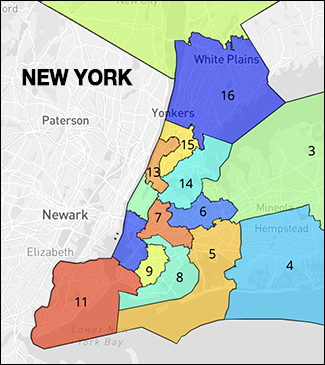
Finally, New York Gov. Kathy Hochul (D) also made public statements about redistricting retribution. Here too, however, a citizens’ commission is involved in the process. In 2021, even a Democratic court rejected the Democratic legislature’s map after the members found a way to usurp the commission plan. In the legislature’s map, the Republicans would have been relegated to four of 26 seats, which the court rejected.

While the Democrats could gain further seats in New York, the process of changing the current map may be too complicated to do so before the 2026 election.

As one can see, redistricting is a complex issue, and predicting what may happen next in any state’s process is always a difficult proposition.

Reapportionment Projection Shows Significant State Gains & Losses

California Congressional Districts

By Jim Ellis — Tuesday, Jan. 7, 2025

Reapportionment

Back in October, the American Redistricting Project released a national reapportionment estimate for the upcoming 2030 census, predicting which states would gain and lose congressional seats based upon unfolding population patterns. This week, the Brennan Center released their own reapportionment data, revealing some differentiation with the ARP conclusions.

Obviously, with half a decade to go before a new Census is conducted, no projection can be considered completely accurate because the population growth patterns will undoubtedly change at least to a degree over the next five years. Still, both the similarities and differences between the two projections are interesting to observe.

The similarities are much greater in number. Both organizations see California losing a whopping four seats, dropping the delegation size from 52 seats to 48. If these projections prove true, it will be only the second time in history that the Golden State will have lost representation. The first downgrade occurred in the 2020 census with a reduction of one district.

On the plus side, both data projections suggest that Texas will gain another four seats on top of the two they added in 2020 for a grand total of 42.

The other states that both organizations agree will gain one new seat are Arizona, Idaho, North Carolina, and Utah. Each agrees that the following states will lose one seat: Minnesota, Oregon, Pennsylvania, and Rhode Island.

The Oregon situation is interesting, because it suggests the Beaver State is on a path to relinquish the new seat they gained in the 2020 census. It is virtually unheard of to see a small population state gain in one census cycle but lose in the next.

Under the national reapportionment formula, the small states must show extreme population gains in order to add new seats, but also must experience extreme inhabitant lag in order to lose any of their congressional districts when compared to what happens in the larger states. Thus, Oregon, with a base of five districts and showing such diametrically opposite growth patterns in consecutive census cycles is a situation that has not before occurred in the modern era.

There are several differences between the projections. Both organizations find Florida in position to be another big gainer, however, the ARP sees the Sunshine State adding three new districts, while the Brennan Center believes the number will be four. If the latter calculation holds, Florida will increase its US House delegation size from 28 seats to 32.

While ARP projects Georgia and Tennessee to gain one seat apiece, the Brennan Center sees both holding their current House delegation quantity. In terms of seat losses, ARP sees New York losing three seats, while the Brennan Center projects a net loss of two. ARP also finds Illinois losing two seats, but BC calculates the Land of Lincoln loss count at only one.

The other difference is the Brennan Center projecting a one-seat loss for Wisconsin while ARP believes the Badger State count will remain at the current eight district level.

The Brennan organization also tracked the population shifts by region beginning in the decade of the 1960s to show how much the country’s migration patterns have changed over the course of what would be 70 years if their 2030 figures prove correct.

In the 60s, three geographic regions dominated the nation’s share of inhabitants. The Midwest and Plains states housed 125 congressional districts, the South 124, and the Northeast 117. Following was the West with 52, while the Rocky Mountain State region held only 17.

The 2030 projection shows big gains for the mountains and South. The Rocky Mountain region is expected to more than double its number of congressional districts from their level in the 1960s, growing from 17 to 36 seats. The South would expand by a third to 164 congressional districts, thus becoming the most populous region in the country. The West would increase to 66 from the 52 districts it held in the 60s.

The Midwest would have the largest reduction, going from 125 seats to 88, while the Northeast would see a similar decline, arriving at 81 seats from the 117 CDs they held in the 1960s.

While the 2030 projections will certainly change before the next Census is conducted, the regional patterns will probably be close to the mark. Therefore, we will see the South and West continue to grow with the colder climates in the Midwest and Northeast again attracting fewer inhabitants.

Senate Recap – Part III

By Jim Ellis — Friday, Oct. 4, 2024

Senate

Our final segment of the three-part US Senate recap series covers the campaigns from Ohio through Wisconsin. At this point, the Republicans appear in favorable position to convert West Virginia and Montana while protecting Florida and Texas. Doing so would give the GOP a small Senate majority, but the question remains as to whether they can expand such a contingent beyond 51 senators.

Ohio Sen. Sherrod Brown (D)

Ohio — One of the races where movement is detected is in the Buckeye State of Ohio where three-term Sen. Sherrod Brown (D) is defending his seat against GOP businessman Bernie Moreno. For months, this race stood with Sen. Brown holding a five-point edge even though former President Donald Trump was posting leads close to 10 points within the same polling samples. Within the past two weeks, however, the race has shown tightening tendencies as detected in publicly released polling.

Sen. Brown has been concentrating his campaign and major resource advantage on driving home the image that he delivers for Ohio and that the state is his top priority. He never mentions the national ticket, Washington, or anything related to the Democratic Party. While Sen. Brown had raised just under a huge $53 million through the end of June, we now see several outside Super PACs coming into the state to help Moreno and attack Brown. Whether this race flips to Moreno in the end still remains to be seen.

Pennsylvania — Sen. Bob Casey Jr. (D) and his late father, Gov. Bob Casey Sr. (D), have together won seven statewide races in Pennsylvania, and the family is a legacy within the state. Lately, the Keystone State race has been the most polled Senate contest in the country and Casey’s once strong lead over Republican former hedge fund CEO David McCormick (R) has narrowed.

This is another key race going down to the wire, but the Casey name is still very formidable in Pennsylvania even though Sen. Casey is far to the left of his more conservative late father. While Trump may well be in position to win here again, as he did in 2016, toppling Sen. Casey will prove to be much more difficult. This remains a race to watch, but Sen. Casey should still be regarded as the favorite.

Texas — We are hearing a familiar refrain from the Lone Star State Democrats as they attempt to sell their argument that Rep. Colin Allred (D-Dallas) can upset Sen. Ted Cruz (R). While Cruz’s favorability numbers are not particularly high, and polling repeatedly shows a close race, such has been the case in many previous Texas races. Yet, in the end, Republicans prevailed with comfortable margins.

The state is changing politically. While Democrat candidates are doing well in the big cities, such as Houston, Dallas, Austin, and San Antonio, the rural areas are strongly Republican and the Hispanic voting patterns are showing further signs of moving closer to the GOP.

Expect the turnout model to favor the Republicans when voters actually cast their ballots. Because President Joe Biden’s energy policies have not been favorable to Texas’ mega oil and gas industry, and the southern border issue dominates the Lone Star issue matrix, it is likely that Rep. Allred, while an attractive candidate, picked the wrong year to attempt to reverse a statewide political trend that hasn’t seen a Democrat win a major office here since 1994.

Utah — Sen. Mitt Romney (R) is retiring after one term, and 3rd District Rep. John Curtis (R-Provo), due to his strong plurality win in a crowded GOP primary – recording 49 percent of the primary vote over three Republican opponents – is poised to easily capture the seat in November. As was the case when Curtis won his House seat in a 2017 special election, he fared poorly in this year’s Republican nominating convention but then rebounded to record a solid primary victory.

Environmental activist Caroline Gleich is the Democrat’s nominee but has little chance of winning the general election during a presidential year in solidly Republican Utah.

Virginia — Sen. Tim Kaine (D), the Democratic vice presidential nominee in 2016, seeks a third term in the Senate and should have little trouble winning in a state that has been definitively trending Democrat over the past decade with the 2021 statewide election being the lone exception. Prior to serving as a senator, Kaine had been elected governor of the state and mayor of Richmond, while being appointed as chairman of the Democratic National Committee.

The senator’s Republican opponent is retired Navy captain and ex-congressional candidate Hung Cao. While Cao over-performed in his congressional race even while losing, his Senate fundraising does not place him in the competitive realm with an accomplished incumbent such as Sen. Kaine. As was the case in his 2018 re-election campaign, expect Sen. Kaine to win re-election with a percentage in the high 50s.

West Virginia — Without Sen. Joe Manchin, now an Independent, on the November ballot, this race is a lock for GOP Gov. Jim Justice, who is ineligible to seek a third term in his current office. Running over 60 percent in the few polls taken of this contest, and seeing his Democratic opponent, Wheeling Mayor Glenn Elliott, failing to raise even $300,000 through the end of June, means the general election is a lock for the GOP and Gov. Justice, and with such a victory comes a 50-50 electoral tie in the Senate chamber.

Wisconsin — Sen. Tammy Baldwin (D) is on the statewide ballot for the third time, after serving seven terms in the US House and six years in the Wisconsin state Assembly. Her opponent is businessman Eric Hovde; potentially stronger Republican candidates such as Rep. Bryan Steil (R-Janesville), decided not to run. Hovde did bring resources to the table when dropping at least $13 million of his own money into the race.

Sen. Baldwin has been polling ahead all year but, as in Pennsylvania and Ohio, we’ve seen a recent tightening of the campaign. Wisconsin races are always close, and the state will figure prominently in the presidential election outcome. Therefore, a late Republican surge here, should it develop, would make the Senate race interesting. Barring such a vote disposition, expect Sen. Baldwin to win re-election with a percentage figure in the low 50s.

RFK JR. Disqualified in New York; Green Party on Ballot in Nevada; Senate Incumbent Way Up in North Dakota; Finally, A Winner in UT-2

By Jim Ellis — Thursday, August 15, 2024

President

Robert F. Kennedy Jr. Photo by Gage Skidmore

Robert F. Kennedy Jr: New York Disqualification — A New York judge has disqualified Robert F. Kennedy Jr. from appearing on the New York election ballot, ruling the address the candidate used in his submission documentation is not valid. This is yet another blow to Kennedy’s flailing campaign and further underscores the difficult road any non-major party contender is forced to traverse just to obtain ballot access in all 50 states.

Although with Kennedy not appearing on the New York ballot, it will have little effect upon the final results. As we know, the Empire State is one of the Democratic strongholds, and Vice President Kamala Harris will have little trouble in capturing the domain’s 28 electoral votes.

Kennedy has qualified for the ballot in 16 states, including three that appear as highly competitive: Michigan, New Mexico, and North Carolina.

Green Party: On Ballot in Nevada — A Nevada judge has ruled against the Nevada Democratic Party’s lawsuit that would have disqualified the Green Party from being on the state’s 2024 ballot. The judge ruled that the party’s ballot line will remain intact.

The judicial order means that Green Party candidate Jill Stein will be on the Silver State ballot, which Democrats obviously believe will hurt Kamala Harris. According to the national Green Party, the entity has secured a 2024 ballot line in 21 states and Stein will appear on four more ballots as an Independent. The party leadership is actively petitioning or awaiting certification in an additional 18 states.

Senate

North Dakota: Dem Poll Finds Cramer Well Up — A just-released Lake Partners Research survey of the North Dakota Senate race, the first published poll since mid-June (for the Katrina Christiansen campaign; July 28-Aug. 2; 500 likely North Dakota voters), sees movement toward the Democratic candidate while still yielding incumbent Sen. Kevin Cramer (R) a double-digit lead. The ballot test finds the senator’s lead at 51-38 percent. The previously released poll, from Public Opinion Strategies (June 15-19; 500 likely North Dakota voters; live interview), projected Sen. Cramer’s lead at 37 points.

Very likely, the ultimate outcome will fall somewhere in between these two surveys. Look for Sen. Cramer to easily win re-election to a second six-year term in a state that the FiveThirtyEight data organization rates as R+37.

House

UT-2: Recount Finally Yields Winner — Seven weeks after the Utah primary, a winner has finally been determined in the state’s 2nd Congressional District. Businessman Colby Jenkins (R) yesterday conceded the race to Rep. Celeste Maloy (R-Cedar City) ending a counting period that continued to drag onward.

The final vote count saw the two candidates separated by just 176 votes, which is still enough for Maloy to clinch her renomination bid. She is now a strong favorite to win a full term in the general election against Democratic nominee Nathaniel Woodward, an attorney. The FiveThirtyEight data organization rates UT-2 as R+23. The Daily Kos Elections statisticians rank the seat as 81st most vulnerable in the House Republican Conference.

Biden Still in Driver’s Seat, But Down in New York; Maloy Still Struggles in Utah; Filing Closes in Delaware

By Jim Ellis — Friday, July 12, 2024

President

President Joe Biden / Photo by Gage Skidmore

President Biden: Still in the Driver’s Seat — While pressure continues to mount on President Joe Biden to withdraw from his re-election candidacy, some still believe there is a way to change the rules at the Democratic National Convention to allow a free vote of the delegates. Doing so will be highly unlikely, however, because Biden’s total delegate vote includes 1,581 individuals not bound by party rules but rather state law. Therefore, those delegates will not be free.

To win the party nomination, a candidate must have 1,968 votes. This means from the remaining delegates, the president would need only keep 387 of the “freed” 2,368 delegates who are already pledged to vote for him. This factors into just 16.3 percent of the non-state law bound delegates.

The party would also have the option of changing the convention rules to allow the Super Delegates to vote on the first ballot, something they cannot currently do. The Super Delegates are officially called PLEO (Party Leader Elected Official) votes. There are 747 of these individuals. To add them, however, the non-PLEO delegates would have to vote to dilute their own power. It is unlikely a majority of the non-PLEO delegates will vote in such a manner even if this unlikely choice is presented.

House

New York: Biden’s Poll Deficit — The political situation continues to deteriorate for President Biden. As reported on X from journalist Jacqueline Sweet, Democratic polls that won’t be published apparently report that the president is trailing in two potential Democratic conversion districts by double-digit margins, seats that he carried in 2020.

The two are NY-17 and NY-19 that freshmen Reps. Mike Lawler (R-Pearl River) and Marc Molinaro (R-Red Hook) currently represent and won with close margins. As a point of reference, Biden carried the 17th with a 54-44 percent margin in 2020, and a 51-47 percent split in NY-19.

UT-2: Canvass Period Begins; Recount to Follow — Utah US Rep. Celeste Maloy (R-Cedar City) is not out of the woods yet from her close Republican primary race against businessman Colby Jenkins, conducted on June 25. The Utah election officials finally finished the end count, and what was a 309-vote margin for Maloy has dropped to 214 votes.

The process is not yet finished. The election staff must conduct a canvass to certify a final vote. Since the current margin is now within the range where a recount can be requested, Jenkins says he will do so after the canvass. This means the counting and recounting process could drag on until the end of July.

States

Delaware: Candidate Filing Closes — Candidate filing has now closed for the late Delaware primary scheduled for Sept. 10. Though the state features an open Senate and at-large House seat, little in the way of competition will be seen either in the Democratic primary or general election.

US Rep. Lisa Blunt Rochester (D-Wilmington) is a lock for the party nomination and the November election and will replace retiring Sen. Tom Carper (D) in the next Congress. State Sen. Sarah McBride (D-Wilmington) is the prohibitive favorite to win the party primary and the November election to replace Rep. Blunt Rochester. Upon election, she will become the first transgender individual elected to Congress.

The only competition appears to occur in the open governor’s race as incumbent John Carney (D) is ineligible to seek a third term. Lt. Gov. Bethany Hall-Long, New Castle County Executive Matt Mayer, and National Wildlife Federation CEO Collin O’Mara are all competing for the Democratic nomination. The eventual primary winner will then punch his or her ticket to the governor’s mansion.