Tag Archives: Texas

New Special Election Data

By Jim Ellis

Susan Wright

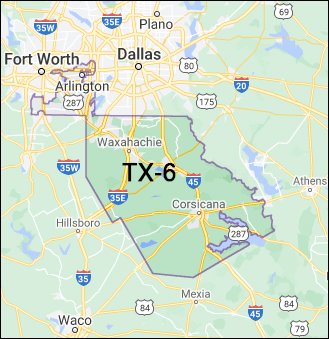
July 26, 2021 — The Texas 6th District special election to replace the late Rep. Ron Wright (R-Arlington) is scheduled for Tuesday, and the Susan Wright campaign has just released the results of their most recent American Viewpoint poll.

According to AV (July 19-21; 400 TX-6 likely runoff voters, live interview), Wright, the late congressman’s widow who placed first in the original May 1 special jungle primary, leads state Rep. Jake Ellzey (R-Waxahachie) by a 44-34 percent count with 12 percent saying they are undecided. The sample’s remaining ten percent apparently didn’t answer the ballot test question since they appear unsegmented.

The Wright pollsters argue in their survey synopsis that the ballot test numbers are actually stronger than presented for underlying reasons. Among the voters who rate themselves as most enthusiastic about voting in the special election (a scale of 1 to 10 with 10 having the highest level of enthusiasm), Wright expands her lead to 54-33 percent.

The pollsters reason the most enthusiastic voters, in this case ones who rated themselves at or between 8 to 10 on this scale, are the most likely group to vote. On the negative side, however, this segment is small. Only 8 percent of the entire sampling universe rated themselves in the highest positive category.

Drilling further into the polling sample’s core, American Viewpoint finds that among the respondents who said they are “certain to vote,” Wright leads Ellzey, 51-33 percent.

Where the state representative scores higher in this double-Republican runoff contest is among the Democrats who choose to participate. Here, Ellzey leads 44-31 percent. The pollsters conclude that Democrats who are motivated to vote largely want to make a statement in supporting the candidate that former President Donald Trump did not endorse…in the 6th District race, Ellzey.

Among what the pollsters describe as the “Trump Movement Republicans,” presumably those who have a positive impression of the former president and generally are inclined to back his endorsement choice, favors Wright by a 61-28 percent spread.

Rep. Ellzey first ran for office in 2018, when he opposed Wright in the 6th District open seat regular congressional election. Underestimated in the primary election, Ellzey finished second and forced Wright, then the Tarrant County Assessor, into a runoff. With Wright favored, Ellzey reduced the former man’s margin of victory to 52-48%, again exceeding expectations.

Continue reading

House Vulnerables – Part II

By Jim Ellis

July 13, 2021 — On Monday, we began a two-part series on what are arguably the most vulnerable dozen US House seats based upon the individual district’s political performance over the past two elections.

Below is the priority order update covering the second half of the top 12 most vulnerable CDs. As you will continue to see below, all of the seats except one are Republican held.

To refresh, the first six covered were:

• IA-2 (Rep. Mariannette Miller-Meeks, R-Ottumwa)
• IA-1 (Rep. Ashley Hinson, R-Marion/Cedar Rapids)
• IA-3 (Rep. Cindy Axne, D-Des Moines)
• FL-27 (Rep. Maria Elvira Salazar, R-Miami)
• CA-48 (Rep. Michelle Steel, R-Orange County)
• NY-22 (Rep. Cynthia Tenney, R-New Hartford)

Here’s our look at the next six:

UT-4: Rep. Burgess Owens (R-Salt Lake City) – Ave R vote: 48.8%
• Former NFL football star and businessman Burgess Owens defeated freshman Rep. Ben McAdams (D) by one percentage point in 2020, and we can expect another competitive race here again within this mostly suburban Salt Lake City congressional district located in the metropolitan area’s southern sector.

Republicans, who are in full control of the Utah redistricting process, will attempt to improve the district for Owens, which is possible since the 4th CD is the fastest growing district in the fastest growing state over the past decade. The best estimates suggest that the 4th District must shed approximately 50,000 people to other CDs. This should allow map drawers to subtract a substantial number of Democratic voters from the district, thus yielding Burgess a slightly more favorable political domain.

At this point, McAdams, who was the Salt Lake County mayor prior to his election to Congress, has not indicated whether he will return for a re-match.

MN-1: Rep. Jim Hagedorn (R-Rochester) – Ave R vote: 49.3%
• Two-term Rep. Hagedorn just announced that his cancer has returned, meaning an immediate treatment regimen. How this will affect his re-election campaign is yet to be determined. Hagedorn has won two close elections, as has his Democratic colleague in the adjacent district, Rep. Angie Craig (D-Eagan).

Minnesota is the only state in the nation that sees a split control legislature, meaning each party controls one house. Since the state did not lose a congressional district in apportionment as originally projected, it would not be surprising to see a legislative deal made where Democrats and Republicans are flipped between the two adjoining districts. The changes would result in Hagedorn gaining Republicans and Craig adding Democrats. Redistricting will perhaps be the most critical factor in determining the outcome of both districts come 2022 and beyond.

Continue reading

Texas GOP Mayoral Victories

Along the US-Mexican border

By Jim Ellis

June 8, 2021 — On Saturday, Republican candidates picked up three victories in a trio of Texas mayoral runoffs, the most surprising of which came in the Mexican border city of McAllen where the Hispanic population is close to 85 percent.

McAllen City Commissioner (Council) Javier Villalobos, a former Hidalgo County Republican Party chairman, won the mayoral runoff election with a 51-49 percent victory. This on the heels of the Texas-Mexico border region voting much more Republican in 2020 than in previous electoral history. From the congressional district that houses McAllen, Rep. Vicente Gonzalez (D-McAllen) won his November re-election contest with only a 50.5 – 47.6 percent victory margin.

In Ft. Worth, an election that broke more definitively along partisan lines, though all of the mayoral elections in the state are nonpartisan in that the candidate’s political party affiliation does not appear on the ballot, Republican Mattie Parker defeated Tarrant County Democratic Party chair Deborah Peoples. The spread was 54-46 percent in a contest where turnout more than doubled the aggregate mayoral vote of four years ago. Voter participation was up in all three of the Texas city runoff elections, but none like the huge increase in Ft. Worth.

The least partisan of the races occurred in Arlington, where former police officer and local businessman Jim Ross defeated Arlington City Councilman Michael Glaspie, also with a 54-46 percent margin. In this election, law enforcement seemed to dominate the campaign as five different police and fire associations rallied to support Ross.

As mentioned above, South Texas voting ventured more toward the Republicans in November even though Democrats still proved victorious in the region. Biden’s margin over then-President Trump dropped as low as 50-48 percent in Rep. Gonzalez’s 15th District, and under 52 percent in three of the four CDs that touch the Texas-Mexico border.

Continue reading

Stansbury Wins New Mexico Special

By Jim Ellis

New Mexico state Rep. Melanie Stansbury (D), winner of Tuesday’s special election.

June 3, 2021 — The New Mexico special election went as expected Tuesday, as state Rep. Melanie Stansbury (D-Albuquerque) defeated state Sen. Mark Moores (R-Albuquerque) by a 60-36 percent count, which is consistent with the partisan early vote turnout.

The overall participation factor exceeded 131,000 voters, or 28.2 percent of the district’s registered voter universe, which is relatively high for a special election. It appears that over 70 percent of the people participating in the electoral contest cast an early ballot.

Stansbury, twice elected to the state House of Representatives, was victorious in the special Democratic district convention whose delegates were empowered with choosing a party nominee to replace resigned Rep. Deb Haaland (D-Albuquerque). Haaland vacated the House upon being confirmed as US Interior Secretary in the Biden cabinet.

The Stansbury congressional victory margin came from population-dominant Bernalillo County, where more than 90 percent of the CD-1 residents live. Stansbury captured 61 percent of the vote here. In the smaller rural counties, Moores took three of four, but the aggregate vote total from each of those entities was individually less than 2,500 cast ballots.

The Democratic mean average in the seat since partisan conversion in 2008 is 58.2 percent, so Stansbury ran about two points above the benchmark. The state’s current governor, Gov. Michelle Lujan Grisham, represented the 1st District for three terms and scored the single-highest Democratic election percentage during the 13-year post-conversion period. She tallied 65.1 percent in 2016, the same election in which Hillary Clinton posted a 52-35 percent CD-1 result and 48-40 percent statewide.

Continue reading

Census Delays: Some Ramifications

By Jim Ellis

June 1, 2021 — As we know, the Census Bureau has delayed in meeting its public reporting deadlines, which causes ramifications in the political world. As a result, the state officials responsible for redistricting could well find themselves placed behind the proverbial eight ball as the new year approaches.

Reapportionment is the term used to explain the entire decennial process. Reapportionment, as the US Supreme Court defined it in their 1999 ruling on the US Census Bureau v. House of Representatives case, is basically divided into two parts. The first, which was finally completed and released on April 26, is the allocation of congressional seats to the states. The second is the re-drawing of congressional, state, and local district boundaries most often referred to as redistricting.

To complicate matters even further, the delayed allocation proved much different – affecting six seats to be exact – than predictions. It was believed for at least two years that Texas would gain three seats in the 2020 reapportionment and Florida two, with Arizona, Colorado, Montana, North Carolina, and Oregon adding one seat apiece. The actual numbers found Texas gaining two, Florida one, and Arizona none. The other one-seat gaining states were correctly predicted.

Conversely, Alabama, California, Illinois, Michigan, Minnesota, New York, Ohio, Pennsylvania, Rhode Island, and West Virginia were all expected to lose one seat apiece. The actual report found Alabama, Minnesota, and Rhode Island each retaining the same number of seats they held in the 2010 reapportionment, while the others did lose a single district apiece.

The Census Bureau claims that COVID is largely responsible for their delays, but the state of Alabama, in their pending lawsuit against the federal statistical entity, disagrees. Alabama claims the deadline violations occurred because of the Bureau’s attempt to impose, for the first time in history, differential privacy over the data. This means, under the argument of protecting individual privacy, data would be deliberately scrambled, and certain information not publicly released.

Differential privacy alone would make redistricting extremely difficult for state map drawers because the released census tract numbers, now by definition, wouldn’t equal the state population figures brought forth earlier in the year. The effect would cause political havoc throughout the country. A court ruling on the Alabama case is expected shortly.

Because of a successful legal challenge from Ohio, the Census Bureau has agreed to make the data necessary for redistricting available to the states by Aug. 15 instead of the Oct. 1 date indicated when allocation was announced.

Continue reading

A Special Election Look-In

By Jim Ellis

May 26, 2021 — The Albuquerque, New Mexico vacant US House seat will be filled on June 1, and a new RRH Elections survey finds the Democratic nominee holding a strong advantage. In Texas, There is no mystery as to which party will win the July 27 special runoff election in North Texas to replace the late Rep. Ron Wright (R-Arlington), but which Republican claims the vacant seat is certainly getting more interesting. We take a look at both races.

NM-1

The RRH Elections poll (May 18-21; 555 NM-1 special election voters and those intending to vote, interactive voice response system and online), finds state Rep. Melanie Stansbury (D-Albuquerque) leading state Sen. Mark Moores (R-Albuquerque), 49-33 percent.

The numbers make sense when overlaying the 1st District voting history. Former Rep. Deb Haaland (D-Albuquerque) naturally resigned the seat after being nominated and confirmed as US Interior Secretary in the Biden Administration weeks after winning re-election to a second term. Her victory percentage was 58, after claiming her first term in 2018 with a 59-36 percent margin.

At one time during the century, the 1st was politically competitive – former Rep. Heather Wilson (R-Albuquerque) held the seat for five terms, ending when she ran unsuccessfully for the US Senate in 2008, for example – but a weakened New Mexico Republican Party and a stronger Democratic composition from redistricting has taken the seat off the board.

President Biden carried the district over former President Trump, 60-37 percent, after Hillary Clinton won here in 2016 with a lower but still comparatively strong 52-35 percent spread. Testing President Biden’s current job approval rating, RRH finds him recording a 57:39 percent favorable to unfavorable ratio, which is similar to his 2020 vote performance. This consistency gives the RHH polling data further credibility.

In terms of finances, Stansbury had raised $1.2 million through the May 12 pre-primary reporting period, with $525,000 cash-on-hand as of that date. Sen. Moores, by contrast, had obtained $595,000 with $125,000 in the bank. His receipts total includes a $200,000 personal loan.

Continue reading

TX-6: Analyzing a Mild Upset

By Jim Ellis

May 5, 2021 — With many observers in and out of Texas conceding that Democrat Jana Lynne Sanchez had a chance to finish first in Saturday’s special jungle primary to begin the process of replacing the late Rep. Ron Wright (R-Arlington), it came as at least a mild surprise to see her failing to even qualify for the secondary election. The final result yielded two Republicans advancing from the huge field of 23 candidates.

Finishing first was Susan Wright (R), the late congressman’s widow, which was not a particularly surprising result as virtually every analyst and available polling data conceded her one of the two runoff positions.

The race got particularly nasty, however, towards the end. An anonymous robocall – one without a legal disclaimer – flooded the district a day before the election claiming Ms. Wright murdered her husband to redeem a $1 million insurance policy. The call text said she deliberately contracted COVID in order to intentionally infect her husband. Rep. Wright died in early February after a long battle with cancer and COVID. Ms. Wright’s attorneys have referred the matter to the FBI, the Department of Justice, and the Tarrant County District Attorney.

Freshman state Rep. Jake Ellzey (R-Waxahachie) edged Sanchez for second place; Ellzey ran against Ron Wright when the congressional seat was last open in 2018 and forced him into a runoff.

For more than a generation, the 6th District was a Republican bastion. Rep. Joe Barton (R), Rep. Wright’s predecessor and former boss when the latter man served as a congressional district office director, held four variations of the 6th over a long 34-year congressional career. The electorate began to turn when Rep. Wright won two underwhelming victories and Democrats significantly closed the partisan gap at the presidential level (’20, Trump 51-48 percent; ’16, Trump 54-42 percent).

Continue reading