Tag Archives: New York

Incumbent Trend Could Soon Turn

By Jim Ellis — Thursday, June 6, 2024

Incumbents

New Jersey freshman Rep. Rob Menendez (D-Jersey City)

We have now seen primary elections held in 22 states, meaning electorates in a majority of 242 US House districts have chosen their general election nominees, and we have yet to see one incumbent lose renomination to a challenger. Alabama Rep. Jerry Carl (R-Mobile) did lose to Rep. Barry Moore (R-Enterprise), but that was due to an incumbent pairing from a court-ordered redistricting directive.

Earlier in the week, New Jersey US Rep. Rob Menendez (D-Jersey City) defeated his Democratic challenger, Hoboken Mayor Ravi Bhalla, by a 54-36 percent margin in a race that polling and fundraising suggested would be close. To date, it appeared that Rep. Menendez was the most vulnerable House incumbent standing for renomination, but in the end he easily repelled the strong challenge.

Menendez, a freshman member of the New Jersey delegation, saw his favorability numbers tumble as a result of his father, Sen. Bob Menendez (D-NJ), and step-mother being indicted for bribery.

With Menendez and Iowa Reps. Mariannette Miller-Meeks (R-LeClair) and Randy Feenstra (R-Hull/Sioux City) winning their primaries on Tuesday, we’ve now seen the incumbents going nine for nine in non-jungle partisan primaries when facing a reasonably credible intra-party opponent. At least another 16 challenges are on tap in the remaining primaries.

The strong incumbent performances suggest we may be seeing early signs that the 2024 election cycle will be similar to 2022. In an election year when polling suggested that the public overwhelmingly believed, and still does, that the country is on the wrong track, and moving in the wrong direction, the voting public then turned around and re-elected virtually every incumbent on the ballot.

Two years ago, 56 senators and governors from both parties ran for re-election; 55 won. In the House, the incumbent retention rate for those seeking re-election was 98.1 percent. These are unusual statistics for an electorate demanding a change in public policy. Though we see the same unrest regarding government policies today, the early voting pattern suggests that, so far, we again see the juxtaposition of incumbents having a strong year even though the electorate is generally displeased.

The trend may soon change, however. Two of the most vulnerable incumbents facing primary challenges are on the ballot this month. Reps. Bob Good (R-VA) and Jamaal Bowman (D-NY) look to be in serious trouble as their respective primaries loom on the near horizon — June 18 for Good and a week later in Bowman’s case.

Rep. Good’s opponent is state senator and retired Navy SEAL John McGuire, who brandishes an endorsement from former President Donald Trump. Since Good was one of the key Republican House members behind the ouster of then-Speaker Kevin McCarthy, another source of opposition is present. Thus, Rep. Good not only faces a Trump endorsement going against him, which has more often than not been golden in a Republican primary, but McCarthy is assisting in directing outside money to help ensure the congressman’s defeat.

Furthermore, competing in a primary is something new for Rep. Good. Previously, he won his nominations through a district party convention before a small number of delegates who favored him. Therefore, facing a credible opponent with backing from national party leaders in an unfamiliar election structure could well be enough to deny Congressman Good renomination.

Rep. Bowman is facing an even more difficult opponent than Good. George Latimer is the Westchester County Executive who represents 91 percent of Bowman’s 16th Congressional District’s constituency in his current position. Before being elected County Executive, Latimer served in the state Senate and Assembly. Latimer has also raised about $1 million more than Rep. Bowman, and even has the endorsement of one of the congressman’s fellow “Squad” members.

Former Rep. Mondaire Jones (D), who represented the adjoining Westchester County congressional district for a term, was a “Squad” member, and is trying to come back in this election. Earlier this week, Jones endorsed Latimer, a former employer, and publicly dispelled Bowman’s comments that Latimer is a racist.

Only two polls of this race have been released, and those were back in March. One showed the two men virtually tied, while the other yielded Latimer a 17-point lead. Yet, Bowman has not produced any countervailing data in the succeeding weeks.

Ironically, both Good and Bowman came to office by deposing an incumbent from their own party. Good, via the district convention, unseated freshman Rep. Denver Riggleman in 2020, while Bowman defeated veteran Congressman Eliot Engel in the Democratic primary of the same year. Now, both men could see the tables turn on themselves very soon.

June Incumbent Challenges – Part II

By Jim Ellis — Friday, May 31, 2024

Primaries

Today, we look at the latter June primaries in our second and final installment examining the House incumbent primary challenges.

Voters in Virginia will cast their nomination votes on June 18. Voters in Colorado, New York, and Utah will cast their nomination votes on June 25; in each of these three states, we see serious incumbent challenges.

Colorado Rep. Lauren Boebert (R-Silt) / Photo by Gage Skidmore

Colorado — Turning first to Colorado, Rep. Lauren Boebert (R-Silt) decided to leave the 3rd District where she was twice elected to seek another term in the open 4th District, the safest Republican seat in the Centennial State. The move may well pay off as was evidenced in her nominating convention victory, which provides her top primary ballot placement.

The congresswoman faces a crowded field of candidates, which also helps her since she has the highest name identification and a solid conservative base. Rep. Boebert also has a major resource advantage (10:1 favorable receipt ratio compared to her closest opponent on the March 31 disclosure report). The representative’s campaign apparatus is stronger than expected, and she is in position to score a significant victory on June 25.

New York — The same may not be said for two-term Rep. Jamaal Bowman (D-Yonkers). His Democratic opponent is Westchester County Executive George Latimer, a former state senator and assemblyman. Latimer currently represents 91 percent of the 16th District and had out-raised the incumbent, $3.6 million to $2.7 million according to the March 31 campaign finance disclosure report. Bowman came to office when defeating veteran Rep. Eliot Engel in the 2020 Democratic primary, but he may well see the tables turn in this election.

Utah — The final June incumbent challenge comes in the state of Utah, where freshman Rep. Celeste Maloy (R-Cedar City), who won a special election in late 2023, seeks a regular term nomination for the first time. A candidate who Sen. Mike Lee (R) heavily backs, technology executive and Army Reserve Colonel Colby Jenkins (R), topped Rep. Maloy at the party nominating convention.

The congresswoman, who did not circulate nominating petitions and therefore could have been eliminated at the convention, received 43 percent of the delegate vote, or just three percent more than the minimum needed to earn a ballot position for the June 25 primary election. Therefore, this is another situation that must be rated as a serious threat to the sitting incumbent.

Virginia — On June 18, Virginia will host another major primary where two-term Rep. Bob Good (R-Lynchburg) is in danger of losing his renomination bid. This is the first time Rep. Good has also faced a primary electorate. Previously, he was nominated by convention.

Rep. Good’s opponent is state Sen. John McGuire (R-Manakin-Sabot), who enjoys strong outside support including a recent endorsement from former President Donald Trump who says that “Bob Good is Bad for Virginia, and Bad for the USA.” Rep. Good endorsed Gov. Ron DeSantis in the presidential election.

Good was also one of the key leaders in the movement to oust Speaker Kevin McCarthy, and the former House leader is clearly involved with bringing in outside money to defeat the congressman. This will be a multi-million dollar campaign, with most of the money being spent through outside organizations. This is a contest where the incumbent is in danger of losing.

• • •

Throughout the election cycle, 24 significant incumbent challenges have been launched against sitting House members, 15 against Republicans and nine versus a Democratic member. Seven have already been decided, and we will see another seven results by the time June draws to a close.

Only one incumbent has been defeated, and such an outcome was inevitable. Alabama Reps. Barry Moore (R-Enterprise) and Jerry Carl (R-Mobile) were paired in one district because of a court-ordered redistricting plan, which led to the latter man’s defeat.

The most serious challenges appear levied against Reps. Rob Menendez (D-NJ), Bowman, and Good in June and against Reps. Ilhan Omar (D-MN) and Cori Bush (D-MO) in August.

Incumbents Winning Big

By Jim Ellis — Thursday, May 23, 2024

Elections

At this point in the 2024 election cycle we have seen a number of budding primary challenges opposite US House members, and through this past Tuesday the incumbents are batting 1.000. It is likely, however, that the most competitive challenges are yet to come.

A total of 17 states have held their down-ballot primary elections. Within this number were 62 partisan challenges to US representatives. The California all-party jungle primary system does not produce traditional intra-party challenges. Therefore, the Golden State races are not included in the partisan statistics quoted in this column.

In only one race, that one in Alabama’s newly constructed 1st District, did an incumbent, Rep. Jerry Carl (R-Mobile), lose. But, in a paired redistricting situation, a sitting member losing was the inevitable conclusion.

We have seen no serious nomination challenges to sitting in-cycle senators. In the House, of the 62 members who have faced an intra-party opponent, 18 have proven to be substantial challenges. This means that the top opponent received at least 30 percent of the vote.

In only two, however, was an incumbent victory even in doubt. On March 19, southern Illinois Congressman Mike Bost (R-Murphysboro) defeated former state senator and 2022 Republican gubernatorial nominee Darren Bailey by a slight 51-49 percent count.

On May 7 in the Hoosier State of Indiana, Rep. Victoria Spartz (R-Noblesville), who originally indicated she would not seek re-election but changed her mind before the candidate filing deadline, only scored 39 percent of the primary vote. The total, however, was enough to turn back eight GOP challengers including state Rep. Chuck Goodrich (R-Noblesville) who captured 33 percent support.

Therefore, at this point in the House cycle with now a bare majority of 218 district electorates having nominated their general election contenders, it appears the stage might be set to see another incumbent-favorable general election.

The primary vote to-date could be the precursor to seeing a similar result to what we saw in 2022, when incumbents fared extremely well even though polling suggested the electorate desired major change. Two years ago, 55 of 56 senators and governors who ran for re-election won, and the incumbent retention percentage in the House was 98.1.

Should the 2024 election result in a similar conclusion, we would again see very small margins in both the House and Senate. Yet, the primary season is only half over, and a number of key members remain embroiled in primary campaigns.

While we’ve only seen two primaries in the first half resulting in close finishes, several upcoming contests could end in close counts or even incumbent upsets. In fact, 13 members in 11 states face challengers who are positioning themselves for serious runs.

Arizona freshman Rep. Eli Crane (R-Oro Valley) sees former Yavapai County Supervisor Jack Smith coming forward. Colorado Rep. Lauren Boebert (R-Silt), while changing to the open 4th District, must overcome Logan County Commissioner Jerry Sonnenberg and two state representatives to secure nomination in the new district.

In Florida, both Reps. Dan Webster (R-Clermont) and Vern Buchanan (R-Sarasota) face a former state representative and ex-school superintendent, respectively.

In what are proving to be the top challenges to Democratic members, Reps. Jamaal Bowman (D-NY), Cori Bush (D-MO), and Ilhan Omar (D-MN), all members of far left “Squad,” each face serious opponents in the persons of Westchester County Executive George Latimer, St. Louis County Prosecutor Wesley Bell, and former Minneapolis City councilman and 2022 congressional candidate Don Samuels.

Oklahoma Rep. Tom Cole (R-Moore/Norman) is repelling a multi-million dollar challenge from Texas transplant Paul Bondar. Two South Carolina members, Nancy Mace (R-Charleston) and William Timmons (R-Greenville), are attempting to defeat strong challenges from former Haley Administration official Catherine Templeton, and state Rep. Adam Morgan (R-Greenville).

Like Rep. Mace, who is under attack for voting to oust former Speaker Kevin McCarthy, Virginia Rep. Bob Good (R-Lynchburg) also has his hands full attempting to defend himself from state Sen. John McGuire’s (R) aggressive challenge.

Tennessee Rep. Andy Ogles (R-Columbia) and Utah’s Celeste Maloy (R-Cedar City), the latter of whom won her seat in a late 2023 special election, also are in serious battles for renomination.

While we have seen an unblemished nomination record for incumbent House members in the first half of primaries, the second half may threaten their so far perfect record.

Curtis Leads in New Utah Poll; California Dem Party Endorses Low; Michigan Candidate in Danger of Disqualification; Three Incumbents Being Outspent in NY, VA, SC

By Jim Ellis — Monday, May 20, 2024

Senate

Utah Rep. John Curtis (R-Provo)

Utah: Rep. Curtis Leading in New GOP Poll — Four Republican candidates are vying for the right to succeed retiring Sen. Mitt Romney (R) in Utah’s June 25 primary election, but one is pulling away from the field. The Conservative Values for Utah super PAC commissioned a Guidant Polling & Strategy survey for the Utah Senate race (April 30-May 3; 600 likely Utah Republican primary voters) and released the results late last week. The ballot test finds US Rep. John Curtis (R-Provo) developing a large 41-14-9-2 percent GOP primary advantage over Riverton Mayor John Staggs, former state House Speaker Brad Wilson, and businessman Jason Walton, respectively.

Mayor Staggs was officially endorsed at the Utah Republican Party Convention and earned former President Donald Trump’s support. Through submitting 28,000 valid signatures, Rep. Curtis and Wilson and Walton all successfully petitioned onto the primary ballot. The eventual Republican nominee will be a heavy favorite in the open general election.

House

CA-16: State Dem Party Endorses Low — With the recount of the tied jungle primary finish between San Mateo County Supervisor Joe Simitian (D) and state Assemblyman Evan Low (D-Campbell), and awarding Low the second qualifying general election ballot position by five votes, the California Democratic Party has taken action. With Simitian not requesting a recount, even though many expected him to ask for a second canvass, the official California party issued an endorsement for Assemblyman Low.

The first-place finisher, former San Jose Mayor Sam Liccardo (D), wrapped up his qualifying position on the March 5 primary election date. Neither Low nor Simitian requested an original recount because under California election procedure, tied candidates both advance into the general election. Instead, allies of Liccardo paid for the recount figuring the tally would move by a handful of votes, which proved true. Later, polling surfaced showing Liccardo doing better in a two-way race against either Low or Simitian, as opposed to a three-way all-Democratic battle. The November winner will replace retiring Rep. Anna Eshoo (D-Atherton).

MI-13: Former State Senator in Danger of Being Disqualified — In 2022, then-state Sen. Adam Hollier (D-Detroit) lost a close crowded primary to then-state Rep. Shri Thanedar (D-Detroit), 28-24 percent, and vowed to try again in 2024. While Hollier announced for the seat and circulated petitions, the preliminary city clerk staff report indicates that his valid signature petitions will fall short of the minimum required number for ballot qualification. After the two-day public comment period expires, the city clerk will make the final decision of whether to award Hollier a ballot line.

Even without Hollier on the ballot, Rep. Thanedar will likely face a Democratic primary challenge from Detroit City Councilwoman Mary Waters and former Southfield City Clerk Shakira Hawkins. The Michigan primary is scheduled for Aug. 6.

House Incumbents: Three Being Outspent — Three US House incumbents are on the short end of spending battles in their respective primaries. Reps. Jamaal Bowman (D-NY), Nancy Mace (R-SC), and Bob Good (R-VA) all face tough challenges against credible opponents.

Reports are surfacing that, led by the American Israel Public Affairs Committee’s United Democracy Project, Westchester County Executive George Latimer is the beneficiary of a media spending advantage against Rep. Bowman of about $3 million to $171,000 according to the AdImpact media monitoring organization. The congressman had more than $1.4 million in his account through March 31 and can expect further outside money to help him close the voter contact gap in the final six weeks of the primary campaign.

Largely due to a PAC that former House Speaker Kevin McCarthy’s allies run, AdImpact estimates spending against Rep. Mace is approximately $4.3 million as compared to $2.5 million backing the congresswoman. Mace’s opponent is former Nikki Haley Administration official Catherine Templeton.

While there are no reported figures for the Virginia race to date, it is clear that challenger John McGuire, a Virginia state senator who has former President Trump’s endorsement, is well ahead of Rep. Good in advertising and polling. An early May Battleground Connect poll found Sen. McGuire leading Rep. Good, 45-31 percent. The congressman, like Rep. Mace, voted to oust former Speaker McCarthy.

RFK Jr. Qualifies in California; CA-16 Tie is Broken; Dem Disqualified in NY-26; New Leader in OR-5 Race

By Jim Ellis — Friday, May 3, 2024

President

Robert F. Kennedy Jr.

Robert F. Kennedy Jr.: Qualifies in CA — Independent presidential candidate Robert F. Kennedy Jr. has qualified for the 2024 general election ballot in California as the nominee of the American Independent Party. In addition to the Golden State, he has an official ballot position in Michigan and Utah. He has filed the requisite number of signatures in Hawaii, Idaho, Iowa, Nebraska, Nevada, New Hampshire, and North Carolina, and awaits certification in each of those states.

While Kennedy may affect the outcome in some of the aforementioned swing states, solidly blue California will not be in play. President Joe Biden will easily carry the nation’s largest state regardless of RFK Jr.’s ballot presence.

House

CA-16: The Tie is Broken — As expected, recounting all ballots in California’s 16th District jungle primary election did break the tied vote for the second qualifying general election ballot position. Both state Assemblyman Evan Low (D-Campbell) and San Mateo County Supervisor Joe Simitian each finished the initial count with 30,249 votes. Allies of the first-place finisher, former San Jose Mayor Sam Liccardo (D), then paid for a recount. Neither Low nor Simitian moved for a recount because California election procedure allows all tied candidates to advance into the general election. Otherwise, it is only the two top vote-getters who compete in November.

With the recount now final, Assemblyman Low finished with an adjusted five-vote margin, meaning he will solely advance to the general election to face former Mayor Liccardo. It will now be interesting to see if Simitian now requests and finances a second recount. With such small vote margins, another recount could produce a different result.

NY-26: Democrat Disqualified — A day after state Sen. Tim Kennedy (D-Buffalo) easily won the special election to succeed resigned Rep. Brian Higgins (D) in New York’s 26th Congressional District, his regular election Democratic challenger, former two-time congressional candidate Nate McMurray, has been disqualified. Election officials ruled he did not file enough valid petition signatures to be awarded a ballot position. Therefore, it appears Rep-Elect Kennedy will now be unopposed for re-nomination. Winning the Democratic primary in this Buffalo-anchored district is tantamount to claiming the November election. The FiveThirtyEight data organization rates NY-26 as D+18.

McMurray lashed out at the party leaders after his rejection was made public claiming in a long letter on X that, “it feels like even if we collected 100,000 signatures it would not have made a difference. They would have found something to throw me off. I’m a threat to their closed shop business. And don’t kid yourself; it’s a business.”

OR-5: New Dem Leader — In 2022, one of the bigger upsets on election night was Republican Lori Chavez-DeRemer defeating Democrat Jamie McLeod-Skinner to convert Oregon’s 5th District to the GOP. Earlier that year, in May, McLeod-Skinner upset seven-term Rep. Kurt Schrader in the Democratic primary.

A new brilliant corners Research & Strategies poll (April 26-28; 402 likely OR-5 general election voters; live interview) finds McLeod-Skinner now trailing state Rep. Janelle Bynum (D-Clackamas) by a 37-34 percent count. Due to McLeod-Skinner losing the seat in the previous election and generally rated as a weaker candidate, most of the Democratic leadership and establishment are backing Rep. Bynum. Therefore, this polling result is not particularly surprising.

Whoever wins the Democratic primary will find themselves already in a toss-up general election battle against Rep. Chavez-DeRemer. The FiveThirtyEight data organization rates OR-5 as D+3. President Biden carried the district in 2020 with a 53-44 percent margin. The Daily Kos Election site statisticians rank the seat as the ninth most vulnerable seat in the Republican Conference.

Last Night’s Primary Results

By Jim Ellis — Wednesday, April 3, 2024

Primaries

We saw four more states vote yesterday and even though the presidential nominations are clinched in both parties, valuable information can still be extracted from last night’s reported results.

So far, presidential voting has occurred in 36 states, and 32 where both parties have comparable systems. In four states, Delaware, Florida, Idaho, and Mississippi, no votes were recorded in one of the party primaries because a major candidate ran without opposition.

Last night, voters in Connecticut, New York, Rhode Island, and Wisconsin had the opportunity of casting their presidential nomination ballots. To no one’s surprise, President Joe Biden and former President Donald Trump easily swept their respective elections and added to their delegate totals. Each man recorded enough bound delegate votes on March 12 to become the respective Democratic and Republican Party’s presumptive presidential nominees so the later primaries are simply providing “icing on the cake.”

The bigger story throughout the 32 comparable states may be the turnout pattern and what that might mean for the general election. If the turnout trends we have seen in the states where ballots have been cast are a precursor to what happens in November, then Trump is well positioned to unseat President Biden.

Though the Democrats had a good night yesterday as more of their party members voted in Connecticut, New York, and Rhode Island, overall, the Republican turnout has been far superior, and in some very surprising states.

At this point, counting the unofficial numbers from last night, we have seen just over 30 million people vote in the 32 comparable states. Of those, 57.1 percent have voted in Republican primaries. One may argue that the more competitive race was on the Republican side, and that could account for the imbalance between the two parties. While there is validity to this line of reasoning, Democratic turnout is running below the party’s historical participation average even in some of their strongest states, thus highlighting the unusual trend.

Out of these 32 states, more Republicans have voted than Democrats in 24 of the domains while the opposite trend occurred in only eight. Of the Democrats’ eight majority turnout states, only one, Utah, is a surprise. The Democratic primary preference share of only 53 percent in both Massachusetts and Washington, however, does raise eyebrows. The same for Republicans recording that same percentage split in Louisiana.

Republicans posted unexpected turnout advantages in Colorado, Hawaii, Maine, Minnesota, New Hampshire, Vermont, and Virginia. While none of these states are likely to be in serious play for Trump during the general election the turnout trends here are noteworthy, nonetheless.

What may be more troubling for the Biden campaign team is how the swing states performed in the primary participation race.

Here, again, Trump outperformed the president’s Democratic Party in Arizona (58.9 percent of the total turnout chose to vote in the Republican primary), Georgia (67.0 percent), Michigan (59.2 percent), Nevada (55.9 percent), North Carolina (60.7 percent), Ohio (68.2 percent), and last night in Wisconsin (51.7 percent). The substantial margins of individuals choosing to vote in the Republican primary is a clue that former President Trump has a chance to build a new coalition of voters in these most critical of states.

The Nevada Republican total is at least slightly skewed. The combined numbers from the non-binding primary and their delegate apportioning caucuses are tainted because voters could participate in both the primary and a respective caucus, which were held on different days. There is no available data suggesting what percentage of voters participated in both, but it appears from the totals associated with each event that a substantial number cast their vote in each election.

Biden, Trump Romp in Michigan; Baldwin Ahead in Wisconsin; New Redistricting Map in NY; The Attempt to Get Rep. Green to “Un-retire”

By Jim Ellis — Wednesday, Feb. 28, 2024

President

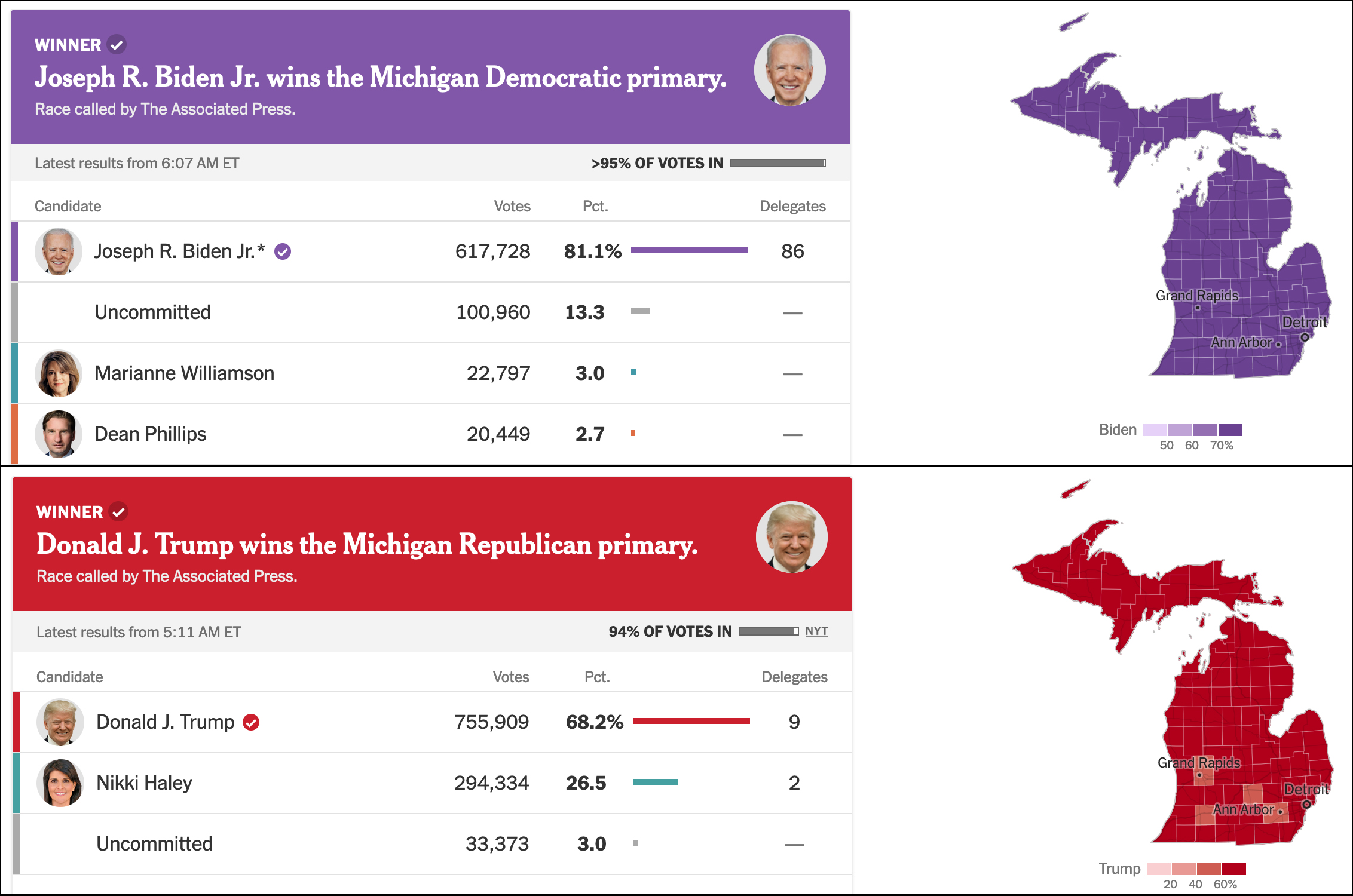
Michigan: Primary Results — As expected, President Joe Biden and former President Donald Trump easily captured large percentages in winning last night’s respective Democratic and Republican Michigan presidential primary elections.

President Biden recorded 81.1 percent of the Democratic vote, though just under 14 percent voted for the Uncommitted Delegate Slate. US Rep. Rashida Tlaib (D-Detroit) was encouraging Democratic voters to choose that option as a way to protest President Biden’s position regarding the Israel-Hamas conflict. For the Republicans, Trump attracted 68.2 percent of the GOP vote, again consistent with the result most pollsters predicted. Overall turnout favored Republicans approximately 1.13 million to about 778,000 individuals.

The Wolverine State primary represents the final installment of the pre-Super Tuesday voting events. The next primaries will occur on March 5 where 16 entities will cast primary or caucus ballots in either Democratic or Republican nomination events.

Senate

Wisconsin: Sen. Baldwin +7 Over Hovde — Businessman Eric Hovde (R) announced his US Senate candidacy in the Badger State last week, and this week we see the first polling pairing with two-term incumbent Sen. Tammy Baldwin (D). Emerson College released their latest Wisconsin survey (Feb. 20-24; 1,000 registered Wisconsin voters; multiple sampling techniques) and while the sampling universe would support Donald Trump 44-42 percent, Democratic incumbent Baldwin would lead the Senate race 46-39 percent.

The poll might look more encouraging for Republicans at first glance since Sen. Baldwin is under 50 percent and has only a single digit lead against a relatively unknown opponent. The polling universe, however, features more Republicans than Democrats, 35-33 percent with an additional 32 percent responding as non-affiliated. Though Wisconsin does not register voters by political party, voter history suggests that the poll, though weighted to reflect the actual electorate, appears to have a slight Republican skew.

House

New York: Dems Unveil New Cong Map — The Democratic super majority in the state Assembly and Senate unveiled a new congressional map that surprised many, but in retrospect the plan is an indication the party leaders knew they would face tough going on a legal challenge if they stretched their partisan interests much further.

As reported earlier, the state’s Citizens Redistricting Commission made only cosmetic changes in the plan the court created for the 2022 election. Though that map only gave Republicans a clear partisan plurality in just three of the state’s 26 seats according to the Dave’s Redistricting App statisticians, the GOP candidates won 11 races. The Citizens Commission members left the court footprint largely intact, which the legislature then rejected. When the people adopted a citizens’ redistricting commission ballot proposition, the process allowed the legislature to either approve or reject the commission adopted plans.

The surprising end to this story is the legislature’s own map is another “least change” map from the court’s original footprint, which very likely means that the 2024 New York congressional playing field will be almost identical to what we saw in 2022.

TN-7: Delegation Attempting to Convince Rep. Green to “Un-retire” — So far in this election cycle, we’ve seen two US House members, Reps. Pat Fallon (R-TX) and Victoria Spartz (R-IN), announce their retirements only to change their mind and seek re-election. We may soon have a third. Public reports are coming from Tennessee where the Republican congressional delegation, including Sen. Marsha Blackburn (R) who previously represented the 7th District during her career in the House, are publicly encouraging Rep. Mark Green (R-Clarksville), the chairman of the House Homeland Security Committee, to change his mind about retiring. Last week, Rep. Green announced he would not seek a fourth term.

The Tennessee candidate filing deadline is April 4 for the Aug. 1 primary, so it is possible we may soon see one less open House seat.